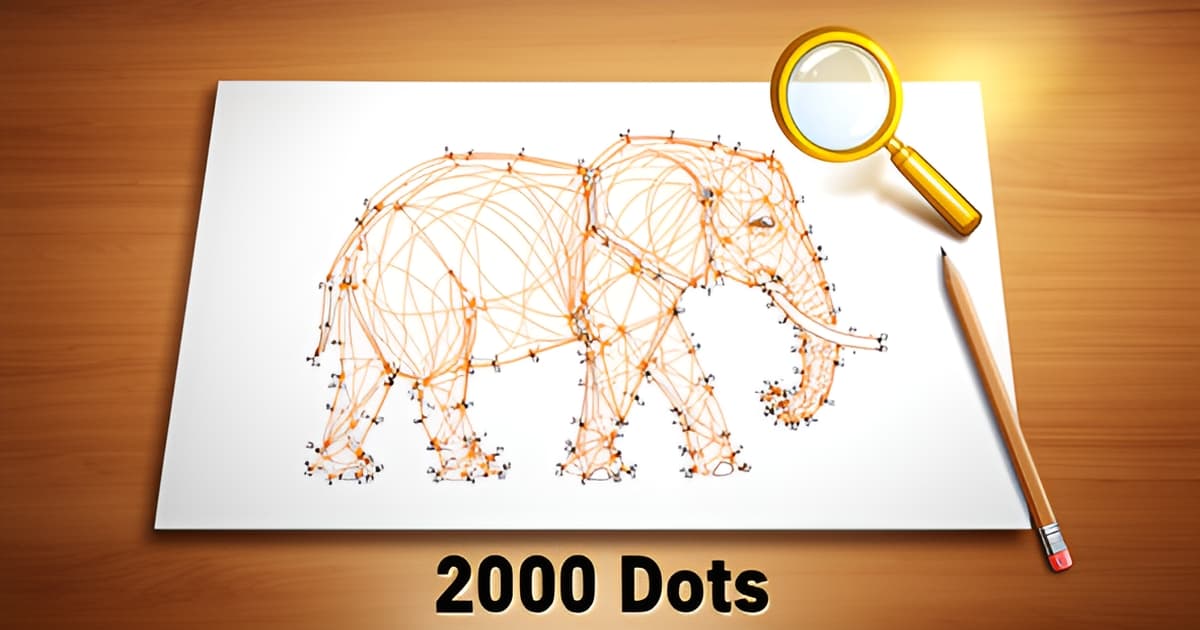
2000 Dots: Extreme Dot-to-Dot Printables You Can
Key Facts
- Extreme dot-to-dot puzzles are defined as containing 2,000 to 3,000 dots, making 2000 dots the entry threshold according to industry definitions.
- MindWare's flagship Extreme Dot to Dot: Around the World book tops out at just 1,400 dots per puzzle across 32 puzzles, per the publisher's product page.
- Amazon's 512 extreme dot-to-dot listings include 1,000-dot titles and even a 100,000-dot book, but none explicitly advertise 2000 dots, according to search results.
- Extreme dot-to-dot and adult coloring books account for 70% of WH Smith's adult activity book sales, per cited reporting.
- Most solvers finish 2000-dot puzzles in 6 to 12 hours, with the 2,500-dot 'Chaos Theory' taking 8 to 12 hours per solving benchmarks.
- Paid extreme dot-to-dot books run $9.25 to $16.95, while most free static printables rarely exceed 200 dots per market analysis.
- AI-based dot-to-dot generators now claim support for 5,000+ dots, according to generator specs.
The 2000-Dot Gap in the Puzzle Market
There's a strange hole in the puzzle market right now, and it sits at exactly 2,000 dots. Puzzle makers generally define "extreme" dot-to-dot printables as those containing 2,000 to 3,000 dots, with some individual puzzles reaching 2,500 or more, according to one industry overview. By that definition, 2000 dots is the entry ticket to the extreme tier. Yet almost nobody is actually printing puzzles that big.
Walk the physical book aisle and the ceiling becomes obvious. MindWare's flagship Extreme Dot to Dot: Around the World, a 32-puzzle book, tops out at 500 to over 1,400 dots per puzzle. It's a well-loved product, but it stops short of the threshold the extreme category is supposedly built around. Amazon's "extreme dot-to-dot" search returns 512 results, including 1,000-dot titles and even a novelty 100,000-dot book, yet no product in those results explicitly advertises 2000 dots on the page.
Free printables don't fill the gap either. Most static connect-the-dots downloads rarely exceed 200 dots, and kids' puzzles typically use around 20 to 30 dots with large, friendly numerals. AI-based generators now claim support for 5,000+ dots, but a searchable, ready-to-print puzzle at the 2000-dot mark remains rare. A handful of enthusiasts share worksheets with over 2,000 points on Pinterest, marketed as hard or extreme dot to dot, but these are scattered one-offs rather than a reliable supply.
The demand side tells a different story. The extreme dot-to-dot boom is described as being driven by adults, not kids, and extreme dot-to-dot plus adult coloring accounts for 70% of WH Smith's adult activity book sales. Adults shopping this category are hunting for focus, memory, concentration, and relaxation, and they're currently paying $9.25 to $16.95 per book for puzzles that, by the strict definition, don't quite reach extreme.
So the gap looks like this:
- Established publishers top out around 1,400 dots per puzzle.
- Free static printables rarely climb past 200 dots.
- No major Amazon listing explicitly advertises 2000 dots.
- Paid books in the category run roughly $9 to $17.
That combination is exactly why free 2000-dot printables matter. At Printoodle, we treat the 2000-dot mark as the honest baseline for a genuinely challenging dot-to-dot puzzle for adults, delivered as a print-ready PDF download rather than a book you have to buy. If you've been searching for a hard connect the dots printable that actually lives up to the word "extreme," this is the tier where the real ones start.
Setting Expectations for Multi-Session Solving
You’re staring at a dense cluster of numbers that looks impossible to track. It’s natural to feel overwhelmed, but you don’t need to solve a 2000 dots puzzle in one sitting.
Think of this as a multi-session project, not a single task. Most solvers finish these extreme challenges in 6 to 12 hours. That time breaks down easily into manageable chunks.
You might wonder if you have the stamina. The answer is yes, if you pace yourself. A 2,500-dot puzzle like "Chaos Theory" typically takes 8 to 12 hours. A "Galactic Map" design runs closer to 6 to 10 hours. These are realistic benchmarks for the extreme dot-to-dot category.
Your eyes need rest. Staring at tiny numbers for hours causes fatigue. Fatigue leads to skipped numbers and frustration.
Stick to 30-60 minute sessions. This window keeps your focus sharp. It prevents the mental fog that sets in after long periods of number sequencing.
When you first start, the image looks chaotic. The numbers seem too small to distinguish. But your brain adapts quickly. One verified reviewer noted that the difficulty fades as your eyes adjust. You find a rhythm. The picture starts to emerge.
This process works like a calming ritual. The repetitive counting acts as a focus tool. It clears the mind of daily stress. Many adults use these puzzles for relaxation, similar to coloring.
Plan your environment for success. You need a stable surface and good lighting. A 2x–5x magnifier helps if your eyes strain.
Here is a simple strategy for your sessions:
- Print the puzzle at 300 DPI for clarity.
- Use a 0.3–0.5mm fine-tip pen for precision.
- Set a timer for 45 minutes to enforce breaks.
- Mark your last connected number with a highlighter.
- Store the sheet in a flat folder between sessions.
Marking your progress is crucial. You don’t want to lose your place. A highlighter or pencil mark saves time. It removes the anxiety of finding where you left off.
Printoodle’s PDFs default to letter size, but you can toggle to A4. This flexibility ensures the dots remain the correct size. Printing at "actual size" prevents scaling issues. Scaling makes numbers too small or too large.
Use cardstock for durability. Thick paper withstands repeated handling. It protects the lines from smudging.
You control the pace. There is no rush. Enjoy the process of watching the image reveal itself. The satisfaction comes from the incremental progress. Each session adds a piece to the whole.
Your stamina will build. The first session is the hardest. The second feels easier. By the third, you’re in the flow.
Trust the process. The numbers will guide you. Just follow the sequence.
Download your free 2000-dot printable from Printoodle and test your puzzle-solving stamina today!
The Print and Solve Toolkit
A 2000-dot puzzle is a 6–12 hour commitment, so the last thing you want is a blurry printout sabotaging hour seven. The good news: getting a clean, solvable copy comes down to a handful of settings you can configure in under a minute.
Start with resolution. According to printing guidance for high-density puzzles, you want 300 DPI as your minimum. At 2000 dots crammed onto a single page, anything lower turns the tiny numbered dots into gray smudges, and misreading a 4 for a 9 can cost you twenty minutes of backtracking.
Paper settings matter just as much. Print on letter size (8.5" x 11") in portrait orientation, and choose the "actual size" option rather than letting your printer scale the image to fit, per recommended print settings for dot-to-dot pages. Scaling shrinks the dots and shifts the spacing, which defeats the purpose of a high-resolution file. Black-and-white printing conserves ink, and cardstock holds up better than standard paper when you're working across multiple sessions.
Your pen choice is the difference between a crisp picture and a scribbled mess. The recommendation is a 0.3–0.5mm fine-tip pen. Here's your full toolkit:
- 0.3–0.5mm fine-tip pen for precise lines between tightly packed dots
- 2x–5x magnifier for dense clusters where the numbers run small
- Cardstock or heavyweight paper for durability across 6–12 hours of solving
- A bookmark or sticky note to mark your last completed number between sessions
If you're generating your own puzzle rather than printing a pre-made one, Printoodle's generator defaults to Letter format with an A4 toggle, so the file arrives print-ready for either standard. That saves you the guesswork of resizing, which is where most DIY prints go wrong.
One honest note on the experience itself. A verified reviewer of a 15,000-dot book put it well: "When you first start out it appears extremely small and rather difficult, but quickly your eyes and mind adjust to it all." Expect the first fifteen minutes of a 2000-dot puzzle to feel overwhelming. Your eyes settle into the rhythm after that, and the sessions experts recommend run 30–60 minutes with breaks rather than one marathon sitting.
Print it. Doodle it. Done. Download your free 2000-dot printable from Printoodle and test your puzzle-solving stamina today!
Curated 2000-Dot Printables and Difficulty Ratings
Not every "extreme" dot-to-dot actually earns the label. MindWare's flagship Around the World book tops out at roughly 1,400 dots per puzzle, and a scan of Amazon's 512 extreme dot-to-dot listings turns up no product explicitly advertising 2000 dots. That leaves a real gap at the true extreme tier, which puzzle makers generally define as 2,000 to 3,000 dots.
Printoodle's free 2000-dot printables sit squarely in that gap, and unlike books priced between $9.25 and $16.95, they cost nothing to download. Each puzzle is a print-ready PDF, defaulting to Letter size with an A4 toggle, so you can reprint from your library as many times as you like.
Here's a curated selection, rated for difficulty against the 2,000-dot benchmark:
- Chaos Theory (2,500 dots) - Expert. The hardest of the set, with a reported 8–12 hour completion time. Expect multiple solving sessions.
- Galactic Map (2,000 dots) - Advanced. Slightly more forgiving at 6–10 hours, but the winding paths still demand full attention.
- Mandala & Geometric (2,000 dots) - Advanced. Symmetrical patterns make number spotting easier, though the dot density stays high throughout.
- Portrait & Landmark puzzles (2,000 dots) - Intermediate-Advanced. Good first 2000-dot project if you're stepping up from 1,000-dot books.
What makes these harder than the dot count alone suggests is the nonlinear path design. Instead of marching neatly around the page's edge, the line doubles back and crosses itself constantly. That's deliberate: winding paths are what preserve fine detail in the finished image, so a face or skyline actually looks like itself when you're done. Straightforward perimeter paths lose that detail.
Plan for a multi-session commitment, not an afternoon. Solvers typically need 6–12 hours for puzzles at this tier, and the recommended rhythm is 30–60 minute sessions with breaks. As one verified reviewer of a 15,000-dot book put it: "When you first start out it appears extremely small and rather difficult, but quickly your eyes and mind adjust to it all." Your eyes adapt faster than you'd expect.
The adult-driven demand behind these puzzles is real: extreme dot-to-dot and adult coloring together account for 70% of WH Smith's adult activity book sales, per reporting cited by Printoodle's extreme puzzle guide. People aren't buying these for kids. They're buying the same focus and relaxation benefits that fuel adult coloring, plus genuine number-sequencing practice that publishers like MindWare say builds concentration alongside fine motor control.
Ready to start? Download your free 2000-dot printable from Printoodle and test your puzzle-solving stamina today. Print it. Doodle it. Done.
Frequently Asked Questions
How many dots actually qualifies as an 'extreme' dot-to-dot puzzle?
Why can't I find a 2000-dot puzzle in stores or on Amazon?
How long does it actually take to finish a 2000-dot connect the dots puzzle?
What's the best way to print a 2000-dot puzzle so the numbers stay readable?
Are extreme dot-to-dot puzzles meant for adults or kids?
Do I need to buy a book, or are there free 2000-dot printables I can download?
Your 2000-Dot Challenge Awaits
The gap in the extreme dot-to-dot market is real: established publishers top out around 1,400 dots, free printables rarely exceed 200, and no major Amazon listing explicitly advertises 2000 dots, even as extreme dot-to-dot and adult coloring together account for 70% of WH Smith's adult activity book sales, according to Printoodle's extreme puzzle guide. That's why true 2000-dot puzzles matter. They demand 6–12 hours of multi-session solving, but with the right toolkit, 300 DPI printing, a 0.3–0.5mm fine-tip pen, 30–60 minute sessions, and a highlighter to mark your place, the challenge becomes a genuinely rewarding ritual of focus and relaxation. Your eyes adjust faster than you'd expect, and the picture emerges one satisfying connection at a time. Ready to prove your stamina? Download your free 2000-dot printable from Printoodle and test your puzzle-solving stamina today. Print it. Doodle it. Done.