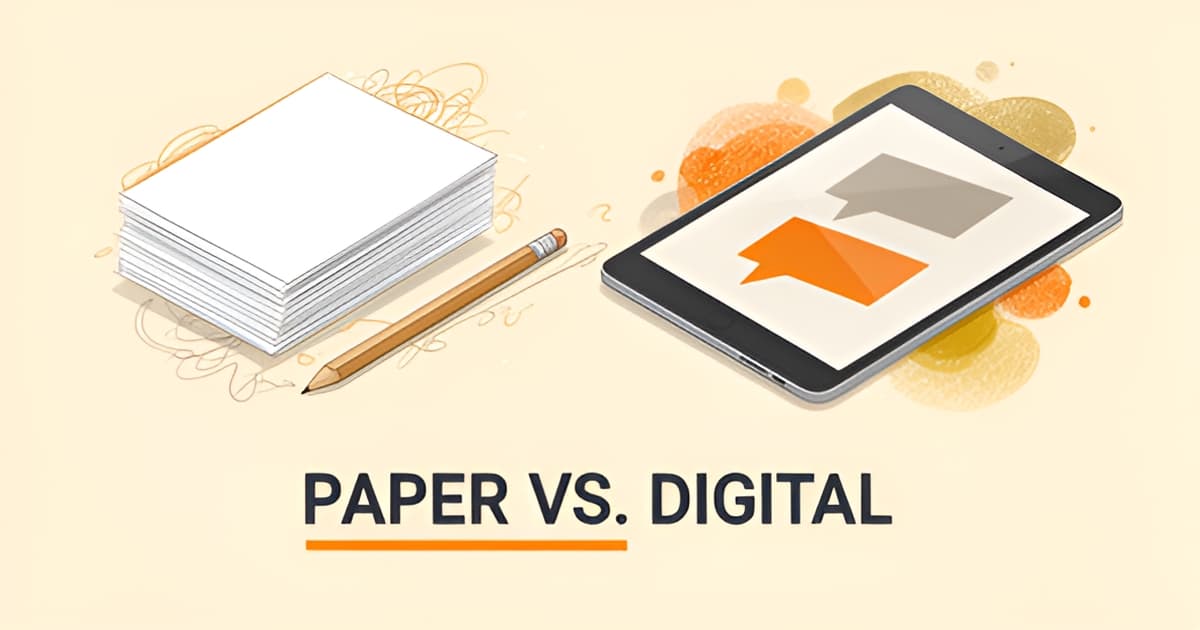
Are paper or online flashcards better?
Key Facts
- Active recall improves long-term retention by up to 50% compared to passive re-reading, according to research on flashcard study methods
- Research confirms spaced repetition significantly outperforms cramming, with a meta-analysis of 254 studies supporting distributed practice
- Ebbinghaus documented the forgetting curve in the 1880s, showing roughly 70% of new information fading within 24 hours without review
- A 12-week university study found teacher-led digital flashcard practice raised vocabulary scores from 71 to 90 (p = 0.000006), while the control group barely moved
- Digital spaced repetition software scales to thousands of cards scheduled individually, a task paper simply cannot do without hours of manual sorting
- Quizlet Plus costs $35.99 per year auto-renewing, and the free tier caps key features like Learn mode and practice tests
- Some learners find tangible paper cards more engaging, sidestepping digital distraction entirely and avoiding screen time concerns
The Science Behind the Card
Before you can answer whether paper or online flashcards are better, you need to know why flashcards work at all. The answer isn't the card stock or the app. It's two cognitive mechanisms that work identically in both formats.
The first is active recall: forcing your brain to retrieve an answer from a cue, rather than passively re-reading it. Retrieval practice improves long-term retention by up to 50% compared with passive review, according to research on flashcard study methods. The second is spaced repetition: reviewing material at growing intervals instead of cramming. Hermann Ebbinghaus documented the problem back in the 1880s with his "forgetting curve," which shows roughly 70% of new information fading within 24 hours without review.
Spaced repetition has a long, well-tested pedigree. A 2006 meta-analysis of 254 studies confirmed that distributing practice over time significantly outperforms massed study, and as far back as 1939, researcher Herbert Spitzer demonstrated the effect with over 3,600 elementary students in Iowa. None of that research cared whether the cards were paper or pixels, and that's the point.
So how does each format deliver these mechanisms?
- Both formats trigger active recall. A printed sight word card and a digital quiz prompt work the same way: cue in, answer out, from memory.
- Both can space repetitions. Paper decks use the Leitner system, a five-level sorting method devised in 1973. Apps automate the scheduling with adaptive algorithms.
- Digital scales better; paper sets up faster. Software can schedule thousands of cards individually, per the research on spaced repetition systems. Paper requires no device, no account, and no learning curve.
- Neither format fixes bad study design. Flashcards excel at facts and definitions, but complex skills need other techniques layered on top.
The practical takeaway for parents and teachers: pick the format that removes friction for your situation, then apply the science. If you're drilling a 20-word vocabulary list with a six-year-old this week, a printed deck from Printoodle's sight word flashcards tool gives you the full active-recall benefit with zero screen time. If you're managing a semester-long deck of thousands of cards, an app's automated scheduling earns its keep.
There's also a middle path worth knowing. Structured, printable practice pages, like the grids in Printoodle's dot paper generator, support the same retrieval-and-review rhythm in written form. The medium is just packaging. The mechanism, a cue, a pause, and an honest attempt to remember, is what actually builds retention. Get that right, and the paper-versus-online question mostly answers itself based on your goal, your timeline, and how much screen time you're willing to spend.
Where Digital Wins and Where It Falls Short
Digital flashcards have one genuinely impressive trick up their sleeve: they remember what you forget. That's the core of the "are paper or online flashcards better" question, and it's where online tools earn their keep.
Where digital wins
The biggest advantage is automated scheduling. Spaced repetition software adapts to individual performance, showing cards you struggle with more often and easy cards less often. It scales to thousands of cards scheduled individually, something paper simply can't do without hours of manual sorting.
Digital decks also add multimedia: images, audio for pronunciation practice, and progress statistics. And the evidence backs the format for structured study. A 12-week university study using Quizlet found teacher-led digital flashcard practice raised vocabulary scores from 71 to 90 (p = 0.000006), while the control group barely moved. A 2008 study cited in the same paper found most students preferred digital over paper.
Where digital falls short
The friction is real, and it compounds over time:
- Quizlet Plus costs $35.99 per year, auto-renewing, and the free tier caps key features like Learn mode and practice tests (per this comparison)
- Anki's iOS app runs $24.99 as a one-time purchase
- Anki has a steep learning curve; many users spend hours configuring it before feeling productive, and many give up first (reviewers note)
- Shared decks may contain mistakes or miss the specific content your course needs
There's also the screen problem. Digital study invites distraction, and some learners simply find tangible tools more engaging, which is exactly why paper cards persist.
The middle path
You don't have to pick a side. A printable generator like Printoodle's sight word flashcards or dot paper gives you the tactile, screen-free experience of paper without the hours of handwriting. For most families and classrooms, that hybrid beats fighting a paywall or an app's learning curve. Print it, doodle it, done.
Why Paper Still Holds Ground
There's a reason flashcards survived chalkboards, overhead projectors, and now tablets: the format works. And when you're asking are paper or online flashcards better for a specific situation, physical cards still have real advantages that digital tools can't copy.
The strongest case for paper comes down to three things: tangibility, zero screen time, and instant setup. Some learners simply find tangible study tools more engaging, and physical cards sidestep the distraction problem entirely, according to one analysis of flashcard learning. For a five-year-old practicing sight words at the kitchen table, a stack of cards beats an app with notifications waiting in the background.
Paper also shines when the goal is short-term. If you have a test next week, either format works, but digital's biggest advantage (algorithm-driven scheduling that adapts over months) doesn't pay off on a two-day timeline. Manual scheduling of physical cards is time-intensive and limits you to simple systems like the Leitner box method, as the research on spaced repetition notes, but for a small deck reviewed over a few evenings, that hardly matters.
Consider paper cards when:
- You want to cut screen time, especially for young kids
- You're working with a small deck and a short deadline
- Your learner finds physical materials more engaging
- You want a parent-and-child activity that doesn't involve handing over a device
The traditional objection to paper has always been the setup cost. Handwriting dozens of cards eats an evening, and that friction alone pushes people toward apps. That's the gap Printoodle closes: you describe what you need, generate print-ready flashcards in seconds, and get the tactile, screen-free benefits of paper without the hours of card-making. The same goes for supporting materials like dot paper for counting practice or sight word flashcards customized to the words your child is actually working on. Reprints are always free, so a spilled juice box doesn't end the study session.
One caveat worth knowing: the research on paper vs. digital is thinner than you'd expect. No head-to-head experimental trial directly compares the two formats, and a 2008 study found most students preferred digital study, though preference isn't the same as effectiveness. Some researchers even argue the ideal study schedule is learner-dependent, so treat any one-size-fits-all verdict with suspicion.
The honest takeaway: paper isn't a relic. For young learners, short-term goals, and screen-free households, physical cards hold their ground, and modern printing tools have removed the main reason to avoid them.
The Printoodle Bridge: Personalized, Print-Ready Flashcards
If you've decided paper flashcards are the right fit for your child, the biggest obstacle usually isn't the studying. It's the making. Handwriting a deck of sight words or math facts takes an evening you don't have, and it's one reason many families drift back to screens even when they'd rather not.
The research bears this out. Wikipedia's overview of spaced repetition notes that without software, users have to schedule physical flashcards themselves, which is time-intensive and limits them to simple systems like the Leitner box. That's the paper format's real weakness: not effectiveness, but setup cost.
This is where a generator changes the math. Printoodle's approach is simple: you describe what you need, spend a credit, and download a print-ready PDF in seconds. The sight word flashcards tool, for example, turns what used to be an hour of handwriting into a quick print job. Because everything you make is saved in your library, reprints are always free, so a lost card or a second child starting school costs you nothing but paper.
What you keep is everything paper does well. The cards land in your child's hands, not on a screen. There's no app subscription, no notification pulling attention mid-session, and no temptation to tap over to something else. That matters because research on digital learning points out that some learners prefer physical cards precisely to avoid screen time and digital distraction, finding tangible study tools more engaging.
A few practical ways to use printed decks at home or in class:
- Run a five-minute review at breakfast or in the car, when a device would be awkward anyway.
- Let kids shuffle, deal, and physically sort cards into "got it" and "not yet" piles. The sorting itself is retrieval practice.
- Pair cards with dot paper so early learners can count out answers and practice number writing alongside the deck.
- Study together. A 12-week university study found teacher-led flashcard practice significantly improved vocabulary scores compared to independent study, so sitting with your child beats handing over an app and walking away.
The free-versus-paid picture is worth noting too. Popular digital tools carry real costs: Quizlet Plus runs $35.99 per year, Anki's iOS app is a $24.99 one-time purchase, and Quizlet's free tier caps key features like Learn mode. Printoodle's free tier gives you 10 credits on email verification, with credit packs from $5, and reprints stay free forever.
For parents and teachers weighing are paper or online flashcards better, the honest answer is that a generator gives you paper's benefits without its usual price in preparation time. Print it. Doodle it. Done.
Frequently Asked Questions
When should I choose paper flashcards for my child instead of an app?
Print It. Doodle It. Done.
So, are paper or online flashcards better? The honest answer: the science doesn't pick a side. Active recall and spaced repetition, the mechanisms that improve retention by up to 50% over passive review, according to research on flashcard study methods, work identically in both formats. Digital wins when you're managing thousands of cards over months and want algorithms to do the scheduling. Paper wins for young learners, small decks, short timelines, and screen-free households. What paper always lost on was setup time, until now. Printoodle closes that gap: describe what you need, generate print-ready sight word flashcards in seconds, and reprint for free forever, with dot paper on hand for counting practice. Your next step is simple: pick the format that fits your week, sit down with your learner, the research favors adult-led practice, and study. Print it. Doodle it. Done.