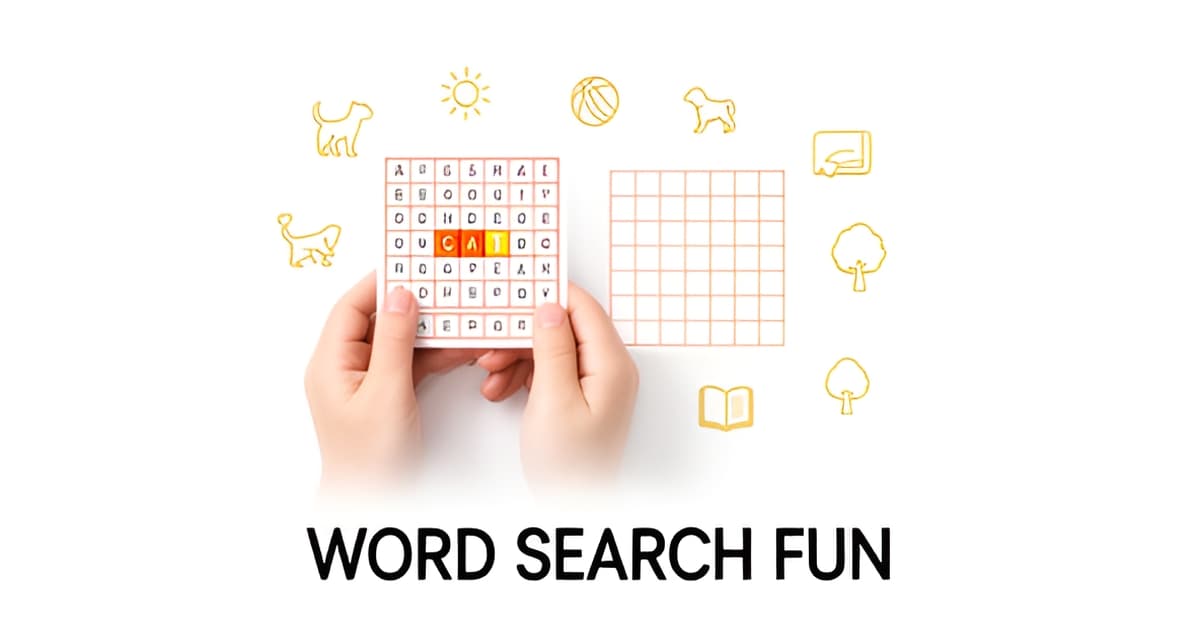
Can kindergarten do word search?
Key Facts
- Kindergarteners can do word searches once they know the alphabet and can read short words, typically ages 5 to 7
- according to guidance for young learners
- Beginner word searches for kindergarteners use 8×8 or 10×10 grids with 6–8 hidden words, each 3–5 letters long
- puzzle design guidance for kids
- Horizontal and vertical words only, with no diagonals or backwards words, are required for kindergarten readiness
- guidelines for kids' word searches
- Word searches work best with reading and writing instruction, never instead of it
- educators who use word searches with young learners
So, Can Kindergarteners Actually Do Word Searches?
So, can kindergarten do word search? Yes, with one honest caveat: it depends on the puzzle, not the kid. According to guidance for young learners, word searches are appropriate once children know the alphabet and can read short words, which lands right around ages 5 to 7. That's the kindergarten window.
The hesitation you might feel as a parent or teacher is legitimate, though. Hand a five-year-old a 15×15 grid crammed with diagonal and backwards words and you'll get tears, not learning. Puzzle design guidance for kids is specific about why: larger letters and fewer words reduce frustration and keep young learners motivated.
What a kindergarten-ready word search actually looks like:
- A small grid, 8×8 or 10×10, not the sprawling adult-size layouts
- Just 6–8 hidden words, each 3–5 letters long (think CAT, DOG, SUN, RED)
- Words placed only horizontally and vertically, never diagonal or backwards
- Big, easy-to-track letters with room to circle them
There's also the "busy work" worry, and it has real history behind it. Some schools have gone as far as banning word searches as a waste of instructional time, and even educators who defend them agree the puzzles don't carry much rigor on their own. The resolution isn't to skip word searches; it's to use them on purpose. The research consensus is that they work with reading and writing instruction, never instead of it.
That framing matters for kindergarteners especially. A word search built from your child's actual sight-word list reinforces exactly what they're practicing in class, and pairing it with writing practice on proper kindergarten writing paper turns a puzzle into a mini literacy lesson. If you're building a themed activity kit, tools like Printoodle let you drop in your own word list, so the puzzle matches what your kid already recognizes, whether that's kindergarten sight words or this week's spelling list.
The fine motor concern is real but manageable. Circling letters does exercise pencil control, which is a genuine benefit at this age, but a frustrated grip defeats the purpose. Start with the smallest grid, keep sessions short, and mix in mostly familiar words so your child gets the win. Confidence, after all, is half the reason these puzzles work at all.
For variety, you can also rotate word searches with related activities like kindergarten sight word bingo, which practices the same recognition skills in a fresh format. The short answer stands: kindergarteners can absolutely do word searches, as long as the puzzle is built for a five-year-old and not a grown-up.
What a Kindergarten-Ready Word Search Looks Like
A five-year-old staring down a 15×15 grid full of backwards, diagonal words is a recipe for tears. The good news: the design choices that make a word search kindergarten-ready are surprisingly specific, and they're backed by clear guidelines from puzzle and early-learning experts.
So if you're asking "can kindergarten do word search?", the answer lives in the layout. According to guidelines for kids' word searches, beginner puzzles should hide words in horizontal and vertical directions only, with no diagonals and no backwards words. A kindergartener who just learned that CAT reads left to right gets thrown off completely when the same word runs right to left. Keeping every word in a familiar reading direction lets the puzzle reinforce what they already know instead of working against it.
Grid size matters just as much. The recommendation for young children is a small 8×8 or 10×10 grid, compared with 12×12 or 15×15 grids for ages 9–12. Fewer letters on the page means less visual clutter to scan, and each hidden word sits closer to the surface. Pair that grid with just 6 to 8 words per puzzle, and the whole thing stays finishable inside a kindergartener's attention span.
- Grid: 8×8 or 10×10, with big letters kids can easily track
- Word length: 3–5 letters, like CAT, DOG, SUN, and RED
- Directions: horizontal and vertical only, never diagonal or backwards
Why do these choices work? Because they're engineered for small wins. Larger letters and fewer words reduce frustration and keep young learners motivated, and each word a child circles delivers a little burst of "I found it!" that builds confidence. That confidence is the point: kids who finish a puzzle want to do another one, and the vocabulary and visual-scanning practice compounds from there.
One smart trick from the research: mix 2–3 new words into a list of familiar ones, rather than making everything new at once. A child who finds SUN and RED quickly keeps scanning for the unfamiliar word instead of giving up. Over time, you gradually increase grid size and word complexity as skills grow.
This is where customizing pays off. Printoodle lets you type in your own word list, so you can build a puzzle around exactly the words your child is working on this week, whether that's a color theme, an animal theme, or the sight words from your kindergarten sight words list. Pair the finished puzzle with a round of kindergarten sight word bingo or practice writing the found words on kindergarten writing paper, and you've turned one small puzzle into a full literacy session. Print it. Doodle it. Done.
Why Word Searches Earn Their Spot (and When They Don't)
So yes, kindergarteners can do word searches, and when the puzzle is built for their level, it actually pulls real weight. The benefits stack up fast: kids practice spelling and letter-order recognition, build sight-word familiarity, sharpen visual scanning and pattern recognition, and develop the kind of focus that comes from a task with a clear finish line. Circling letters with a pencil quietly builds fine-motor control too, the same grip strength they need for handwriting.
The confidence piece matters just as much. According to educators who use word searches with young learners, those achievable "small wins" keep five-year-olds motivated in a way that drills rarely do. A child who finds CAT and SUN on her own wants to find the next word. That's intrinsic motivation, and you can't hand it out with a sticker.
What a purposeful word search actually delivers:
- Sight-word and spelling reinforcement through repeated letter-order recognition
- Visual scanning and pattern recognition, core skills for early reading
- Sustained focus and persistence on a task with a visible end
- Pencil control from circling and tracing letters in a grid
Now, the honest objection. Some schools have flat-out banned word searches, calling them a waste of instructional time because they don't promote higher-order thinking. An educator with 20+ years of classroom experience grapples with this directly, agreeing that word searches alone lack rigor, while still defending their value when used sparingly and with intent. The research consensus lands in the same place: word searches work best with reading and writing, not instead of them.
That gives you a simple rule of thumb. Aim for 2 to 3 puzzles a week, and tie each one to what you're already teaching. A "Weather Words" puzzle during a seasons unit, or a grid built from this week's sight words, turns the puzzle into reinforcement. A random puzzle with no connection to anything? That's when the busy-work critics have a point.
This is also where custom puzzles shine. With Printoodle, you can type in your own word list, whether that's your class's sight words, spelling words, or the theme of the week, and generate a print-ready puzzle in seconds. Pair it with a kindergarten sight words list or a round of kindergarten sight word bingo for variety, and follow up by having kids write their found words on kindergarten writing paper. Search, say, write. That's a full loop, not a time filler.
How to Make a Custom Word Search Your Kindergartener Can Finish
The difference between a word search your five-year-old finishes with a grin and one that ends in tears comes down to the words you put in it. Once you know that kindergarteners can do word searches when the puzzle matches their level, the next step is building one that does.
Start with words your child already reads. Beginner puzzles work best with 6–8 short words of 3–5 letters, like CAT, DOG, SUN, and RED, according to guidelines for kids' word searches. That's why a generic printable so often misses: it wasn't built from your list.
With Printoodle's word search generator, you paste in your own sight words or spelling words, so the puzzle matches exactly what your child is learning this week. If you need a starting point, the kindergarten sight words tool gives you a ready list to pull from.
Pick a theme your child cares about, whether that's animals, colors, or the season you're studying. Then set the grid small. Research recommends an 8×8 or 10×10 grid for ages 5–7, with words hidden only horizontally and vertically, since diagonals and backwards words push a puzzle past beginner level.
Bigger letters and fewer words keep frustration low and motivation high. You can download the finished puzzle as a print-ready PDF in Letter or A4, and since it lives in your library, reprinting it for a second child or a second week costs nothing.
Here's your kindergarten-ready checklist:
- 6–8 words total, each 3–5 letters long
- Horizontal and vertical words only, no diagonals or backwards words
- An 8×8 or 10×10 grid with large letters
- A theme tied to something familiar, like animals or weather
- 2–3 new words mixed in with words your child already knows
That last point matters more than it sounds. Mixing a couple of new words into familiar ones builds confidence, because your child finds the easy wins first and warms up for the harder ones.
Word searches work best alongside reading and writing, not instead of them. After the puzzle, hand your child a sheet of kindergarten writing paper and have them write each word they found. The search builds recognition; the writing cements it.
If you want a change of pace, the kindergarten sight word bingo tool covers the same word list in a game format. Two or three puzzle-based activities per week is the sweet spot, enough to reinforce the words without burning out your little searcher.
Type in your words, hit generate, and print a puzzle your kindergartener can finish. Print it. Doodle it. Done.
The Short Answer: Yes, and Here's How to Get It Right
So, can kindergarten do word search? Absolutely, when the puzzle is built for a five-year-old, not a grown-up. Keep grids small (8×8 or 10×10), stick to 6–8 short words placed horizontally and vertically only, and mix in mostly familiar words so your child racks up quick wins. Used two or three times a week alongside reading and writing, not instead of them, word searches reinforce sight words, sharpen visual scanning, and quietly build pencil control. Ready to put this into practice? Pull words from your kindergarten sight words list, generate a custom puzzle with Printoodle, then have your child write each found word on kindergarten writing paper to cement it. For variety, swap in a round of kindergarten sight word bingo. Type in your words, hit generate, and print a puzzle your kindergartener can actually finish. Print it. Doodle it. Done.