Christmas Tree Maze and More: Free Printable Christmas Mazes in Holiday Shapes
Key Facts
- A maze cut into a Christmas tree shape beats a plain square grid for younger solvers every time, per maze design guidance for kids.
- Age-band mismatch, not art or price, is the top cause of one-star reviews on children's maze books, according to industry analysis of maze products.
- Maze difficulty maps cleanly to age: 3-4 year olds get 5x5 to 6x6 grids, 5-6 year olds get 7x7 to 10x10, and 8-10 year olds handle 15x15 to 20x20, per this age-to-grid-size mapping.
- A Twinkl Christmas maze pack rates 4.7 out of 5 across 26 reviews, reflecting strong demand for age-tiered holiday maze worksheets.
- Story prompts like 'help Father Christmas find his sleigh' are a widely adopted engagement device, per Twinkl's Christmas maze resources.
- Mazes4Kids recommends just 10-15 minutes of maze practice a day, several times a week, for steady skill-building, per a parents' guide to mazes.
- Mazes build five developmental skills at once: strategic thinking, problem solving, spatial awareness, focus, and patience, according to Mazes4Kids' parent guide.
Why a Christmas Tree Beats a Square Grid: The Shape-Cut Hook
December has a way of turning even the calmest classroom fizzy. Kids are buzzing about Santa, sugar is running high, and a plain worksheet with a grid on it looks exactly like what it is: homework. You need something that grabs attention in the first three seconds, and a square full of lines doesn't do it.
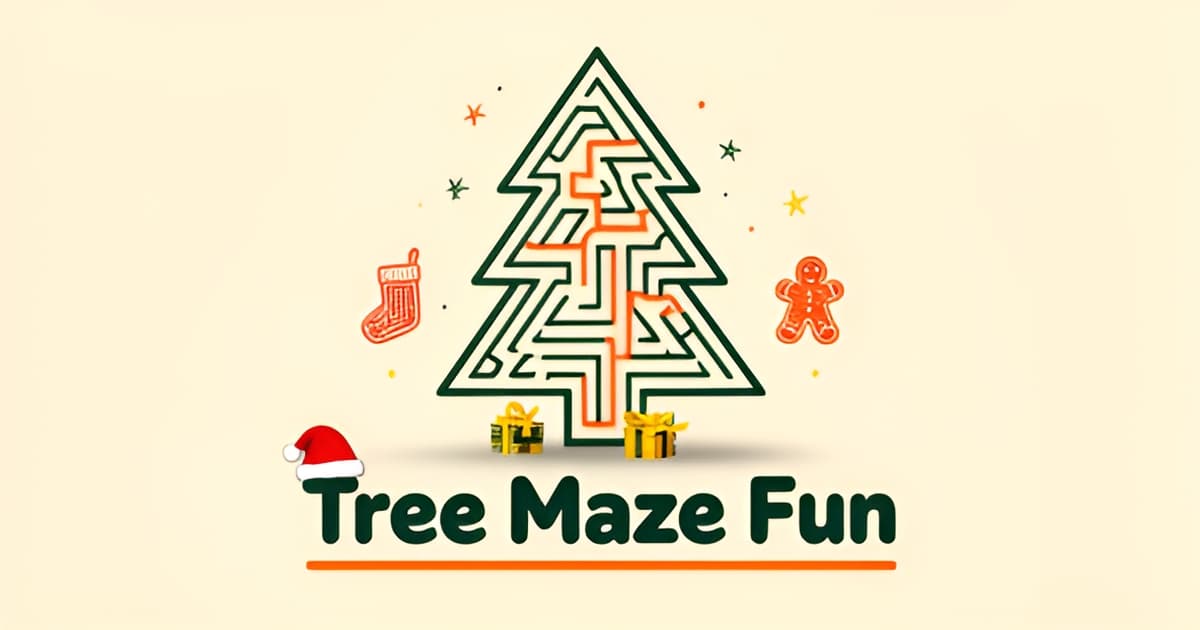
A maze cut into a shape does. According to maze design guidance for kids, a maze clipped into a recognizable picture beats a plain square grid for younger solvers every time. "Help the rabbit find the carrot" lands with a five-year-old in a way "solve this grid" never will. The same logic applies in December: a maze that is a Christmas tree, a stocking, or a gingerbread man stops being a worksheet and becomes part of the holiday.
The category has already caught on. Picklebums offers mazes cut into a Christmas tree, present, star, and decoration, and other printables come in snowman and Santa shapes. Shaped puzzles are one of the clearest ways publishers differentiate a kids' activity book from the crowd.
Then there's the story layer. A mission changes everything:
- "Help Santa reach the presents" turns dead ends into stakes rather than failures.
- Educational publishers like Twinkl recommend prompts such as helping Father Christmas find his sleigh or Rudolph find his carrots.
- Sites like North Pole Times build whole puzzles around characters like a little elf who needs rescuing.
This kind of narrative framing is a widely adopted engagement device across the category, and it's not decoration. Mazes4Kids notes that encouraging children to tell their own stories as they solve develops creativity and language skills alongside the obvious pencil-control and problem-solving practice.
The shape and the story work together. A five-year-old doesn't care about spatial reasoning; they care that Santa is stuck and only they can get him to the presents. The developmental benefits, the fine motor work, the persistence practice, come along quietly while the mission happens.
Printoodle's Christmas tree maze generator leans into exactly this: a maze cut into a holiday shape, framed as helping Santa reach the presents, with the difficulty matched to the child's age and a solution included so you can check answers fast. Every activity is free, there's no signup, and every press of the button makes a new one, which matters more than you'd think in a classroom of kids who will absolutely compare notes on who solved "the same maze" first.
That's the real case for shape-cut over grid: attention is the scarce resource in December, and a puzzle that looks like Christmas earns it before the pencil even touches the page. If you want other holiday shapes beyond the tree, the broader Christmas maze generator covers the same ground.
Getting the Difficulty Right: Age Bands That Actually Work
Nothing kills a kid's enthusiasm for mazes faster than handing a four-year-old a puzzle built for a ten-year-old. Get the difficulty right and the same child will happily solve a dozen in a row; get it wrong and you'll be doing the maze yourself while they wander off.
The stakes here are real, if a little funny. According to one analysis of children's maze products, the single most common reason a maze book gets a one-star review isn't the art, the paper, or the price. It's a mismatch between the stated age range and the actual difficulty. Successful maze publishers therefore use narrow age brackets rather than wide ones, because a puzzle that claims to serve everyone from preschool to upper elementary usually serves nobody well.
So what actually works? Maze publishers converge on a fairly consistent grid-size-by-age mapping: ages 3–4 get tiny grids around 5×5 to 6×6, ages 5–6 get 7×7 to 10×10, and by ages 8–10 kids can handle 15×15 to 20×20 grids. The tuning levers are grid size, path width, and dead-end count:
- Ages 3–4: very simple mazes with wide paths and minimal turns, so little hands can trace the route without frustration.
- Ages 5–6: moderately complex layouts with more turns and only a few dead ends, enough to require real decisions.
- Ages 7+: complicated patterns with multiple dead ends, where backtracking becomes part of the fun.
Two practical techniques make a big difference at the younger end. Educational publisher Twinkl suggests learners run through the maze with their finger before trying it with a pencil, which builds a mental map first and saves pencil-control practice for the second pass. And when a child hits a wall, treat it as part of the process rather than a problem: frustration is a natural part of learning, and the recommended fix is to drop back to an easier maze to rebuild confidence, then tackle a harder one together while talking through your strategy out loud.
This is also where a generator beats a fixed printable. Instead of downloading one PDF and hoping it fits your child, you can adjust difficulty until it matches. On Printoodle's free Christmas tree maze generator, every press makes a new maze, so if the first one is too easy, you simply generate a harder version in seconds. There's no signup and no cost, and each maze comes with a solution so you can check answers quickly. If you'd rather browse other holiday shapes, the broader Christmas maze tool works the same way.
The goal isn't to challenge a child into quitting. It's to keep them one small step beyond comfortable, so every solve feels earned.
Skills Under the Tinsel: What Kids Practice While They Solve
A maze looks like a quiet little puzzle, but a lot is happening in those few minutes of pencil work. Trace the path through a Christmas tree shape and you're practicing fine motor control and pencil grip, the same muscles that will later handle handwriting. Educational publishers describe mazes as building "problem-solving and pencil control skills" in one activity, which is why they show up so often in classroom packs and holiday worksheet sets (Twinkl's Christmas maze resources).
The skill list is longer than most parents realize. Activity sites across the category consistently point to the same developmental benefits, and one guide breaks them into five: strategic thinking, problem solving, spatial awareness, focus and concentration, and patience and persistence (a parents' guide to mazes and logical thinking). That's a solid return for a printable that takes ten minutes.
- Problem-solving: dead ends force kids to back up, reassess, and try a new route, which is genuine analytical practice, not just busywork (North Pole Times frames its mazes exactly this way).
- Pencil control: staying inside the path trains the steady hand teachers look for in early writing.
- Focus: a maze demands sustained attention to the whole path, not just the next turn (Printables for Life highlights problem-solving and focus as core benefits).
- Patience and persistence: hitting a dead end and trying again builds the tolerance for frustration that helps in every subject later.
You don't need a big time commitment, either. The same parents' guide recommends about 10–15 minutes a day, several times a week, which fits easily into a December afternoon. And if a child gets stuck, one practical tip from teachers is to have them trace the route with a finger before picking up the pencil. Frustration is a natural part of learning; when it runs high, drop back to an easier maze and rebuild confidence before trying the harder one together.
For classrooms, mazes slot neatly into the December rhythm. They work well in early-finisher bins, as a calm holiday party station, or as a warm-up while students settle in. Because Printoodle's generator produces a fresh maze on every press, you can print a different tree for each child at the same difficulty level, so nobody copies a neighbor. Everything is free with no signup, and each maze comes with a solution included, so checking answers takes seconds.
At home, pair the maze with the story: Santa needs to reach the presents, and only your child can find the way. Narrating the mission keeps young solvers engaged and, as maze educators note, inviting kids to tell their own version of the story stretches creativity and language skills too.
Make One in Seconds: How the Printoodle Maze Generator Works
Here's the thing about most printable Christmas mazes: you get the same four puzzles as everyone else. A free printable set might include a tree, a present, and a star, and once you've printed it twice, your kids have memorized the paths. Printoodle works differently. Every press of the button generates a brand-new maze, so the tree your child solved yesterday isn't the tree they get today.
The tool is free with no signup. You don't hand over an email, create an account, or burn through a trial. Open the page, make a maze, print it. That's the whole flow.
How it works in three steps:
- Pick a shape. Choose a Christmas tree, stocking, or gingerbread man, and the maze gets cut into that outline. Each maze comes with a story hook like "help Santa reach the presents," which matters because shaped mazes with a narrative beat plain square grids for younger solvers, according to maze design guidance.
- Set the difficulty. Match it to your child's age. This matters more than you'd think: mismatched difficulty is the single most common reason children's maze products get poor reviews, per industry analysis. Narrow age bands work better than guessing.
- Print. Choose US Letter or A4 depending on your paper. Every maze ships with a solution included, so you can check answers at a glance instead of tracing the path yourself at 9pm.
The solution key sounds minor until you're a teacher with 25 worksheets to mark or a parent whose child insists they "definitely found the way" when they didn't. Having the answer on hand settles it in seconds.
If you want to try it right now, the Christmas tree maze generator is the fastest place to start. Need a different shape or a whole stack for a classroom party? The broader Christmas maze generator handles stocking, gingerbread man, and other holiday shapes with the same free, no-signup setup.
Because every press makes a fresh maze, the tool works as a December-long supply rather than a one-time download. Print an easy one for your four-year-old, a harder one for your eight-year-old, and another for tomorrow's snow day. No two come out the same.
Print it. Doodle it. Done.
Classroom and Kitchen Table Ideas: Stretching One Generator All December
One generator, pressed once a day, can carry you from December 1st straight through to Christmas Eve. That's the quiet superpower of a maze tool that makes a new puzzle every single time you press the button, and it's exactly how teachers and parents can stretch a single free resource across an entire month of holiday chaos.
Try a mini-maze advent calendar. One small maze per day works beautifully as a countdown ritual, and the format is proven: Univers.studio's Christmas maze generator ships its holiday offering as 24 mini-mazes, one per day, at 300 DPI print-ready quality. You can build the same rhythm with Printoodle's Christmas tree maze generator: print tonight's maze, tuck it under the tree, and let the "help Santa reach the presents" story do the morning motivation for you.
For mixed-ability classrooms, difficulty tiers are where a generator beats any fixed PDF. The research is blunt about why: guidance on age-appropriate maze difficulty notes that mismatch between stated age and actual difficulty is the top complaint reviewers leave, and that a book claiming "ages 3–10" serves nobody well. Generate three versions at different difficulty levels and hand them out by readiness, not by grade:
- Ages 3–4: very simple paths, wide lines, minimal turns
- Ages 5–6: more turns and a few limited dead ends
- Ages 7 and up: complicated patterns with multiple dead ends
That tiering comes straight from Mazes4Kids' parent guide, which also suggests 10–15 minutes of maze time a day, several times a week. A daily holiday maze fits that window perfectly.
Holiday parties are the other obvious win. Run maze races: same shape, same difficulty, first correct path wins a candy cane. When a sharp-eyed kid memorizes the route, you don't need a new resource. You just press the button again and get a fresh maze with the same tree shape and the same Santa story, which is the core difference between a generator and a fixed four-maze PDF you can only print once.
Every maze on Printoodle is free, with no signup required, and every maze you generate lands in your library where reprints are always free. If a student tears a page or wants a rematch, you reprint at no cost, forever. Print it, doodle it, done.
Ready to build your December stash? Head to the free Christmas tree maze generator and press the button as many times as your calendar needs.
Frequently Asked Questions
Why do shaped Christmas mazes work better for young kids than regular square grids?
How should I choose the right difficulty level for my child?
What skills do kids actually learn while solving these mazes?
Is it okay if my child gets frustrated and hits a dead end?
Do I need to sign up or pay to generate these Christmas mazes?
Why is a maze generator better than downloading a fixed set of PDFs?
Your December Is Covered, One Button at a Time
A shaped maze beats a square grid because it earns attention before the pencil touches the page. The right difficulty keeps kids solving instead of quitting, and the quiet skill-building, pencil control, problem-solving, persistence, comes free along the way. The only thing left is supply, and that's where a generator outlasts any fixed printable: every press makes a new maze, so the tree your child solved yesterday isn't the one waiting tomorrow. Printoodle's Christmas tree maze generator is free with no signup, matches difficulty to age, includes a solution with every maze, and saves everything to a library where reprints are always free. Start simple: generate one tree maze tonight, tell your child Santa needs help reaching the presents, and watch what happens. If you need a stocking or gingerbread man for the classroom party, the broader Christmas maze generator works the same way. Print it. Doodle it. Done.