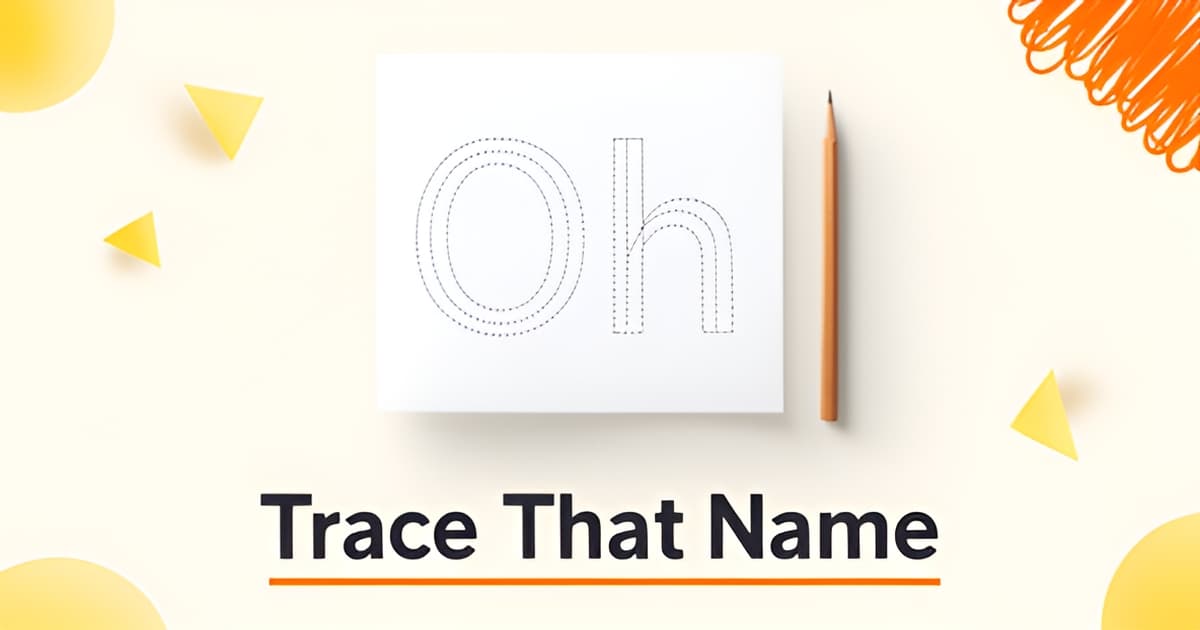
How can I create a name tracing worksheet?
Key Facts
- A study of 4- and 5-year-olds across 81 classrooms found children averaged just two minutes a day of writing instruction.
- Namewriting proficiency is associated with alphabet knowledge, letter writing, print concepts, and spelling, per NAEYC research.
- A Journal of Educational Psychology study found children who learn correct letter formation early show significantly better handwriting fluency later, according to practitioners.
- Portrait mode fits about 12 characters per line while landscape fits up to 17, per A to Z Teacher Stuff.
- Experts recommend keeping tracing sessions to 5-10 minutes, since short frequent sessions beat infrequent long ones, per TracingWorksheets.com.
- Children typically can't imitate diagonal lines until ages 4-6, making names like 'Wyatt' harder than 'Emma', per an occupational therapist.
- Without a start-here dot, children form letters bottom-up or mid-shape, creating neuromotor habits that are very hard to break, warn early childhood practitioners.
Why Your Child's Name Is the Best First Word to Trace
You're here because you want one page with your child's name on it, not a 40-page workbook full of random words. That instinct is better than you might realize.
Your child's name is the most meaningful word they own, and it turns out it's also the ideal first word to trace. According to NAEYC research on emergent writing, name writing is one of the first words children learn, and namewriting proficiency is associated with alphabet knowledge, letter writing, print concepts, and spelling. In other words, the letters in "Maya" or "Elijah" aren't just practice. They're a foundation for reading and writing across the board.
Here's the gap a simple worksheet fills. A study of 4- and 5-year-olds across 81 classrooms found that children averaged only about two minutes a day writing or being taught writing. Two minutes. A personalized tracing page at home, even used for the recommended 5 to 10 minutes a few times a week, can more than double the writing practice many preschoolers get in the classroom.
Why the name, specifically, works so well as a starting point:
- It's personally meaningful, so motivation comes built in. Kids want to write their own name.
- It teaches letter recognition for the exact letters your child will use every day, on cubbies, artwork, and sign-in sheets.
- The motor practice of forming letters appears to solidify letter-sound correspondences, supporting early reading, not just handwriting.
- It's short. A 4-letter name fits neatly into a preschooler's attention span.
There's one design detail that matters more than everything else: stroke direction beats repetition. Practitioner guidance warns that without a "start here" cue, children often form letters bottom-up or mid-shape, and those neuromotor habits are very hard to break once set. A well-designed worksheet prevents the problem before it starts.
That's really all you need to understand why you're making this page. Now for the easy part. If you're wondering how to create a name tracing worksheet without fiddling with fonts or formatting software, Printoodle's name tracing printable is the fastest route: type the name, pick a dotted or dotted-and-lined style, and download a print-ready PDF in seconds. The name tracing generator handles the layout for you, and once it's in your library, reprints are free forever, so you can pull the same sheet out again next week. For more practice variations, the full set of name tracing worksheets has you covered. Print it. Doodle it. Done.
How to Create a Name Tracing Worksheet in Printoodle, Step by Step
If you've ever wondered how to create a name tracing worksheet without wrestling with fonts and word processors, the good news is that the process takes about a minute once you know the pattern. Every solid generator follows the same flow: enter a name, pick a style, adjust, preview, and print. Here's how it works in Printoodle.
Step 1: Open the generator and type the name. Head to the name tracing generator and enter the child's name. This is the industry-standard input step across generator tools, from A to Z Teacher Stuff's worksheet maker to other popular options, so the workflow will feel familiar if you've made a name tracing printable before.
Step 2: Choose a dotted or dotted-and-lined font. "Dotted" gives clean outline letters to trace, while "Dotted & Lined" adds top, middle, and bottom guidelines that act as a visual roadmap for letter height and placement, according to TracingWorksheets.com. Lined styles are worth the extra visual clutter for beginners who are still learning where letters sit.
Step 3: Adjust size and repetitions. Bigger letters are easier for little hands, so start large and shrink as control improves. Set the number of repetitions based on attention span: research suggests keeping tracing sessions to 5–10 minutes, since short, frequent sessions beat infrequent long ones.
Step 4: Pick portrait or landscape. Orientation matters more than you'd think. Portrait mode fits about 12 characters per line, while landscape fits up to 17, per A to Z Teacher Stuff. A short name like "Mia" works fine in portrait; a longer name like "Alexandra" often breathes better in landscape.
Step 5: Preview, toggle Letter or A4, and download. Check the preview, switch between Letter (the default) and A4 if you're outside North America, then download the print-ready PDF. Every worksheet you make lives in your Printoodle library, and reprints are free forever, so you can run off a fresh copy whenever the crayons win.
Before you hit print, a few practical tips:
- Set your browser print margins to 0.5 inch or less so nothing gets clipped.
- Always check print preview before committing paper.
- Laminate the sheet or slip it in a page protector with wipe-off markers for repeated practice from one printout.
That's the whole routine. If you want more name tracing worksheets for classroom sets or siblings, the same steps apply. Print it. Doodle it. Done.
Design Choices That Actually Build Good Handwriting
More tracing isn't better tracing. When parents ask how they can create a name tracing worksheet that actually helps, the answer usually isn't "add more rows." It's "add better cues." A worksheet with twenty repetitions and no stroke guidance can do more harm than a carefully designed page with five.
The #1 mistake is letting kids trace without any indication of where to start. Without a starting cue, children form letters bottom-up, begin mid-shape, or reverse their strokes entirely. According to early childhood practitioners, once those neuromotor patterns are set, they're very difficult to break. A simple dot at the top of each letter acts as a visual anchor and can completely change a child's trajectory.
The research backs this up. A study published in the Journal of Educational Psychology (Alstad, Ehri, and Bloodgood, 2015) found that children who learn correct letter formation from the beginning show significantly better handwriting fluency and fewer reversal errors later in elementary school. In other words, the first ten traces matter more than the next hundred.
So what does good design look like? Keep it simple:
- Start-here dots on every letter, so the pencil always begins in the right place.
- Top-to-bottom stroke cues that reinforce the left-to-right, top-down habits print requires.
- Larger letter sizes for beginners. Generator tools consistently recommend extra-large fonts for new writers and smaller sizes as control improves.
- Top, middle, and bottom guidelines that act as visual roadmaps for letter height and placement.
When you build your page in a name tracing generator, these are the settings worth slowing down for. In Printoodle, that means choosing a dotted-and-lined style, bumping the font size up for a first-timer, and previewing before you print. The same name tracing printable can grow with your child: shrink the letters, fade the dotted model, and eventually remove the model entirely.
Developmental sequence matters too. An occupational therapist with 35+ years of experience recommends starting with all capitals, since capital letters use only big lines and curves, then progressing to title case. Diagonal lines, which appear in letters like A, K, M, and W, typically aren't imitated well until ages 4–6, so a name like "Wyatt" is genuinely harder than "Emma."
If you're building a set of name tracing worksheets, design each page around formation quality, not repetition count. Five well-cued traces in a 5–10 minute session beat a full page of sloppy ones. Print it, laminate it, and let the muscle memory build the right way from trace one.
Leveling Up: Difficulty, Reuse, and Practice Habits
A worksheet that works on Monday can be useless by Friday if it doesn't grow with your child. The good news: a few small adjustments turn one page into a whole progression.
Start with all capital letters. According to an occupational therapist with 35+ years of experience, capitals are developmentally easier because they use only big and little lines and curves, while lowercase letters add more complex formations. The recommended sequence is prewriting strokes, then the name in ALL CAPS with a visual model, then title case, then fading the model until the child writes independently.
Watch out for diagonal strokes. Names beginning with letters like A, K, M, N, R, V, W, X, Y, and Z are trickier because children typically can't imitate diagonal lines until ages 4–6. If your child's name starts with one of these, expect slower progress and don't push.
Keep sessions short. Research recommends 5–10 minutes, and short, frequent sessions beat infrequent long ones. One study of 4- and 5-year-olds across 81 classrooms found children averaged just two minutes a day writing or being taught writing, so even a small daily habit puts you ahead of the curve.
To reuse a single page, laminate it or slide it into a page protector with wipe-off markers, a practice recommended by teachers and parents who print once and practice for weeks. Printoodle keeps reprints free forever, so you can also regenerate a fresh name tracing printable whenever your child advances a level.
Here's how to scale the difficulty over time:
- Start with a large dotted font, then shrink the size as control improves.
- Move from ALL CAPS to title case, then fade the model so only the first line shows the letters.
- For extra challenge, have your child trace similar names or names starting with the same letter, a trick that practitioners use to sharpen letter discrimination.
- Add variety with colorful pencils, crayons, or finger paints to keep motivation high.
One caution from the research: prioritize correct stroke formation over volume. Children who learn to form letters properly from the beginning show significantly better handwriting fluency and fewer reversal errors later in elementary school, according to research cited in the Journal of Educational Psychology. Ten careful minutes with starting dots beat thirty rushed minutes without them.
When you're ready, Printoodle's name tracing generator makes it easy to create each stage in seconds, and the full library of name tracing worksheets is there whenever you need a fresh page. Print it. Doodle it. Done.
Frequently Asked Questions
How can I create a name tracing worksheet for free?
Should I use a dotted font or a dotted-and-lined font for my preschooler?
How many repetitions and how long should a name tracing session be?
Why do tracing worksheets need a 'start here' dot on each letter?
Should my child start tracing their name in capital letters or lowercase?
How can I reuse a name tracing worksheet without printing a new copy every time?
Your Child's Name, One Dotted Letter at a Time
So, how can you create a name tracing worksheet that actually works? Keep it personal, keep it short, and keep the stroke cues front and center. Start with big dotted letters and a "start here" dot, move from ALL CAPS to title case, and keep sessions to 5–10 minutes, remember, preschoolers in one study averaged just two minutes of daily writing practice, so even a small home habit puts your child ahead. Laminate the page for wipe-off practice, and reprint a fresh copy whenever your child levels up, Printoodle keeps reprints free forever, so growing the difficulty costs nothing. Ready to make your first page? Head to the name tracing generator, type your child's name, and download a name tracing printable in seconds. Need more variety for siblings or a classroom? Browse the full name tracing worksheets library. Print it. Doodle it. Done.