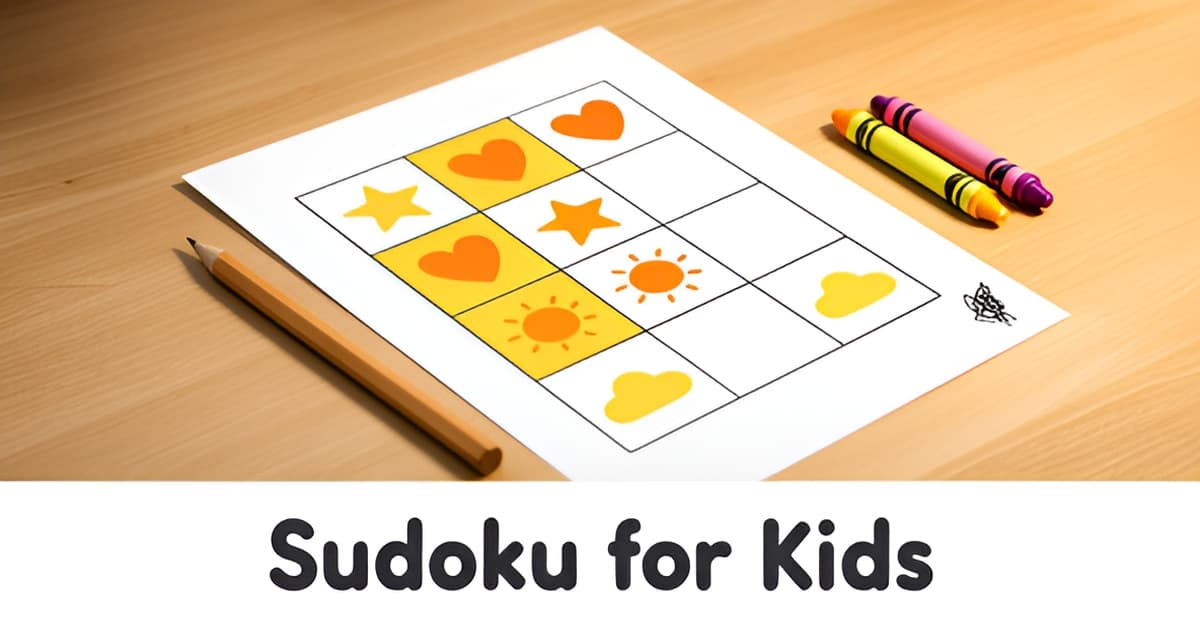
How can I explain Sudoku to kids?
Key Facts
- A peer-reviewed neuroscience study confirms Sudoku requires no math, just logic, so kids who can't add yet can still play (source: https://pmc.ncbi.nlm.nih.gov/articles/PMC7718610/).
- A study of 118 preschoolers aged 54–77 months found they could solve Sudoku, with no difference by gender (source: https://www.researchgate.net/publication/338627086_Comparison_of_Sudoku_Solving_Skills_of_Preschool_Children_Enrolled_in_the_Montessori_Approach_and_the_National_Education_Programs_Yildiz_Guven1_Cihat_Gultekin1_A_Beyzanur_Dedeoglu1).
- Preschoolers in Montessori programs outperformed peers in traditional programs on Sudoku skills, while prior experience made no difference (source: https://www.researchgate.net/publication/338627086_Comparison_of_Sudoku_Solving_Skills_of_Preschool_Children_Enrolled_in_the_Montessori_Approach_and_the_National_Education_Programs_Yildiz_Guven1_Cihat_Gultekin1_A_Beyzanur_Dedeoglu1).
- A 7-week study of 62 fifth graders found Sudoku reasoning practice improved mathematical achievement over traditional teaching (source: https://www.researchgate.net/publication/362633124_Teaching_Through_Reasoning_with_Sudoku_Puzzles_Effects_on_Pupils'_Mathematical_Achievement_and_Reasoning_Performance).
- When rules were introduced gradually, participants scored 99.29% and 98.21% accuracy on two Sudoku stages with no significant difference (source: https://pmc.ncbi.nlm.nih.gov/articles/PMC7718610/).
- Educational guides recommend a grid progression: 4×4 for ages 5–7, 6×6 for ages 8–9, and 9×9 for ages 10+ (source: https://premiumsudoku.com/en/articles/sudoku-for-kids).
- Sudoku's digits 1–9 are pure symbols, they could be swapped for letters, colors, or emojis and the puzzle works identically (source: https://premiumsudoku.com/en/articles/sudoku-for-kids).
First, Drop the Math Worry: Sudoku Is a Logic Puzzle
If you're wondering how can I explain sudoku to kids, the biggest obstacle usually isn't the child's ability. It's the parent's assumption that Sudoku is a math activity, and that a five-year-old who can't yet add past ten simply isn't ready. That assumption is wrong, and letting go of it changes everything about how the conversation goes.
The research is unambiguous on this point. A peer-reviewed neuroscience study states plainly that Sudoku "requires no math" and is based on three simple rules about numbers not repeating in a subgrid, row, or column. You don't solve it with arithmetic; you solve it by using logic. That's why educators describe it as a puzzle that demands sustained attention, working memory, and rule-based reasoning, with zero calculation involved.
Here's the detail that reframes the whole thing for a child: the digits are just symbols. As one guide for teaching kids puts it, the numbers 1 through 9 could be replaced with letters, colors, or emojis and the puzzle would work identically. Nothing about "7" matters except that it's different from "3." A preschooler who can sort four different colored buttons into four boxes already has every skill a 4×4 Sudoku requires.
In fact, a study of 118 preschool children (ages 54 to 77 months) found these kids could solve Sudoku puzzles, and prior experience didn't even affect their scores. What mattered was the educational approach: children in Montessori programs, which emphasize self-directed logical reasoning, outperformed peers in traditional programs. Gender made no difference either.
So when you sit down with your child, drop the word "math" entirely. Try one of these framings instead:
- "It's a detective game. Every empty box is a mystery, and you figure out the clue."
- "Nothing can repeat in a row, column, or box. That's the only rule."
- "We could play this with dinosaurs instead of numbers and it would be the same game."
- "You're not adding anything. You're just checking what's missing."
This reframe also opens the door to symbol-based versions. Printoodle's kids sudoku printable generator lets you start with small grids where the "numbers" can effectively be treated as pure symbols, and pairing it with gentler logic activities like mazes for kids or rebus puzzles for kids builds the same reasoning muscle from different angles.
The stakes here are real. A seven-week study of 62 fifth graders found that reasoning practice with Sudoku improved mathematical achievement compared with traditional teaching. So the irony is sweet: the puzzle that requires no math turns out to be one of the best reasoning workouts a child can get. Start with logic, and the math confidence follows later.
Start Small: The Grid-Size Progression That Actually Works
Handing a five-year-old a full 9×9 grid is like teaching swimming in the deep end. The fastest way to explain Sudoku to kids is to shrink the puzzle until the logic becomes visible, then grow it back up.
The age-based framework is simple. Ages 5–7 start with 4×4 grids using numbers 1–4, ages 8–9 move to 6×6 grids with 2×3 box regions, and ages 10+ tackle the classic 9×9, according to educational guides on Sudoku for kids. Each stage adds one layer of reasoning: basic elimination first, then multi-step deduction, then the full row-column-box balancing act. A typical 4×4 takes a child 2–5 minutes, a 6×6 runs 5–10 minutes, and a 9×9 fills a good 10–30 minutes.
Neuroscience backs this step-by-step approach with hard numbers. A peer-reviewed study deliberately broke Sudoku into two stages, first filling missing numbers in 3×3 subgrids using only the subgrid rule, then an easy 9×9 that added row and column rules. Participants hit 99.29% accuracy on step one and 98.21% on step two, with no statistically significant difference between them. When you introduce rules gradually, the harder step stops feeling harder.
So what does each stage actually teach?
- 4×4 grids (ages 5–7): rule-following and simple elimination, with quick wins that keep attention on the logic itself.
- 6×6 grids (ages 8–9): multi-step reasoning and spatial awareness, plus sentence starters like "I know a 3 goes here because...".
- 9×9 grids (ages 10+): the full puzzle, starting with easy-rated grids that give plenty of clues.
The counterintuitive part: err on the side of too easy. Confidence comes before challenge, and the same guidance notes that a child who masters 4×4 puzzles transitions to 6×6 more smoothly than one who was pushed too quickly. A bored child asks for a harder puzzle. A frustrated one decides Sudoku isn't for them, and that belief sticks. Since research on 118 preschoolers found that previous Sudoku experience didn't affect scores, there's no rush at all: a complete beginner can pick this up at any pace.
Printoodle's kids sudoku printable generator makes the progression easy to run at home, since you can start with small grids loaded with given numbers and dial the difficulty up only when your child asks for it. If the number format stalls, mix in alternatives: mazes for kids build the same planning skills, and rebus puzzles for kids stretch logic in a different direction before you circle back to the grid.
Talk It Out: Why Co-Solving Beats Handing Over the Puzzle
If you're wondering how can I explain Sudoku to kids, the answer has less to do with the grid and more to do with the conversation you have around it. Sitting beside your child and solving together turns a quiet worksheet into a reasoning workout.
The research is clear on this point. Educators recommend that parents and children solve puzzles together, discussing why certain numbers belong in specific places rather than simply filling in answers. That verbalization is where the real learning happens: your child isn't just placing digits, they're learning to articulate a chain of logic.
The most effective technique is simple. Say your reasoning out loud: "I know a 3 goes here because..." Then invite your child to finish the sentence. This approach is specifically recommended for ages 8–9 working through 6×6 grids, according to one teaching guide. When parents solve alongside their children, it also sends a message that learning is a lifelong activity and challenges are meant to be enjoyed, not feared.
There's hard evidence behind the payoff. A 7-week quasi-experimental study of 62 fifth-grade pupils found that teaching through reasoning with Sudoku puzzles enhanced both mathematical achievement and reasoning performance compared to traditional instruction methods. The researchers concluded that pupils given the chance to practice reasoning skills could reach high achievement levels.
Co-solving doesn't mean hovering. A study of 118 preschool children found that kids in Montessori programs, where self-directed learning is the norm, demonstrated more developed Sudoku skills than peers in traditional national education programs. The lesson: be present, model reasoning, then step back and let your child drive.
A practical co-solving rhythm looks like this:
- Print an easy 4×4 puzzle and solve your own copy side by side.
- Think aloud once or twice, then hand the narration to your child.
- Ask "how do you know?" instead of "are you sure?"
- Celebrate the wrong turns; they're part of the reasoning process.
Ten minutes a day of beginner puzzles is the suggested practice frequency, which fits neatly into an after-school snack. You can generate a fresh kids sudoku printable each day, or mix in a mazes for kids page or rebus puzzles for kids sheet to keep the reasoning practice varied. Print it. Doodle it. Done.
Print Your First Puzzle: From Explanation to Playtime
You don't need to be a math whiz to introduce your child to Sudoku, you just need the right starting grid. Research consistently confirms that Sudoku is a logic-based activity, not a math test, which means children who haven't mastered arithmetic can still succeed. The key is following a proven progression: start with a 4×4 grid for ages 5–7, move to 6×6 for ages 8–9, and work up to the classic 9×9 format around age 10+. This staged approach prevents frustration and builds the logical reasoning skills that make the puzzle rewarding.
Data from cognitive studies shows that children as young as 5 can grasp the basic deduction required for a 4×4 puzzle, where they use the numbers 1–4 and focus on ensuring no number repeats in a row, column, or box. For older children, the 6×6 format introduces an extra layer of complexity with 2×3 box regions, strengthening spatial awareness and multi-step reasoning. A 7-week intervention study with Grade 5 pupils found that regular engagement with Sudoku improved mathematical achievement and reasoning performance compared to traditional methods, highlighting how the puzzle's demand for working memory and pattern recognition transfers to academic success.
One of the most effective ways to teach Sudoku is through family co-solving. When you sit down with your child and verbalize your thinking, saying "I know a 3 goes here because the row already has a 3", you model the reasoning process and turn a solitary challenge into a bonding activity. Research specifically notes that this discussion-based approach builds the skill of explaining logic, which reinforces the child's own understanding. The consensus across educational sources is clear: always start "on the side of too easy." A child who masters a 4×4 puzzle with many given numbers experiences a quick win, which builds the confidence needed to tackle more complex grids later.
Printoodle makes it easy to put this research into practice with its kids sudoku printable generator. You can select the perfect grid size for your child's age and download a print-ready PDF in seconds, freeing you from the hunt for age-appropriate puzzles. Once they’ve conquered their first printable, you can keep the momentum going with related activities like mazes for kids to strengthen problem-solving flow, or rebus puzzles for kids to practice pattern recognition in a different format. Print it. Doodle it. Done.
Frequently Asked Questions
Does my child need to be good at math to learn Sudoku?
What's the best age to start teaching Sudoku, and what grid size should I use?
How do I actually explain the rules to a young child?
Should I solve Sudoku with my child or let them figure it out alone?
Is Sudoku actually beneficial for kids, or just a time-filler?
My child got frustrated with a 9×9 puzzle. What should I do?
Your First Puzzle Is Ten Minutes Away
So, how can I explain Sudoku to kids? Drop the math framing, shrink the grid, and solve it together. Research shows Sudoku is pure logic, the digits are just symbols, and children as young as five can succeed with a 4×4 grid. Start too easy on purpose, let quick wins build confidence, then progress to 6×6 and eventually the classic 9×9. Think aloud with sentences like "I know a 3 goes here because..." and hand the narration to your child; the reasoning practice pays off, as a 7-week study of 62 fifth graders found Sudoku-based reasoning improved mathematical achievement over traditional teaching. Your next step is simple: print an easy 4×4 today, sit down for ten minutes with your child, and see what happens. Printoodle's kids sudoku printable generator makes fresh, age-appropriate grids a click away, and if your child wants variety, mazes for kids and rebus puzzles for kids build the same thinking skills from new angles. Print it. Doodle it. Done.