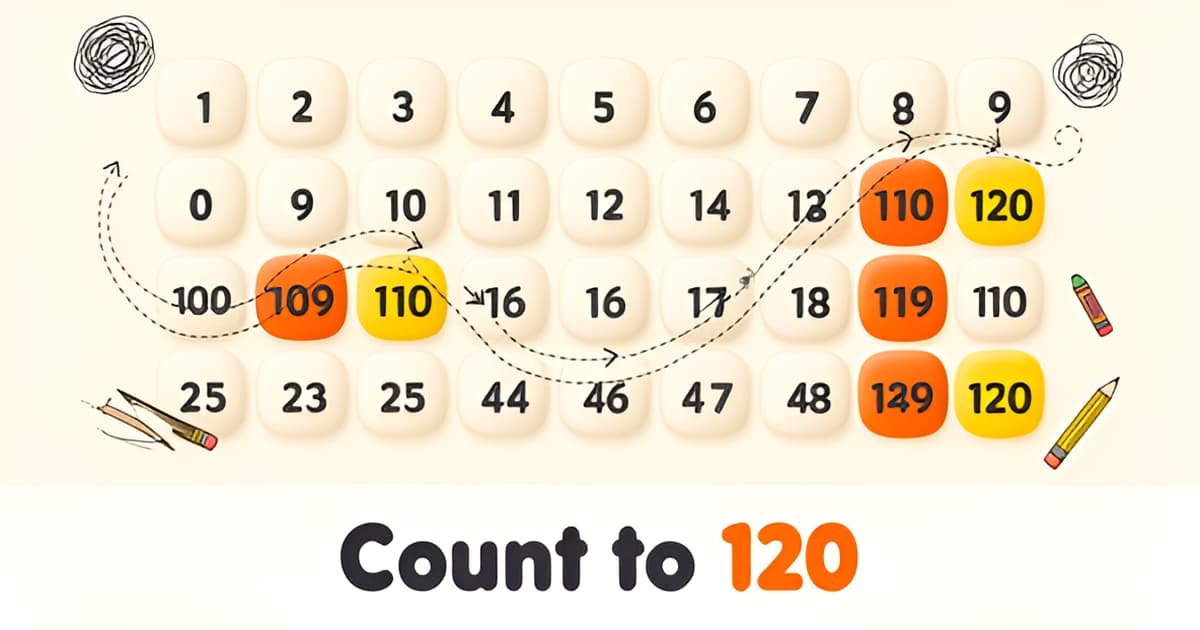
How do you count by ones to 120?
Key Facts
- Counting standards extend to 120 instead of 100 because crossing the century boundary forces children to confront place value patterns head-on.
- Most counting errors happen in the 100-to-120 range, which is why a tracing track for those numerals belongs on every strong worksheet.
- MagiCore's founder Julie taught grades 2-5 in Florida and Rhode Island for 10 years before creating her own standards-aligned resources according to her site.
- A first-grade teacher reports quality resources "not only saved me time but also enhanced the quality of my lessons" per teacher testimonials.
- One-minute fluency checks recording each student's furthest accurate count can generate grouping data in minutes.
- New Printoodle accounts get 10 free credits after email verification, and reprints from your library stay free forever.
- Short, frequent, varied counting practice beats one long session, with a class checklist showing growth students can see.
Why Counting to 120 Matters for Young Learners
If you've ever watched a first grader confidently sail from 1 to 100 and then stall at 109, you've witnessed the exact moment where counting instruction earns its keep. The question "how do you count by ones to 120" sounds simple, but the answer shapes how a child understands our entire number system.
Early elementary standards ask students to count to 120 rather than the traditional 100 for a reason: crossing that first-century boundary forces children to confront place value patterns head-on. When a child says "one hundred nine, one hundred ten," they're proving they understand that the pattern restarts and builds, rather than simply memorizing a fixed sequence that ends at 100.
This is also where counting becomes reasoning instead of recitation. Students start noticing that the "teen" pattern they mastered at 13 and 14 reappears, in modified form, at 113 and 114. That observation is the seed of everything that follows in elementary math.
Effective practice doesn't just drill the sequence. It builds understanding through several complementary experiences:
- Oral counting with a partner, so children hear and produce the tricky crossover numbers
- Written sequences with missing numbers, which reveal whether a child truly knows what comes after 109
- Counting real objects grouped in tens, connecting the spoken sequence to quantity
- Number chart work that makes the place value pattern visible across rows
Teachers who create their own materials often see the best results, a point echoed by educators like MagiCore's founder Julie, who spent ten years teaching second through fifth grade and began building her own standards-aligned resources when existing ones didn't fit her students. The same principle applies to counting worksheets: a page tailored to where your learners actually are, with the right numbers missing in the right places, outperforms a generic sheet every time.
That's why tools that let you generate practice pages matter. With Printoodle, you can build a step-by-step counting worksheet that walks children through the sequence to 120 in stages, and everything you create stays in your library for free reprints year after year. The same platform handles your other practice needs too, from its word search maker for vocabulary review to a printable word search for seasonal themes.
Counting to 120 is a milestone, not a chore. A child who owns that sequence walks into second grade ready for place value, comparison, and early addition. Print it. Doodle it. Done.
Building a Step-by-Step Counting Routine
Starting with numbers is one of the first milestones in early math, but guiding students from single digits into the triple digits requires a careful progression. Counting by ones to 120 builds number sense and prepares learners for place value concepts, yet the journey from 0 to 120 is not always smooth. Educators know that the transition across decades, particularly the tricky jump from 99 to 100, often causes stumbles that require targeted practice.
A logical counting routine typically moves through distinct bands. Beginning with 0 through 20 helps students solidify the foundational sequence and recognize numeral formation. Moving into the twenties, thirties, and beyond reinforces the pattern of tens and ones. As students approach the nineties, the structure remains consistent, but the crossing of the century mark introduces a new layer of complexity. Navigating the "decade transition" is where many learners need extra support to maintain the correct order.
To bridge these gaps, a step-by-step counting worksheet can provide the structured repetition necessary for mastery. Printoodle’s worksheet generator allows teachers and parents to create customized practice pages that target specific ranges, whether focusing on 0-20 or extending all the way to 100-120. These printable resources can be tailored to address the exact hurdles students face, offering a tangible way to reinforce the sequence. Using a tool like the word search maker or exploring a printable word search can also integrate counting practice into engaging, themed activities that keep young learners motivated.
Building confidence in counting sets the stage for all future math success. By breaking the task into manageable chunks and providing consistent practice, educators can help students cross every decade with ease. Print it. Doodle it. Done.
Designing Printable Counting Worksheets with Printoodle
Once your students can recite the sequence aloud, the fastest way to reinforce it is with a worksheet they can actually put a pencil to. If you've been asking how do you count by ones to 120 in a way that sticks, a printable practice page turns that spoken skill into written evidence you can review, grade, and send home.
Printoodle's worksheet generator takes the burden off your design skills. You describe the activity in plain language, something like "fill in the missing numbers counting by ones to 120," and the tool builds a clean, print-ready PDF in seconds. The default is Letter size with an A4 toggle, so it works whether your school printer is in the US or abroad.
The customization options matter more than you might expect. A plain grid of numbers is fine, but a page themed around dinosaurs, ocean animals, or the season keeps first graders engaged longer. Teachers consistently report that well-designed, standards-aligned materials hold attention in ways generic photocopies don't. One educator told MagiCore Learning that quality resources "not only saved me time but also enhanced the quality of my lessons, keeping students engaged and improving their understanding," and that principle applies just as strongly to a counting page as to any other subject.
Here's what a strong counting-to-120 worksheet typically includes:
- A partially completed 120 chart with strategic blanks to fill in
- Number sequences with missing terms, such as 47, 48, __, 50
- A tracing or writing track for numerals 100 to 120, where most errors happen
- A short challenge row that starts mid-sequence instead of at 1
Every page you generate lives in your Printoodle library, and reprints are always free. That's useful when half the class needs a second attempt, or when you want the same worksheet with a different theme for a substitute teacher. If you're building out a broader math station, you can pair the counting page with a puzzle from the word search maker using number words, or grab a ready-made printable word search for early finishers.
You don't need credits to try it. New accounts get 10 free credits after email verification, and each content page carries a free sample so you can test a counting worksheet before spending anything. Print it. Doodle it. Done.
Tips for Reinforcing Counting Skills in the Classroom
A worksheet is only the starting line. Fluency with counting to 120 comes from repetition in lots of different formats, and the classroom offers more opportunities to practice than most teachers realize.
If you're asking how do you count by ones to 120 in a way that builds lasting fluency, the answer is routine: short, frequent, varied practice beats one long session every time. Teachers who build counting into transitions, lining up, and calendar time see the skill transfer to worksheets and assessments much faster. One first-grade teacher notes that well-chosen resources don't just save prep time; they keep students engaged and improve understanding across lessons.
Start with a large classroom number line from 0 to 120. Have students physically hop forward by ones, then call out "count on from 47" so they practice starting at numbers other than 1. That bridge decade numbers, where most errors happen.
Choral counting is another low-prep win. Count aloud together as a class, then stop at a random point and ask, "What comes next?" Mix in whisper counting (loud on multiples of ten, quiet otherwise) to keep attention high. A second-grade teacher reports that a consistent daily routine has been the single best thing in her classroom, with students improving every day.
Quick-check assessments tell you who needs more support before gaps widen:
- Start-and-stop counting: ask students to begin at 68 and count to 83 while you note where they hesitate.
- Fill-in-the-blank strips with missing numbers in a sequence, refreshed weekly.
- Partner counting, where one student counts and the other checks and coaches.
- One-minute fluency checks, recording how far each student counts by ones accurately.
Keep the data simple. A class checklist showing each student's furthest accurate count gives you grouping information in minutes, and it shows growth over time in a way students can see too.
Variety matters as much as frequency. Rotate between number lines, hundred charts, counting collections, and printable practice pages so students encounter the sequence in different contexts. Generating a step-by-step counting worksheet up to 120 with Printoodle takes seconds, and because reprints are always free, you can refresh the numbers each week without touching your credit balance. If you want a fun wrap-up activity, a counting-themed puzzle built with the word search maker or a printable word search featuring number words keeps the vocabulary side of counting in play.
Fluency doesn't come from any single tool. It comes from a teacher who counts constantly, checks quickly, and makes the number path to 120 feel familiar long before the test asks for it.
Frequently Asked Questions
Why do first graders need to count to 120 instead of just 100?
Where do kids usually get stuck when counting by ones to 120?
What does a good counting-to-120 practice routine look like?
What should a counting-to-120 worksheet include?
How can I check whether my students actually know the sequence past 100?
Can I make my own counting worksheets instead of buying them?
From 109 to 120: Where Counting Becomes Confidence
The answer to how do you count by ones to 120 turns out to be less about reciting a sequence and more about building a habit: short, varied practice across oral counting, number lines, charts, and pencil-to-paper worksheets, with extra attention on the tricky crossover past 100. When you break the journey into bands, check fluency with quick start-and-stop counts, and refresh practice pages weekly, students cross every decade bridge with confidence instead of stalling at 109. That's where Printoodle fits in naturally, describe the worksheet you need, generate a step-by-step counting page in seconds, and keep it in your library with free reprints whenever a student needs a second attempt. Pair it with a themed word search maker puzzle or a printable word search for early finishers, and your counting station stays fresh all year. Your next step is simple: pick the range where your learners actually stumble, generate a practice page, and try it this week. Print it. Doodle it. Done.