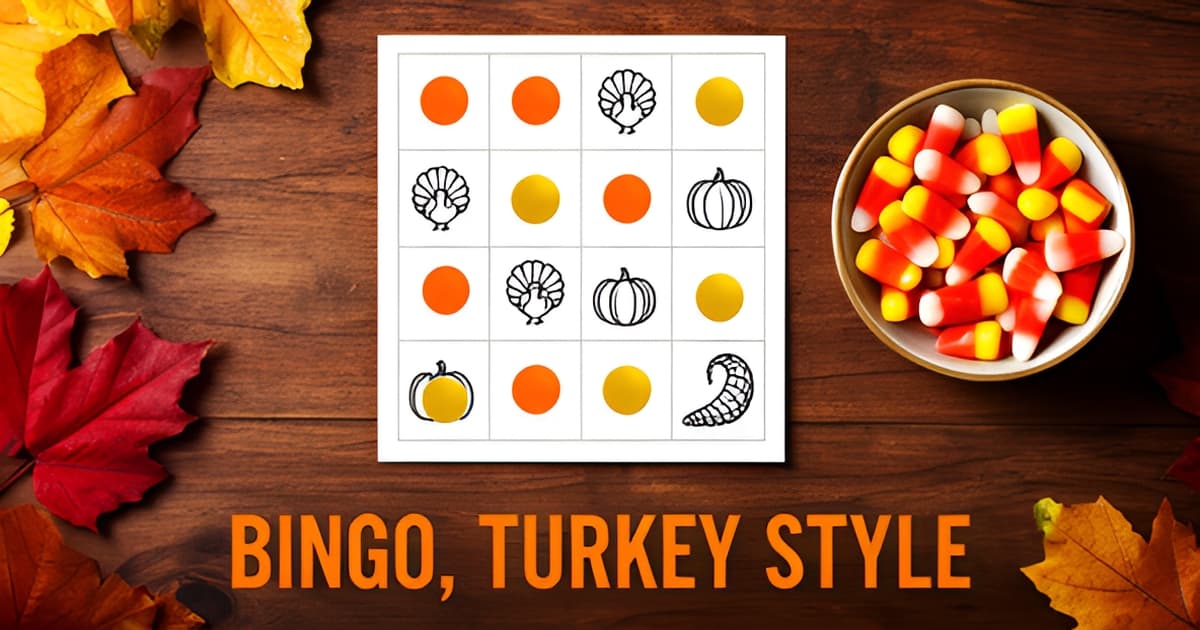
How do you play Thanksgiving bingo?
Key Facts
- A standard 5x5 bingo card can generate over 15 septillion unique cards, 15,511,210,043,330,985,984,000,000, according to Bingo Baker.
- Free printable Thanksgiving bingo sets cap at just 8 boards from Crazy Little Projects, which suggests splitting larger groups.
- The Best Ideas for Kids tops out at 30 unique cards, pushing players toward line wins instead of blackout.
- Play Party Plan's set uses just 30 unique images versus 75 numbers in traditional bingo, calling blackout 'not ideal' for its 20-card set.
- Thanksgiving bingo swaps numbers for holiday images, with the center free space counting toward any winning line.
- Experts recommend removing squares about politics, religion, or difficult memories, per Bingo Card Creator's guidelines, for mixed-age family play.
- Remote relatives can join Thanksgiving bingo via shared card links, according to myfreebingocards.com, with a built-in virtual caller.
The Thanksgiving Bingo Problem: Too Many Guests, Too Few Cards
Anyone who's hosted Thanksgiving knows the real challenge isn't the turkey. It's keeping a room full of grandparents, teenagers, and sugar-fueled six-year-olds happily occupied at the same time, which is exactly why so many hosts reach for Thanksgiving bingo in the first place.
If you're wondering how do you play thanksgiving bingo with a crowd that big, the printable route quickly hits a wall. The popular free downloads cap out fast. Crazy Little Projects offers just 8 boards and suggests splitting larger groups, Play Party Plan provides 20 unique cards, and The Best Ideas for Kids tops out at 30 unique cards. Once your headcount passes those numbers, duplicates appear and the game's integrity collapses along with the fun.
The card limits also force compromises on how you actually play. With only 30 unique images in play, Play Party Plan flatly calls blackout "not ideal" and recommends alternative patterns like four corners or an X instead. The Best Ideas for Kids steers players toward line wins for the same reason. So even before you deal the first card, fixed printables have quietly decided your winning conditions for you.
Here's what those compromises typically look like in practice:
- Splitting the family into smaller groups, which fragments the one moment everyone could share together
- Skipping blackout play because the card pool can't support it
- Handing out duplicate boards, which means two cousins win simultaneously and arguments follow
- Rationing cards while late arrivals watch from the couch
The math behind the game makes the stakes clear. A standard 5x5 card layout can generate a staggering 15,511,210,043,330,985,984,000,000 unique cards, according to Bingo Baker's capability figures. Fixed printables use a sliver of that potential. An instant generator uses as much of it as your guest list requires.
That's the fix. With Printoodle's thanksgiving bingo cards generator, you produce exactly as many unique, print-ready boards as you have seats at the table, generated in seconds rather than hunted down across five different blogs. No group splitting, no pattern restrictions, no duplicates. You can run five-in-a-row for the kids and a full blackout round for the competitive adults, all from the same session.
And bingo doesn't have to carry the whole afternoon. Pair it with a thanksgiving maze for kids who finish early, or a thanksgiving trivia round for the table while pie is being cut. Print it, doodle it, done.
How Do You Play Thanksgiving Bingo: The Rules Explained
Thanksgiving bingo swaps the traditional number grid for a 5x5 card filled with holiday-themed images. Players receive one card each, and a caller draws items, whether words, pictures, or observed moments, from a stack or digital list. The goal is to mark five squares in a row, column, or diagonal. The center square is a free space, meaning it counts toward any line passing through it, which speeds up gameplay and adds a strategic advantage.
Winning patterns go beyond the standard line. Some groups go for the four corners, an X, a T-shape, or a postage stamp (a 2x2 block in any corner). For larger gatherings, a blackout, covering every square on the card, is a common finish, though sources note it works best with smaller groups due to the time required. With only 8 to 30 unique cards typically provided in free printables, line play is often recommended to keep the game moving, especially when card pools are limited.
Printoodle generates themed bingo cards instantly through its web app, letting users customize titles, backgrounds, and content before downloading print-ready PDFs. The platform supports groups of any size by producing unlimited unique cards, unlike fixed printable offerings that cap at 30. Whether played in person or shared via link for remote guests, the setup is straightforward: print one card per player, prepare markers like candy or small items, and let the caller keep the game flowing. Guests can join virtually by receiving cards via email or link, making it a flexible addition to any holiday gathering.
thanksgiving bingo cards thanksgiving maze thanksgiving trivia
Choosing Your Format and Keeping It Family-Friendly
Part of learning how do you play Thanksgiving bingo is deciding when it happens, because the format you pick shapes the whole game. There are two main styles, and each fits a different part of the day.
Called rounds work like classic bingo: a designated caller draws items, and players mark matching pictures on their cards. The goal is five marked spaces in a row, vertical, horizontal, or diagonal, with the center free space counting toward any line through it. This format shines in a defined slot, like while guests arrive or right after the meal, so it gets a proper window without competing with the turkey carving. If you're playing with a small deck, keep in mind that free printables vary widely: one popular set offers just 8 boards, with a suggestion to split larger groups into teams, while another provides 30 unique cards and recommends playing for lines rather than a full-card blackout.
Observation cards flip the dynamic. Instead of waiting for a caller, players mark squares as they spot real moments around the house: someone dozing on the couch, a kid sneaking a second dessert, the dog begging at the table. Play runs from arrival until an agreed end time, which keeps the game humming in the background without hijacking anyone's attention. Either way, timing matters: avoid disrupting cooking, serving, cleanup, or childcare, and pick a window that lets the host actually enjoy their own party.
Whatever format you choose, spend a few minutes reviewing every square against your actual guest list. Some bingo boards floating around online lean on edgy jokes like "drunk grandmas" or "angry politics," which might get a laugh at an adults-only table but can land badly with mixed ages. A good rule of thumb for a family gathering:
- Skip squares about politics, religion, money, or difficult memories
- Remove prompts that assume a particular meal, household role, or family structure
- Let anyone pass on a square without explaining why
- Lean instead on favorite foods, seasonal activities, and classic imagery like pumpkins and turkeys
When you build your own set with thanksgiving bingo cards, that filtering happens before you ever hit print, so every square is something you'd be happy reading aloud to a seven-year-old and a grandmother at the same table. It's the same spirit behind the rest of the holiday lineup, from a thanksgiving maze for the kids' table to a round of thanksgiving trivia between dinner and dessert.
Print it. Doodle it. Done.
Generating Your Thanksgiving Bingo Cards Instantly with Printoodle
Thanksgiving bingo swaps traditional numbers for holiday imagery, turkeys, pumpkins, and autumn leaves, so players mark matching squares as a caller draws from a themed deck. The center space is typically "free," counting toward any line that passes through it. To win, players aim for five marked spaces in a row, vertically, horizontally, or diagonally, though some variations favor full-card completion or alternative patterns like four corners or an X. According to Play Party Plan, blackout (filling every square) is "not ideal" with standard card sets, making line-based wins the more practical goal for most gatherings.
The number of cards in play directly affects how the game feels. The Best Ideas for Kids provides 30 unique cards, which shifts the strategy toward line play since the 30-card pool makes full-card coverage unlikely. Crazy Little Projects offers only 8 boards, suggesting hosts divide larger guest lists into smaller groups to keep the game moving. Play Party Plan sits in the middle with 20 unique cards across 30 distinct images, recommending alternative patterns as viable winning conditions. Printoodle’s instant generation capability solves this variability entirely, hosts can produce as many unique cards as needed for their specific guest count, then download a single PDF containing a complete calling list alongside the player cards.
Setting up the game is straightforward: print one card per player plus a few extra copies of the calling sheet for the host. Markers can be anything small and festive, candy corn, dried beans, or themed erasers work well. For remote relatives joining via video call, shared PDFs are the simplest solution. The host can email or text the download link, or display the calling list on screen while players mark their own printed or digital copies. Because Printoodle outputs print-ready PDFs in Letter or A4 format, the cards look consistent whether held in hand or viewed on a tablet, making it easy to include everyone from the kitchen table to the living room couch.
The themed content itself benefits from a light touch. Bingo Card Creator’s guidance suggests replacing squares about politics, religion, or difficult memories with safer topics like favorite seasonal activities, favorite foods, or classic Thanksgiving films. This keeps the game inclusive for mixed-age groups and diverse family dynamics. Printoodle’s web app lets users customize titles and backgrounds to match the holiday mood while maintaining that family-friendly default, ensuring the final PDF feels festive without crossing into sensitive territory.
Print it. Doodle it. Done.
Round Out the Day: More Printable Thanksgiving Activities
A great bingo game only fills one slice of Thanksgiving Day, and the kids who finish first will let you know it. The fix is simple: keep a couple of backup activities printed and ready before anyone asks. And since you've already learned how do you play Thanksgiving bingo, the rest of the day slots right into place.
Start with the early finishers. While the bingo round wraps up, hand slower-paced games to the kids who are already bouncing off the walls with a thanksgiving maze. A maze needs no caller, no rules explanation, and no supervision, which makes it the ideal quiet-table activity while the turkey finishes resting. It also buys you twenty minutes of calm, which any host will tell you is worth its weight in gravy.
After dinner, when everyone is too full to move but not ready to leave the table, shift gears to thanksgiving trivia. Trivia works for mixed-age groups in a way most games don't, because everyone from grandparents to eight-year-olds gets a question they can answer. It's a natural fit for that post-meal window when the dishes can wait and the conversation needs a gentle push.
If you're planning the whole day, here's how the pieces fit together:
- Arrival and pre-meal: a few rounds of thanksgiving bingo cards to break the ice while appetizers circulate.
- Between rounds: mazes for early finishers so nobody drifts toward the TV.
- After dinner: trivia at the table, where full bellies and comfy chairs keep everyone in one place.
The math matters more than you might think. Free printable sets vary widely in how many players they support: Crazy Little Projects offers just 8 boards and suggests splitting into groups for bigger crowds, while The Best Ideas for Kids includes 30 unique cards. If your guest list sits somewhere in between, generating your own set means you never have to turn a cousin away from the table.
The best part is that nothing here is a one-and-done download. Everything you create in Printoodle lives in your library, and reprints are always free. So next November, when someone asks how do you play Thanksgiving bingo again, your cards, mazes, and trivia decks are exactly where you left them. Print it. Doodle it. Done.
Frequently Asked Questions
How many unique Thanksgiving bingo cards do I need for my guest list?
What are the official rules for playing Thanksgiving bingo?
Can I play Thanksgiving bingo with a large group without duplicates?
What winning patterns are possible in Thanksgiving bingo?
How can I make Thanksgiving bingo inclusive for all ages?
Can Thanksgiving bingo work for remote or virtual guests?
Your Table, Your Rules, Your Bingo
So, how do you play Thanksgiving bingo? The same way you host a great holiday: with a little planning and room for everyone. The rules are simple, holiday-themed squares, a caller, five in a row, and a free center space, but the real work happens before the first card is dealt. Free printables cap out between 8 and 30 boards, forcing you to split groups, skip blackout rounds, or hand out duplicates. Since a standard 5x5 grid can generate over 15 septillion unique cards, according to Bingo Baker's capability figures, there's no reason your guest list should ever outgrow your card pool. Pick your format, screen every square for mixed ages, and time the game around the meal, not through it. When you're ready, generate exactly as many unique thanksgiving bingo cards as you have chairs, then round out the day with a thanksgiving maze and a thanksgiving trivia round. Print it. Doodle it. Done.