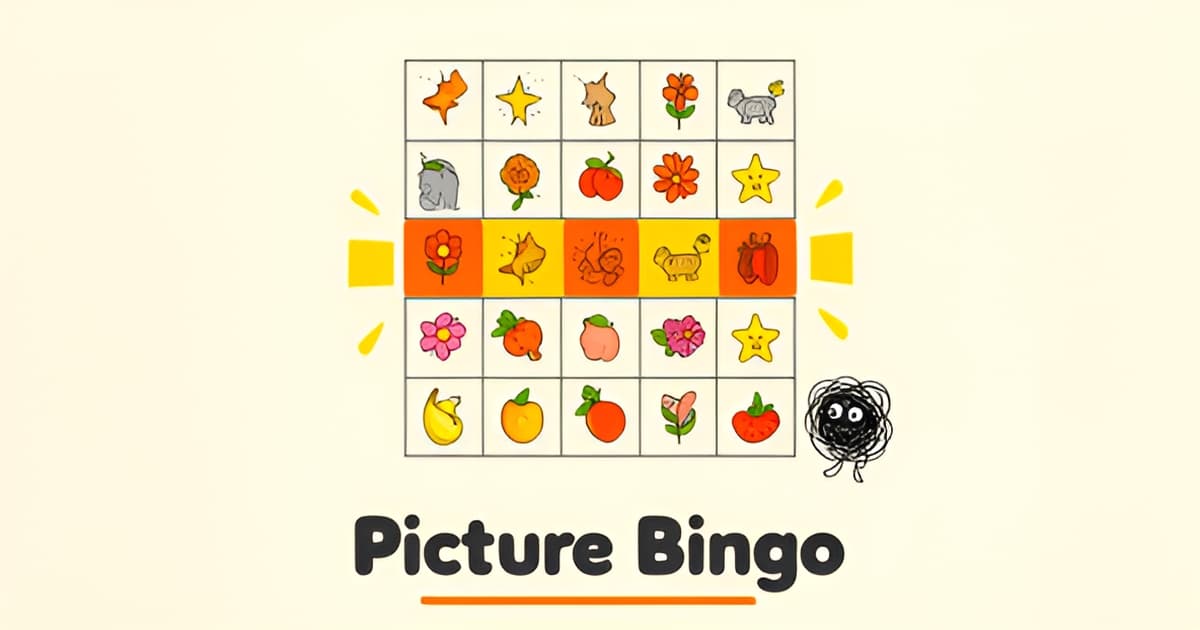
How does bingo work with images?
Key Facts
- A 5×5 bingo card can generate over 15 septillion unique card combinations, according to bingo generator tools.
- Picture bingo dates back to 19th-century Germany, where a lotto-style game taught children spelling, animal names, and multiplication tables, as Wikipedia documents.
- A small 3×3 bingo grid still produces 362,880 unique card arrangements, per Bingo Baker.
- Bingo organizers rotate through 3–5 winning patterns per session, saving the hardest, Coverall, for a late jackpot round, Bingo Innovation recommends.
- TikTok's early 2025 "vision board bingo" trend replaces numbers with personal goals, with players photographing each finished goal "so it's actually a picture of success", Pedestrian.tv reported.
- Quick wins like Four Corners and Postage Stamp require just 4 marked squares, while Coverall needs every square on the card, according to Bingo Innovation.
- Designers recommend adding a text shadow to labels so they pop against background images instead of melting into them, per Bingo Baker's design tips.
Why Number Bingo Falls Flat (and What Image Bingo Fixes)
If you've ever tried to run a bingo game for a classroom, a birthday party, or a family game night, you've probably hit the same wall: the numbers don't fit the room. Traditional 75-number bingo works at a bingo hall, but it does almost nothing for a five-year-old learning sight words or a baby shower crowd. And if you've tried to fix that by hand-drawing picture cards, you know the real cost: hours of sketching, photocopying, and hoping nobody notices the lopsided dinosaur.
That's why so many people ask how does bingo work with images, and the answer is more reassuring than you might expect. Picture bingo isn't a gimmick invented last year. Wikipedia documents it as a standard educational variant where "the numbers are replaced with beginning reader words, pictures, or unsolved math problems." The mechanic goes back even further: a lotto-style game was widely played in 19th-century Germany to teach children spelling, animal names, and multiplication tables.
The core rules stay the same. Players get a randomized grid, a caller announces items, and everyone marks squares until someone completes a line, corners, or a full card. What changes is the content. Instead of abstract digits, each square carries something your players actually recognize: vocabulary pictures for ESL learners, animals for a preschool unit, or the guest of honor's face at a bridal shower.
The payoff shows up in a few concrete ways:
- Pre-readers can play, because a picture square doesn't require knowing numerals or letters.
- The game doubles as a teaching tool, the exact use case Wikipedia highlights for classrooms and ESL instruction.
- Themes become trivially easy: one set of uploaded images turns the same mechanic into holiday bingo, reading bingo, or a birthday kit.
You don't lose the math that makes bingo fair, either. A standard 5×5 card can produce over 15 septillion unique combinations, so every player still gets a genuinely different card, as bingo generator tools note. The randomization just works on images instead of numbers.
The remaining friction is production. Hand-drawing 30 picture cards for one classroom is a weekend project, and that's where generators earn their keep. Printoodle's bingo card generator lets you upload your own images, drop them into randomized grids, and download print-ready PDFs with a matching call sheet, so the game is actually playable straight off the printer. Teachers building a reading bingo set from their own lesson vocabulary get the same shortcut.
Picture bingo is a proven teaching mechanic with nearly two centuries of classroom history behind it. The only hard part was making the cards, and that part is now solved. Upload your images, print, and play. Print it. Doodle it. Done.
How Does Bingo Work With Images? The Core Mechanics, Explained
So how does bingo work with images? The rules stay almost identical to classic bingo; pictures simply replace the numbers. Each player gets a randomized grid where every square holds an image, a word, or both, and a caller presents items one at a time. Players mark the matching square on their card, and the first to complete a winning pattern calls out.
The grid itself comes in a few standard sizes. The traditional American card is a 5×5 grid of 25 squares with a free center space, but image bingo works just as well on 4×4 and 3×3 grids, which are popular with younger players and shorter games. According to Wikipedia's overview of American bingo, wins occur when marked squares form a horizontal, vertical, or diagonal line, and the caller verifies each win before the game continues.
Winning patterns go well beyond straight lines, too:
- Four Corners or a Postage Stamp, which require just 4 marked squares
- Picture frame, where players mark the entire outer border
- Blackout, also called coverall, which requires every square except the free space
- "Crazy" versions of any pattern, where the shape counts in any rotation and completes faster
Experienced organizers often rotate through 3–5 patterns per session and save the hardest, like coverall, for a late jackpot round, a structure that Bingo Innovation recommends for keeping games fresh.
One mechanic sets image bingo apart: the flipped square. A square can carry a word on the front, say "Bear," while a picture of a bear sits on its back. During play, that image appears on the call list, and players must find the matching word on their card. It's a simple twist that turns picture bingo into a vocabulary or matching game, which is why it's long been a classroom staple. Educational bingo dates back to 19th-century Germany, where a lotto-style game taught children spelling, animal names, and the multiplication table, and picture-based versions remain a recognized instructional tool in schools and ESL teaching today.
Fairness comes down to randomization. Each player needs a different card arrangement, and the math backs this up: a 5×5 grid can produce over 10²⁵ unique cards, while a 3×3 grid yields 362,880. With that many possible arrangements, two players rarely hold matching cards, so everyone competes on equal footing.
This is where a good bingo card generator earns its keep. Printoodle lets you upload your own images into the squares, then generates randomized, print-ready cards along with a matching call sheet, so a baby shower game or a set of reading bingo cards for your classroom takes seconds rather than an afternoon of cutting and pasting. Print it. Doodle it. Done.
Designing Image Bingo Cards That Actually Look Good
A beautiful bingo card isn't just decoration. When you're asking how does bingo work with images in practice, design choices determine whether players instantly recognize a square or squint at it for ten seconds.
The most common mistake is treating an image and its label as separate problems. The best cards combine both in the same square, and tools that support drag-and-drop image squares recommend two specific fixes when text sits on top of a photo. First, add a text shadow so the label pops against the background instead of melting into it. Second, adjust the vertical alignment so the label doesn't cover the part of the image that actually identifies the item. A caption sitting over a puppy's face defeats the purpose of using the photo at all.
Grid size matters just as much as square design, and it should match your audience:
- 3×3 for young kids: nine squares means faster wins and shorter attention demands, and a 3×3 card still yields 362,880 unique combinations, so no two cards match.
- 4×4 as a middle ground: good for mixed-age family games where you want more variety without much extra difficulty.
- 5×5 for parties and classrooms: the classic 25-square grid keeps a room of twenty players engaged, and the math backs it up, since a 5×5 card can generate over 15 septillion unique cards.
Whichever grid you choose, think about the win condition at the same time. A straight line takes five marks, or four if it runs through a free space, while a coverall needs nearly every square on the card. That's the difference between a game that ends before the cake is cut and one that outlasts the party.
One piece many DIY sets forget: the call sheet. A bingo game needs a caller, and the caller needs something to call from. If your printable set is just a stack of cards, someone has to improvise a call list, and with image bingo that means describing pictures from memory. Every set you generate should include a matching call sheet with the same images, so the game is playable straight from the PDF with no prep.
Printoodle's bingo card generator handles these details for you: upload your images, pick a grid size, and the output includes a coordinated call sheet alongside the cards. It's the same approach that makes a reading bingo set work, where the called word and the square have to line up exactly for the game to function. Print on cardstock, as design guides suggest, and your cards survive multiple rounds of enthusiastic dabbing.
Making Image Bingo With Printoodle's Bingo Card Generator
So you understand how bingo works with images and you're ready to make your own. The good news: once you have your pictures, the generator does the heavy lifting. Picture bingo itself is nothing new. Educational lotto games in 19th-century Germany used images to teach spelling and animal names, and picture bingo remains a standard classroom and ESL tool today, with custom bingo creation programs widely recognized as a way for teachers and parents to build cards from their own content.
With Printoodle's bingo card generator, the process takes a few minutes:
- Pick a theme or upload your own images: pet photos for a birthday kit, vocabulary pictures for a lesson, or photos of the bride-to-be for a bridal shower.
- Choose your grid size. A 5×5 card is the classic, but 4×4 and 3×3 work well for younger kids or shorter games.
- Let the generator randomize the images across the grid so every card comes out different.
- Download a print-ready PDF in Letter or A4, with a matching call sheet so you can actually run the game.
The randomization matters more than it sounds. Even a small 3×3 card produces 362,880 unique arrangements, and a full 5×5 card can generate over 15 quintillion unique cards, so nobody at the table ends up with an identical card.
Different audiences use this differently. Teachers building a lesson can upload images from their own material and create a reading bingo board where the called picture prompts kids to find the matching word, the same flipped mechanic that picture-based educational bingo has used for decades. Party hosts running baby shower bingo can drop in photos of the guest of honor, and guests mark squares as the stories come out. Parents can throw together animal bingo from a handful of pet or wildlife photos on a rainy afternoon.
A few practical tips from people who make these cards regularly. Designers at Bingo Baker recommend using a text shadow so labels pop against background images, and adjusting vertical alignment so text doesn't cover the important part of a picture. If you're printing cards you want to reuse, printing on cardstock is the standard advice. And since Printoodle saves everything you make in your library, reprints are always free: print 10 cards for a classroom or a fresh set when the first ones get crumpled.
Everything defaults to safe-for-kids, with no trademarked characters, so what comes out of the printer is ready to hand straight to a five-year-old. Print it. Doodle it. Done.
Game Ideas and Winning Patterns for Your Next Round
Once you've got your image cards in hand, the real fun begins: choosing how to win. A straight line is only the start. Winning patterns in bingo range from simple shapes like Four Corners and Postage Stamp to the granddaddy of them all, Coverall, where players mark every square on the card except the free space.
If you're hosting a longer session, borrow a page from the pros. Bingo Innovation recommends rotating through 3 to 5 patterns per session and saving the hardest one, usually Coverall, for a late-session jackpot round. This keeps the pace varied and gives everyone something to chase as the night goes on. Quick patterns like Four Corners (just four marked squares) work well early, while longer patterns build suspense toward the finale.
Here are a few winning patterns worth rotating through:
- Four Corners: players mark the four corner squares of their card. Fast, satisfying, and a great opener.
- Postage Stamp: a 2×2 block of marked squares anywhere on the card. Another quick win that keeps energy high.
- Picture Frame: every square along the outer edge of the card must be marked. A solid mid-session challenge.
- Coverall (Blackout): every square on the card gets marked. Save it for the jackpot round.
Pattern play isn't the only creative direction, either. A TikTok trend from early 2025 called vision board bingo replaces numbers entirely with personal goals, with some players adding a photo to each square as they complete it. One commenter described the format as photographing each finished goal "so it's actually a picture of success." The same idea translates beautifully to classroom and party settings: a reading bingo card where each square holds a book cover image, or a baby shower game where guests mark photos instead of words. TikTok creator Kaylen Faye even suggests organizing goal squares into categories like personal growth, health and fitness, and social fun, which works just as well for party themes as it does for New Year's resolutions.
When you're ready to play, tools like a bingo card generator let you upload your own images, generate a randomized set of unique cards, and download a print-ready PDF with a matching call sheet. For literacy-focused games, a reading bingo template pairs book images with reading goals on a 3×3 or 5×5 grid. Print your cards, cut your call list into a hat, and you're set.
Print it. Doodle it. Done.
Frequently Asked Questions
How does bingo work with images instead of numbers?
Is picture bingo actually a real thing, or just a gimmick?
What grid size should I use for picture bingo with kids?
What are the best winning patterns to use in an image bingo game?
How do I make picture bingo cards without drawing everything by hand?
Can image bingo work as a vocabulary or reading game?
How do I keep text labels readable on top of photos in bingo squares?
Your First Image Bingo Card Is Minutes Away
So, how does bingo work with images? Simple: pictures replace numbers, the rules stay the same, and suddenly the game fits any room, a preschool classroom, a baby shower, or a rainy Saturday at home. You've seen that the mechanic has nearly two centuries of history, that grid size and winning patterns shape the pace of play, and that small design choices like text shadows and a matching call sheet make the difference between a game that runs itself and one that stalls. The randomization math holds up no matter what's in the squares, a 5×5 card can produce over 15 septillion unique combinations, so fairness never has to be your worry. The only thing left is making the cards, and that's the part Printoodle handles: upload your images, pick a grid, and download a print-ready PDF with cards and call sheet in one go. Teachers can build a reading bingo set from lesson vocabulary; party hosts can drop in photos of the guest of honor. Start with the free tier, ten credits, no cost, and see what comes off your printer. Print it. Doodle it. Done.