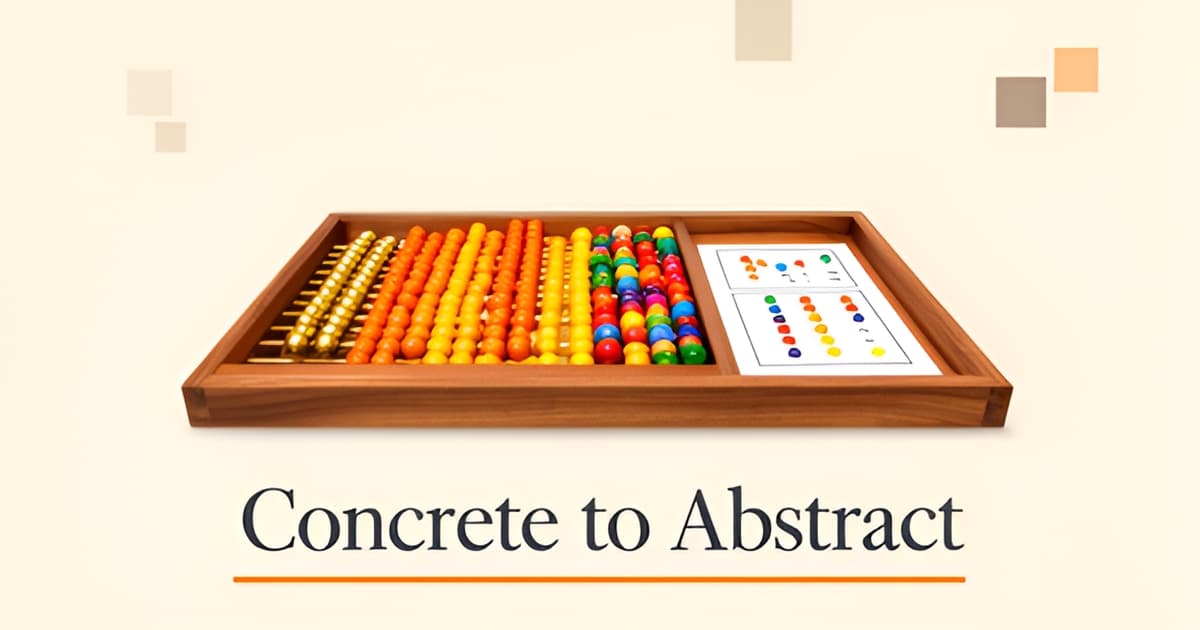
How does Montessori teach addition?
Key Facts
- Montessori students score about a quarter of a standard deviation higher in math than traditional-education peers, per a meta-analysis of 32 rigorous studies (g=0.22).
- A randomized trial found Montessori 3-6 year olds showed no kindergarten math edge, yet outperformed peers in 5th-grade problem-solving by 5th grade (d=0.58).
- Montessori teaches addition through 7 core materials for ages 3-6, moving from bead stairs to the Bank Game, following a defined concrete-to-abstract sequence.
- In the Addition Snake Game, children exchange bead combinations for a golden 10-bar every time they reach ten, making 'ways to make 10' second nature.
- Montessori teaches fact families together, 4+3=7, 3+4=7, 7-4=3, 7-3=4, showing addition and subtraction as interconnected relationships.
- Montessori prioritizes manipulation over memorization, so children handle physical quantities before ever writing an abstract equation, according to Montessori math guides.
- Montessori education is used in over 550 public and 3,000 private US schools, making it the world's most widely implemented alternative education.
Why Flashcards and Rote Memorization Backfire in Early Addition
Every parent and teacher knows this moment: a child rattles off "7 plus 8 equals 15" on command, then stares blankly when asked to show it with counters. The recitation is there. The understanding isn't. If you've wondered why that gap keeps appearing, the answer lies in how the facts were taught in the first place, and it gets to the heart of how does Montessori teach addition differently.
Montessori classrooms draw a hard line between manipulation and memorization. Children learn the same addition skills taught in traditional settings, but Montessori math instruction uses manipulation of physical materials first, with memorization reserved for after hands-on operations are mastered. A child working with bead bars physically puts two quantities together and sees the combined amount before ever writing an equation. The abstract symbol comes last, as evidence of understanding rather than a substitute for it.
Traditional instruction often runs this sequence in reverse. Facts get memorized through flashcards and repeated drills before the child has built a mental model of what addition actually means. The result is exactly the frustration you're seeing: correct answers with no ability to explain, model, or extend them. That shaky foundation tends to surface later, when problems get harder and recitation alone can't carry the weight.
The evidence suggests the concrete-first approach pays off in ways that aren't always visible right away. A meta-analysis of 32 rigorous studies found Montessori students performed about a quarter of a standard deviation better than peers in traditional education on math outcomes (g=0.22), with researchers rating that evidence as high quality. More striking is what a randomized controlled trial on early math learning found over time: children who used an adapted Montessori curriculum at ages 3 to 6 showed no advantage in kindergarten, yet by 5th grade they significantly outperformed peers on math problem-solving, with an effect size of d=0.58. Researchers call this a "sleeper effect." The benefit was quietly building the whole time.
So what does this mean for the worksheets and practice pages you use at home or in the classroom? The same principle applies on paper. A worksheet covered in bare equations asks a child to retrieve memorized facts with nothing to fall back on. Practice that mirrors the Montessori sequence gives the child something sturdier:
- Problems that show quantities visually, so the child can see the two groups coming together
- Color-coded bead bar patterns that match the materials used in Montessori classrooms
- "Ways to make 10" exercises, the same combinations children build with the Addition Snake Game
- Fact families presented together, so 4+3=7 sits alongside 7-4=3 and the relationship becomes visible
This is the thinking behind the printable addition worksheets on Printoodle. Each page follows the concrete-to-abstract progression, using color-coded quantity representations and fact family groupings so that paper practice reinforces the hands-on work rather than replacing it. When a child can trace an abstract equation back to quantities they've actually handled, memorization stops being a party trick and becomes the natural endpoint of real understanding.
The Montessori Addition Sequence: From Beads in Hands to Numbers on Paper
Ask a Montessori guide how they teach a five-year-old to add, and they won't hand you a stack of flashcards. They'll hand you beads. That's because how Montessori teaches addition rests on one core principle: children manipulate real quantities first, and abstract symbols come only after their hands have done the thinking.
Montessori addition for ages 3–6 follows a defined sequence, moving from physical quantity work with the bead stair and number rods, through memorization tools like the strip board, and finally into place value with the bank game and stamp game. Practitioners identify seven core addition materials for this age range, each one building on the last, as described by Arborland Montessori Academy.
It starts with the Short Bead Stair and Number Rods, which help children physically count and internalize that addition means putting two quantities together. Then comes the Addition Snake Game, where children count beads from left to right and exchange them for a golden 10-bead bar every time they reach a sum of ten. This is where "ways to make 10" becomes second nature, a strategy that recurs across nearly every material in the sequence, according to Montessori educators who use bead bars daily.
The abstract ideas that trip up many children in traditional classrooms get concrete grounding here:
- Commutative property: 6+7=13 and 7+6=13, shown by simply flipping the same two bead bars.
- Associative property: (3+5)+7 becomes 8+7=15, felt by regrouping actual beads.
- Fact families: 4+3=7, 3+4=7, 7-4=3, 7-3=4, all demonstrated with the same physical set.
- Regrouping: counting only up to ten, then laying a 10-bar beneath the addends introduces carrying, per the Montessori Album lesson wiki.
The Addition Strip Board then reinforces these essential combinations through memorization, and the Bank Game and Stamp Game give children a sensorial impression of combining quantities into larger ones, introducing place value. Manipulation, not memorization, drives every step, as Montessori guides explain.
The payoff shows up in the data. A randomized controlled trial found children who received Montessori curriculum at ages 3–6 outperformed peers on math problem-solving in 5th grade with an effect size of d = 0.58, even though the advantage wasn't measurable at the end of kindergarten.
If you're supporting this progression at home, printable addition worksheets can bridge the gap between beads and pencil, as long as they mirror the same sequence: quantity pictures first, color-coded values, fact families together, and abstract equations last. Printoodle's addition worksheets are built so you can follow exactly that order. Print it, doodle it, done.
Bringing the Method Home: Montessori Addition Practice Without a Classroom Budget
Bringing the Montessori addition sequence home doesn’t require a classroom budget or a cupboard full of specialized materials. Research into Montessori math methodology confirms that the core principle is a concrete-to-abstract progression: children first manipulate physical quantities, then connect those quantities to visual symbols, and only later work with abstract equations. For families and educators without access to Golden Beads, this sequence can be replicated using everyday objects and simple DIY adaptations.
The research highlights that “manipulation rather than memorization is used to teach those concepts,” which means the goal is for children to internalize the idea of addition through hands-on experience before they are asked to solve problems on paper. One of the most accessible entry points is counting quantities in daily life, whether it is setting the table, sorting laundry, or measuring ingredients while cooking. These moments allow children to practice adding small groups of objects and verbalizing the total, building the foundational number sense that formal lessons later build upon.
A key strategy emphasized across Montessori sources is exploring “ways to make 10.” The Addition Snake Game, for example, teaches children to count beads from left to right and exchange every time they reach a sum of ten. This “ways to make 10” approach appears across multiple materials, including the Short Bead Stair and the Strip Board, and it supports the development of fact fluency. Parents can recreate this at home by laying out colored buttons, pom-poms, or blocks in groups that add up to ten, encouraging the child to find different combinations that create the same sum.
For a more structured DIY option, the research specifically suggests making a bead frame from a shoebox and colored beads. This simple tool can mirror the color-coding of traditional bead bars: red for one, green for two, and so on. Children can slide beads across the box to represent addition problems, physically moving the quantities together before stating the total. This maintains the tactile, multi-sensory element that research identifies as critical to Montessori math learning, even without the original materials.
Printable worksheets can serve as an effective bridge between these concrete experiences and abstract equations, provided they follow the same progression. Worksheets that begin with visual representations, such as grouped objects or colored bead bar patterns, before transitioning to numeric equations mirror the Montessori sequence and support the child’s move toward abstraction. Printoodle’s addition worksheets are designed with this concrete-to-abstract sequence in mind, offering problems that incorporate color-coded bead bar patterns and “ways to make 10” exercises that align with the method’s core strategies. These worksheets can mirror the bead bar color coding and provide the structured practice needed to move from manipulating physical objects to solving equations independently.
The research also notes that Montessori addition instruction includes fact family relationships, showing how addition and subtraction are interconnected. For example, presenting 4+3=7 alongside 7-4=3 helps the child see the operations as related rather than separate. Worksheets that include these fact family pairs reinforce this interconnected understanding. By starting with familiar objects, building toward visual patterns, and finishing with abstract equations, parents and teachers can support the same developmental path Montessori classrooms follow, without the need for a full set of Golden Beads.
Designing Worksheets That Respect the Method: A Checklist
A page of bare equations like "7 + 5 = ___" might look like math practice, but in a Montessori context it skips everything that makes the learning stick. The method's core principle is that manipulation comes before memorization, so a worksheet that presents abstract symbols with no concrete foundation actually contradicts the approach. Here's how to design practice pages that respect it.
Start with visual quantity. Montessori classrooms move through a deliberate sequence: physical materials first, then visual representations, then abstract equations. Research on how Montessori teaches addition to 3–6 year olds describes this progression from the Short Bead Stair through the Strip Board to the Bank Game, and your worksheet should mirror it. Early pages should show colored bead bars or grouped objects children can count, with the numeral appearing alongside, not instead.
Build in "ways to make 10" exercises. This is central to the Addition Snake Game, where children exchange bead combinations for a golden 10-bar every time they reach ten. A worksheet asking children to find every pair that makes 10, or to circle combinations that "turn golden," directly supports the fact fluency the method develops.
Pair addition with subtraction. Montessori teaches these as interconnected relationships through fact families: 4+3=7, 3+4=7, 7-4=3, 7-3=4. Presenting all four together on one page reinforces the connection instead of treating subtraction as a separate, later skill.
A quick checklist for any Montessori-aligned practice page:
- Visual quantity representation appears before or alongside every bare equation
- Includes "ways to make 10" exercises, not just random sums
- Fact families show addition and subtraction as two views of the same relationship
- Color coding stays consistent for each number value, echoing the bead bar colors
- Sums progress in stages: combinations up to 10 first, then beyond, introducing regrouping visually
That color point matters more than it might seem. The bead bars give children what one educator describes as auditory, tactile, kinesthetic, and visual understanding of number sense, and consistent colors are part of that sensory scaffolding. Keep 1 red, 2 green, and so on across every page in a set.
The payoff is real, and it's long-term. A randomized controlled trial found children taught with Montessori math in early childhood outperformed peers on fifth-grade problem-solving with an effect size of d=0.58, even though the advantage wasn't visible at the end of kindergarten. Fidelity matters: a review of the curriculum notes the math benefit depends on how faithfully the program follows the method's principles.
If you're building pages yourself, Printoodle's addition worksheets generator lets you sequence problems the same way: quantity-rich pages first, fact families next, abstract equations only once the foundation is there. Print it, doodle it, done.
Key Takeaways
{ "title": "From Beads to Equations: Building Math That Sticks", "content": "Montessori teaches addition by putting physical quantities in a child's hands before a pencil ever touches paper. Rather than starting with flashcards and rote memorization, this method moves through a deliberate sequen