How to be the fun teacher?
Key Facts
- ["83% of students say school doesn't give them enough room to be curious EdWeek survey", "44% of K-12 teachers feel burned out 'always' or 'very often' with an average 50-hour workweek Gallup survey data", "Excited teachers report 83% of students are excited to learn vs. 58% for others Gallup's teacher survey", "Students who had a teacher excited about the future were 30x more likely to be engaged Gallup 2014 analysis", "78% of students agree they have a teacher who makes them excited about the future Gallup poll", "93% of teachers say adaptive learning would help increase engagement EdWeek Market Brief survey", "Only 50% of students say school lets them do what they do best Gallup poll"]
The Engagement Problem: Why Students Are Tuning Out
Every teacher who wants to know how to be the fun teacher starts in the same place: a room full of students who'd rather be anywhere else. The data confirms you're not imagining it. According to an EdWeek Market Brief survey, 46% of teachers say student engagement has dropped since 2019, and 83% of students say school doesn't give them enough room to be curious.
The picture from the student side is just as blunt. A 2025 Gallup study found that more than 1 in 3 students learned nothing interesting in the past seven days. That's a third of your class mentally checking out before the bell even rings.
Engagement isn't a nice-to-have. Gallup's research, cited by Instructure, shows it accounts for roughly one-third of the variance in student success, including grades, test scores, GPA, and college enrollment. Engaged students are also about 2.5 times more likely to report excellent achievement than their actively disengaged peers.
So the stakes are real, and they compound:
- Disengaged students fall behind on the measurable stuff: grades, test scores, and long-term outcomes.
- Only 50% of students say school lets them do what they do best, even after recent gains.
- 43% of students still don't feel prepared for the future, despite engagement ticking upward since 2023.
Here's the uncomfortable part. Teachers who are visibly excited about what they teach report far more engaged students: 83% versus 58%, according to Gallup's teacher survey data. But 44% of K-12 teachers report feeling burned out "always" or "very often," on top of an average 50-hour workweek. You're being asked to bring more energy with less fuel in the tank.
That's the trap: designing interactive lessons takes time you don't have, so many teachers default to whatever's fastest, and engagement pays the price. The fix isn't more effort; it's removing the friction between a good idea and a ready-to-use activity. A tool like Printoodle exists for exactly this problem: you feed it your own lesson material and it turns out a print-ready word search maker puzzle or a printable word search in seconds, so the fun part of your lesson stops costing your Sunday afternoon.
Because here's the encouraging news: engagement responds to how you design the experience, and that's something you can change on Monday morning.
Why Your Energy Is the Fastest Lever You Have
Here's the thing most advice on how to be the fun teacher misses: you already have the single biggest engagement lever, and it's free. It's your own enthusiasm, and the data on it is startling.
Gallup surveyed teachers on whether they feel excited about what they teach, and the gap is hard to ignore. Teachers who strongly agree they're excited report that 83% of their students are excited to learn, versus just 58% for everyone else. The same teachers are also far more likely to say their students are on track to succeed, 76% compared to 56%, according to Gallup's teacher survey data.
The effect compounds when enthusiasm meets a strengths focus. Older Gallup analysis found that students who had even one teacher who made them excited about the future, at a school committed to building on their strengths, were 30 times more likely to be engaged in school. Your energy doesn't just set the mood. It measurably changes how invested kids are.
There's an obvious objection, and it's fair. You can't radiate excitement on fumes. Gallup's data shows 44% of K-12 teachers feel burned out "always" or "very often," and the average teacher workweek runs about 50 hours. Telling someone in that position to add more creative flourishes to every lesson is like telling a marathoner to sprint the last mile.
So the honest version of the advice looks like this:
- Protect your energy first. Excitement is a resource, and 50-hour weeks drain it.
- Cut planning time where you can, since every hour saved on prep is an hour you can spend actually teaching.
- Lean on tools that generate interactive materials fast, like Printoodle's word search maker, which turns your own lesson vocabulary into a puzzle in seconds.
- Reuse what works. A printable word search saved to your library costs nothing to reprint for next year's class.
The research backs this tool-first approach. A full 87% of respondents agree that digital tools are essential for tailoring learning to individual students, and 93% of teachers say adaptive learning would boost engagement, per an EdWeek Market Brief survey. As Instructure's analysis puts it, how learning experiences are designed has more impact on engagement than which platform delivers them.
That's the real insight. The fastest path to being the fun teacher runs through your own schedule. Design engaging lessons in minutes instead of hours, and the enthusiasm follows, because you're no longer exhausted before the bell even rings.
How to Be the Fun Teacher: Five Practical Habits
Most teachers entered the classroom to inspire curiosity, not to spend evenings designing activities from scratch. Yet the data shows 44% feel burned out with 50-hour workweeks, and 83% of students report insufficient opportunities for curiosity at school. The challenge isn't a lack of enthusiasm, it's a lack of time to turn that enthusiasm into interactive experiences students actually love.
Research confirms that 78% of students agree they have a teacher who makes them excited about the future, and those excited teachers are 30 times more likely to have fully engaged classrooms. However, the term "fun" itself deserves nuance: Education Week notes that framing learning as purely "fun" can trivialize the serious work of education. The sweet spot lies in "engaging," "joyful," and "stimulating" experiences that punctuate the day, like quick interactive formats that feel like a break but reinforce the lesson.
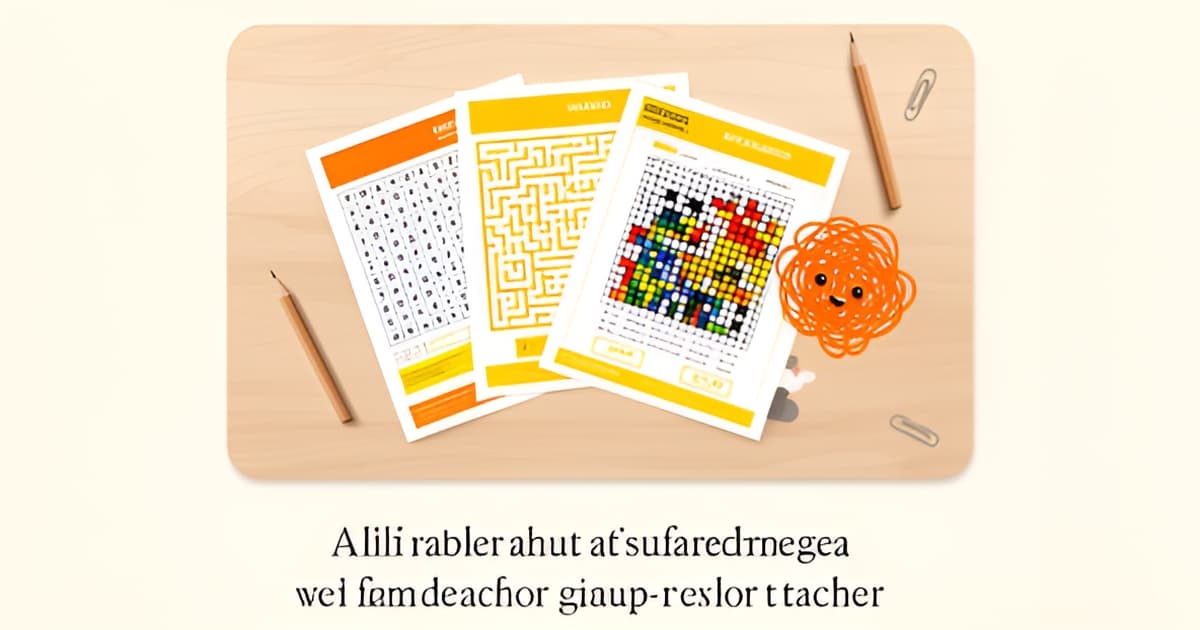
This is where tools like Printoodle's word search maker and printable word search come in. Teachers can plug in their own vocabulary lists, spelling words, or key concepts and generate a print-ready puzzle in seconds. These aren't time-fillers; they're quick, low-stakes formats that break up a lecture, reinforce terminology, and give students a moment of focused engagement. Because the content comes from the teacher's own lesson material, the activity feels intentional rather than random.
Beyond word searches, Printoodle supports a range of activity types, mazes, bingo cards, crosswords, and dot-to-dot, that serve the same purpose: punctuating learning with a change of pace. When teachers can swap a worksheet for a themed puzzle designed from their own material in minutes, they preserve their own energy while keeping students mentally present. The platform's library, where every creation lives and reprints are free forever, means the same puzzle can be reused for review, homework, or a fast-finisher station without additional planning.
The goal isn't to make every minute of class entertaining. It's to design moments of joy and challenge that respect both the teacher's time and the student's curiosity. When the planning burden lifts, the enthusiasm returns, for the teacher and the classroom. Print it. Doodle it. Done.
Make It Simple: Turn Your Lesson Material Into Activities in Seconds
Here's the frustrating math of being the fun teacher: 44% of K-12 teachers report feeling burned out "always" or "very often," with an average 50-hour workweek, according to Gallup survey data. The teachers most likely to inspire engaged students are also the ones with the least time to plan. That's the workload-interactivity tradeoff, and it's the real reason so many good intentions die in the planning stage.
The fix isn't working harder. It's shortening the distance between "I have lesson material" and "I have an activity students actually want to do." With a tool like Printoodle, you upload a short brief or your own document, and it generates print-ready word searches, crosswords, flashcards, and worksheets from your content. You download a Letter or A4 PDF, print it, and you're done. Everything you make stays in your library, so reprints are free forever. If a class needs a second copy or a student wants another go at a puzzle, you don't rebuild anything.
This matters because the design of a learning experience carries more weight than the platform delivering it. As Instructure's research on K-12 engagement puts it, how learning experiences are designed has more impact on engagement than what platform they're delivered on. The tool's job is to buy back your time so you can spend it on design decisions that actually move students: the theme, the difficulty, the personal touches that make a worksheet feel like it was made for them.
There's also broad agreement that this kind of tool support is worth it. In an EdWeek Market Brief survey, 87% of respondents agreed digital tools are essential for adapting content to individual learning, and 93% of teachers said adaptive learning would help increase engagement.
Here's a simple weekly routine that keeps this in minutes, not hours:
- Monday (10 minutes): Pick one topic from the week's plan and generate a word search or crossword from its key terms.
- Midweek (5 minutes): Build one flashcard set or worksheet for review or early finishers.
- Friday (5 minutes): Skim your library, reprint anything that worked, and note one activity to vary next week.
Fifteen to twenty minutes total, once a week, and you've got a rotating set of activities built from your own material. That's what makes being the fun teacher sustainable: the enthusiasm comes from you, and the busywork gets handled in seconds.
Frequently Asked Questions
Does being a fun teacher actually improve student outcomes, or is it just about making class enjoyable?
How much does my own enthusiasm as a teacher really matter for student engagement?
Isn't focusing on 'fun' the wrong goal for serious learning?
How can I be the fun teacher when I'm already burned out and working 50-hour weeks?
Are students really less engaged than they used to be?
Do digital tools actually help, or do they just add another thing to learn?
Your Energy Is the Real Lesson Plan
The data is clear: student engagement hinges on teacher enthusiasm, yet 44% of educators burn out with 50-hour workweeks, leaving little fuel for creativity. Your excitement isn't just mood-setting, it's measurable. Teachers who feel excited about their material report 83% of students engaged, versus 58% for their peers. The fix isn't more effort; it's removing the friction between a great idea and a ready-to-use activity. Printoodle exists for exactly this problem: feed it your lesson vocabulary and it turns out a print-ready word search maker puzzle or printable word search in seconds, so the fun part of your lesson stops costing your Sunday afternoon. When the planning burden lifts, the enthusiasm returns, for you and your classroom. Print it. Doodle it. Done.