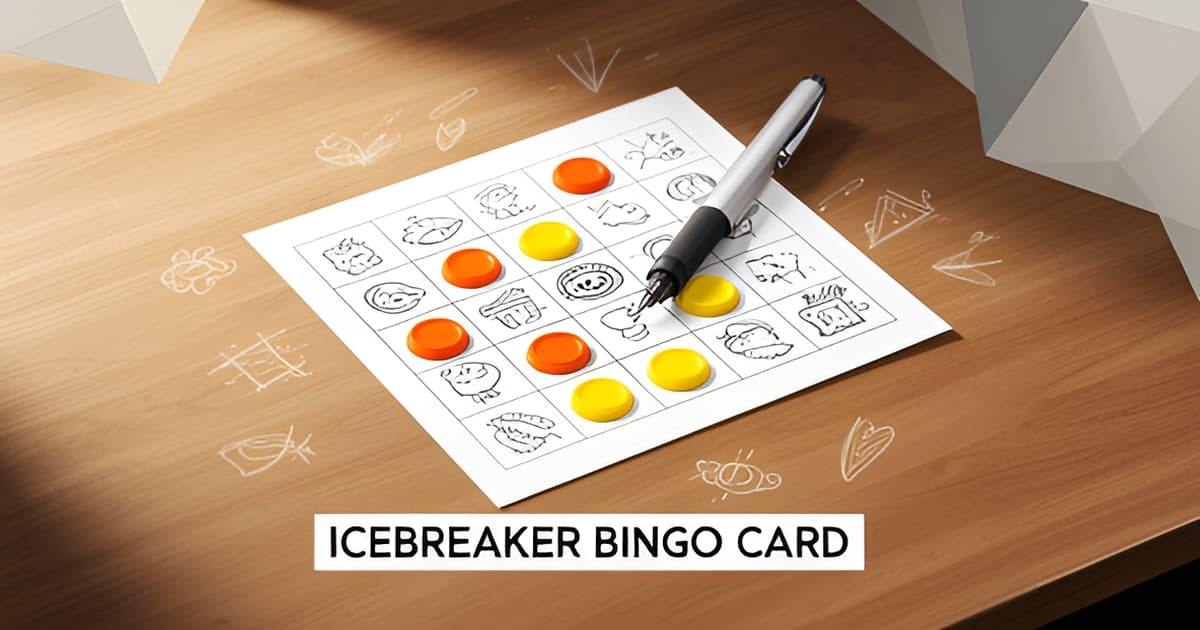
How to do icebreaker bingo?
Key Facts
- Icebreaker bingo suits introverts and skeptics alike because TeamBonding says the card gives every player a ready-made conversation script.
- Team-building experts recommend two winning formats: race to finish first, or run play for a set time before counting squares, per TeamBonding.
- Customization dominates 2025 team-building trends, with companies ditching one-size-fits-all activities for experiences tailored to their teams' personalities, trend research shows.
- The best team-building experiences in 2025 are going 100% offline, with teams craving real face-to-face interaction over screen-based activities, according to trend reports.
- Adding game elements like point systems, leaderboards, and timed challenges makes team building significantly more engaging, research finds.
- Corporate demand now includes high-energy icebreakers for events with up to 500 employees, Premier Team Building reports.
- Conversation-sparking talking points beat flat facts as bingo squares, 'find someone with a weird hidden talent' keeps people talking longer than yes/no prompts, TeamBonding advises.
Why Generic Icebreakers Fall Flat (And Why Bingo Works)
We've all been there. Someone announces "let's do a quick icebreaker," and you can feel the room deflate before the first person answers "two truths and a lie" for the hundredth time. If you're wondering how to do icebreaker bingo instead, you're already ahead of the trend: it fixes exactly what makes generic icebreakers fail.
The problem isn't icebreakers themselves. It's the one-size-fits-all approach. According to 2025 team-building trend research, teams now want experiences that fit their energy, interests, and personalities, and companies are actively choosing tailor-made activities over generic ones. Premier Team Building reports the same shift, with businesses moving away from one-size-fits-all programs toward experiences that actually resonate. A canned icebreaker can't do that. A bingo card built around your specific group can.
There's a second problem, too: screens. The same research notes that in a world where everything is digital, teams crave real, face-to-face interaction, and the best team-building experiences in 2025 are going 100% offline. Handing someone yet another app or slideshow works against that. Handing them a printed bingo card works with it.
Icebreaker bingo, sometimes called human bingo, succeeds because it's built on the principles practitioners recommend:
- Tailored prompts. TeamBonding advises choosing fun topics that suit your group, with conversation-sparking talking points making the best square content.
- Light instructions. A brief line at the top of the card is plenty; TeamBonding explicitly warns against being heavy-handed with rules.
- Built-in game mechanics. Run it as a race to finish or for a set time. The gamified format keeps energy up without anyone having to perform.
- Introvert-friendly play. Players work the room at their own pace, so skeptics and quieter teammates can opt in comfortably.
That last point matters more than people think. Small-group formats lead to better communication and more meaningful connections than large events, so a game that gets everyone talking one-on-one beats a presenter firing questions at a crowd. If you need prompt ideas, our icebreaker questions tool is a good starting point for squares, and the icebreaker questions for kids version works well for classrooms.
The best part: you don't need to design cards by hand. With Printoodle, you describe your group, drop in your prompts, and generate a print-ready themed bingo PDF in seconds. Letter or A4, as many unique cards as you need, reprints free forever. Print it. Doodle it. Done.
How to Design Icebreaker Bingo Squares People Actually Want to Fill In
The squares make or break the game. A card full of dull prompts kills conversation before it starts, while a well-tuned one turns strangers into chatterboxes in minutes.
The first principle is simple: tailor your prompts to your specific group. TeamBonding, which runs human bingo grids professionally, advises treating any prompt list as inspiration only and choosing "fun topics that will suit your group," with talking points always being a safe bet. This matches what's happening across team building generally: according to 2025 trend reporting, one-size-fits-all activities are out, and companies now want experiences that fit their teams' energy and personalities. A card for a sales offsite should look nothing like one for a third-grade classroom.
Favor conversation-starting talking points over flat facts. "Find someone who has run a marathon" is fine, but "Find someone who has a weird hidden talent" gets people talking well after the square is signed. If you're stuck for ideas, browse a bank of icebreaker questions and adapt your favorites into find-someone-who prompts. For classroom variations, the same trick works with icebreaker questions for kids, softened into kid-friendly squares like "find someone who has a pet."
Keep the instructions at the top of your card light. TeamBonding's own example grids include a note that there's "no need to be as heavy handed" with rules as some templates are. Two lines is plenty: what players must do, and how someone wins.
Decide your win condition before you print. TeamBonding recommends two formats that both work well:
- Race to finish: first player to complete the whole card (or a full row) wins, which injects energy fast.
- Timed play: run the game for a set window, then count squares, which suits groups that include slower talkers.
- Hybrid: race for a line, then keep playing to full card so nobody drops out early.
Whichever format you pick, remember the game is inclusive by design. TeamBonding positions human bingo as suitable for introverts and skeptics precisely because it gives every player a script and a reason to approach people, something that matters if your group includes reluctant participants.
Generating the cards themselves is the easy part. With Printoodle, you describe your group and your prompts in a short brief, spend a credit, and download a print-ready PDF (Letter by default, with an A4 toggle). Reprints stay free forever, so you can refresh squares for a new cohort without paying again. That printed format also fits the broader shift toward offline, face-to-face interaction that trend watchers say defines the best team experiences right now: hand out cards, put phones away, and let the talking points do the work.
Two Ways to Play: Race Format vs. Timed Rounds
Once everyone has a card and a pen, you have one decision left: how does the game actually end? Team-building experts at TeamBonding recommend two formats: "make it a race to finish or run it for a set time." Both work well, but they suit different rooms.
In the race format, the first person to complete a full row (or the whole card) shouts "Bingo!" and wins. This creates a burst of energy and works best when you have a lively group, a short window of time, or a competitive crowd. It's the classic choice for parties and team offsites where you want a clear, exciting finish.
Timed rounds flip the dynamic. You set a clock, say ten or fifteen minutes, and let people mingle at their own pace. When time runs out, whoever has the most squares filled wins. This format suits larger or more reserved groups because nobody feels rushed, and conversations get room to breathe. It's also the safer pick for classrooms, where the goal is connection rather than a sprint.
A quick guide on when to use each:
- Race format: small to medium groups, high energy, parties, and short time slots.
- Timed rounds: bigger groups, classrooms, corporate mixers, and anyone who hates being rushed.
- Hybrid option: run it as a race within a set time limit, so stragglers still get to finish their chats.
One of the best things about icebreaker bingo is how inclusive it is. TeamBonding positions the activity as suitable for introverts and skeptics alike, because the bingo squares give quieter people a ready-made reason to start a conversation. Nobody has to improvise small talk from scratch; the card does the heavy lifting. Even the cynics in the room tend to come around once there's a grid to fill.
The format also taps into what's trending. According to 2025 team-building trend research, "adding game elements like point systems, leaderboards, and timed challenges makes team building way more engaging," and teams are increasingly seeking 100% offline, face-to-face experiences. A printed bingo card sits right at that intersection: gamified, screen-free, and social.
If you want your cards ready in minutes, you can generate a custom icebreaker bingo PDF with Printoodle. Drop in prompts tailored to your group (TeamBonding advises choosing "fun topics that will suit your group"), pick your grid, and download a print-ready file in Letter or A4. Reprints are always free from your library, so you can run the same game again with a new crowd.
Print it. Doodle it. Done.
Step by Step: Generate Your Icebreaker Bingo Cards in Printoodle
You've brainstormed your prompts, picked a format, and now you're ready to make the cards. This is where the whole thing comes together: in under a minute, you can go from a short brief to a stack of print-ready icebreaker bingo cards.
Step 1: Write a short brief. Open the Printoodle bingo generator and describe what you want in plain language. Something like "icebreaker bingo for a 5th grade class, squares with 'find someone who has a pet' and 'find someone who speaks two languages'" works fine. TeamBonding's practical advice applies here: choose fun topics that suit your group, and lean on conversation-sparking talking points rather than yes/no facts. If you're stuck for square ideas, the icebreaker questions tool is a good place to mine prompts, and there's a dedicated icebreaker questions for kids version for classroom groups.
Step 2: Spend a few credits and generate. Each card costs credits from your balance. New accounts get 10 free credits on email verification, which is enough to test the waters before a big event. There's also a free sample on the page so you can see the output quality before spending anything.
Step 3: Download and print. Your PDF arrives print-ready, with Letter as the default paper size and an A4 toggle if you're outside North America. Print as many copies as you need. That matters for bigger groups: corporate demand for icebreakers now includes events with hundreds of participants, and a photocopier makes short work of that.
Step 4: Reprint anytime, free. Everything you generate lives in your library, and reprints are free forever. Lost a card? New student joined mid-year? Running the same session next quarter? Pull it up and print again at zero cost.
Why the print angle matters beyond convenience: 2025 team-building trend reports note that the best experiences are going fully offline, with teams wanting real, face-to-face interaction instead of screen-based activities. A paper bingo card is about as screen-free as it gets.
A quick recap of the workflow:
- Enter a short brief with your chosen prompts
- Spend credits, download the print-ready PDF (Letter default, A4 toggle)
- Print as many copies as your group needs
- Reprint free forever from your library
Print it. Doodle it. Done.
Frequently Asked Questions
How do you actually play icebreaker bingo?
What makes a good icebreaker bingo square?
Does icebreaker bingo work for introverts and people who hate icebreakers?
Should I use a race format or a timer for my icebreaker bingo game?
Why is a printed bingo card better than a digital icebreaker app?
How do I make custom icebreaker bingo cards without designing them by hand?
Your First Bingo Card Is One Brief Away
Knowing how to do icebreaker bingo comes down to three things you now have: prompts tailored to your group, light instructions at the top of the card, and a win condition that fits the room, a race for high-energy crowds, timed rounds for bigger or quieter ones. The rest is momentum. 2025 team-building trend research points the same direction: tailored, gamified, fully offline experiences win, and a printed bingo card checks every box. So take the next step while it's fresh. Skim our icebreaker questions for squares that spark real conversation, or the icebreaker questions for kids version if you're prepping a classroom. Then open Printoodle, describe your group in a sentence or two, and download a print-ready PDF in seconds, Letter or A4, with free reprints forever in your library for the next cohort, class, or shower. New accounts start with 10 free credits, so your first game costs nothing but a few minutes. Print it. Doodle it. Done.