How to play boogie bingo?
Key Facts
- Boogie bingo is classic bingo with songs replacing called numbers, a themed adaptation, not a separate rule set.
- 75-ball bingo accounts for about 80% of American games, according to aggregated bingo statistics.
- The free center space on US bingo cards has been standard since the 1940s, per bingo statistics.
- 65% of bingo players cite social interaction as their primary reason for playing, aggregated statistics show.
- UK bingo clubs host around 50,000 drag shows annually, per bingo statistics, proving themed bingo draws real crowds.
- In boogie bingo, the DJ acts as the live caller, a role bingo hall operators call central to the in-person experience per bingo hall operators.
- Win patterns range from a quick single line to a full blackout requiring every song on the playlist to be identified.
What Boogie Bingo Is and Why It Works
Turn the music up and the numbers off. If you're wondering how to play boogie bingo, the short answer is this: it's classic bingo with a soundtrack, where songs replace the called numbers and your ears do the marking.
Boogie bingo is a themed adaptation of standard bingo, not a separate rule set. The core mechanic stays the same as any bingo game: match the called items to the squares on your card and complete the announced pattern. Instead of a caller drawing numbered balls, someone plays short clips of songs, and players mark the matching titles on their cards.
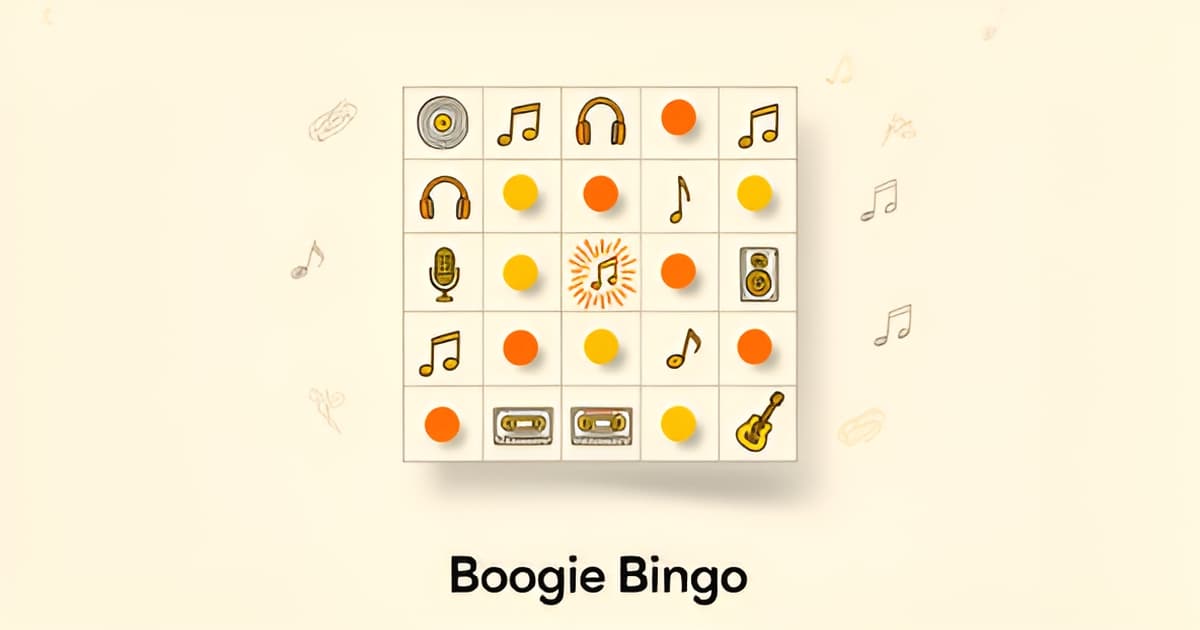
The familiar structure matters. US bingo cards use a 5x5 grid drawn from 75 numbers, and 75-ball bingo accounts for about 80% of American games, with a free center space that's been standard since the 1940s. When your boogie bingo card follows that same 5x5 layout, players already know what to do. You're swapping content, not teaching a new game.
The appeal is social, and the data backs that up. 65% of bingo players cite social interaction as their primary reason for playing, according to aggregated bingo statistics. Boogie bingo leans directly into that motivation: someone acts as the DJ-caller, everyone argues over half-remembered chorus lyrics, and the room stays loud between rounds.
Themed bingo has already proven itself as a crowd-pleaser. Traditional halls build variety through themed nights, changing patterns, and special sessions, and the trend extends well beyond the bingo hall: UK bingo clubs host around 50,000 drag shows annually, evidence that experience-driven bingo draws real audiences. Music bingo is a natural fit for that same energy, whether you're running a birthday party, a family game night, or a classroom activity.
A few reasons the format works so well:
- The DJ-caller preserves the live, human element that makes in-person bingo special.
- Song prompts spark conversation, which suits the 65% of players who show up for the social side.
- The 5x5 grid with a free center space keeps the rules instantly recognizable.
- Every card is unique, so no two players have identical boards.
Getting started is simple. Build your cards with song titles in place of numbers using Printoodle's bingo card generator, where you can theme each card around your playlist and print as many copies as you need. The same approach works for other themed formats too, like reading bingo, if your group wants a quieter spin on the same idea. Print it, cue the playlist, and let the first clip play.
The Rules: Classic Bingo Mechanics with a Playlist Twist
The standard 5x5 grid with a free center square provides the familiar structure players expect, whether numbers or song titles fill the squares. In US bingo, 75-ball games dominate, using 75 numbers arranged across five columns marked B-I-N-G-O, and this format translates directly to a music-prompt card where each square holds a song title or artist rather than a number. The core mechanic remains unchanged: a live caller, whether a person or a DJ, announces items, and players mark their cards, aiming to complete the announced pattern before anyone else. This live-caller format is what gives the game its social energy, and research confirms that 65% of bingo players cite social interaction as their primary reason for playing, which is exactly what boogie bingo leverages to turn a simple music game into a shared experience.
Win conditions in boogie bingo follow the same variety found in traditional halls. A single line across, down, or diagonally is the most common early win, while four corners offer a quicker alternative for shorter rounds. For a longer session, the blackout, or full house, requires marking every square on the card, which in a music version means identifying every song on the playlist. These patterns keep the game moving and give players clear goals, whether they are aiming for a quick line or going for the full house. Themed bingo events have become a staple for operators looking to boost engagement, with clubs hosting 50,000 drag shows annually as part of their themed offerings, proving that music and novelty nights resonate with players looking for something beyond the standard game.
- The DJ or music player acts as the live caller, queuing tracks one by one.
- Players mark their card when a called song plays, using a pen or token.
- Winning patterns include one line, four corners, or a full blackout.
- The first player to complete the pattern calls “Bingo!” and wins the round.
Printoodle’s bingo card generator makes it easy to create custom cards with music prompts, turning any playlist into a playable game in seconds. Users can generate a 5x5 grid tailored to their event, whether it’s a kids’ dance party or an adult retro night, and download a print-ready PDF to hand out. Cross-linking to a reading bingo format shows how the same card-generation approach works across different themes, letting hosts swap song titles for book titles or trivia answers without changing the mechanics. The free tier gives 10 credits on email verification, and every card created lives in the user’s library where reprints are always free, making it simple to print fresh cards for each new round.
Building Your Card: The 5x5 Music Grid
The 5x5 grid is the natural starting point for any boogie bingo card, mirroring the standard US format that 80% of players recognize. Since the center square is traditionally a free space, it becomes an instant "wild" square that speeds up gameplay and reduces the number of songs needed for a win. Printoodle's bingo card generator makes designing these music-prompt cards effortless, just input your playlist and the tool lays out a unique 5x5 grid with a free center space in seconds, ready for printing or digital sharing.
Variety keeps the game flowing, so mix square types across the card. Some squares can feature specific song titles you’ll play, while others might ask players to identify the artist, the year, or a lyric snippet. You could include a "wild card" square that lets a player mark any spot, or a "dance break" square that awards bonus points for getting up and moving. This range of prompts ensures that every round feels fresh, whether you are hosting a family reunion or a classroom activity.
Generating your custom cards is quick with Printoodle. The bingo card generator lets you input your music prompts, select the 5x5 layout with a free center, and download a print-ready PDF in Letter or A4 format. Because every card is a unique combination, no two players will have the same grid, which adds to the competitive fun. Once printed, the cards are yours to reuse, reprints are always free from your library, and the free tier gives you 10 credits upon email verification, making it easy to print as many copies as your gathering requires.
A live "caller" is essential to keep the energy high. In boogie bingo, that role falls to the DJ or music player, who announces each track and cues the song. This mirrors the traditional bingo hall experience, where the live caller is central to the social atmosphere. With 65% of bingo players citing social interaction as their primary reason for playing, the person controlling the playlist becomes the heart of the event, guiding the group from one track to the next and building anticipation with every beat.
The familiar structure means your guests can start playing immediately. Because the 5x5 grid with a free center space is the standard format, there is no learning curve, everyone knows how to scan their card and listen for the match. Pair this with a well-curated playlist, and you have a themed game that feels both classic and completely new. Printoodle makes it easy to bring this concept to life, whether you are planning a birthday party, a classroom music lesson, or a casual get-together with friends.
Print it. Doodle it. Done.
Ready to create your own music-prompt cards? Generate your first card with the bingo card generator and see how quickly your playlist turns into a game. If you are also planning a literary-themed event, try the reading bingo generator for a different twist on the classic format.
Hosting the Game: Parties, Classrooms, and Family Nights
Boogie bingo works best when there's a crowd, a playlist, and someone willing to be the DJ. That combination fits three settings especially well: birthday parties, family gatherings, and classroom music activities.
The social pull is real. According to aggregated bingo statistics, 65% of bingo players cite social interaction as their primary reason for playing, which is exactly what a music-prompt version amplifies. Instead of quietly marking numbers, players listen, sing along, and argue about whether that song counts as a "dance hit."
For birthday parties, build the card around the birthday kid's favorite songs and use the standard 5x5 grid with a free center space, the format used in 80% of US games and familiar to almost every player. The person running the music acts as the live caller, a role that bingo hall operators describe as central to the in-person experience. Play 10 to 20 seconds of each track, let kids shout guesses, then confirm the square they can mark.
For classrooms, pacing matters more than volume. Keep each song clip short, announce the win pattern before you start (a single line is the easiest first round), and give students a moment between tracks to check their cards. You can also adapt difficulty by age:
- Ages 3-5: use well-known nursery or movie songs and a smaller 3x3 grid so matching stays manageable.
- Ages 6-8: stick to familiar radio or classroom songs and play full lines before revealing answers.
- Ages 9-12: add a guessing layer, where kids must name the song before they can mark the square.
For family nights, mix generations deliberately. Put grandparent-era hits next to current chart songs on the same card so everyone gets a few "I know this one!" moments. Themed variety is a proven formula: traditional bingo venues keep players engaged through themed nights and changing patterns, and that same logic works at your kitchen table.
Prizes keep the energy up without much cost. Small treats, a pick-the-next-song privilege, or a homemade "Dance Champion" certificate all work. For multi-round games, switch the win condition each round: first line, then two lines, then a full card, mirroring how bingo halls structure longer sessions.
If you're making your own cards, Printoodle's bingo card generator produces print-ready 5x5 grids from your own song list in seconds, and reprints from your library are always free. The same approach powers themed variants like reading bingo, so you can swap themes as your group's tastes change. Print it. Doodle it. Done.
Frequently Asked Questions
How do you play boogie bingo?
What does a boogie bingo card look like?
How long should each song clip be?
Can young kids play boogie bingo?
What win patterns can we use?
How do I make boogie bingo cards without a lot of prep work?
Cue the Playlist, Call the First Song
Learning how to play boogie bingo takes almost no time at all, because you already know the game: it's classic bingo with the numbers swapped for songs. Keep the familiar 5x5 grid with a free center space, the format behind 80% of US games, pick a live DJ-caller, and decide whether you're playing for one line, four corners, or a full blackout. The payoff is the room itself: with 65% of bingo players citing social interaction as their main reason for playing, per aggregated bingo statistics, a game built on half-remembered choruses and friendly arguments over song titles is exactly the kind of energy that keeps a crowd engaged. Your next step is simple: build a playlist around your crowd, then turn it into unique, print-ready cards with Printoodle's bingo card generator, every card is one of a kind, and reprints from your library are always free. Want a quieter theme next time? Try the reading bingo generator with the same mechanics. Print it. Doodle it. Done.