Is the color by number app safe for kids?
Key Facts
- Common Sense Media flagged in-app purchases at $0.99 per pack with no parent gate, rating comparable coloring apps 8+ overall according to their review
- The Canadian Centre for Child Protection found age verification on apps is 'easily circumvented,' with users confirming 'Yes, I'm 17' while the app store knows the real age per Global News report
- Fluent Research's 2025 study found children ages 3-5 with low self-regulation 'disengaged easily from low-PD apps but took significantly longer and needed more support with moderate/high-PD apps' per Mallawaarachchi et al.
- Common Sense Media reviewers stated linking out of coloring apps to shopping sites, YouTube, etc., is 'unnecessary and inappropriate for most kids' in their review
- The Coloring.app platform claims 'uploaded photos are not stored' and users can keep artwork private or share publicly per Newsfile Corp
- The Anti-Coloring Book App was flagged for having 'no privacy policy available at the time of review,' which Common Sense Media called a 'significant red flag' per their findings
- Growth Market Reports valued the coloring books for toddlers market at USD 1.72 billion in 2024, projected to reach USD 3.01 billion by 2033 (CAGR 6.4%) per market analysis
Why Parents Question Kids' Coloring Apps in the First Place
Handing a tablet to a child and wondering what they are actually seeing is a valid worry these days. The kids' app landscape is filled with hidden pitfalls, and research shows those concerns are well-founded. A Common Sense Media review of a comparable coloring app found in-app purchases, often priced at $0.99 per pack, with no parent gate, meaning children can spend money without any adult oversight. The review also noted that linking out to shopping sites and YouTube is "unnecessary and inappropriate for most kids," yet those retail links appear on every single page. Compounding the issue, there was no privacy policy available at the time of the review, a gap Common Sense Media flagged as a "significant red flag" for parents.
The risks extend beyond just purchases. The Canadian Centre for Child Protection found that age verification on apps is "easily circumvented," with users simply confirming "Yes, I'm 17" while the app store already knows the account holder's real age. This means children can access content or features far beyond their developmental stage with just a few taps. Furthermore, research from Fluent Research indicates that persuasive design features, such as rewards tied to in-app purchases and pop-up suggestions for other games, do not actually make apps more fun for children, but they do make them harder to put down, potentially overriding a child's natural ability to self-regulate.
Before trusting any coloring app, parents should adopt a five-point checklist mindset to evaluate safety:
- Parent Gates: Are in-app purchases locked behind a parent gate, or can kids spend freely?
- Privacy Policy: Is there a clear, accessible privacy policy detailing data collection and storage?
- External Links: Are there links that lead children out of the app to unsupervised content or shopping sites?
- Age Appropriateness: Does the content and complexity match the child's developmental stage?
- Persuasive Design: Does the app use manipulative features like countdown timers or locked content to drive engagement?
Is the color by number app safe for kids? Parents should scrutinize any app against these criteria before handing over the device. Printoodle offers a safe-for-kids default experience with no trademarked characters and no NSFW content, providing a secure environment for children to create. mazes for kids, kids sudoku printable, and rebus puzzles for kids are all available to try for free. Print it. Doodle it. Done.
How Printoodle's Color by Number App Handles Safety
When Common Sense Media reviewed a popular kids' coloring app, its reviewer flagged "linking out of the app to shopping sites, YouTube, etc." as "unnecessary and inappropriate for most kids." That single line captures the core safety question parents ask about any color by number app, so it's worth walking through how Printoodle measures up against it.
Printoodle has no ads and no external links. There's no pathway from a coloring page to a shopping site, a video platform, or anything else. The child isn't one tap away from the open internet, which removes the exact risk the review flagged. The app also contains no trademarked characters and no NSFW content, so what you generate is what your child sees.
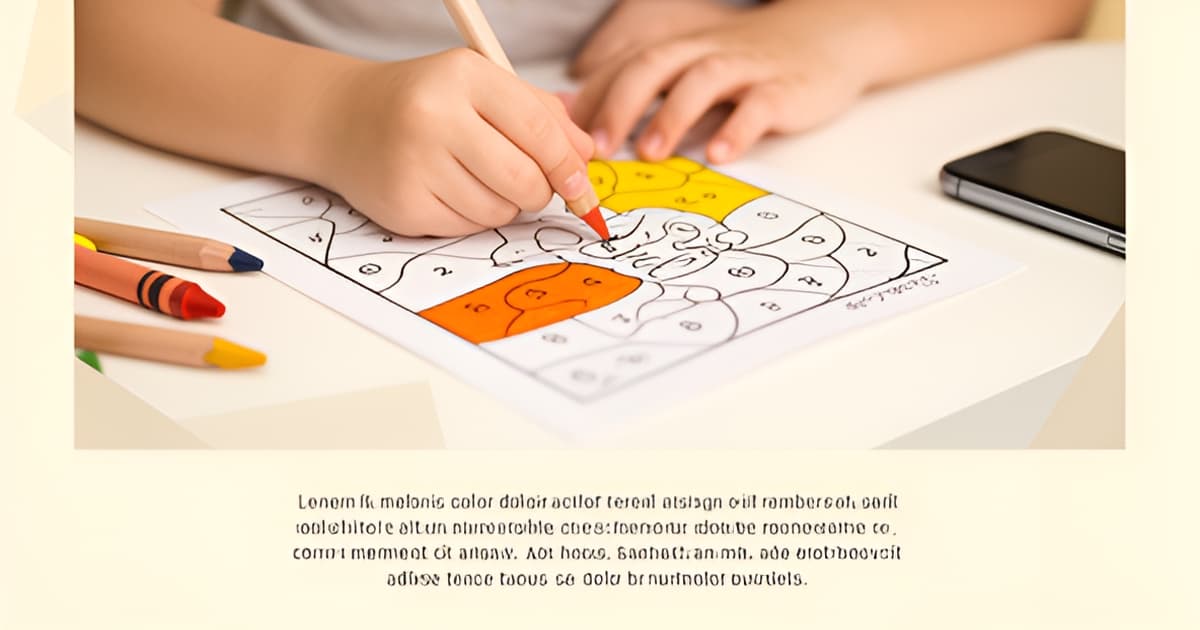
Then there's the print-first model, which changes the safety picture entirely. Your child colors on paper, not on a screen. The app is simply the tool you use to create the page; the activity itself happens at the kitchen table with crayons. That's a meaningful difference from typical screen-based coloring apps, where the child's face stays in the device.
The credit system deserves an honest look, since in-app purchases are a known weak point. Common Sense Media flagged a comparable coloring app for charging $0.99 per page pack with no parent gate at all. In Printoodle, purchases happen in the parent's account, never in a child-facing interface. And once a page exists in your library, reprints are free forever, so there's no purchase loop a child could stumble into, and no reason for one to exist.
- No ads, no external links to shopping sites or YouTube
- No trademarked characters or NSFW content
- Purchases stay in the parent's account; reprints are always free
- The coloring happens on paper, not on a screen
You might wonder whether an app this plain can hold a child's attention without the usual hooks. It can. A study by Mallawaarachchi and colleagues found that children liked apps equally whether or not they contained persuasive design features. Streaks, virtual coins, and countdown timers make apps harder to leave, not more fun. Manipulative mechanics simply aren't needed, so Printoodle doesn't use them.
If you want a screen-light activity rotation, Printoodle also generates mazes for kids, a kids sudoku printable pack, and rebus puzzles for kids, all following the same print-first, ad-free approach.
The Screen-Time Angle: Why Print-First Beats App-First
Most kids' apps aren't designed to be finished. They're designed to be endless. That distinction matters more than any content rating when you're deciding whether a color by number app is safe for kids.
A 2025 study by Dr. Mallawaarachchi and colleagues examined how persuasive design (PD) features shape children's screen behavior. The mechanics will sound familiar to any parent: virtual rewards and coins, locked content tied to purchases, pop-up suggestions for other games, and autoplay or countdown timers that make an app harder to leave. These features don't make apps more fun. They make them harder to quit.
The study's most useful finding for parents concerns age. Children ages 3–5 with low self-regulation disengaged easily from low-PD apps, but took significantly longer to pull away from apps with moderate or high persuasive design, and needed more adult support to do it. As Dr. Mallawaarachchi put it, "If persuasive features override a child's available strategies and capacities, then the child is no longer in control." A preschooler simply doesn't yet have the brakes that a ten-year-old is building.
Here's the encouraging part: children in the study liked apps equally regardless of how many persuasive features they contained. Developers don't need timers, coins, and locked levels to make an app appealing to kids. When a typical coloring app does include them anyway, it's worth asking who benefits. Common Sense Media's review of a comparable coloring app flagged in-app purchases at $0.99 per pack with no parent gate, retail links on every page, and no privacy policy at the time of review, rating the app 8+ overall.
Printoodle takes a different shape. The parent runs the generation step for a few minutes, and the child's actual activity happens on paper with crayons. There's no timer counting down, no coin economy, no locked picture waiting on a purchase. The pages themselves suit ages 3–12, and for the youngest kids the adult handles the app entirely, which sidesteps the self-regulation problem the study identified. The same print-first logic applies across the whole library, whether you're making mazes for kids, a kids sudoku printable, or rebus puzzles for kids for older children.
A quick age-and-design checklist you can apply to any coloring app:
- Does it use timers, streaks, or autoplay to extend sessions?
- Is content locked behind purchases, and is there a real parent gate?
- Does it link out to shopping sites, YouTube, or other apps?
- Is the child coloring on a screen, or on paper?
Dr. Mallawaarachchi's framing is the right lens here: "Not all children use screens in the same way, but also screens don't affect all children the same way." A four-year-old with emerging self-regulation and a nine-year-old are facing very different odds against a well-engineered hook. Print-first beats app-first because it removes the hook entirely: the screen does a job, then gets out of the way.
Your 5-Minute Safety Check Before Any Kids' App
Five minutes with a checklist beats an hour of worry. When parents ask, "is the color by number app safe for kids," the honest answer is that safety depends on a handful of features you can verify quickly, before your child ever touches the screen. Reviewers at Common Sense Media have shown how much a quick inspection can reveal.
Here's the checklist we use, and how Printoodle measures up on each point.
- Look for a parent gate on purchases. Common Sense Media flagged one coloring app for having in-app purchases ($0.99 per pack) with no parent gate at all. Printoodle's purchases happen in a parent-facing flow: parents buy credit packs starting at $5, and kids work with printed pages, not a payment screen.
- Find the privacy policy. Its absence is what Common Sense Media calls a "significant red flag." Printoodle publishes one, and the tool works from prompts and photos you choose to upload, so you know exactly what's going in.
- Check for external links. Reviewers called links out to shopping sites and YouTube "unnecessary and inappropriate for most kids." A printed page has no links. The only screen time involved is the few seconds you spend generating it.
- Notice persuasive design. A 2025 study found children ages 3 to 5 with low self-regulation disengaged easily from low-persuasive-design apps but needed more support with moderate and high-PD apps. Countdowns, virtual coins, and locked features are the tells. Printoodle has none, because the output is paper.
- Match complexity to your child. Common Sense Media rates comparable coloring apps 8+ based on child development research. With Printoodle you control difficulty directly: simple number grids for a four-year-old, denser pixel mystery pictures for older kids.
That last point matters more than it sounds. As study author Dr. Mallawaarachchi put it, "If persuasive features override a child's available strategies and capacities, then the child is no longer in control." A printable sidesteps the whole problem, and the same safe-by-default approach carries across Printoodle's other screen-light activities like mazes for kids, a kids sudoku printable, or rebus puzzles for kids.
So run the five-minute check on any app you're considering. Or skip the screen entirely: generate a free color by number page, print it, and hand over the crayons.
Screen Time Without the Stress: Making Safer Choices for Kids
When parents hand a tablet to a child, the question isn't just about entertainment, it's about what happens behind the screen. Research consistently shows that many coloring apps rely on persuasive design, hidden purchases, and unsupervised external links that can turn a simple activity into a minefield. The good news? Safety comes down to a few concrete features: parent gates on purchases, transparent privacy policies, and content that stays on the page. Printoodle’s print-first approach sidesteps these risks entirely, turning screen time into a quick creation step and then moving the fun to the kitchen table with crayons. Children engage equally with apps whether they contain manipulative hooks or not, meaning developers don't need timers or virtual coins to make an activity appealing. A quick five-minute check using a parent gate, privacy policy, and external link scan can reveal a lot before the device ever reaches small hands. For families ready to simplify, Printoodle offers a safe-for-kids default experience with no trademarked characters and no NSFW content, providing a secure environment for children to create. Print it. Doodle it. Done.