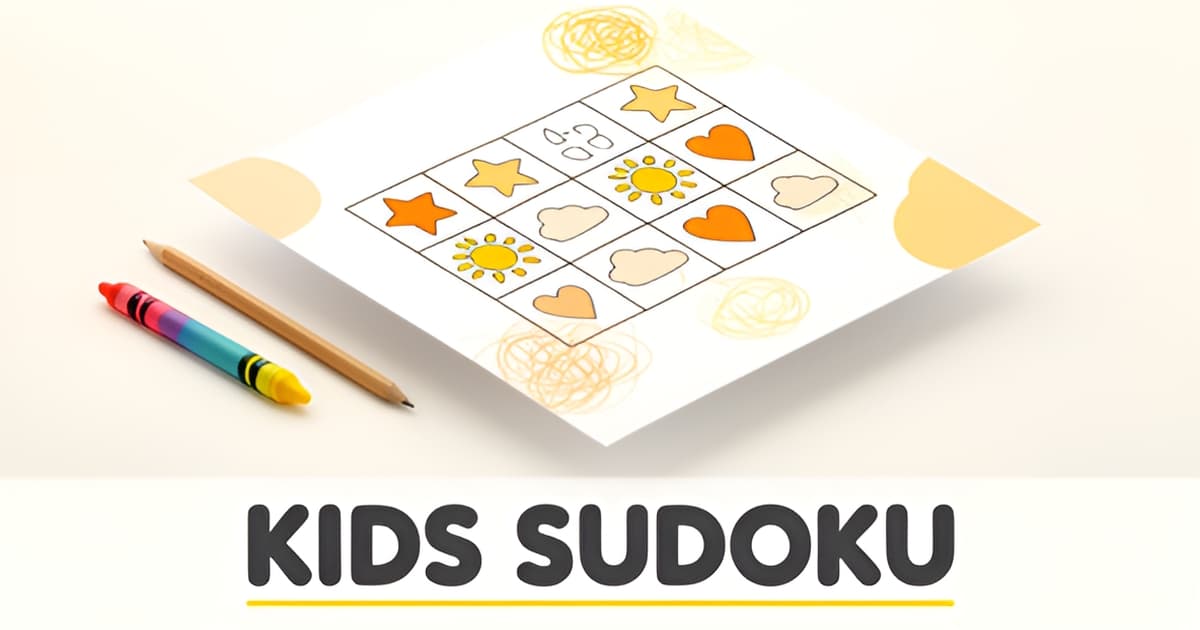
Is there a kids version of Sudoku?
Key Facts
- Yes, kids Sudoku exists: puzzle generators offer 4×4 grids and an 'Easiest Ever' level explicitly designed for kids and absolute beginners according to generator specs.
- Kids Sudoku difficulty is controlled by two levers, how many numbers are given at the start and how complex the logical steps are per puzzle generator documentation.
- Logic puzzles, the category that includes Sudoku, grow at 8.7% a year, with Sudoku apps positioned between gaming and brain training per market analysis.
- Children's digital puzzle spending grows at just 4.8% annually, the slowest segment, because parental controls and in-app purchase rules limit kids' apps according to Dataintelo's report.
- The children's segment is projected to be the fastest-growing physical puzzle category through 2025–2032, driven by educational puzzle demand per Fortune Business Insights.
- Schools increasingly use puzzles to build visual-spatial reasoning and fine motor skills, which is exactly what a printed 4×4 Sudoku worksheet practices industry research notes.
- Printable Sudoku worksheets are explicitly built for classrooms and home learning, with PDF export and 1–12 puzzles per page per generator features.
The Real Question: Standard Sudoku Is Too Hard for Kids
Yes, there is a kids version of Sudoku, and it looks quite different from the standard 9×9 grid most adults know. Kid-friendly Sudoku is an established format built around smaller 4×4 grids, more starting numbers filled in, and simpler logical steps. The standard grid simply isn't the starting point for a six-year-old.
If you've watched a child try a regular Sudoku, you know how it goes. They fill in a few cells, hit a step that requires tracking three possibilities at once, and lose interest. Puzzle generators explicitly design around this problem: difficulty is determined by how many numbers are initially given and how complex the logical steps are. The easiest level, described as "extremely beginner-friendly," packs the grid with starting numbers and is designed for people learning Sudoku for the first time, including kids and absolute beginners.
Kid versions differ from standard Sudoku in a few key ways:
- Smaller grids: 4×4 instead of 9×9, so a child only juggles four symbols instead of nine.
- More starting numbers: a mostly-filled grid means fewer leaps of logic per move.
- Shorter solve time: a puzzle finishes in minutes, which matters for young attention spans.
- Same core rule: each row and column contains each symbol once, so kids learn the real logic, not a simplified fake.
The demand for this kind of puzzle is real. The children's segment is projected to be the fastest-growing category in the puzzle market through 2025–2032, driven by the popularity of educational puzzles among kids, according to a market report from Fortune Business Insights. The same report notes that schools increasingly use puzzles to support visual-spatial reasoning and fine motor skill development, which is exactly what a classroom Sudoku worksheet practices.
There's also a good case for print over apps here. Children's digital puzzle spending grows at only 4.8% a year, the slowest of any segment, largely because parental controls and rules on in-app purchases limit what kids can access, per Dataintelo's puzzle market analysis. A printed 4×4 grid sidesteps all of that. It's one sheet of paper, no screen, no purchases.
This is where a kids sudoku printable generator earns its keep. On Printoodle, you can generate beginner-friendly 4×4 Sudoku pages and download a print-ready PDF in seconds, then reprint them free whenever you need a fresh batch. If your child is younger or wants variety, the same approach works for mazes for kids and rebus puzzles for kids, which make a natural warm-up before graduating to number logic.
The short version: kids Sudoku exists, it's genuinely easier, and it teaches the same reasoning skill adults get from the 9×9 version.
What Makes a Sudoku Kid-Friendly (and Why Print Beats Apps)
If your six-year-old can count to four, they can solve a 4×4 Sudoku. That's the short answer to whether a kids version of Sudoku exists: puzzle generators offer "beginner-friendly 4×4 puzzles" alongside standard 9×9 grids, and many include an "Easiest Ever" difficulty level described as being "designed for people who are learning Sudoku for the first time. Ideal for kids and absolute beginners," according to puzzle generator documentation.
The mechanics of making Sudoku easier are simple. Difficulty depends on "how many numbers are initially given in the grid and how complex the logical steps are required to complete the puzzle." More starting numbers means less deduction required, so a child's first puzzle might have most cells pre-filled. Smaller grids shrink the logic further: a 4×4 uses digits 1 through 4, so each row, column, and box is a quick matching exercise rather than a full reasoning chain.
Now, why print instead of an app? The market data makes a surprisingly clear case. Spending on children's puzzle apps is the slowest-growing digital segment at just 4.8% a year, "limited by parental controls and stricter rules on in-app purchases aimed at minors," per Dataintelo's puzzle game market report. Meanwhile, physical children's puzzles are projected to be the fastest-growing segment from 2025 through 2032, driven by the popularity of educational puzzles, according to Fortune Business Insights.
There are practical reasons print wins for this age group, too:
- No screen time negotiation. A printed page sidesteps the app-store rules and purchase prompts that constrain kids' digital puzzle spending in the first place.
- Pencil-friendly practice. Erasing and rewriting on paper builds the fine motor skills schools actively emphasize alongside puzzle-based reasoning.
- Classroom-ready. Printable Sudoku worksheets are explicitly built for "classrooms and home learning," so one PDF serves a whole table of kids.
- Free reprints. A torn, scribbled-on, or dog-eared page costs nothing to replace.
That's the approach Printoodle takes with its kids sudoku printable generator: you pick the grid size and difficulty, download a print-ready PDF, and reprint forever at no cost. It fits a natural puzzle progression, too. Younger kids often start with mazes for kids or rebus puzzles for kids, then graduate to 4×4 Sudoku once they're ready for number logic.
The broader numbers back the format. Logic puzzles, the category that includes Sudoku, are growing at 8.7% annually, and educators continue to lean on puzzles for visual-spatial reasoning and concentration. A kid-friendly version of Sudoku isn't a compromise; it's where the fastest growth in children's puzzles is happening. Print it. Doodle it. Done.
Why Kids Sudoku Is Worth the Ink: The Learning Case
So yes, there is a kids version of Sudoku, and the case for printing it goes well beyond keeping little hands busy on a rainy afternoon. The format itself is built for beginners: 4×4 grids, generous starting numbers, and difficulty levels described by puzzle generators as "ideal for kids and absolute beginners" because more given numbers mean simpler logical steps (per generator specs).
The numbers behind the trend are worth a look. Logic puzzles, the category that includes Sudoku, grow at 8.7% a year, with Sudoku apps positioned squarely between gaming and brain training (market analysis). Meanwhile, the children's segment is projected to be the fastest-growing end-user category for physical puzzles through 2032, driven by rising popularity of educational puzzles among kids (industry research).
Why print beats apps for this age group
Here's the tension worth knowing: children's digital puzzle spending grows at just 4.8% annually, the slowest segment, largely because parental controls and stricter in-app purchase rules limit spending on kids' apps (the same analysis). Print sits exactly where families already are. A kids sudoku printable needs no screen time negotiation, no subscription, and no downloads, just paper and a pencil.
Educators add another layer. Institutions consistently emphasize puzzles for visual-spatial reasoning and fine motor skill development, which is why printable Sudoku worksheets appear in both classrooms and home learning (research notes). A 4×4 grid teaches scanning, elimination, and patience without asking a five-year-old to read a word problem.
The personalization angle matters too. Manufacturers offering personalized puzzles and artwork are fueling demand globally (market reports), and that's the same logic behind tools that generate custom print-ready pages in seconds. When a worksheet feels made for them, kids engage longer.
If you're building a puzzle progression at home, a sensible ladder looks like this:
- Start younger kids on mazes for kids to build path-following and pencil control.
- Add rebus puzzles for kids to layer in picture-based logic and decoding.
- Graduate to 4×4 Sudoku, where number placement introduces deduction without reading demands.
- Scale up to 6×6 and 9×9 grids as confidence with elimination strategies grows.
Print it, doodle on it, and watch a struggling reader suddenly reason like a small detective. That's the quiet payoff of paper.
A Puzzle Progression: From Mazes to Sudoku
So yes, there is a kids version of Sudoku, but the smarter question is where your child should start. Handing a five-year-old a 9×9 grid is like handing them a novel before they can read the alphabet. The puzzles that feel like play in the early years are quietly building the exact reasoning skills Sudoku rewards later.
Start with mazes. Tracing a path from entrance to exit teaches a child to hold a rule in mind ("don't cross the lines") while tracking where they've been, which is spatial reasoning in its purest form. Market researchers note that educational institutions increasingly emphasize puzzles precisely because they develop visual-spatial reasoning and fine motor skills, and mazes deliver both on a single printed page.
Next come rebus puzzles, where pictures stand in for words and a child has to decode what the images are telling them. This shifts the emphasis from spatial tracking to rule-based deduction: each symbol has a meaning, and the answer follows from applying that meaning consistently. It's the same mental move Sudoku asks for, just with pictures instead of digits. Printoodle's rebus puzzles for kids and mazes for kids generators cover both stages, so you can print a fresh batch whenever the old ones stop being a challenge.
From there, the jump to Sudoku is small. The beginner-friendly format is a 4×4 grid using the numbers 1 through 4, and puzzle generators describe these as ideal for kids and absolute beginners because the difficulty comes down to how many numbers are given at the start. More starting numbers means more early wins, and early wins keep a child asking for the next puzzle.
A rough sequence looks like this:
- Ages 3–5: simple mazes and picture-based rebus puzzles
- Ages 5–7: 4×4 Sudoku with plenty of starting numbers
- Ages 7–9: 6×6 grids, then 9×9 puzzles at the easiest difficulty
- Ages 9 and up: standard 9×9 Sudoku with fewer clues
Print beats apps for this progression, and the data backs that up. Children's digital puzzle content grows at just 4.8% a year, the slowest segment in the category, largely because parental controls and in-app purchase rules limit spending on kids' apps. Physical children's puzzles, by contrast, are the fastest-growing segment in the market. A kids sudoku printable sidesteps the screen-time debate entirely: your child gets a pencil, a grid, and a puzzle that ends when they solve it, not when the app asks for a purchase.
The beauty of this staged approach is that no stage feels like a lesson. Each puzzle type trains the same muscles, pattern recognition, rule-following, and step-by-step deduction, just at a different level of abstraction. By the time your child meets their first real 9×9 grid, they've been solving Sudoku in spirit for years.
How to Generate and Print Kids Sudoku in Minutes
Making a kids Sudoku page takes less time than heating up the juice boxes. Once you know the format works (a 4×4 grid with plenty of starter numbers), the whole thing comes down to three quick choices: grid size, difficulty, and paper size.
Here's the straightforward path on Printoodle's kids sudoku printable generator:
- Pick the grid size. Start with 4×4 for beginners. It's the format puzzle generators describe as beginner-friendly for a reason: fewer cells means the logic stays within reach of a six-year-old.
- Choose an easy difficulty. The easiest level packs the grid with starting numbers. Difficulty in Sudoku comes down to how many numbers are given up front and how complex the logical steps are, so more givens equals a gentler puzzle for first-timers.
- Generate and download. You get a print-ready PDF, with Letter as the default and an A4 toggle if your printer (or your school's) runs on A4.
- Print and repeat. Everything you make lives in your library, so reprints are always free. Need the same puzzle again for a second child or tomorrow's warm-up exercise? It's already waiting.
New accounts get 10 free credits on email verification, so you can try the generator before spending anything. There's a free sample on the page too, if you just want to see the format before committing.
A few practical tips from teachers and parents who use printables regularly. For classroom use, generate a small batch at the same difficulty so no student feels stuck or bored; education researchers note that schools increasingly use puzzles to build visual-spatial reasoning and fine motor skills, so matching difficulty to ability matters. For home use, one page per rainy afternoon is usually plenty. Kids Sudoku works best in short sessions.
Print also beats apps here, and the numbers back that up. Children's digital puzzle spending grows at only 4.8% a year, the slowest segment tracked, largely because parental controls and stricter in-app purchase rules limit kids' app spending. Meanwhile, children's puzzles overall are the fastest-growing category through 2032, driven by demand for educational formats. Paper wins for this age group.
One more thought on progression. If your child isn't quite ready for number logic, start them on mazes for kids or rebus puzzles for kids, then graduate to 4×4 Sudoku once the pencil-holding and patience are in place. Same printer, same routine, slightly bigger challenge.
Print it. Doodle it. Done.
Frequently Asked Questions
Is there a kids version of Sudoku?
What age is 4×4 Sudoku appropriate for?
How is kids Sudoku different from regular 9×9 Sudoku?
Should I use a Sudoku app or print puzzles for my child?
Does kids Sudoku actually teach anything educational?
My child finds 4×4 Sudoku too easy, what's the next step?
Print It. Doodle It. Solved.
So, is there a kids version of Sudoku? Absolutely, and it's a genuinely better starting point than the 9×9 grid adults know. A 4×4 grid with plenty of starting numbers teaches the same scanning, elimination, and deduction skills without frustrating a five-year-old, and the market is moving that way: children's puzzles are the fastest-growing physical puzzle segment through 2032, driven by demand for educational formats (industry research shows), while kids' digital puzzle spending lags at just 4.8% a year. Print wins for this age group. Your next step is simple: pick a grid size, choose an easy difficulty, and download a print-ready PDF from Printoodle's kids sudoku printable generator, new accounts get 10 free credits, and reprints are always free. If your child isn't ready for number logic yet, warm up with mazes for kids or rebus puzzles for kids, then graduate to 4×4 Sudoku. One sheet of paper, one pencil, no screen-time negotiation. Print it. Doodle it. Done.