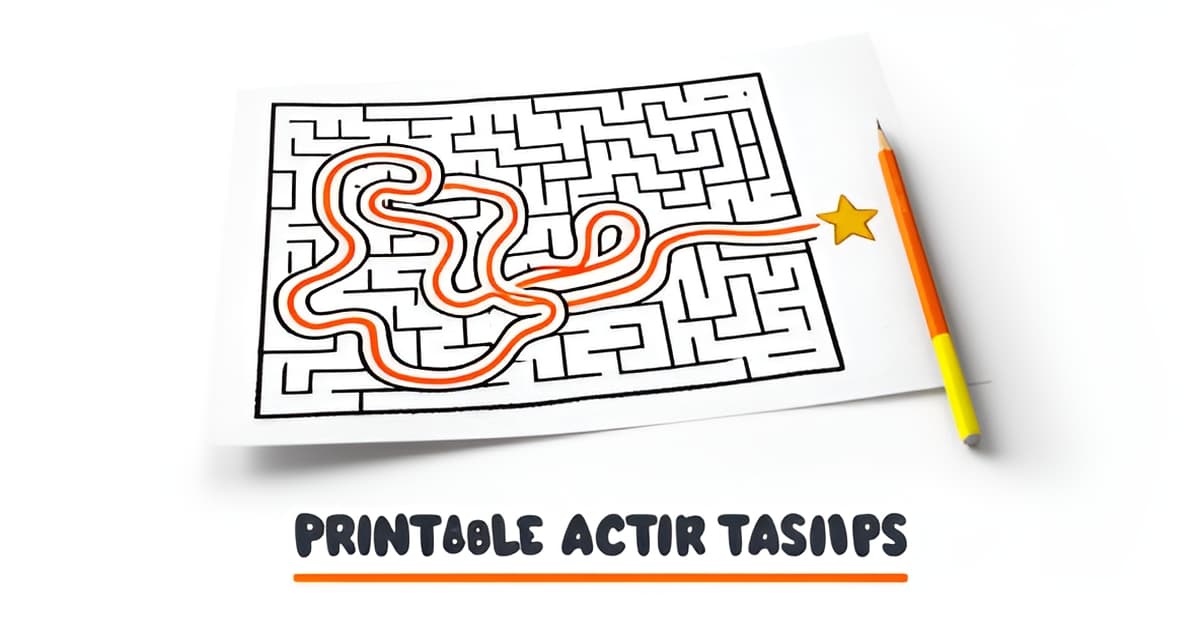
Is there a trick to mazes?
Key Facts
- No single method solves a well-designed maze on the first try, because mazes always demand some trial and error, according to Puzzle Genius.
- The right-hand rule works on any maze you could draw in one go without lifting your pen, Puzzle Genius explains.
- Maze solvers spend 15 to 25 percent of their total time exploring and backtracking, an eye-tracking study of 25 subjects found.
- Keeping one hand on the wall guarantees an exit in simply connected mazes, Wikipedia's algorithm overview confirms.
- It doesn't matter which hand you use, as long as you stay consistent, BBC Future reports.
- The brain breaks mazes into subsections and solves each step with simple heuristics, MIT neuroscientist Mehrdad Jazayeri says.
- Trémaux's breadcrumb algorithm is guaranteed to exit any maze, though never take a path with two trails, per BBC Future.
Why Mazes Frustrate Everyone (and Why There's No Magic Fix)
Picture it: your kid is hunched over a maze worksheet, pencil hovering, having circled the same dead end three times and starting to suspect the whole thing is rigged. That's usually the moment someone asks, half-joking, is there a trick to mazes? The honest answer is more interesting than you'd expect.
Here's the blunt truth: no single method solves a well-designed maze on the first try. As Puzzle Genius puts it, "there is no single magical method that will always lead you to the correct solution first time." Mazes aren't sudoku. You can't logic your way straight to the exit; a well-designed maze always demands a little trial and error, and that's by design.
So how do humans actually cope? Research from MIT offers a clue. Neuroscientist Mehrdad Jazayeri explains that we break a maze into subsections and solve each step with relatively simple heuristics, rather than tracking every possibility at once. "When we don't have the means to solve a complex problem, we manage by using simpler heuristics that get the job done," he says. In other words, your brain already uses tricks. It just uses several of them, flexibly, and switches strategies depending on what's working.
That flexibility shows up in the data, too. An eye-tracking study of 25 subjects found that exploration, the searching, backtracking phase, accounted for 15 to 25 percent of total solving time, and that share grew as mazes got harder. Frustration, in measurable terms, is a normal part of the process, not a sign your kid is bad at puzzles.
If you're planning a puzzle afternoon, it helps to have a few options on the table:
- A printable maze that matches your child's age and patience level, so difficulty doesn't do the frustrating all by itself
- A halloween trivia round as a palate cleanser between maze attempts
- A family trivia game so the whole table stays engaged while one person grinds through a tricky puzzle
Printoodle's printable mazes are built for exactly this kind of session: quick to generate, easy to reprint when a pencil line goes wrong, and adjustable in difficulty so nobody hits a wall they're not ready for.
Now for the good news. While no method is universal, one trick works surprisingly often, and it's simple enough to teach a five-year-old in under a minute. It's called the right-hand rule, and it's been getting people out of mazes for a very long time. The next time your kid is stuck, it's the first thing to try.
The Right-Hand Rule: The Trick That Actually Works (Most of the Time)
So you're staring at a printable maze, pencil hovering, wondering if there's a shortcut. There is, and it's delightfully low-tech: the right-hand rule, the most well-known maze-solving trick there is.
Here's the whole technique. Put your right hand on the wall beside you at the entrance. Keep it there, and keep walking, letting your hand trace every twist, dead end, and turn. When you hit a dead end, your hand follows the wall around the loop and carries you back out. That's it. No memory required, no pencil marks, no backtracking decisions.
The guarantee behind it is real, with conditions. According to Wikipedia's overview of maze-solving algorithms, if a maze is simply connected, meaning every wall is connected to the outer boundary, then keeping one hand in contact with one wall means you're guaranteed not to get lost, and you'll reach an exit if one exists. In technical terms, wall-following works as a depth-first traversal of the maze's tree structure. Puzzle Genius puts it in a way that's easy to remember: the trick works on any maze you could draw in one go without lifting your pen. If the whole maze is one unbroken line, your hand will eventually trace all of it, including the path to the exit.
One reassuring detail from BBC Future: it doesn't matter which hand you use, as long as you're consistent. Left hand on the left wall works just as well as right hand on the right wall. What breaks the method is switching sides halfway through.
Know the limits before you trust it:
- Mazes with "islands," disconnected wall sections floating inside the maze, can trap you circling that island forever. Puzzle Genius notes these are often placed deliberately to defeat wall-followers.
- The method assumes you start at the entrance. Starting from an arbitrary point inside the maze can leave you looping along walls with no way out.
- If the start or finish sits in the maze's centre, BBC Future warns the trick may not work at all.
- Complex real-world mazes defeat it too: the beech hedge maze at Escot Gardens in Devon has five bridges, making it far from simply connected.
The good news for families and classrooms: most printable mazes, including the ones you can generate with Printoodle, are simply connected by design, so the right-hand rule works exactly as promised. Print a batch, hand the kids the trick, and watch a "hard" maze turn into a five-minute win. It's the closest thing mazes have to a genuine cheat code, as long as you know when to use it.
When the Trick Fails: Islands, Loops, and Tricky Exits
The right-hand rule feels like a cheat code, but it has a breaking point. This classic "hand on the wall" trick works beautifully in simple layouts, yet it crumbles the moment a maze introduces islands, those disconnected wall sections placed deliberately to frustrate wall-followers. Research confirms that starting down a looping corridor can trap a solver circling a blue island forever, with no exit in sight.
For families printing puzzles at home, these failures are more than theoretical. Studies show that 15 to 25 percent of total solving time is spent in exploration, and initial solving time climbs linearly as maze difficulty increases. When the trick fails, the circular-trap failure mode leaves kids frustrated and pencils moving in endless loops.
The honest solution is to trade the trick for a guaranteed method. Trémaux's algorithm, documented by BBC Future, works by leaving breadcrumb trails: at every junction, choose a new path randomly, prefer paths used once over paths used twice, and never, ever select a path already containing two trails. This approach is guaranteed to exit any maze with defined passages, though it won’t necessarily find the shortest route. For kids with a pencil, the Hansel and Gretel path-marking method offers a reliable backup, simply mark each corridor traveled and avoid any path with two marks, ensuring a solution even in mazes with islands. Dead-end pruning, while time-consuming, provides another fool-proof option by blocking every dead end starting from the exit.
Printoodle’s printable mazes are designed for curious minds, and knowing these strategies turns a potential dead end into a solvable challenge. Print it. Doodle it. Done.
Teach It, Print It, Play It: Using Maze Tricks at Home and in Class
Maze-solving often feels like a game of luck, but research into human strategy reveals consistent patterns that anyone can use. A 2013 eye-tracking study tracking 23 undergraduates and two paid volunteers found that solvers allocate roughly 15 to 25 percent of total solving time to off-path guidance and exploration, with that exploration time increasing as maze difficulty rises. This data helps explain why a simple "hand-on-the-wall" approach works for some layouts but stumps others entirely.
The right-hand rule, keeping your right palm pressed against the right wall as you navigate, is the most widely taught trick, and it works reliably only on mazes that are "simply connected," meaning the walls form one continuous path without isolated islands or loops. According to Wikipedia and BBC Future, if a maze contains islands, the rule can trap a solver circling that feature forever. Puzzle Genius notes that roughly 60 percent of physical labyrinths intentionally include these features to defeat the technique. For these complex layouts, the Hansel and Gretel method of marking your path as you go offers a guaranteed solution, though it requires a pencil and the discipline never to reuse a marked corridor.
Printoodle’s printable maze generator lets users start with easier designs where the right-hand rule succeeds, then progress to trickier layouts that require path-marking. Teachers can pair a maze session with the halloween trivia or family trivia game tools to create a quiz-plus-activity kit that keeps kids engaged from start to finish. When the solving feels stuck, switching to Trémaux’s algorithm, leaving breadcrumb trails at each junction and preferring unexplored paths, provides a fail-safe that works for almost any maze type.
Ready to test a trick for yourself? Print a custom maze from Printoodle and see which strategy clicks best with your solving style.
Frequently Asked Questions
Is there a trick to mazes that always works?
How does the right-hand rule work in a maze?
When does the right-hand rule fail?
What maze-solving method works on any maze?
Why do I spend so much time going down dead ends in mazes?
Does it matter which hand I use for the wall-following trick?
So, Is There a Trick to Mazes? Yes, and Now You Have Three
So, is there a trick to mazes? The honest answer: there's no magic method, but there are real, teachable strategies. The right-hand rule works beautifully on simply connected mazes, the kind you can draw without lifting your pen, and it's simple enough for a five-year-old to learn in a minute. When islands and loops break that trick, breadcrumb methods like Trémaux's algorithm and the Hansel and Gretel path-marking approach guarantee an exit from almost any maze. And remember: research shows solvers spend 15 to 25 percent of their time exploring and backtracking, so a little frustration is part of the process, not a sign of failure. The real win is matching the maze to the solver: start easy, teach the tricks, and level up as confidence grows. Printoodle's printable maze generator makes that easy, pick your difficulty, print as many copies as you need, and reprint for free when a pencil line goes rogue. Ready to put the tricks to the test? Generate a maze, hand your kid the right-hand rule, and let the solving begin. Print it. Doodle it. Done.