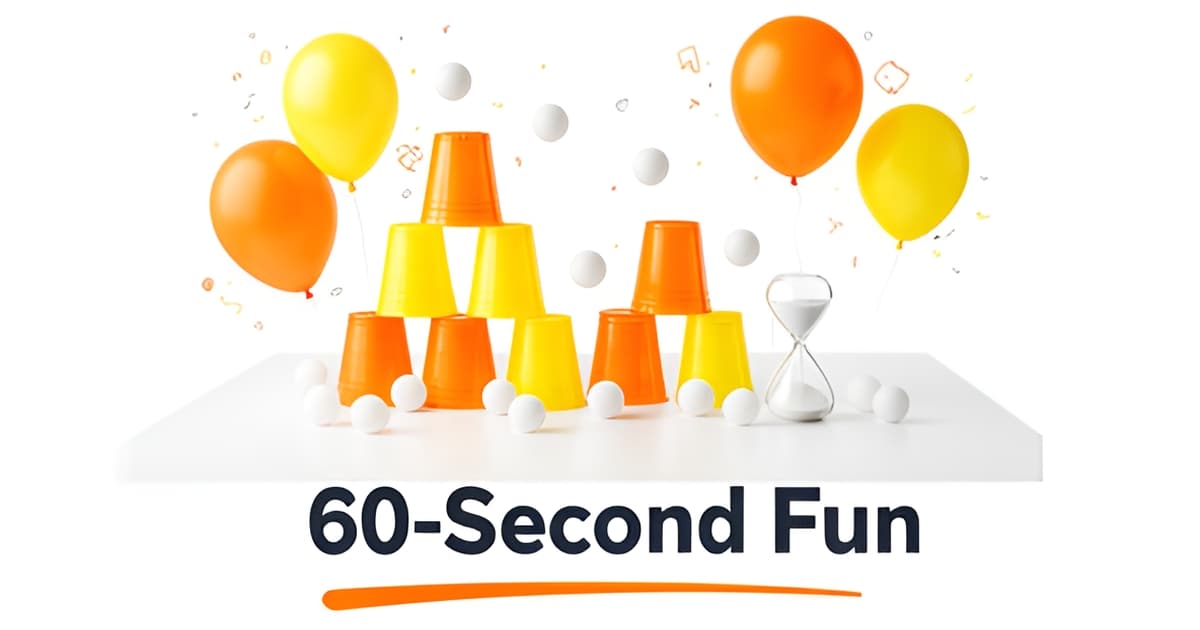
One Minute Games for Kids: Birthday Party and Classroom Challenges
Key Facts
- One dollar-store trip covers a full one minute games for kids party: cups, ping-pong balls, balloons, and an odds box according to hosting guides.
- A real 10-game birthday party used 144 ping-pong balls, 36 plastic cups, and 90 minutes of play per one mom's three-party case study.
- Stack Attack builds an 8-7-6-5-4-3-2-1 pyramid from 36 cups, dropping to 28 for beginners per Today's Parent.
- Station rotation with 3–4 games on separate tables scales Minute to Win It parties to 20+ guests per staging guidance.
- WeAreTeachers catalogues 75 kid-friendly 60-second games, many needing no equipment at all in its classroom collection.
- A 40-year PE teacher says these games teach kids to handle disappointment while cheering for friends' successes per expert insights.
- A mom's proven scoring system awards 5 points for first, 3 for second, and 1 for third each round from her birthday party format.
Why 60-Second Challenges Are the Easiest Party Win (and Which Ones to Skip)
You've got a dozen kids, zero budget, and a hard rule against screens. That's the exact moment one minute games for kids earn their spot in your party plan: cheap, loud, and over before anyone gets bored.
The format is simple. Each challenge runs exactly 60 seconds using household items, and the clock does the work of keeping energy high. Parenting experts and a 40-year PE teacher back the format because it builds fine and gross motor skills, eye-hand coordination, focus, and a tolerance for losing. Licensed counselor Michael Anderson adds that a 60-second window forces full concentration, which is exactly the kind of short burst kids can sustain.
It's also the cheapest entertainment on the market. One dollar-store run covers nearly everything: a sleeve of plastic cups, a tube of ping-pong balls, a bag of balloons, plus a snack-and-odds box of cookies, dice, pencils, rubber bands, tissue boxes, and straws. Hosting guides note that this kit supports 50+ game variations and scales past 20 guests when you run stations.
But here's the filter most lists skip. A surprising number of popular Minute-to-Win-It games put things in kids' mouths, and those need to go. Skip these entirely:
- Cookie Face / Face the Cookie, where a cookie travels forehead to mouth using only facial muscles
- Suck It Up and any straw-suction transfer (shared straws, shared candy)
- Nose Dive, which dips a nose in petroleum jelly to carry cotton balls
- Noodling Around (spaghetti held in teeth) and Bite Me (bags lifted by mouth)
- Mad Dog and Pom-Pom Drop with a spoon gripped in the teeth
The hygiene math is obvious once you say it out loud: a classroom of 24 kids passing a shared cookie is a cold waiting to happen. The good news is that party planners have already built non-mouth swaps for nearly all of these: a ping-pong ball instead of a cookie, chopsticks instead of straw-suction, a spoon held in the hand instead of the teeth. Same laugh, zero germs.
Once you've filtered the list, the winning move for a big group is the station rotation. Set up three or four games on separate tables and let teams cycle through. Classroom teachers use the same structure for brain breaks and inside recess, and it keeps every kid playing instead of waiting in line.
If you want a head start, Printoodle publishes a curated set of one minute games for kids with the mouth-catch games already removed, plus printable scorecards and station signs you can run off in minutes. There's a matching set of 60-second party games if you want to theme the stations to a birthday or holiday.
Print it. Doodle it. Done.
Grab a ready-to-print station kit and skip the hygiene guesswork.
The Kid-Safe Game Bank: Best No-Mouth Challenges for Ages 3 to 12
Every game in this list keeps hands, feet, and teamwork doing the work. No cookies balanced on faces, no straw-sucking, no pantyhose on heads. Just fast, funny challenges built from cups, balloons, and balls, all playable in 60 seconds.
Here's the kid-safe bank, with supplies and a one-line rule for each:
- Stack Attack: 36 plastic cups stacked into an 8-7-6-5-4-3-2-1 pyramid, then unstacked, in under a minute. Beginners drop to 28 cups.
- Defying Gravity: Keep three balloons in the air for a full 60 seconds. Little kids can play with just two balloons.
- Junk in the Trunk: An empty tissue box loaded with 8 ping pong balls ties to the waist; kids shake until the box is empty, no hands allowed.
- Keep It Up: Three balloons must stay inside a taped square on the floor. Shrink or grow the square to adjust difficulty.
- LEGO Tower: Build the tallest one-handed tower in a minute. Simple rule, big concentration.
- Sock Sort: Match up pairs of socks against the clock. Start beginners with six pairs.
- Speedy Bowling: Roll or toss five tennis balls to knock down pins or bottles. Count knocked-down pins for scoring.
- Cotton Ball Spoon: Scoop cotton balls onto a spoon and carry them across the room. Skip the blindfold for little ones.
Most of these come straight from curated lists of 75 Minute to Win It games for kids and 50 kid-tested challenges, so you can swap in alternatives whenever a game doesn't land with your group.
A few tweaks make these work for ages 3 to 5. Roder, an expert cited by Today's Parent, advises avoiding small objects like pennies and dice for young children since fine motor skills are still developing. She also recommends games with only one or two steps, because younger kids struggle with complex multi-step instructions. In practice that means wider containers for dropping games, larger pieces for little hands, and no blindfolds.
Scoring stays simple for this age group too. Count what each child finishes: cups stacked, socks matched, pins knocked down. Placement points like the 5/3/1 system some party hosts use work better for kids 8 and up. For preschoolers, effort and applause beat leaderboards every time.
One more hosting tip worth stealing: time yourself on each station before the party so you know which games are too easy and which are nearly impossible, then adjust targets before guests arrive. And keep a printed stack of instruction cards at each table. If you want ready-to-print game cards and station signs for your one minute games for kids lineup, Printoodle can generate personalized party packs with your child's name in seconds, so setup is as quick as the games themselves.
How to Run Stations at a Birthday Party or in the Classroom
The games are the easy part. What trips up most hosts is logistics: how to keep twenty sugared-up children engaged when only one kid can bounce a ping-pong ball at a time. The fix is picking the right staging format before you buy a single plastic cup.
According to staging guidance from The Gourmet Host, three formats cover every group size. A single station works best for groups under a dozen: one table, one game at a time, everyone watching. Parallel heats put two players side by side, with the fastest finish winning the round. And for crowds of 20 or more, station rotation, with 3–4 games set up on separate tables that teams cycle through, is described as the simplest way to run group games for a big crowd.
- Single station: best for under a dozen kids; one table, whole-group play.
- Parallel heats: two players compete head-to-head; fastest finish wins.
- Station rotation: 3–4 games on separate tables; scales to 20+ guests.
Prep work matters more than game selection. Event planner Jasmine Charbonier, quoted in Today's Parent, recommends creating visually clear instruction cards, pre-packaging game materials in labeled containers, and color-coding different team stations. She also advises measuring your available square footage in advance so games fit the space without feeling cramped.
Test each game before the party, too. The Gourmet Host suggests timing yourself on each station once so you know which games are too easy and which are nearly impossible, then adjusting targets before guests arrive rather than mid-game. And gather all materials the day before: party planning guidance from ReplayMyDay notes that having everything ready means smoother transitions, and recommends keeping 2–3 backup games in case one falls flat.
Teachers get a shortcut here. WeAreTeachers recommends assembling a permanent "Minute to Win It box" stocked with plastic cups and bowls, ping-pong balls, balloons, and other basics, so a brain break or indoor recess game is always ready. Many of their 75 catalogued games use common classroom items or need no equipment at all.
If you're building your station lineup from scratch, our one minute games for kids generator creates themed, printable challenge cards in seconds, and the 60-second party games tool pairs them with score sheets and station signs. Print them the day before, drop each set into its labeled container, and your rotation runs itself.
One Dollar-Store Trip: Your Complete Supply Kit
The best part about one minute games for kids? You can stock an entire party's worth of challenges in a single dollar-store run. According to The Gourmet Host's supply guide, nearly every game in the format runs on four cheap categories: a sleeve of plastic cups, one tube of ping-pong balls, one bag of balloons, and an odds box of straws, rubber bands, tissue boxes, pencils, and dice.
Before you shop, it helps to know what a real party actually used. The mom behind momof6.com ran a 10-game Minute to Win It party three times for three different sons, and her shopping list was specific: 144 ping-pong balls, 36 plastic cups, and 90 minutes of play for the whole game portion. That's your baseline for a birthday crowd of roughly a dozen school-age kids.
Scaling from there is simple math. If you're hosting 20 or more guests, The Gourmet Host notes that station rotation formats (3 to 4 games on separate tables) keep big crowds moving, which means you'll want enough cups and balls to run those stations simultaneously rather than resetting one table between rounds.
Your dollar-store shopping list
- Plastic cups: two sleeves covers a 36-cup Stack Attack pyramid plus spares (beginners can drop to 28 cups)
- Ping-pong balls: two to three tubes; games like Junk in the Trunk use 8 per player, so multiply by your headcount
- Balloons: one bag runs Defying Gravity (3 per player) and Keep It Up
- Odds box: straws, rubber bands, tissue boxes, pencils, and dice for sorting, stacking, and matching challenges
- Prizes: momof6.com used large chocolate bars for 1st, standard bars for 2nd, and snack-size bars for everyone else
A few shopping notes for younger guests. Roder, a contributor cited in Today's Parent's expert roundup, advises avoiding small objects like pennies and dice for young children, so if preschoolers are coming, swap those games for balloon and cup challenges instead. And skip anything mouth-based: straws in your kit are for fanning and sorting, not suction games.
Once you've shopped, pack everything into one labeled bin. WeAreTeachers recommends keeping a permanent "Minute to Win It box" stocked with cups, balls, and balloons so a classroom brain break or rainy-day round can happen anytime. If you want printable score sheets, station signs, or themed game cards to tuck in alongside the supplies, Printoodle's generator turns out party packs in seconds, including ones personalized with the birthday kid's name.
Scoring and Prizes That Keep Little Kids Happy
A four-year-old doesn't care about point totals. She cares that she stacked eleven cups before the timer beeped. For ages 3 to 7, keep scoring count-based and visible: cups stacked, balls tossed into a bucket, balloons kept off the floor. As one party-planning guide puts it, young kids do best when success is measured in items completed, not abstract scores.
Save the placement systems for older kids. The momof6.com birthday format awards 5 points for first, 3 for second, and 1 for third each round, and it works beautifully for ten-year-olds tracking a running total. Hand that same rubric to a preschooler and you'll spend the party explaining math instead of playing. Counting beats ranking for little kids, and it lets every child finish with a number they're proud of.
Event planner Jasmine Charbonier's advice is refreshingly blunt: "The winner wins a prize, but it doesn't need to be costly." The momof6.com party proves the point, handing out 7-ounce chocolate bars for first place, 1.55-ounce bars for second, and snack-sized bars for every other participant. Small prizes, something for everyone, and nobody leaves empty-handed.
A few ground rules keep the prize table simple:
- Stock a participation prize so every child gets something, even a sticker or snack-sized treat.
- Keep first-place prizes small and cheap; a big reward raises the emotional stakes for losing.
- Praise effort out loud, not just wins. Roder, a child development expert quoted in Today's Parent, urges adults to "dole out plenty of praise for effort" and discourage trash-talking.
That last point matters more than any prize. Len Saunders, a PE teacher with 40 years of experience, notes that these games teach children "how to handle disappointment while also cheering for their friends' successes." Losing a 60-second round is a low-stakes rehearsal for bigger disappointments later.
Pace matters as much as prizes. Party planners recommend you alternate active games with calmer ones so kids don't get overstimulated and melt down in hour two. Follow Defying Gravity with Memory Match. Put a quiet LEGO tower round after Balloon Stomp. Rhythm is the difference between a party and a sugar crash.
Want the paperwork handled for you? Printoodle's one minute games for kids generator creates printable score sheets for count-based rounds, station signs for your rotation tables, and themed game cards matching your party's motif. It pairs with the 60-second party games tool for classroom parties and bigger events. Generate it, print it, and run your rounds. Print it. Doodle it. Done.
Frequently Asked Questions
What are the best one minute games for kids that don't involve putting things in their mouths?
How many one minute games do I need for a birthday party with 20 or more kids?
How should I score one minute games for preschoolers versus older kids?
Are one minute games actually good for kids, or just party filler?
How do I make one minute games easier for 3 to 5 year olds?
How much do supplies for one minute games cost?
One Timer, One Dollar, One Unforgettable Party
The math on one minute games for kids is hard to beat: a dollar-store run, a handful of cups and balloons, and a station rotation that keeps twenty kids playing instead of waiting in line. You've got the kid-safe game bank, the staging formats that scale from a living room to a classroom, the supply list, and a scoring approach that works whether your crowd is three or thirteen. The only thing left is printing the cards, packing the bin, and starting the clock. If you'd rather skip the setup scramble, Printoodle turns out themed challenge cards, score sheets, and station signs in seconds, including a matching set of 60-second party games you can personalize with the birthday kid's name. Print it, drop each set into its labeled container, and your rotation runs itself. Print it. Doodle it. Done.