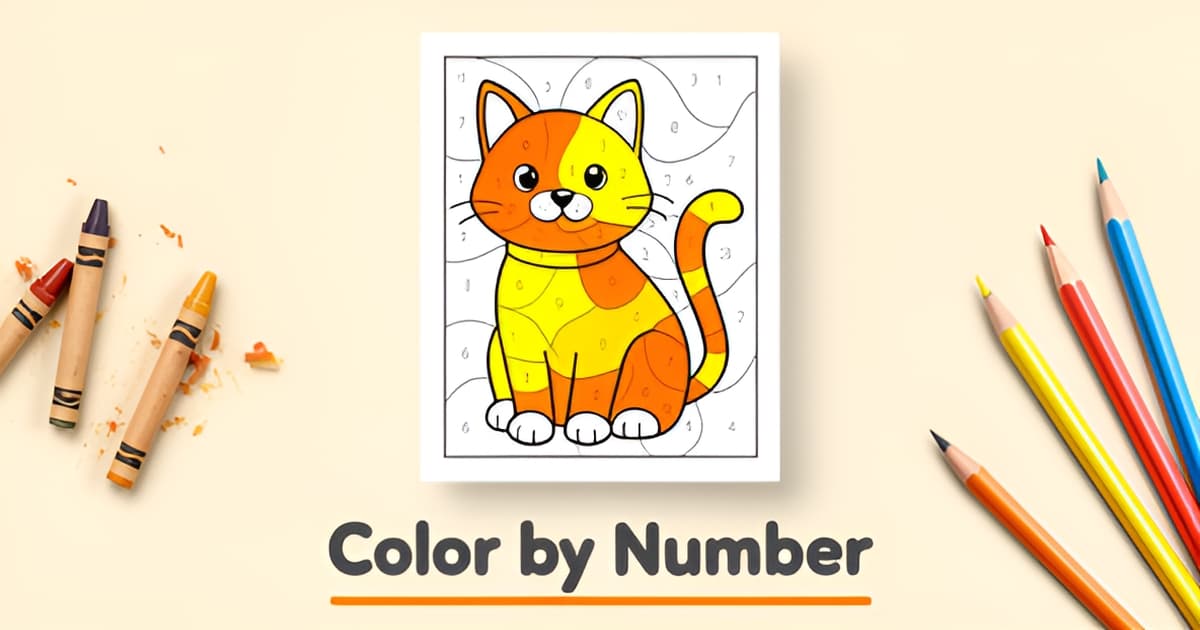
What are color by number worksheets?
Key Facts
- The first commercial paint-by-number kits launched in 1954 and sold over 3 million units in just two years, according to craft historians.
- Dan Robbins invented modern paint-by-number around 1951 at Detroit's Palmer Paint Company, as documented by Pinwheel Crafts.
- Kids' color by number pages use 8-12 colors with large cells, while adult versions run 24-32 colors, per technical conversion guidelines.
- For best photo-to-worksheet results, upload images at least 800×800 pixels with a single clear subject, technical guides recommend.
- The Happy Color app sees 4 million monthly US downloads, evidencing strong demand for guided coloring.
- Teachers use color by number as formative assessment, not summative, says education consultant Heather Wagoner.
- Guided coloring removes colour-choice anxiety and builds art confidence in children as young as three, according to Lil Legends Books.
What Color By Number Actually Is
If you're wondering what are color by number worksheets, the answer is refreshingly simple: they're coloring pages where each region carries a number, and a key tells you which color that number represents. Fill in every numbered space correctly, and a finished picture emerges. It's art with training wheels, and that's precisely the point.
The format has deeper roots than most people realize. According to craft historians, Dan Robbins developed the modern paint-by-number concept around 1951 at the Palmer Paint Company in Detroit, and the first commercial Craft Master kits launched in 1954. They sold over 3 million units in their first two years. Clearly, people liked having the decisions made for them.
The core mechanic hasn't changed much since. A number line or legend maps each digit to a specific color, and the colorist matches, fills, and watches the image take shape. What has changed is how these worksheets get made. Where 1950s kits shipped in boxes, today's versions are generated in seconds from photos, documents, or short briefs.
Printoodle sits squarely in that modern wave. You upload a photo of a pet, a family member, or a classroom subject, spend a credit, and download a print-ready PDF in Letter or A4 format. The tool handles the number chart and color mapping automatically, deciding how many colors to use and how large each cell should be based on the image and intended audience.
That mapping is where the craft lives. Technical guides from dedicated conversion tools show how much the settings matter: worksheets for young children typically use 8–12 colors with large, forgiving cells, while detailed adult versions run 24–32 colors with much finer detail. The same photo can become a preschool-friendly page or an intricate pixel-style challenge, depending on the preset.
What makes browser-based generation such a shift is accessibility. There's no software to install, no queue to wait in, and in some tools, not even an account to create. You drop in a photo and get results before you've finished reading the instructions. That zero-friction experience is a long way from ordering a boxed kit from a 1950s catalog.
The format's persistence comes down to how it makes art feel approachable, as one children's publisher puts it: guided coloring removes color-choice anxiety and builds confidence instead. Kids as young as three can start, and adults still enjoy the structured, calming process. Seventy years on, the numbered canvas is still doing its job.
Educational Value and Audience Benefits
Color by number worksheets occupy a unique space where structured activity meets educational reinforcement. For children, the format serves as a gateway to number recognition and fine motor development; following a color key requires scanning, matching, and controlled crayon movement, skills that translate directly to early writing readiness. Research indicates that age-appropriate specifications matter: younger learners benefit from 8 to 12 colors with larger cell sizes and labels, while detailed adult versions typically employ 24 to 32 colors with smaller, more precise cells. Educators have long recognized this dual potential, using the format not as free-form art but as a formative assessment tool. As education consultant Heather Wagoner notes, these worksheets "are not suitable for summative assessment but work as formative assessing," allowing teachers to observe student progress, identify knowledge gaps, and form small groups for targeted practice without the pressure of a graded test.
Beyond the classroom, the activity offers measurable anxiety-reduction benefits. The guided nature of matching a number to a specific color removes the pressure of creative decision-making, a feature that Lil Legends Books argues "builds art confidence by removing colour-choice anxiety." This structured approach can calm the mind and refocus the body, making it an effective wind-down routine. Mind Matters Pedagogy describes the worksheets as "the Swiss Army knife of teaching tools" that "reinforce key concepts, help students stay engaged, and ease anxiety, all while making your life easier," particularly when pairing visual elements with scientific concepts to improve recall through multisensory learning.
Printoodle supports this versatile format by enabling users to generate personalized, print-ready color by number worksheets from photos or brief prompts. The platform’s browser-based processing creates four simultaneous views from a single upload, allowing users to select the version that best fits their needs before downloading a PDF. With a free tier of 10 credits upon email verification and credit packs starting at $5, teachers and parents can quickly produce customized activities tailored to specific lesson themes or individual student needs. Whether used to reinforce number concepts in a preschool setting or to provide a calming, structured task for older students, color by number worksheets deliver academic and emotional benefits in a single, accessible format.
number line and number chart tools are available to complement these activities. Print it. Doodle it. Done.
Making It Work: Tips, Quality, and Getting Started
A great color by number worksheet starts before you ever pick up a pencil. The photo you upload and the paper you print on decide whether the finished page looks like a keepsake or a smudge. Here's how to set yourself up for a page that actually works.
Start with the right photo. According to the technical guidelines for photo-to-worksheet conversion, aim for a minimum of 800×800 pixels, a single clear subject, good light with real shadows, and a background that contrasts with your subject. Busy scenes, very dark or backlit shots, and heavy digital zoom all fight the conversion process. If your photo is borderline, tools like a sharpness slider can rescue it before you commit.
Choose your version deliberately. Modern generators typically produce four views from a single upload, so don't just grab the first one. Compare them for clean edges and readable number labels, especially around faces and fine details. The same source recommends 8–12 colors with large, forgiving cells for young children, versus 24–32 colors with smaller cells for detailed adult pieces. Pick the view that matches the colorist, not the photo.
Print on paper that can take the media. For colored pencils or crayons, standard printer paper is fine. If paint is on the menu, use 120 gsm or heavier stock to prevent buckling from watercolor or acrylic. One practical habit from experienced practitioners: always print a single test page first before running off a full set.
Printoodle generates print-ready Letter and A4 PDFs with every download, and reprints from your library stay free, so experimenting with different versions costs you nothing but time.
Here are quick preset recommendations by age and media:
- Ages 3–5: 8–10 colors, large cells, bold outlines. Crayons or thick colored pencils.
- Ages 6–12: 10–12 colors, medium cells. Standard colored pencils on regular paper.
- Teens and adults: 24–32 colors, fine cells. Sharp pencils on heavier stock.
- Painters of any age: fewer colors, 120 gsm paper minimum.
For teachers, the guidance from classroom practitioners is clear: use these worksheets as formative assessment, not summative. Watch how students work, then group them accordingly. Gift-givers get the simplest workflow of all: upload a pet or family photo, pick the friendliest of the four generated views, print on decent paper, and pair it with a small set of sharpened pencils. The result feels personal in a way no store-bought book can match.
Your First Worksheet Is One Photo Away
So, what are color by number worksheets? They're a seventy-year-old format that still delivers: number recognition and fine motor practice for little ones, formative assessment for teachers, and a genuinely calming wind-down for adults. The rules are simple, pick a photo with a clear subject and good light, match the preset to your colorist (8–12 colors for ages 3–5, 24–32 for detailed adult pieces), and print on paper that suits your medium. What's changed since Dan Robbins sold millions of boxed kits is the convenience: you no longer need a catalog or a shipping wait. With Printoodle, you upload a photo, spend a credit, and download a print-ready PDF in seconds, with the number line and number chart handled for you, plus free reprints whenever you need them. Start with the free tier of 10 credits and turn a pet photo or classroom theme into this week's favorite activity. Print it. Doodle it. Done.