What are good classroom games?
Key Facts
- 67.7% of students say gamified courses are more motivating than regular classes, according to market research.
- Knowledge and skill-based games are the largest classroom game segment at 34.3% of the market, industry analysis shows.
- Offline, in-person classroom games still hold roughly 53% of revenue share, per recent research.
- Custom gamified courses cost $2,000–$20,000 each, putting them out of reach for most schools, research finds.
- AI-based games are the fastest-growing education game type at roughly 22% annual growth, market data shows.
- Duolingo shipped 148 AI-generated language courses in under a year, work that would take a decade manually, industry analysis reports.
- The game-based learning market is projected to grow from $27.75 billion in 2025 to $136.62 billion by 2035, according to forecasts.
Why classroom games work (and why motivation is the real goal)
When students were asked how they feel about gamified courses compared with regular classes, 67.7% said the gamified versions were more motivating, according to market research. That's the core reason classroom games matter. If you're wondering what are good classroom games, the honest answer starts with motivation: a game that doesn't make students want to participate won't teach them much, no matter how clever the design.
Most teachers already know games boost engagement. The harder problem is picking ones that actually teach. A game can be fun for twenty minutes and leave nothing behind, or it can drive real practice with vocabulary, math facts, or reading comprehension. The difference usually comes down to structure.
So what separates a good classroom game from a time-filler? Research on gamification points to a handful of mechanics that consistently drive engagement and retention:
- Points and badges that give students visible, immediate feedback on progress
- Leaderboards that tap into healthy peer competition
- Clear achievement goals, so students know exactly what "winning" requires
- Knowledge and skill-based formats, which make up the largest classroom game segment at 34.3% of the market, according to industry analysis
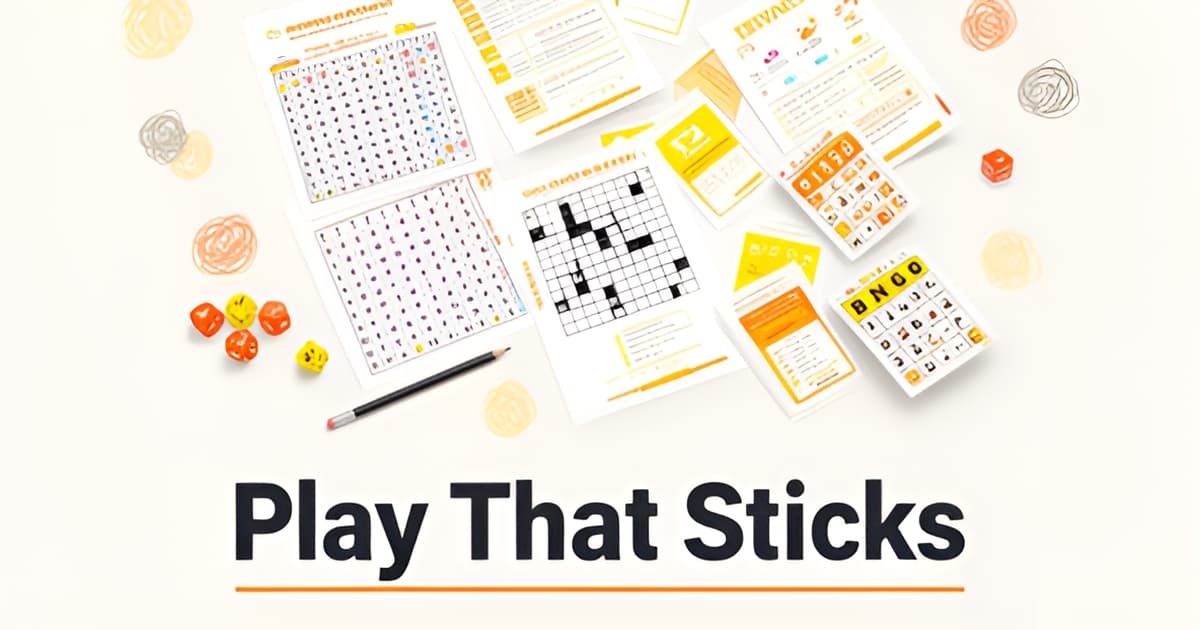
Notice that quiz-style games, word searches, bingo, and trivia cards fit this profile well. They build in competition and achievement naturally, and they tie directly to lesson content. That's also why offline, in-person games still hold roughly 53% of revenue share: teachers prefer collaborative, hands-on formats where they can watch students work and step in when someone gets stuck. Printable games fit that reality. A bingo round built from this week's spelling words or a custom word search from your science vocabulary costs minutes to prepare, and tools like Printoodle let you generate print-ready versions from your own lesson material in seconds.
The motivation statistic is worth sitting with for a moment. Nearly seven in ten students find gamified courses more motivating, and motivation is what carries them through the repetitive practice that builds retention. Gamified approaches lead to deeper engagement with material, which translates into better information retention and comprehension. In other words, the game isn't the goal. Motivation is the goal, and the game is how you get there.
The practical takeaway: pick games with clear rules, real competition or achievement mechanics, and content that matches what you're teaching. Everything else is decoration.
The games teachers reach for most: quiz-style and knowledge-based formats
Ask teachers what fills their game shelf and the answer is rarely high-tech. Knowledge and skill-based games hold the largest share of classroom game use at 34.3%, which tells you something simple: the best classroom games are usually the ones that test and build what students are already learning. Trivia, flashcards, and quick recall activities beat elaborate setups almost every time.
Why do these formats work so well? Because they turn review into competition without much prep. Research on gamification points to points, badges, and leaderboards as the mechanics that push students to compete and stay engaged, and quiz-style games deliver all three with nothing more than a stack of cards and a scoreboard on the board.
The concrete versions of this category are familiar to any teacher:
- Trivia cards drawn from your own lesson material, perfect for team rounds or exit-ticket review.
- Flashcards for paired practice, where students quiz each other in two-minute bursts.
- Word searches and crosswords that reinforce vocabulary without feeling like a test.
- Bingo, where the caller reads definitions or facts and students match them on their cards.
- Mazes, dot-to-dot puzzles, and custom worksheets for early finishers or quiet stations.
Notice what all of these have in common: they're printed, physical, and played face to face. That's not nostalgia. Offline, in-person games still hold about 53% of revenue share, largely because traditional education prefers the collaborative, hands-on environments where students build direct relationships with each other. Teachers also report they can't engage as effectively in online formats for hands-on subjects. Paper games fit that preference exactly.
The catch has always been time and cost. Building a custom gamified course runs between $2,000 and $20,000 per course, and full platforms start at $10,000 or more, budgets most schools simply don't have. That's the gap Printoodle was built for: teachers can generate print-ready trivia cards, bingo sets, word searches, and worksheets from their own lesson material in seconds, then reprint them free whenever a class needs another copy.
It also matters when you need a game right now. A substitute showed up late, a lesson ran ten minutes short, or the class earned a reward period. Having a bank of one minute games for kids ready to print means those gaps become game time instead of chaos time.
The broader trend backs this approach. Generative AI now updates educational game content in days rather than months, and it's the same shift that lets a teacher type in this week's spelling list and get a printable word search back before the copier warms up. Good classroom games don't need a big budget. They need your actual content, a printer, and a format students already love to compete over.
The budget problem: why most schools can't afford great games
The games that work best aren't always the ones schools can buy. When teachers ask what are good classroom games, the honest answer often collides with an uncomfortable number on a purchase order.
According to market research on game-based learning, developing a single custom gamified course costs between USD 2,000 and 20,000, and licensing a full platform runs USD 10,000 to 50,000 or more. The same report is blunt about the consequence: "Many, if not most, of the schools and districts do not have anything close to a budget that allows for either building bespoke solutions or purchasing existing game-based learning platforms."
So the teacher who wants to run a quiz-based review game faces a choice between a five-figure procurement process and a photocopier. It's not a fair fight. Even the roughly USD 190 billion in U.S. ESSER relief funding that industry analysis says flowed into digital learning infrastructure mostly landed on district-level systems, not on the individual teacher who needs a bingo set for Friday's vocabulary review.
The irony is that the expensive, platform-based route isn't even what most classrooms use. Offline, in-person games held about 53% of revenue share in 2023, largely because traditional education prefers collaborative, face-to-face environments where students build direct relationships. The format teachers actually reach for is printable, physical, and played together. The budget barrier, in other words, blocks a product many classrooms never wanted in the first place.
The practical answer is for teachers to generate the games themselves, from their own lesson material, at close to zero cost. A custom word search built from this week's spelling list costs a sheet of paper. So does a set of trivia cards, a bingo grid, or a round of one minute games for kids printed for a transition window between lessons.
This is where the generative-AI shift matters for ordinary classrooms. The same research notes that AI pipelines now update educational content "in days, not months," and points to Duolingo shipping 148 AI-generated language courses in under a year versus a decade of manual development. That same capability, scaled down to a single classroom, means a teacher can turn a lesson brief into a print-ready game in seconds.
What the low-cost route looks like in practice:
- Word searches and crosswords built from your own vocabulary lists
- Bingo and trivia cards for review sessions and rainy-day fillers
- Flashcards generated straight from lesson material
- Quick, one-page games for transitions and early finishers
Printoodle sits squarely in this space: teachers generate worksheets, word searches, and quizzes from their own material, print them, and reprint from their library for free. No procurement cycle, no platform license, no waiting on a district budget that was never coming.
The budget problem is real. The workaround is already sitting next to the photocopier.
How to make classroom games from your own lesson material
The best classroom games are the ones built from your own lesson material, and for the first time, that's actually practical for an ordinary Tuesday morning. Generative AI has collapsed the timeline for creating educational content: industry analysis describes AI pipelines that now update educational content "in days, not months," displacing the static worksheets and slide decks teachers have relied on for years.
The most famous example is Duolingo, which used generative AI to launch 148 new language courses in under a year, a body of work that would have taken more than a decade to build manually. That same shift is reaching everyday classrooms. AI-based games are the fastest-growing game type in education at roughly 22% annual growth, according to market research, because they can personalize feedback and adjust difficulty in real time.
Here's why this matters if you're wondering what are good classroom games for your own students. Custom games used to be out of reach: bespoke gamified courses cost $2,000 to $20,000 each, and platform startup costs run $10,000 to $50,000 or more. Most schools simply don't have that budget. Printable, teacher-generated games sidestep the problem entirely.
Printoodle sits squarely in this shift. You upload your lesson material or write a short brief, and the generator produces print-ready pages drawn from your actual curriculum: word searches built from this week's vocabulary, trivia cards from your unit review, bingo, flashcards, mazes, and dot-to-dot pages themed to your topic. Need something for the gap before lunch? Try one minute games for kids as quick fillers.
The workflow takes minutes:
- Upload a document, photo, or a short text brief describing your topic
- Generate print-ready activity pages from your material
- Download the PDF (Letter or A4) and print for your class
- Reprint from your library anytime, free, forever
Because everything you make lives in a personal library, next semester's version of the same unit is a reprint away, not a rebuild. That's a meaningful change for teachers who currently spend Sunday evenings hand-building review games.
Credit packs start at $5, which puts custom classroom games well inside a teacher's own pocket, no district approval required. Print it. Doodle it. Done.
Your Next Great Game Is Already in Your Lesson Plan
So, what are good classroom games? The answer turned out to be simpler than the market makes it look: games built from your own content, with clear rules and real achievement mechanics, played face to face. Nearly 67.7% of students find gamified courses more motivating than regular classes, according to market research, and motivation, not the game itself, is what drives the repetition that builds retention. You don't need a five-figure platform to get there. A bingo set from this week's spelling list, trivia cards from your unit review, or a stack of one minute games for kids covers the transitions, the early finishers, and the lessons that run short. If you want to try this on your next unit, start small: pick one lesson you're teaching next week, upload the material to Printoodle, and generate a word search or bingo set in seconds. Your first ten credits are free, reprints are always free, and credit packs start at $5. Print it. Doodle it. Done.