What are some activities to teach subtraction in 1st grade?
Key Facts
- First graders should fluently subtract within 10 by year's end, according to Happy Hearts in 1st Grade.
- Standard algorithm mastery isn't expected until grade 4 under Maine Learning Results and Common Core standards.
- Teachers can choose from 41 classroom-tested subtraction activities cataloged by We Are Teachers.
- Five core mental math strategies, Count Back, Friends of 10, Backwards Doubles, and more, beat rote memorization, per Happy Hearts in 1st Grade.
- Students with learning disabilities may always need manipulatives, which can even be written into IEPs, notes Classroom Callouts.
- Derived fact strategies like Making 10 rely entirely on automaticity of foundational facts, Monster Math research explains.
- After 1–2 weeks of strategy practice, students pick whichever strategy works best for them, Susan Jones Teaching recommends.
Why Concrete Comes First: Building Subtraction Understanding
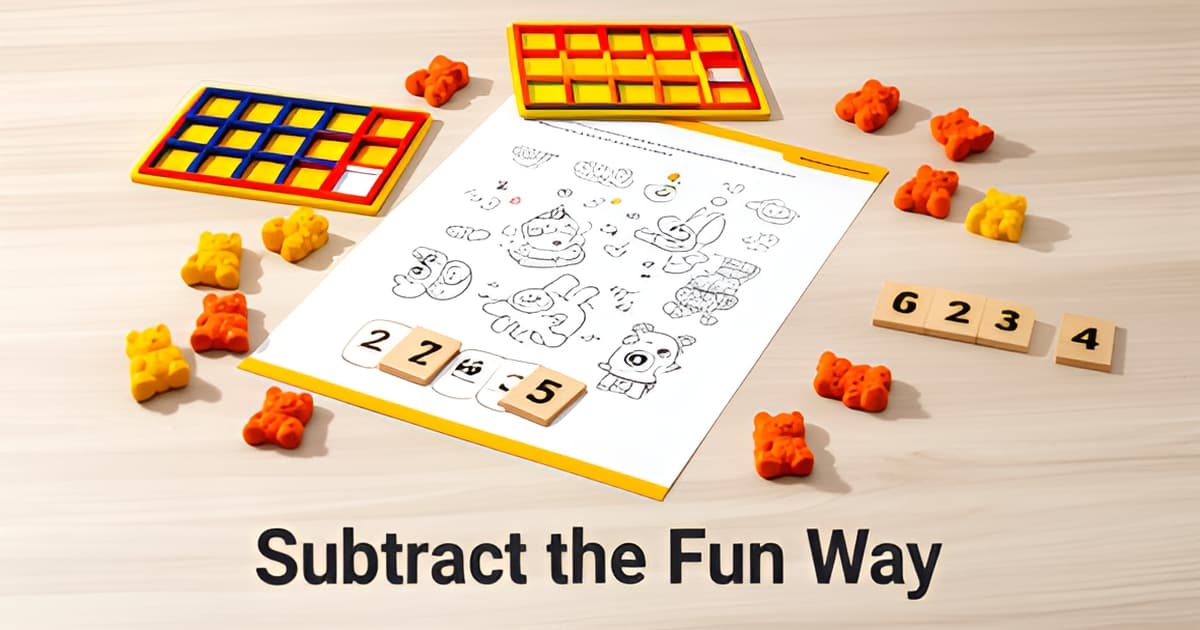
Starting with physical manipulatives is the most critical step in building genuine subtraction understanding for 1st grade learners. Research consistently shows that students "initially experience subtraction through manipulatives (cubes, counting bears, buttons, five/tens frames, fingers, counters)" before any abstract concepts are introduced. The Maine DOE module emphasizes that these models "remain helpful across part-part-total, change, and comparative subtraction problems," and Classroom Callouts reinforces that "students with learning disabilities may always need them." This concrete phase prevents the common gap where students can solve 5 - 2 = 3 on paper but cannot explain what "taking away" actually means in a real-world context.
Using counters and ten-frames allows students to physically model subtraction situations, which builds the foundational number sense required for all future math work. The target fluency goal by the end of 1st grade is that students can fluently subtract within 10, and this fluency cannot develop without the concrete stage. Students who skip manipulatives often develop procedural memorization without conceptual understanding, making later topics like "think addition to subtract" nearly impossible to grasp.
Once students are comfortable moving counters on a ten-frame, the progression naturally shifts to number lines and visual models that bridge the gap to abstract thinking. Education.com features games using "counting back on number lines," while the Maine DOE module details "open number line utility" as distinct from traditional number lines starting at zero, noting they are "blank and can be used for any useful values." This visual representation helps students see subtraction as a distance or difference between values, connecting directly to the research-backed insight that "subtraction means the difference or distance between the minuend and subtrahend values." Number lines also support the "counting back" strategy, one of the five core mental math approaches identified by Happy Hearts in 1st Grade.
The research is clear: starting with counters, ten-frames, and number lines isn't just a nice starting point, it's the essential foundation that prevents conceptual gaps later. Students who build understanding through physical and visual models before moving to abstract algorithms are better prepared for the strategy frameworks that follow, from "Friends of Ten" to "Think Addition to Subtract." This progression respects how 1st grade learners actually develop mathematical thinking, ensuring that when they eventually encounter standard algorithms in grade 4, they understand the math behind the procedure rather than just memorizing steps.
Printoodle makes it easy to create the printable worksheets and visual aids that support this concrete-to-abstract progression. Teachers can generate ten-frame mats, number line templates, and counter sets in seconds to pair with physical manipulatives, or use them as standalone visual supports for students who need extra scaffolding. third grade sight word bingo, first grade sight word bingo, and second grade sight word bingo provide ready-made formats that teachers can adapt for subtraction practice, keeping the focus on skill-building rather than design time.
5 Strategies Students Can Count On
When you're planning what are some activities to teach subtraction in 1st grade, strategy-based instruction beats drill every time. One experienced teacher puts it beautifully: strategies are "tools in their tool box," and students can pull out whichever tool fits the problem, according to Happy Hearts in 1st Grade. The target fluency goal is that students can fluently subtract within 10 by the end of first grade, and these five strategies get them there.
1. Count Back. Students hop backward on a number line or hundreds chart. As the Maine DOE module explains, when a student counts back in subtraction, the numbers go down the chart. It works best for small differences like 9 minus 2.
2. Subtract 0 and Subtract All. These are the "freebies" worth teaching explicitly. When you take away nothing, the number stays the same; when you take away everything, you're left with zero. Kids pick these up fast, and they build confidence early.
3. Friends of 10. This one deserves extra time. Carrie Lutz at Classroom Callouts is blunt about it: "If they learn the differences from 10, all the others will be easier. Focus your energy there." Ten-frames and two-sided counters make the pairs visible.
4. Backwards Doubles. If students already know 4 + 4 = 8, then 8 minus 4 becomes obvious. Research from Monster Math notes that derived fact strategies "rely entirely on the automaticity of foundational facts," so doubles knowledge pays off twice.
5. Think Addition to Subtract. Knowing 3 + 2 = 5 makes 5 minus 3 a snap. Fact families turn subtraction into a familiar problem, which is why so many teachers introduce them together.
Here's how you might sequence a strategy unit across two weeks:
- Days 1-2: model each strategy with manipulatives and anchor charts
- Days 3-6: practice one strategy per day with matching worksheets
- Days 7-8: mixed practice, letting students choose their own tool
- Days 9-10: assess with word problems and fluency checks
That last piece matters. After one to two weeks of practicing all strategies, students choose whichever strategy works best for them, a differentiation approach Susan Jones Teaching recommends.
You can build the printable side of this easily in Printoodle: strategy posters, ten-frame mats, number lines, and fact family triangles, all generated in seconds. If you're already using bingo for literacy practice with tools like first grade sight word bingo, try a subtraction bingo variation where each square holds a problem. The same generator approach works for second grade sight word bingo and third grade sight word bingo, so one familiar format can carry your math and literacy centers all year.
Give students the toolbox, and fluency follows without a single flashcard marathon.
Game-On: Fluency Through Play
When subtraction practice turns into a game, kids stop counting on their fingers to survive and start racing to answer first. If you're wondering what are some activities to teach subtraction in 1st grade that actually build fluency, game-based math centers are where the research points again and again.
The goal is clear: by the end of first grade, students should fluently subtract within 10. Games get them there faster because repeated practice stops feeling like drill work. We Are Teachers catalogs 41 classroom-tested subtraction activities, and many of the most popular ones need little more than dice, counters, and a printed game board.
A few standouts worth building into your centers:
- Subtract and Cover, a simple dice and spinner partner game where kids roll, subtract, and cover the answer on their board.
- Subtraction Bingo, described as one of the most popular subtraction activities out there, with printable versions covering everything from basic facts to two-digit problems.
- Subtraction Bowling, where students knock down pins, count what fell, and write the matching subtraction sentence.
- Shake 'n Spill, using two-sided counters to generate random subtraction problems every round.
Teacher blogger Carrie Lutz notes that if students master the differences from 10, everything else gets easier, and she recommends flash cards and repeated practice to lock those facts in. Bingo-style games are a natural fit for that kind of repetition. If your class already plays sight-word review games, the same format transfers directly; you can even bridge the two with a first grade sight word bingo set alongside your subtraction cards, or keep the routine consistent with second grade sight word bingo and third grade sight word bingo as students move up.
Partner games do double duty. While one child solves, the other checks the answer, so every round includes instant feedback without you hovering over each pair. Math centers also let you differentiate naturally: one table can work with counters and a ten-frame mat while another plays a dice game with facts to 10.
The materials are the easy part. With Printoodle, you can generate print-ready bingo boards, Subtract and Cover mats, and themed game sheets from your own lesson material in seconds, then reprint them free whenever a board gets lost or a new group needs a set.
Fluency comes from volume of practice, and games deliver that volume without the groans. Stack a few of these into your weekly centers and watch the speed build on its own.
From Worksheets to Word Problems: Printable Tools That Work
Subtraction in 1st grade shifts quickly from simple "take away" to flexible problem-solving, and the right printable tools make that transition smoother. Research across 11 sources confirms that students benefit most when they move from concrete manipulatives toward abstract reasoning using structured formats like missing-number exercises, numberless word problems, and bingo dabber games. A key statistic highlights that by the end of first grade, students should fluently subtract within 10, yet standard algorithm mastery is not expected until grade 4 per Common Core and Maine Learning Results, making targeted practice essential.
Classroom Callouts specifically identifies three worksheet formats for missing numbers in all positions, differences, missing minuends, and missing subtrahends, emphasizing that students need practice finding values in every location of a problem to build deep conceptual understanding. The Maine DOE module corroborates this, noting students require practice with critical missing values across all problem positions. Printoodle can generate these worksheets using visual aids like ten-frames or number lines to support the concrete-to-abstract progression that all sources agree is universal.
Beyond worksheets, strategy-based game packs featuring the five core mental math strategies, Count Back, Subtract 0/Subtract All, Friends of 10, Backwards Doubles, and Think Addition to Subtract, provide students with multiple approaches rather than rote memorization. Happy Hearts in 1st Grade frames these strategies as tools in a toolbox, while We Are Teachers and Classroom Callouts both reference games targeting the Friends of Ten strategy specifically. Printoodle can create themed game packs where each game focuses on one strategy, using number lines for Count Back and ten-frames for Friends of 10, aligning with the research consensus that strategy instruction supports fact fluency.
Numberless word problem templates offer another effective entry point. Susan Jones Teaching and Happy Hearts in 1st Grade both emphasize starting with a story problem without numbers to build comprehension through visualization and class discussion before introducing numerals for solving. This approach helps students picture what the problem is actually asking, reducing the tendency to simply pull numbers and operate without context. Printoodle can design template worksheets that present subtraction scenarios gradually, scaffolding from description to equation.
Bingo and dabber games remain a classroom staple for fact fluency reinforcement. Classroom Callouts mentions Subtraction Bingo Dabber Games as a free download, while We Are Teachers lists two-digit subtraction bingo with free printable as one of the most popular activities available. Education.com features four subtraction strategy games with racing formats that engage students through play. Printoodle can generate bingo card templates where each square contains a subtraction problem, with calling cards for whole-class or small-group practice that supports the target fluency goal of subtracting within 10 by the end of 1st grade.
Printoodle makes it easy to bring these proven formats into your classroom. With the generator, teachers can create missing-number worksheets, strategy game packs, numberless word problem templates, and bingo dabber games in seconds, all print-ready and designed to align with how 1st grade students actually learn subtraction. It only takes a brief brief or photo upload to get started, and every creation lives in a library where reprints are always free. Print it. Doodle it. Done.
third grade sight word bingo third grade sight word bingo first grade sight word bingo first grade sight word bingo second grade sight word bingo second grade sight word bingo
Frequently Asked Questions
What are some activities to teach subtraction in 1st grade?
Why should I start with manipulatives instead of just worksheets?
What subtraction strategies should 1st graders learn?
How fluently should 1st graders be able to subtract?
Which subtraction facts should my students master first?
Do students with learning disabilities need different subtraction support?
How can I use games to build subtraction fluency without it feeling like drill?
Key Takeaways
{ "title": "From Manipulatives to Mastery: Building Subtraction Fluency That Sticks", "content": "Teaching subtraction in 1st grade isn't about rushing to algorithms, it's about respecting how young learners actually build mathematical understanding. The research is clear: starting with physical