What are some classic camp crafts?
Key Facts
- Pet rocks are the only craft explicitly called 'the canonical classic camp craft' among 20 listed by Fun-A-Day's preschool roundup.
- Friendship bracelets appear in every major camp craft source, with Pinwheel Crafts calling them 'the easiest station to scale', per its camp guide.
- Tie-dye for 20 campers demands 60–80 rubber bands, 10–12 squeeze bottles, and 20 labeled bags, one craft planning guide calculates.
- Age guidance varies wildly across sources: beading is recommended for ages 5 and up, while pennant flags suit toddlers through 5+, one parent-tested roundup notes.
- A bracelet station can run on just one bin of sorted cords and printed pattern cards, Pinwheel Crafts confirms.
- Historical camps successfully teach through crafts like tin punching, candle making, and basket weaving, one museum program reports.
- Nature collages earn their classic status because 'the collecting does half the teaching for you,' per Pinwheel Crafts.
Why Picking the Right Camp Craft Feels Harder Than It Should
You'd think a list of classic camp crafts would be the easy part of camp planning. Search for what are some classic camp crafts and you'll find plenty of ideas: pet rocks, friendship bracelets, nature collages, tie-dye. The hard part comes after the list, when you try to run any of those projects at a real table with real kids.
The problem is that most craft roundups are written for one child and one parent on a rainy afternoon. A camp is a different animal. As Pinwheel Crafts puts it, "a craft has to be fun, but it also has to survive a full group setting, mixed ages, shared tables, and limited staff attention." That's the test most lists never apply.
The inconsistencies pile up fast when you compare sources. Age guidance varies wildly: Fun-A-Day's roundup targets preschoolers, while Our Days Outside recommends beading for ages 5 and up and pennant flags for toddlers through 5+. Mess ratings are just as slippery. Pinwheel Crafts rates tie-dye as high-mess and friendship bracelets as low, but other sources list tie-dye shirts with no mess designation at all, which means you're left guessing whether that project works in your cabin or your craft hall.
So camp planners end up making three judgment calls that no blog post makes for them:
- Whether a craft scales from 4 kids to 20 at shared tables
- Whether the youngest camper and the oldest camper can both finish something they're proud of
- Whether the project survives with one counselor's attention split five ways
There's a reason friendship bracelets show up in every major list of classics. They're the easiest station to scale, with a small footprint, low mess, and no drying time, and Pinwheel Crafts notes a bracelet station can run beautifully with one bin of sorted cords and printed pattern cards. That last detail matters more than it sounds. Printed guides do the supervising for you, which is exactly what a stretched-thin staff needs.
The same logic applies beyond bracelets. Templates that front-load the prep, with pre-cut lines, collection prompts, or built-in pattern cards, buy back staff attention. A nature collage works better when the sheet tells campers to find three leaf textures and two smooth stones, because as Pinwheel Crafts observes, "the collecting does half the teaching for you." Tools like a word search maker or a printable word search follow the same principle: a printed page runs itself while you circulate.
Pick crafts that pass the group test, and the guessing mostly disappears.
The Classic Camp Crafts That Never Fail (and Why They Stick Around)
Every generation of campers makes the same handful of crafts, and that's not an accident. When you ask what are some classic camp crafts, the same names keep coming up across educators, parents, and camp directors, because these projects have already survived the toughest test there is: a table full of kids with mixed ages and one counselor watching all of them.
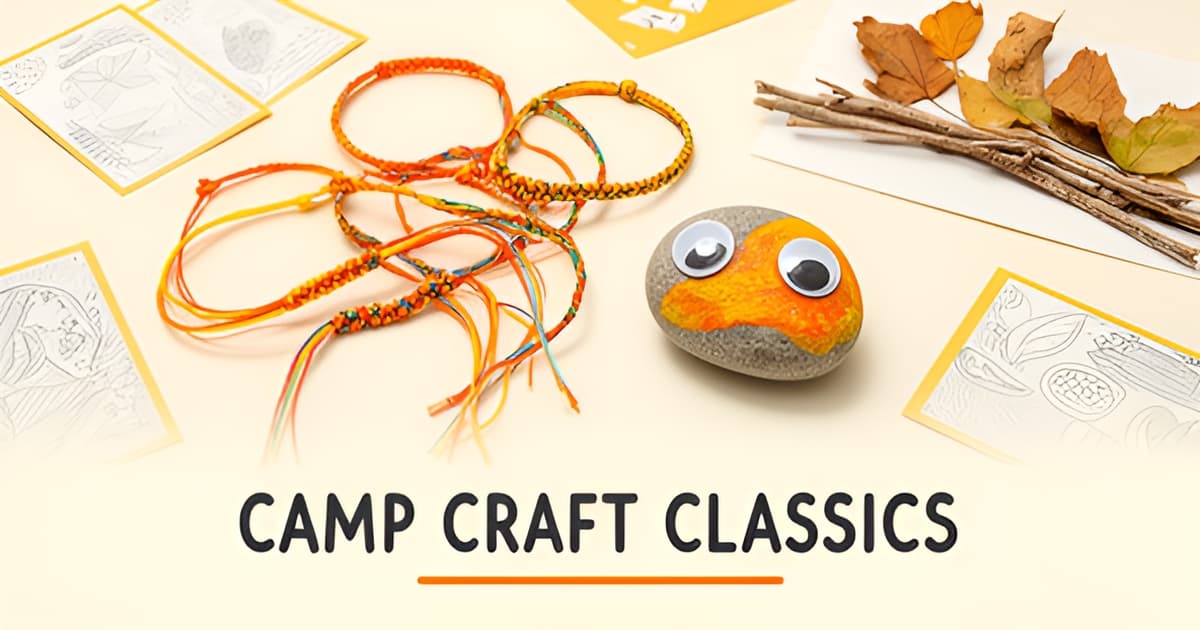
Pet rocks sit at the top of the list. Fun-A-Day calls them the canonical classic camp craft, and it's the only project on their list of 20 that gets that explicit designation. They need almost nothing: a rock, some paint, googly eyes, and imagination.
Friendship bracelets and beading are the one category that shows up in every major source, from beaded keychains and belts to bracelets made from found twigs. Pinwheel Crafts calls them "the easiest station to scale" thanks to their small footprint, low mess, and no drying time, and notes that a bracelet station can run beautifully with one bin of sorted cords and printed pattern cards. That last detail matters if you're planning stations: a printed guide does a lot of the supervising for you.
Nature collages and suncatchers earn their spot because, as Pinwheel Crafts puts it, "the collecting does half the teaching for you." The walk to gather leaves, smooth stones, and seed pods becomes the activity itself. Rock painting sits nearby, rated Medium on mess but forgiving on skill, which makes it work for nearly any age.
Campfire-themed projects round out the classics. Popsicle stick s'mores and foil-painted campfires deliver the camp aesthetic without an actual flame, which is exactly why counselors keep them in rotation.
So why do these five stick around year after year? A few shared traits:
- Low mess: no glue puddles or dye spills that eat up the rest of the afternoon.
- No drying time: campers finish and take the project home the same day.
- Easy scaling for mixed ages, with pre-cut strands or pre-punched holes leveling the field for younger hands.
- Minimal supervision, so one staff member can run a full station.
Printoodle fits naturally into this picture. If you're building a craft station, you can pair a bracelet table with a quiet-time corner using its word search maker or a printable word search themed around the camp itself. The classics handle the hands-on fun; a printed page handles the lull in between.
How to Run These Crafts With Printables (Station Setup Made Simple)
Setting up five craft stations for thirty campers sounds like a full-day job, but the right printouts shrink it to an hour of prep. The reason is simple: a printed template carries the instructions, the pattern, and the difficulty level all at once, so your counselors don't have to.
Take friendship bracelets first. As one craft retailer's camp guide puts it, a simple bracelet station may run beautifully with one bin of sorted cords and printed pattern cards. That's the whole station. Print a stack of chevron, stripe, and spiral pattern cards at three difficulty levels, clip them to the table, and the station practically runs itself. The same guide notes that pre-cut strands save time for kids with limited hand strength, and binder clips on cardboard replace taping bracelets to tables.
Nature stations work the same way, with one twist: the kids gather the materials. Print a collection prompt card, something like "find 3 leaves with different textures, 2 smooth stones, and 1 interesting seed pod," and hand it out before the walk. The guide's observation that the collecting does half the teaching for you holds up in practice; campers who've hunted for specific textures arrive at the collage table already sorting, comparing, and narrating what they found. Your only prep is the prompt card itself.
Felt sewing stations benefit most from print. Felt is forgiving, easy to hold, and doesn't fray, and pre-punched holes are a genuine gift for younger kids and first-time stitchers, according to the same source. A printed template with hole markers lets staff punch ahead of time, or older campers can punch their own along the printed dots.
Here's a quick station-prep checklist that works across all of these crafts:
- Print pattern cards in two or three difficulty versions so younger and older campers share one table.
- Pre-cut cords and pre-punch felt before the session, not during it.
- Laminate or reprint freely; digital templates mean reprints cost nothing.
- Keep a rainy-day stack ready for cabin confinement.
That last point matters more than it seems. When rain traps a cabin full of campers indoors, a themed word search maker or printable word search page buys you a calm thirty minutes, and camp-themed puzzles generated with a word search maker keep the mood on-message while the storm passes. Printoodle's generator handles both in seconds, so a cabin backup folder costs one prep session in June and pays off all summer.
Print it. Doodle it. Done.
Your Camp Craft Plan: Matching Crafts to Ages, Mess, and Weather
A great craft hour rarely happens by accident. If you've been asking what are some classic camp crafts and how to actually schedule them, the answer comes down to three planning questions: how messy is it, who can do it, and what's your backup when it rains?
Start with mess. Not all classics are equal on the cleanup scale, and one craft planning guide rates friendship bracelets and beading as low-mess stations, rock painting as medium, and tie-dye as high. That matters because, as the same source puts it, "a craft has to be fun, but it also has to survive a full group setting, mixed ages, shared tables, and limited staff attention." A bracelet station can run on one bin of sorted cords and printed pattern cards. Tie-dye for 20 campers needs 60 to 80 rubber bands, 10 to 12 squeeze bottles, gloves for everyone, and 20 labeled bags for the shirts to travel home in. Schedule accordingly.
- Low mess: beading, friendship bracelets, felt sewing, and paper crafts. Run these indoors or at shared tables any time.
- Medium mess: rock painting and nature collages. Great outdoors, manageable inside with table covers.
- High mess: tie-dye and dyeing projects. Save these for outdoor days with hose access and a dedicated drying plan.
Next, match the craft to the age of your campers. Age guidance varies quite a bit across sources, so build in flexibility. One parent-tested roundup recommends beading for ages 5 and up, while pennant flags work for toddlers through age 5 and beyond. For mixed-age groups, small adaptations close the gap: pre-cut strands save time for kids with limited hand strength, and pre-punched holes are, in the words of one craft educator, "a gift when you're working with younger kids or first-time stitchers." Older campers can graduate to paracord projects or more complex bracelet patterns at the very same table.
Then plan for rain, because it will rain. Keep a stack of printable backups ready: camp-themed coloring pages, a word search maker for puzzles built around your camp's own traditions and inside jokes, or a printable word search with a nature or campfire theme that pairs with whatever craft got rained out. Nature crafts offer a bonus here too. As one guide notes, "the collecting does half the teaching for you," so a rainy afternoon can become a sorting and categorizing session with materials campers gathered the day before.
With Printoodle, you can generate all of these in seconds: bracelet pattern cards, themed coloring pages, and rainy-day puzzles, all saved in your library with free reprints forever. Print it. Doodle it. Done.
Frequently Asked Questions
What are the most common classic camp crafts that work well for large groups of mixed ages?
Why do some camp craft lists give such different age recommendations for the same activity?
How messy are classic camp crafts really, and should I avoid high-mess projects for indoor cabins?
Can one counselor successfully run a craft station with 20 kids at a shared table?
What should I plan as a backup craft activity when it rains out at camp?
Are pet rocks really a classic camp craft, and what makes them stand out from other activities?
Classic Crafts, Modern Prep: Your Camp Summer, Sorted
So, what are some classic camp crafts? The answer hasn't changed in generations: pet rocks, friendship bracelets, nature collages, rock painting, and campfire-themed projects. What has changed is how easily you can run them for a full group. The classics stick around because they pass the real camp test, surviving mixed ages, shared tables, and a counselor's split attention with low mess, no drying time, and simple scaling. Your next step is simple: pick one low-mess station to pilot this week, print pattern cards at two or three difficulty levels, and build a rainy-day backup folder before you need it. That's where Printoodle earns its keep, turning a word search maker session into camp-themed puzzles, or a printable word search into a calm thirty minutes of cabin confinement insurance, all saved in your library with free reprints forever. Prep once in June, and your craft hour runs itself all summer. Print it. Doodle it. Done.