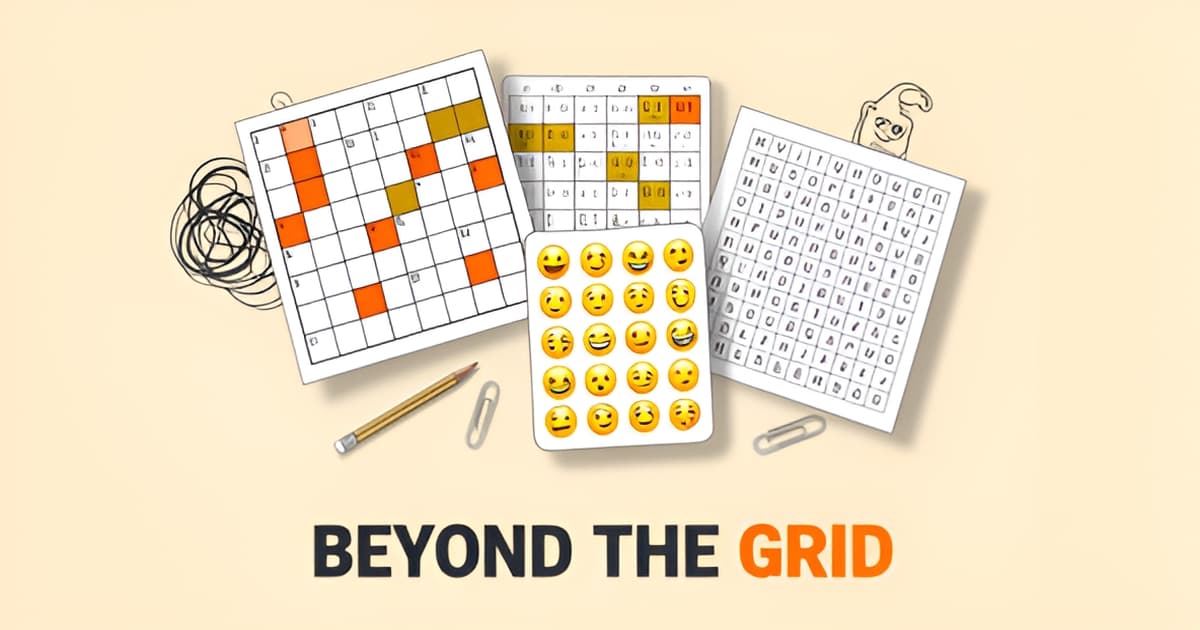
What are some crossword-like games?
Key Facts
- One puzzle platform documents 47 distinct puzzle maker types, including seven crossword-style variants according to Puzzel.org.
- Emoji-clue crosswords let children as young as 5 play before they can read written clues per BookWidgets.
- Education.com offers roughly 30 decorative crossword themes and recommends keeping puzzles to 50 words or less on its worksheet generator.
- As Deb Amlen of The New York Times puts it, 'Learning to solve crossword puzzles is not easy, but learning to make them is even harder' per the NYT.
- Amuse Labs recommends putting multimedia in at least one-third of clues for greater solver engagement in its best-practices guide.
- AI-assisted creation is the standout 2026 trend in crossword tools, with saving even 15 minutes per activity adding up over a school year per a classroom crossword-maker roundup.
- The Internet TESL Journal's guideline for puzzle tools: 'Keep it simple, keep it fast, keep it focused' as quoted on ESL crossword guidance.
Why Standard Crosswords Only Scratch the Surface
If you've only ever solved the classic black-and-white grid, you're playing one format out of dozens. That's the real answer when someone asks what are some crossword-like games: the standard crossword is just the most famous member of a much bigger family, and sticking to it means missing puzzles that fit younger kids, other subjects, or a party table full of guests.
The variety is bigger than most people realize. One puzzle platform alone documents 47 distinct puzzle maker types, including seven crossword-style variants such as picture-clue puzzles, vocabulary crosswords, and even news-quiz crosswords built around current events. Beyond the grid itself sit close cousins like arrowwords, where clues sit inside the squares, plus acrostics, word scrambles, and cryptograms.
The standard format also assumes a standard solver, and that's where it falls short. A five-year-old who can't read clues fluently is locked out of a definition-based crossword, yet emoji-clue crosswords let children ages 5-7 play while they're still building reading and writing skills. Meanwhile, a math teacher has little use for vocabulary definitions when a cross-number puzzle can put equations in the clue slots instead.
Different occasions call for different shapes, too:
- Classroom subjects: cross-numbers for math, cause-and-effect grids for history, vocabulary puzzles for language lessons.
- Young kids: picture-clue and emoji-clue puzzles that don't require strong reading skills.
- Group settings: icebreaker crosswords where students fill in classmates' names from descriptive clues.
- Celebrations: personalized puzzles like graduation crosswords with hidden messages, or a themed easter crossword for a holiday morning.
There's a practical reason to look beyond the standard grid as well. As Deb Amlen of The New York Times puts it, "Learning to solve crossword puzzles is not easy, but learning to make them is even harder" (NYT). Hand-building a themed puzzle for a specific child, lesson, or shower takes real effort, which is why tools that generate printable crossword puzzles in seconds, like Printoodle, have changed the equation for parents and teachers.
The rest of this guide walks through that broader family: the variants, the near-relatives, and the formats that match each age, subject, and occasion.
9 Crossword-Like Games Worth Knowing
Crossword puzzles have evolved far beyond the classic black-and-white grid, offering a diverse range of formats that cater to different ages, skill levels, and learning goals. While the standard vocabulary crossword remains the most recognizable, researchers and educators have developed numerous variants that repurpose the grid format for math, riddles, images, and even emojis. This variety ensures that there is a suitable crossword-like game for everyone, from young children taking their first steps in literacy to adults seeking a mental workout.
One of the most significant expansions of the format involves adapting clues to non-word formats. Cross-numbers, for instance, replace word definitions with math equations; a clue might read "12kg of apples cost €24. How much does 20kg cost?" requiring solvers to calculate the numerical answer. Similarly, riddle crosswords swap definitions for puzzling descriptions that test critical thinking, while cause-and-effect crosswords, often used in history lessons, ask players to identify answers based on causal relationships rather than simply recalling names or dates. For the youngest learners, typically ages 5 to 7, emoji-clue crosswords and picture-clue crosswords provide a bridge into puzzle solving by using visual cues instead of text, allowing children to engage with the format before mastering reading and writing skills. Research from educational platforms like BookWidgets highlights that these visual variants are specifically designed to support early literacy development.
The educational value of these games is well-documented, with vocabulary building cited as the primary use case across classrooms and homes. Studies, including those referenced in educational blog analyses, consistently show that the active recall required when solving crosswords strengthens memory and deepens mastery of subject matter, whether in language learning, science, or economics. Furthermore, the format’s flexibility means it can be applied across subjects; math crosswords bring real-world scenarios into the puzzle, while "icebreaker crosswords" prompt students to fill in classmates' names from descriptive clues, fostering both vocabulary and classroom community. As one educational resource notes, students generally perceive these puzzles as a challenge or game rather than an assessment, which increases engagement and makes the learning process more enjoyable.
For those looking to explore this format, Printoodle offers a quick way to generate customized versions of these games. Whether you need printable crossword puzzles for a classroom activity or a specialized easter crossword for a holiday event, the platform provides themed, print-ready options that can be tailored to specific occasions or lesson plans. With a free tier that includes initial credits and the ability to reprint designs forever, it serves as a practical tool for parents planning rainy-day activities, teachers creating worksheets from their own material, or hosts preparing themed party games.
Print it. Doodle it. Done.
Themed and Personalized Crosswords for Every Occasion
The best crosswords rarely come off a shelf. The ones people remember are built around a person, a holiday, or a room full of guests, and one of the most common questions puzzle fans ask is what are some crossword-like games they can actually personalize. The answer covers a lot of ground, from holiday grids to graduation keepsakes.
Seasonal themes are a proven format. Education.com's worksheet generator offers roughly 30 decorative themes, including easter egg hunt, valentine's day, autumn leaves, outer space, and under the sea source, which tells you how much demand exists for puzzles tied to a moment on the calendar. An easter crossword filled with basket, bunny, and hunt clues turns a rainy spring afternoon into a quiet table activity, and it prints just as easily as any standard grid.
Graduation takes the theme idea one step further. Puzzle platforms now offer personalized graduation crosswords where the clues are all about the graduate, and marked cells spell out a hidden message across the finished grid source. Instead of a card, the guest of honor solves their own story: favorite teacher, first job, the college they're headed to. When the last square fills in, "CLASS OF 2026" or a short congratulations appears in the shaded squares.
Icebreaker crosswords work the same way in reverse. A popular classroom format has students fill in their classmates' names from descriptive clues source, so "plays trumpet" or "moved here from Ohio" becomes a clue pointing at a real person. It's an easy first-day-of-school or dinner-party activity, and it doubles as a name-learning exercise for teachers and hosts alike.
A few themed formats worth trying:
- Holiday grids: seasonal clue sets for Easter, Halloween, or winter break, printed as party placemats or rainy-day pages.
- Hidden-message puzzles: shaded cells that spell out a birthday wish or congratulations once the grid is solved.
- Name crosswords: clues written about real guests or classmates, solved as a group.
- Subject-themed puzzles: vocabulary and facts from a lesson, trip, or family inside-joke list.
The nice thing about themed puzzles is that the grid mechanics stay identical; only the clue list changes. That's also why they're simple to generate. With Printoodle's printable crossword puzzles tool, you type in a theme and a word list, and the generator produces a print-ready PDF with an answer key. Since reprints are always free, you can run extra copies when the whole table wants to race.
Print it. Doodle it. Done.
How to Create Your Own Crossword-Style Puzzle in Minutes
Building a crossword from scratch is harder than it looks. As Deb Amlen of The New York Times puts it, "Learning to solve crossword puzzles is not easy, but learning to make them is even harder" (NYT). The grid has to interlock cleanly, the words have to fit, and the theme, which constructors call "the heart of most daily crossword puzzles," has to hold together too.
That's why tools have taken over the heavy lifting. According to a 2026 roundup of classroom crossword makers, the standout trend is AI-assisted creation: the software generates clues, organizes vocabulary, and produces usable materials much faster than manual construction. Traditional template makers help too, but they still leave you fitting words into grids by hand.
The time savings matter more than you'd think. That same roundup makes the case plainly: saving even 15 minutes per activity adds up to a meaningful difference over a school year. If you're a teacher prepping weekly puzzles, or a parent assembling a birthday activity kit, those minutes are the whole game.
The best guideline for choosing a tool comes from The Internet TESL Journal, quoted in this piece on ESL crosswords: keep it simple, keep it fast, keep it focused. Here's how that plays out when you build a puzzle with Printoodle's printable crossword puzzles generator:
- Pick your theme and word list. Vocabulary building is the dominant use case for crosswords, so start with the words you want learners to actually recall.
- Let the generator fit the grid and write the clues. This is the step that makes manual construction painful, and it takes seconds with AI assistance.
- Download the print-ready PDF with the answer key included. Print output remains core: platforms like Puzzel.org also support printing blank worksheets with answer keys (Puzzel.org).
- Test-solve it. Amuse Labs' best-practices guide recommends having someone test-solve your puzzle before you hand it out (Amuse Labs).
Keep the word count modest. Education.com recommends a limit of 50 words or less per puzzle (Education.com), and smaller grids solve faster and print cleaner. Seasonal themes work especially well: Education.com offers roughly 30 decorative themes, including an easter egg hunt, and a themed easter crossword follows the same proven seasonal demand.
Because everything you generate lives in your Printoodle library, reprints are always free, so next year's version is one small edit away rather than one long afternoon. Print it. Doodle it. Done.
Frequently Asked Questions
What are some crossword-like games beyond the standard word grid?
Can young children who can't read well still do crossword-style puzzles?
How can teachers create crosswords for different subjects like math or history?
Can I personalize crosswords for occasions like graduations or holidays?
Is it difficult to build a custom crossword puzzle from scratch?
Your Next Puzzle Is One Word List Away
So, what are some crossword-like games? Far more than the classic grid alone: cross-numbers for math class, emoji-clue puzzles for five-year-olds, riddle and cause-and-effect variants for critical thinking, icebreaker name puzzles for classrooms and parties, and themed grids for holidays and graduations. Each format keeps the familiar solve-while-you-learn mechanics while opening the door to different ages, subjects, and occasions, and as educators consistently find, active recall through puzzles strengthens vocabulary and subject mastery without feeling like a test. The catch has always been construction time, which is why the smart move is to pick your format, gather a word list of 50 words or fewer, and let a generator handle the grid. Ready to try one? Printoodle's printable crossword puzzles tool turns your theme into a print-ready PDF with an answer key in seconds, and a themed easter crossword is a great place to start. Print it. Doodle it. Done.