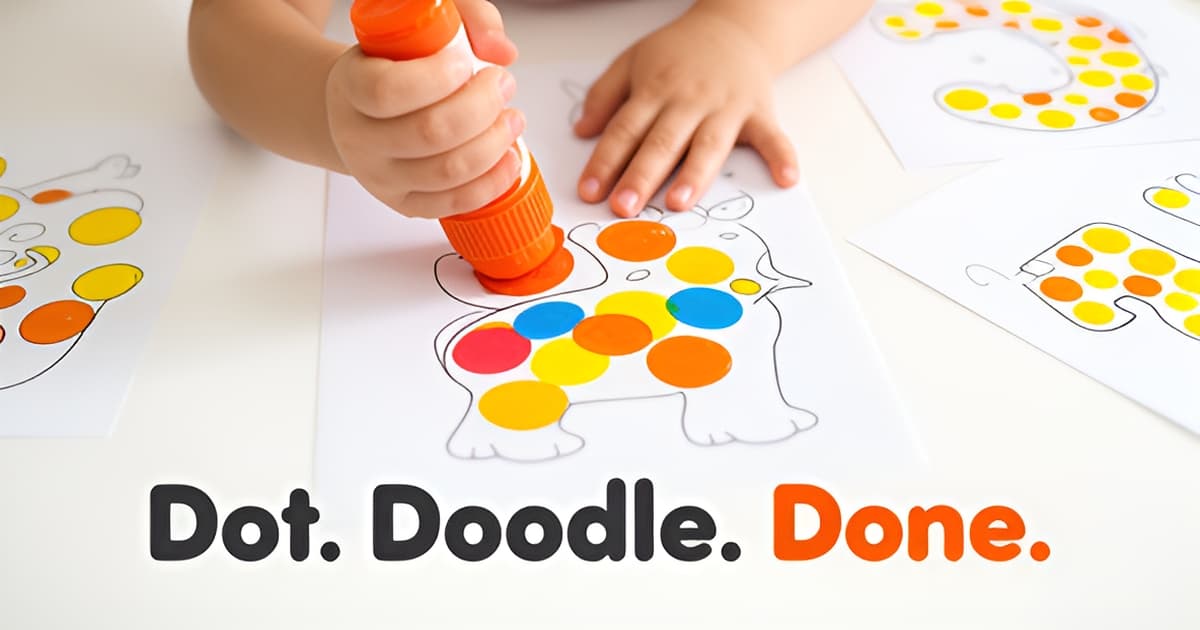
What are some fun activities for kids with dot markers?
Key Facts
- Do A Dot Art! markers are designed for ages 3+ with supervision and are washable, non-toxic, and conform to ASTM D-4236 safety standards
- Do A Dot Art! markers have 41 customer reviews with 95% rated 5 stars, making them a verified customer favorite
- Dot markers work best on regular paper, since ink can pool or bleed on thin sheets, according to JoyCat's market comparison guide
- DoodleHog's blog states that activity sheets provide structured play with steps and sequences while still allowing independent, unsupervised play
- Count-and-dot number pages are a top activity category that doubles as fine motor strength building for preschoolers
- Printoodle's Letter-format PDFs are optimized for standard printer paper to prevent ink bleed from dot markers
- A verified customer review describes Do A Dot Art! markers as "bright, bold, and incredibly fun to use" for crafts and learning activities
Why Dot Marker Time So Often Ends in Frustration (and How the Right Activities Fix That)
Dot markers promise mess-free creativity, yet ten minutes in, many parents find themselves staring at soaked-through paper and a table that needs a wipe-down. If you've ever wondered what are some fun activities for kids with dot markers that actually hold a preschooler's attention, the answer usually isn't blank paper.
The problem isn't your child's enthusiasm. It's physics. Dot markers use a wide sponge tip designed for bold, generous marks, so they're less precise than finer tools and can produce big blots instead of small dots. On thin paper, ink pools and bleeds, which is why the markers work best on regular-weight paper.
With no plan on the page, a three-year-old keeps stamping the same spot, the ink saturates, and frustration follows on both sides of the table. Dot markers are built for ages 3+ with supervision, according to the original manufacturer, and that age group needs a little structure to keep the momentum going.
Structured sheets solve the blank-paper problem by giving kids something to follow. DoodleHog's guidance on dot markers in child development makes the point directly: activity sheets provide structured play with steps, sequences, and instructions, while the simplicity of the markers still allows independent, unsupervised play. That balance is exactly what a parent needs at 4 p.m. on a Tuesday.
A good sheet turns one big chaotic canvas into a series of small, winnable tasks:
- Dot inside letter outlines to build letter recognition
- Make a specific number of dots for counting practice
- Complete color patterns to practice sequencing
- Fill in animal outlines for imaginative dot art
Each of these has a clear stopping point, which means the ink never gets a chance to pool in one spot. And the developmental upside is real: the repetitive action of dotting strengthens fine motor skills and hand-eye coordination over time, preparing kids for more complex activities later.
You don't need to buy a pre-made book to get this structure. Printoodle lets you generate print-ready dot marker pages in seconds, on standard Letter or A4 paper, so you're printing on the regular-weight stock that handles sponge tips best. Once the dotting is done, you can extend quiet time with mazes for kids, a kids sudoku printable, or rebus puzzles for kids for the same early-learner crowd. Print it. Doodle it. Done.
7 Fun Dot Marker Activities That Build Real Skills (Backed by What Early-Learning Brands and Parents Report)
Wondering what are some fun activities for kids with dot markers? The good news is that the same handful of activity types show up again and again across early-learning brands, parents, and the original manufacturer, so you can skip the guesswork and go straight to the projects that actually hold a preschooler's attention.
Dot-the-letter pages are the top pick for letter recognition. As DoodleHog's early-learning blog puts it, kids "learn letter recognition by dotting within the outlines of letters." Print a big bubble letter, hand over a marker, and the dotting does the teaching.
Count-and-dot number pages work the same way for early math. Ask your child to make exactly five dots next to the numeral 5, or fill a ten-frame. It's counting practice disguised as art, and it doubles as fine motor strength building, since the repetitive press-and-lift motion is exactly what strengthens little hands for writing later.
Dot art animals lean into imaginative play. A dotted giraffe, ladybug, or rainbow fish gives kids a shape to fill while still leaving room for color choices. Pattern pages push it further: alternate red-blue-red-blue, or let kids experiment with layering colors to see what new shades appear.
- Dot-the-letter pages for letter recognition
- Count-and-dot number sheets for early counting
- Dot art animals for imaginative coloring
- Pattern and color-mixing exploration pages
- Simple group projects for siblings or classrooms
Group projects round out the list. A shared poster or classroom mural where each child dots one section builds teamwork, and structured sheets give kids clear steps to follow while still allowing independent play once they get the hang of it.
A quick honesty note: the developmental claims here (fine motor skills, hand-eye coordination, focus, patience) come from vendor blogs like JoyCat's marker comparison guide, not clinical studies. That said, the logic is sound, and parents clearly agree: Do A Dot Art!, the original manufacturer (a family business since 1989), reports 95% of its 41 customer reviews are five stars.
On safety, you're covered. The markers are washable, non-toxic, and conform to ASTM D-4236 safety standards, rated for ages 3 and up with supervision. One practical tip: dot markers work best on regular paper, since ink can pool or bleed on thin sheets.
When you're ready to print, Printoodle can turn any of these ideas into a print-ready page in seconds, and you can pair dot marker time with mazes for kids, a kids sudoku printable, or rebus puzzles for kids to keep the quiet-time momentum going. Print it. Doodle it. Done.
How to Turn Each Idea into a Printable Project in Minutes
Turning a blank sheet into a finished activity takes just a few clicks with Printoodle’s generator. Parents can choose from themed dot outlines, letter and number tracing sheets, or counting pages, all rendered as print-ready PDFs on standard Letter paper. Since dot markers work best on regular paper to avoid ink bleed, this format ensures every project prints cleanly on the first try. The age 3-6 sweet spot aligns with how young children naturally grip and dotting, and with Printoodle’s free reprints from the library, there’s no worry if a page needs a second attempt or a sibling wants a turn. Personalizing each page with the child’s name or favorite animal transforms a generic sheet into a keepsake they will want to return to again and again.
mazes for kids and kids sudoku printable make natural follow-up challenges for the same age group, while rebus puzzles for kids add a fun problem-solving twist after the markers are capped.
Letter tracing and counting games consistently rank as the most popular dot marker activities, and Printoodle lets users generate both in seconds. A verified review notes the markers are “bright, bold, and incredibly fun to use,” making them ideal for these early-learning formats. Parents can create a “Dot the Letter A” page or a “Count to Five” sheet and download a PDF ready for the high-chair tray or kitchen table. Themes range from animals to vehicles, keeping the activity fresh as interests evolve.
Dot art animals and pattern exploration round out the most-requested activity categories. Printoodle’s themed outlines let kids fill in a lion’s mane or a butterfly’s wings using only dots, building hand-eye coordination with every press. Since sources confirm dot markers are washable and non-toxic with ASTM D-4236 safety certifications, parents can relax while children explore color mixing and imaginative play. The library’s free reprint policy means a favorite animal page can be printed again and again without extra cost.
Print it. Doodle it. Done.
What to Pair with Dot Markers for a Full Activity Hour
A dot marker session rarely ends because the child is done being creative. It ends because the page is full of dots. That's the moment to have a second stack of printables ready, so the activity hour keeps rolling without you scrambling for ideas.
The trick is matching the energy. Dotting is active and a little loud, so follow-ups work best when they're quieter and more focused. DoodleHog notes that structured activity sheets give kids a sequence to follow while still allowing independent play, which makes puzzle-style printables a natural next step after free-form dotting. The same source points out that the repetitive dotting motion builds fine motor skills over time, and quiet pencil work reinforces that same hand control from a different angle.
Here's a simple pairing that works well for the 3-to-6 crowd:
- Dot marker art first (15–20 minutes). Patterns, letter outlines, count-and-dot pages, or dot animals. This is the high-energy opener.
- Mazes second (10 minutes). Tracing a path with a finger or crayon is a calm-down activity that still feels like play. Printoodle's mazes for kids generator lets you print themed mazes sized for young hands.
- Kids sudoku third (10 minutes). A picture-based kids sudoku printable introduces logic without any reading required, which suits preschoolers perfectly.
- Rebus puzzles last (5–10 minutes). Rebus puzzles for kids work as a wind-down, especially if a grown-up sits alongside and helps decode the pictures.
One practical note on paper choice: JoyCat cautions that dot marker ink can pool or bleed on thin paper, so standard-weight printer paper is the right surface. Printoodle's PDFs default to Letter size (with an A4 toggle), so they print cleanly on whatever's already in your tray.
Before you start, run through this quick setup:
- Standard printer paper (not thin or glossy stock)
- Washable, non-toxic markers; Do A Dot Art! markers conform to ASTM D-4236 safety standards and are designed for ages 3 and up
- Supervision for ages 3+, per the manufacturer's guidance
- A wipeable surface or tray underneath, since even washable ink spreads
With the paper loaded and the follow-up pages already printed, you've turned a single dot marker activity into a full hour of varied, low-prep play. Print it. Doodle it. Done.
Frequently Asked Questions
What are some fun activities for kids with dot markers?
What age are dot markers appropriate for?
Are dot markers safe and non-toxic for kids?
Why does the ink bleed through my kid's dot marker pages?
Do dot markers actually help with child development?
What should my child do after a dot marker session?
From Messy Marks to Meaningful Moments
Dot markers turn a blank page into a series of winnable tasks, but without structure, those bold sponge tips quickly lead to ink pools and frustrated little hands. The secret to turning dot marker time into a skill-building win lies in guided activity sheets that provide clear steps, like dotting inside letter outlines or filling a specific number of dots, while still letting kids work independently. This balance of direction and freedom is exactly what parents need to keep the creative momentum going, especially during those busy after-school hours. With the right printable projects, every dotting session becomes an opportunity to build fine motor strength and hand-eye coordination that prepares kids for writing later. Printoodle makes it easy to generate these structured pages in seconds, turning a simple craft supply into a library of low-prep learning moments. Print it. Doodle it. Done.