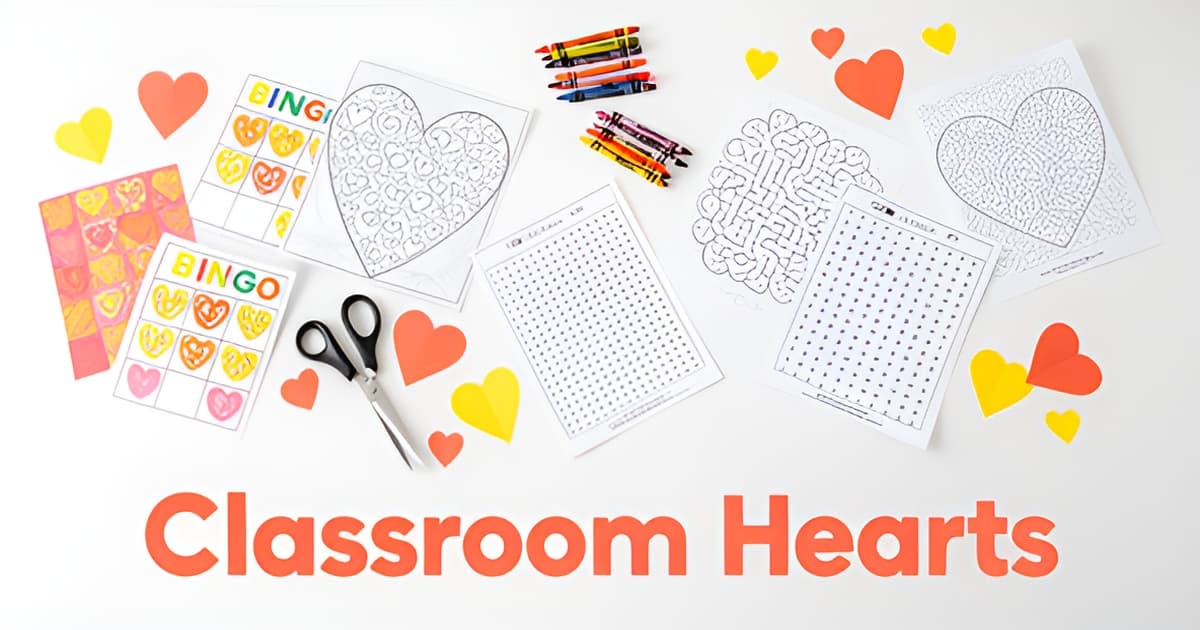
What are some fun activities for Valentine's Day at school?
Key Facts
- Teachers Pay Teachers hosts 159,045 Valentine's Day resources, with 'no prep' as the top selling point according to marketplace data.
- Three independent teacher sources recommend station-rotation parties with 5–6 stations of 10–15 minutes each per Lucky Little Learners.
- Card exchanges can become 'social-emotional nightmares' for excluded kids, so templates level the playing field Teach Starter warns.
- Conversation hearts have been a Valentine's staple since 1866 according to Teach Starter.
- The borax crystal heart science experiment needs 2–3 tablespoons per 250 ml of water and 12–24 hours to form crystals per HMH's classroom guide.
- Budget-friendly craft sets under $10 cover 18–20 crafts, enough for a whole class one elementary teacher reports.
- Pairing Valentine's Day with Random Acts of Kindness Day on February 17 turns one party into a week of goodwill HMH suggests.
Introduction
Valentine's Day morning in an elementary classroom is a beautiful kind of chaos: twenty-five kids hopped up on conversation hearts, a card exchange that could go sideways, and a party squeezed into the last hour before dismissal. If you're wondering what are some fun activities for Valentine's Day at school that actually work with a room full of kids, you're in the right place.
The good news is that teachers have figured out what works. The most recommended format, appearing across multiple independent guides, is a station-rotation party: small groups moving through 5–6 stations of roughly 10–15 minutes each, plus a read-aloud, a snack, and a card exchange. It keeps the energy up and the meltdowns down.
There's also a quieter shift happening in how schools approach the day. Rather than treating it as a candy-and-cards free-for-all, many teachers now frame it as a friendship and kindness celebration, tying February 14 to Random Acts of Kindness Day on February 17. And there's a practical reason printables have become central: as Teach Starter notes, providing card templates in class creates an even playing field for students whose families can't afford store-bought cards.
The demand for ready-made activities is enormous. Teachers Pay Teachers alone hosts 159,045 Valentine's Day resources, with "no prep" as the most common selling point. Teachers are clearly hungry for activities that don't eat up their evenings.
That's where this guide comes in. Here's a preview of what works best, based on what experienced teachers actually do:
- Station-rotation parties with crafts, games, bingo, and a puzzle corner
- Curriculum-tied activities like candy heart graphing, crystal heart science, and kindness writing prompts
- Printable games, from bingo and word searches to a class crossword
- Inclusive card exchanges where every student gets to participate
Every idea below can be pulled off with printable templates you generate yourself. Tools like Printoodle let you create a themed school crossword puzzle, bingo cards, or color-by-number pages in minutes, so your stations come together without a late-night laminating session. Print it. Doodle it. Done.
Let's get into the activities.
Key Concepts
The most effective classroom celebrations balance structure with spontaneity, and this is where the station-rotation model earns its reputation. By dividing students into small groups that rotate through 3–6 activity stations lasting 10–15 minutes each, teachers can maintain energy levels while ensuring every child participates in a variety of experiences. Research into classroom party planning consistently shows this format reduces chaos and maximizes engagement, with recommended station timing ranging from 10 minutes per rotation to 15 minutes across a full cycle of activities.
A significant body of classroom practice centers on inclusivity and low-prep execution. With 159,045 Valentine's Day resources currently available on teacher marketplaces, the demand for "no prep" solutions is clearly substantial, reflecting the very real time constraints educators face daily. Teach Starter emphasizes that providing templates within the classroom setting creates an even playing field, ensuring students whose families cannot afford store-bought cards are not excluded from the exchange. This approach aligns naturally with Printoodle's own positioning as a family-friendly tool that offers a free tier of 10 credits upon verification, with reprints free forever, making it a practical resource for teachers aiming to foster equity without adding to their workload.
Curriculum integration remains a cornerstone of modern classroom celebrations, with activities deliberately designed to reinforce academic concepts while festive. Candy heart graphing and fraction puzzles turn confectionery into math lessons, while color-by-number activities blend number recognition with seasonal art. Science experiments, such as crystal heart creations using a borax and water solution, provide hands-on learning opportunities tied to states of matter. These academic connections ensure that the celebration contributes to learning objectives rather than existing solely as a diversion from the regular curriculum.
Printoodle's suite of generators directly supports the activity types most frequently recommended across classroom resources. Teachers can quickly generate school crossword puzzles, word searches, bingo cards, and coloring pages that align with lesson themes or vocabulary lists. The platform's themed party packs and worksheet creators allow for customization that feels personal without requiring hours of design time. For educators seeking to implement the station-rotation model, Printoodle's tools provide the print-ready materials needed to populate each station efficiently, allowing the focus to remain on student engagement rather than administrative preparation.
The social-emotional learning component should not be overlooked in favor of purely academic or craft-based activities. Many sources frame Valentine's Day as an opportunity to emphasize kindness and friendship, with some recommending anonymous compliment boxes or "secret valentine" good deeds as alternatives to traditional card exchanges. These approaches can mitigate the social-emotional challenges that card exchanges sometimes create, particularly for students who might feel left out. By incorporating activities that promote gratitude and connection, teachers can transform the holiday into a meaningful exercise in community building.
Print it. Doodle it. Done.
Best Practices
A great Valentine's party doesn't happen by accident. The teachers who pull it off well share a few habits worth copying, and they start with structure, inclusivity, and printables you can actually rely on.
Plan stations, not free-for-alls. Three independent sources converge on the same format: small groups rotating through short activity stations. Lucky Little Learners recommends 5–6 stations of 10–15 minutes each, plus a read-aloud, snack, and card exchange. SignUp.com suggests roughly 10 minutes per station. Short rotations keep energy up and behavior problems down.
Make sure nobody gets left out of the card exchange. Card exchanges can become "social-emotional nightmares for kids who are left out," as Teach Starter puts it. Providing templates in class creates an even playing field for students whose families can't afford store-bought cards. If your class dynamics are tricky, an anonymous compliment box accomplishes the same warmth with zero exclusion risk.
Keep crafts almost embarrassingly simple. Elementary teacher and reading specialist Teach Mama's rule: "the crafts for these parties have to be SO EASY IT'S NUTS," and glue-free is even better. Younger students need activities they can finish inside one station rotation.
Lean on printables, but skip the marketplace markup. Teachers Pay Teachers hosts 159,045 Valentine's Day resources, with top items priced $3.00–$8.50 and "no prep" as the loudest selling point. That's real demand for ready-to-go materials. Tools like Printoodle's school crossword puzzle generator let you build a puzzle station from your own vocabulary list in minutes, and bingo or color-by-number pages work the same way.
A quick checklist before party day:
- Send parent notice about 3 weeks ahead, especially for snack donations or craft supplies.
- Check school snack restrictions and food allergies before planning any food station.
- Mix at least one academic station into the fun, like candy heart graphing or kindness writing prompts.
- Build in buffer time for the card exchange itself; for many kids, that's the whole point.
One last framing tip: treat the day as a friendship holiday rather than a romantic one. Pairing February 14 with Random Acts of Kindness Day on February 17 turns one party into a week of goodwill, and that's the version of the celebration students remember.
Implementation
The best Valentine's party ideas fall apart without a plan, so here's how to actually run one. The structure teachers keep coming back to is simple: small groups rotating through stations.
Build your station rotation
According to Lucky Little Learners, the sweet spot is 5–6 short stations of 10–15 minutes each, plus a whole-group read-aloud, snack, and card exchange. SignUp.com suggests roughly 10 minutes per station for younger classes with shorter attention spans. Split your class into 3–4 small groups, set a timer, and let them rotate.
A workable station lineup looks like this:
- Puzzle station: a Valentine's word search or a school crossword puzzle generated from your own vocabulary list, so the theme doubles as literacy practice.
- Craft station: one glue-free craft. Teach Mama, an elementary teacher, insists party crafts have to be "SO EASY IT'S NUTS" for the little ones.
- Game station: bingo with Valentine's images, called by a parent volunteer.
- Math station: candy heart graphing or a color-by-number page, which sneaks curriculum into the celebration.
Handle the card exchange with equity in mind
Before the party, decide how you'll handle cards. Some students can't afford store-bought valentines, and Teach Starter recommends providing templates in class so everyone starts on an even playing field. Generating a class set of printable cards or an anonymous compliment box takes minutes with a tool like Printoodle, and reprints stay free in your library, so late arrivals are never left out.
Prep timeline and logistics
Give parents about three weeks' notice, which Teach Mama found works well for gathering supplies and volunteers. Budget-friendly craft sets run under $10 and cover 18–20 crafts, so one set handles a whole class. Check snack restrictions and food allergies with your school before any food-involved activity.
If you want a science station, the borax crystal heart experiment needs 2–3 tablespoons of borax per 250 ml of water and 12–24 hours to form crystals, so start it the day before and let students observe the results at the party. With your stations mapped, templates printed, and volunteers assigned, the party runs itself. Print it. Doodle it. Done.
Conclusion
Finding activities that keep every student engaged without adding hours to your prep list is the real challenge of Valentine's Day planning. Research shows the station-rotation format is the most practical solution, with multiple sources recommending 3–6 short stations that let kids move through crafts, games, and learning activities in 10–15 minute bursts. This structure works especially well when you have a mix of puzzle-based and creative stations ready to go.
Printoodle’s tools fit perfectly into this model. The school crossword puzzle generator, for example, lets you create custom clues tied to your curriculum, vocabulary words, math facts, or spelling lists, so the activity feels like learning rather than just a time-filler. Pair it with a color-by-number pixel mystery or a themed word search, and you have a rotation that’s both fun and academically grounded. Teachers consistently report that “no prep” options are their top priority, and with 159,045 Valentine’s Day resources already on the market, the demand for printable, reusable templates is clear.
Inclusivity is another area where printable templates level the playing field. As Teach Starter notes, providing the templates in class ensures that students whose families can’t afford store-bought cards aren’t left out of the exchange. Printoodle’s free tier gives every teacher 10 credits upon signup, with the ability to reprint forever at no extra cost, making it easy to send every student home with a personalized card or activity sheet without dipping into family budgets.
Blending the celebration with curriculum is where the day really shines. Think candy heart graphing for math, a borax crystal heart experiment tying into states of matter, or a “Valen-slime” session exploring non-Newtonian fluids. These activities turn the party into a learning opportunity, and they pair naturally with Printoodle’s themed generators. Whether you’re setting up a kindness writing prompt station or a science-themed color-by-number, the goal is the same: keep the energy high, the prep low, and every student included in the fun.
Print it. Doodle it. Done.
Frequently Asked Questions
What's the best way to structure a Valentine's Day party in an elementary classroom?
How can I make sure no student feels left out of the Valentine's card exchange?
What are some easy Valentine's Day crafts for a class party?
Can Valentine's Day activities actually tie into the curriculum?
How far in advance should I start planning a classroom Valentine's party?
Where can I find low-prep Valentine's Day activities without paying marketplace prices?
Your Best Valentine's Party Yet Is One Print Away
So, what are some fun activities for Valentine's Day at school? The answer that keeps emerging from real classrooms is refreshingly simple: a station-rotation party with 5–6 short stations of 10–15 minutes each, a mix of crafts, games, and curriculum-tied fun like candy heart graphing or a kindness writing prompt, and an inclusive card exchange where every child starts on an even playing field. Frame the day as a friendship celebration, pair it with Random Acts of Kindness Day on February 17, and you've turned one chaotic afternoon into a week of goodwill. The best part? None of this requires a late-night laminating session. With Printoodle, you can generate a school crossword puzzle from your own vocabulary list, spin up bingo cards and color-by-number pages in minutes, and reprint anything from your library for free, so late arrivals are never left out. Your first 10 credits are free. Print it. Doodle it. Done.