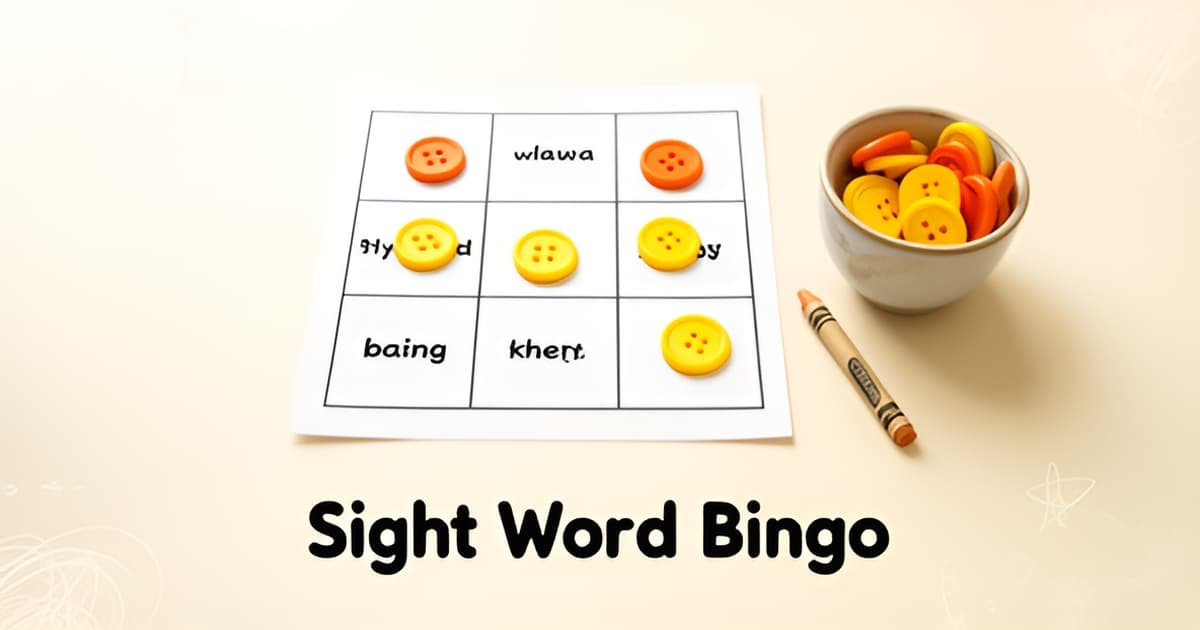
What are some fun and engaging sight word bingo games for kindergarteners?
Key Facts
- A peer-reviewed study found sight word bingo improved word recognition by roughly 30 percentage points, with students reading over 90% of target words correctly.
- The first 100 high-frequency sight words make up more than 50% of early reading texts, according to reading specialists at Reading Eggs.
- Children typically learn 20 to 50 sight words in their first year of instruction, experts recommend introducing no more than 4 new words at a time.
- Reading Eggs recommends keeping sight word practice sessions short, just 5 to 15 minutes daily for young readers.
- A beginner 3x2 bingo grid with only six words keeps frustration low for brand-new kindergarten readers, per Reading Eggs guidance.
- Teachers use bingo as sneaky formative assessment: kids who mark words by sound alone show stronger recognition than board-watchers, per classroom guides.
- Dolch Kindergarten and 1st Grade sight word lists combine to 93 words, and free generators can produce up to 30 custom cards per batch.
Why Sight Words Are Hard (and Why Bingo Fixes It)
Ask any kindergarten teacher what the first year of reading instruction feels like, and you'll hear the same thing: a lot of memorization in a very short window. If you've been searching for fun and engaging sight word bingo games for kindergarteners, you already sense that flashcard drills alone won't get you there.
Here's the scale of the challenge. Children typically start learning sight words between ages 4 and 6, and they're expected to pick up 20 to 50 words in their first year of instruction, according to reading specialists at Reading Eggs. These aren't words kids can sound out, either. Sight words like "the," "said," and "was" break the phonics rules, so children have to recognize them instantly, like familiar faces in a crowd.
The stakes are real. English has more than 200 sight words, and the first 100 high-frequency words alone account for more than half of the words in early reading texts. A child who stumbles over "the" and "of" on every page burns mental energy that should go toward understanding the story. That's why teachers push for speed, not just accuracy.
The problem is that the standard fix, flashcard drills, gets stale fast. Round after round of "what's this word?" works for maybe a week before a five-year-old tunes out. The recommended pacing doesn't help: introduce a maximum of four new words at a time, keep sessions to 5–15 minutes daily. Short, frequent, repetitive practice is exactly what a drill format makes miserable.
This is where bingo earns its keep. It wraps the same repetition in a game kids actually ask to play. A peer-reviewed study by Kirby, Holborn and Bushby, published in the Journal of Applied Behavior Analysis, found that word game bingo produced a mean improvement of roughly 30 percentage points in word recognition, with students eventually reading more than 90% of target words correctly. The authors recommended bingo specifically as an effective technique for training sight word reading.
Bingo also solves problems drills can't touch:
- Engagement: Group play turns repetition into friendly competition rather than a boring task, as early literacy educators note.
- Assessment: Teachers can watch who marks a word by sound alone versus who waits for it written on the board, revealing exactly where recognition gaps sit.
- Flexibility: Grids scale from a beginner-friendly 3x2 board with six words up to full 5x5 cards, so difficulty grows with the child.
- Motivation: Winners can earn small tokens or privileges, adding a behavioral reward layer the research supports.
The format works at every level, too. A kindergarten teacher can run a simple six-word sight word bingo board with picture supports for struggling readers, while parents of older siblings might pull up a third grade sight word bingo set for the same family game night. Printoodle built its bingo generator around exactly this kind of customization: you pick the word list, the grid size, and the theme, and print.
The evidence points one direction. When the task is high-frequency repetition, the format matters as much as the content, and bingo is the format that keeps five-year-olds asking for one more round.
5 Fun Sight Word Bingo Games for Kindergarteners
Wondering what are some fun and engaging sight word bingo games for kindergarteners that actually hold a five-year-old's attention? The trick is matching the format to your child's level, and these five variations cover everything from first-time players to whole-class showdowns.
1. Classic Teacher-Called Bingo
The original format still works best for most classrooms. The teacher calls words aloud from printed caller cards while kids mark matches with chips or daubers, and you can keep it fresh with win variations like four corners, traditional bingo, and blackout. Prep is simple: laminate the cards, print the caller deck, and hand out one board per student, according to classroom practitioners. It doubles as informal assessment, since students who mark words by sound alone show stronger recognition than those waiting for you to write the word on the board.
2. Beginner 3x2 Grid Bingo with Flashcards
For brand-new readers, scale down. Reading Eggs recommends a 3x2 grid holding just six sight words, paired with matching flashcards: draw a card, say the word, and have your child cross it off. Since children typically learn 20 to 50 sight words in their first year and experts suggest introducing no more than four new words at a time, a small grid keeps frustration low. Grow the grid as their word bank grows.
3. Whole-Class Fry First-100 Bingo
When everyone plays at once, energy goes through the roof. Teach Starter's whole-class version uses the first 100 Fry Sight Words, which matter because those 100 high-frequency words make up more than 50% of early reading texts. Print on sturdy cardstock so the set survives year after year. Want your own word mix instead? You can generate a custom set of sight word bingo cards in seconds with Printoodle, tailored to your exact word list.
4. Digital Audio-Call Bingo
Perfect for centers or interactive whiteboards, digital bingo has students listen to a word spoken aloud, identify it, and click it, as digital game advocates describe. The audio-only format sharpens listening and word recognition without any printing or prep, and it works for independent practice or whole-group play.
5. Token-Reward Bingo
A peer-reviewed behavioral study used 5x5 bingo cards (24 words plus a free center square) where winners earned tokens traded weekly for preferred activities. Students improved by roughly 30 percentage points, with correct reading exceeding 90% by the end of treatment. The token layer gives reluctant readers a concrete reason to care, and it works just as well at home with stickers or screen-time minutes.
Making It Easier (or Harder): Differentiation Tips
No two kindergarteners hit sight words at the same pace, and a bingo game that's too easy bores your advanced readers while one that's too hard frustrates your strugglers. The fix is adjusting the same game three ways: the card, the words, and the pacing.
For students who need support, add picture cues alongside the words on their bingo charts so they can confirm what they're marking. For kids ready for a stretch, flip the setup and have them write the sight words onto blank cards themselves. That writing step adds encoding practice and turns the game into something closer to a spelling check. Both tweaks come straight from classroom bingo guides that treat differentiation as a core part of the format, not an afterthought.
Grid size is your other main lever. Reading Eggs recommends starting beginners with a 3x2 grid holding just six sight words, then expanding as the child learns more. Once students are comfortable, scale up to bigger grids. A sight word bingo generator lets you set the word list and grid per group, so your struggling table can play a six-word card while your advanced table plays a full-size one from the same print session.
Pacing matters as much as difficulty. Two rules from Reading Eggs are worth memorizing:
- Introduce a maximum of 4 new sight words at a time, so the called words stay recognizable rather than overwhelming.
- Keep sessions to 5 to 15 minutes daily. Short, frequent play beats long marathons at this age.
- Use bingo as a warm-up to activate words from a previous lesson, or as a lesson-ender to consolidate new ones.
- Print cards on sturdy cardstock so you can reuse the same set across the week instead of reprinting daily.
That last point saves real prep time. Laminated or cardstock cards turn a one-off activity into a reusable routine, which is exactly what Teach Starter recommends for whole-class play with the first 100 Fry words.
One more thing worth knowing: this format scales far beyond kindergarten. The same call-and-mark structure works with harder word lists for older readers, and Printoodle's third grade sight word bingo tool applies the identical approach to more advanced high-frequency words. So if you build the routine now, you're really building a system that grows with your readers rather than a single-game gimmick.
Start small: one 3x2 card, four words, ten minutes. Adjust from there based on who's winning too fast and who's not winning at all.
Bingo as a Sneaky Assessment Tool
Here's the part most teachers don't expect: the bingo game you're running for fun is quietly handing you assessment data. While your kindergarteners think they're just racing to get five in a row, you're getting a live read on who actually recognizes each word.
The trick is simple. Call a word aloud and watch the room. Some children mark it immediately, purely by sound. Others hesitate, eyes on the board, waiting for you to write it down. Those waiters are telling you something important: they can't yet match the spoken word to its written form. As classroom guidance from Savvy School Posters explains, teachers call the word, observe who marks it by sound alone, then write it on the board so the rest of the class can catch up.
That gap between the instant markers and the board-watchers is exactly the information you'd otherwise spend a testing session collecting. Instead of pulling kids aside for flashcard drills, you're gathering the same insight during a game they'd beg to play again. It's informal formative assessment disguised as Friday fun.
A few patterns worth watching for as you play:
- Instant markers recognize the word by sound alone, which suggests solid sound-to-print mapping.
- Board-watchers wait for the written word, revealing a word-recognition gap worth targeting in small groups.
- Children who mark the wrong word entirely may be guessing from first letters, a habit worth interrupting early.
- Fast, accurate markers across a whole session may be ready for a bigger grid or new words.
The stakes are real. The first 100 high-frequency sight words make up more than 50% of early reading texts, according to Reading Eggs, so a child who falls behind on these words struggles with nearly every sentence they meet. Bingo gives you a low-pressure way to catch those gaps early, when a short small-group session can still close them.
If you want to make this assessment loop easy, generate your own boards with a tool like Printoodle's sight word bingo generator, which lets you load exactly the words your class is working on. Teachers moving up a grade can do the same with the third grade sight word bingo version. Print it, play it, and read the room while they play. Game time doubles as data collection, and nobody has to know.
How to Build Your Own Sight Word Bingo Cards in Minutes
The best sight word bingo games for kindergarteners get even better when the cards match exactly what your class is learning. Instead of hunting through pre-made sets that never quite fit, you can build your own bingo cards in minutes and start playing before the coffee gets cold.
Start with your word list. The Dolch kindergarten list is the classic choice, but the first 100 Fry words work just as well for whole-class play, since they cover the high-frequency words kids meet constantly in early texts. In fact, those first 100 sight words make up more than 50% of the words in early reading material, so every round of bingo doubles as high-value practice. If you're mid-unit on farm animals or the seasons, drop in your themed words alongside the sight words. And because children typically learn 20 to 50 sight words in their first year, per Reading Eggs' guidance, a fresh set of cards every few weeks keeps pace with their growing vocabularies.
With Printoodle's sight word bingo generator, you enter your word list once and get a full class set of unique cards, so no two neighbors can copy off each other. Print, cut, and play. The whole process takes less time than a lunch period.
Here's a quick workflow that works for most classrooms:
- Type or paste your words: Dolch kindergarten words, Fry words, or themed unit vocabulary.
- Generate a unique card for every student in one batch.
- Print on cardstock so the cards survive repeated rounds, a trick Teach Starter recommends for reuse all year long.
- Save the set to your library for free reprints whenever a card goes missing or a new student joins.
Personalization is where custom cards outshine anything store-bought. Add your students' names as words on the board and watch five-year-olds light up when "Emma" gets called. Themed sets for holidays, classroom pets, or a science unit make bingo feel like part of the lesson rather than a separate activity. You can even scale the challenge: a simple 3x2 grid with six words suits beginners, and you can grow the grid as their word banks expand, matching the progressive difficulty approach reading specialists recommend.
Differentiation is easy too. For students who need extra support, pair the bingo cards with picture cues. For kids ready for a challenge, have them write the words on their cards themselves before playing, which sneak in handwriting practice. And if you teach older students, the same generator approach works for third grade sight word bingo, so one tool covers your whole word-work rotation.
Once your cards are printed, everything else is simple: chips or daubers for marking, a caller list for you, and win variations like four corners or blackout to keep rounds fresh. Print it. Doodle it. Done.
Frequently Asked Questions
Do sight word bingo games actually help kindergarteners learn to read?
What are some fun and engaging sight word bingo games for kindergarteners?
How many sight words should a kindergartener know, and how many should I introduce at once?
How do I make sight word bingo easier or harder for different kids?
Can I use bingo to assess which sight words my students are struggling with?
How do I make my own sight word bingo cards for my class?
One Small Card, One Big Reading Win
So, what are some fun and engaging sight word bingo games for kindergarteners? The answer is whichever format fits your readers today: a gentle 3x2 grid for beginners, classic teacher-called rounds for the whole class, digital audio bingo for centers, or token-reward play for reluctant readers. The research is clear that the format matters as much as the words themselves, one peer-reviewed study found bingo improved word recognition by roughly 30 percentage points, with students eventually reading over 90% of target words correctly. Along the way, you get built-in differentiation, sneaky formative assessment, and a routine that scales from kindergarten through third grade sight word bingo. Your next step is simple: pick four words, set a ten-minute timer, and play. When you're ready for cards that match your exact word list, Printoodle's sight word bingo generator turns it into a class set in seconds. Print it. Doodle it. Done.