What are some fun dinosaur activities for children?
Key Facts
- Over 700 dinosaur species have been identified, with fossils found on every single continent, according to Twinkl's dinosaur facts.
- A T. Rex stretched twelve meters long and could run up to 32 kph, making it an unbeatable conversation starter for kids.
- Twinkl's Spinosaurus word search pack for ages 7-11 earned a 4.8 out of 5 rating from educator reviewers.
- Scholastic calls fine motor coordination vital for children beginning to write, making tactile dinosaur play foundational learning.
- Three major education publishers, Scholastic, Twinkl, and Kaplan, agree dinosaurs are a perennial classroom favorite loved by children for generations.
- Dinosaur activities need only everyday household items like pasta, rice, and muffin tins to keep costs low for families.
- Twinkl positions printable word searches as rewards children enjoy after they've worked hard, not as the main event.
Why Dinosaurs Hook Kids (and What Parents Need)
If you've ever asked yourself what are some fun dinosaur activities for children, you already know the real challenge: finding something that holds their attention for more than five minutes. Parents and teachers don't lack activity ideas. They lack activities kids actually stick with. Dinosaurs, it turns out, solve half that problem before you've even chosen the activity.
The theme itself is a proven engagement driver. Scholastic asks, "What preschooler is not intrigued and fascinated by these massive, majestic, and treacherous creatures?" and builds an entire activity collection around that fascination. Twinkl's family blog puts it even more bluntly: "you won't come across many preschool children who aren't completely fascinated by them!" Kaplan calls dinosaurs "a perennial classroom favorite, loved by children for generations." When three major education publishers agree on one theme, that's a signal worth acting on.
There's real substance behind the appeal, too. With more than 700 dinosaur species identified and fossils found on every single continent, the topic gives you endless material to work with. A T. Rex that stretched twelve meters long and could run up to 32 kph makes for a conversation starter no sticker chart can match.
What works best, though, is a mix. Kids need both active play and quiet, focused time, and the best activity plans build in both:
- Active, hands-on play like fossil digs, ice egg excavation, and dough rolling, which Twinkl notes doubles as hand-strengthening fine motor work.
- Quiet puzzle time with printables, which Twinkl positions as a "fun and engaging activity" kids enjoy after they've worked hard on something else.
- Skill-building in between, from Scholastic's literacy and math categories to Kaplan's STEAM projects blending art, sensory play, and engineering.
That active-plus-quiet structure is where printables earn their keep. A hands-on dig gets energy out; a puzzle brings the focus back in. If you want that quiet-time piece ready in seconds, Printoodle lets you generate a dinosaur word search, a dinosaur maze, or a dinosaur crossword puzzle as a print-ready PDF, sized to your child's reading level. You can even drop in your child's name or your own vocabulary list, so the puzzle matches what they're actually learning.
The rest of this article leans on sources like Twinkl's 25 PreK dinosaur activities and Scholastic's collection for ages 3 to 5, both of which lean on everyday household items like pasta, muffin tins, and rice to keep costs down. You don't need a craft room. You need the right theme, a mix of movement and quiet work, and a printer.
Hands-On Dinosaur Activities That Build Real Skills
Children naturally gravitate toward dinosaur themes, and research confirms that hands-on activities are the most effective way to engage them while building essential skills. Scholastic emphasizes that fine motor coordination, the strengthening of muscles in the fingers, hands, and wrist, is vital for children beginning to write, making tactile play a foundational element of early learning. Twinkl's PreK article notes that actions such as rolling, squeezing, and pinching are all great hand strengthening exercises to practice regularly, and S&S Worldwide confirms that activities can use everyday household items like pasta, recycled card, and rice to lower cost barriers for families.
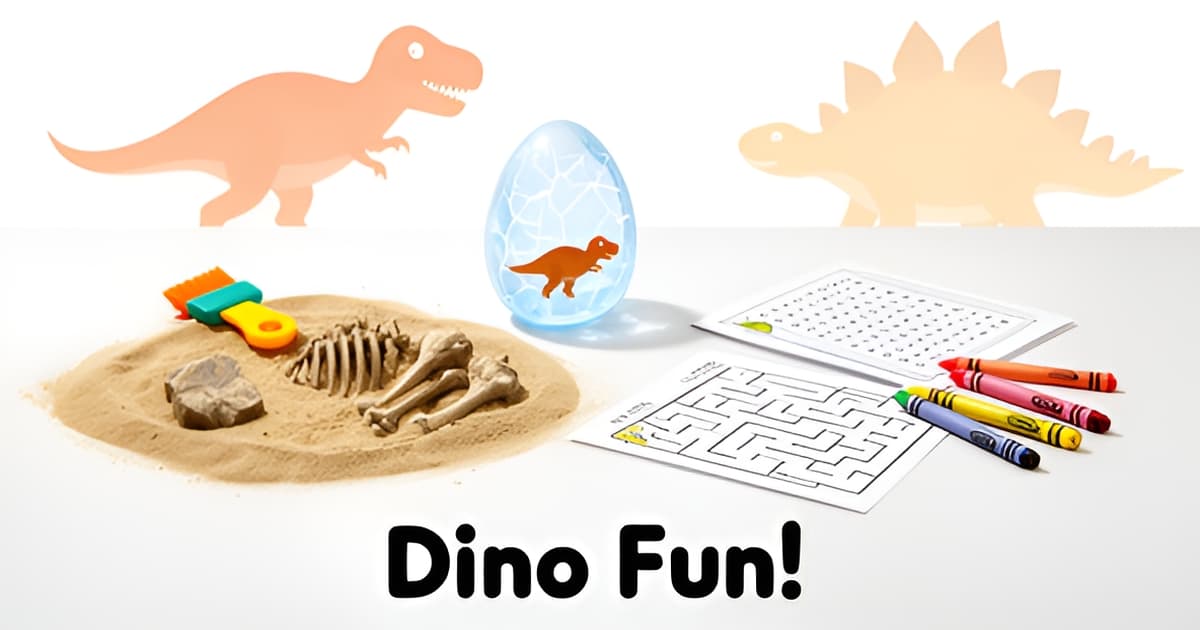
One of the most popular research-backed ideas is fossil excavation in kinetic sand. Burying toy dinosaur bones or puzzle pieces in sand allows children to dig, brush, and uncover "artifacts," which develops hand strength and hand-eye coordination in a format that feels like a real archaeological dig. Ice egg digs offer a similar sensory challenge: freezing small dinosaurs inside baking soda or water eggs encourages children to chip, pour, and melt their way to the prize, building patience and problem-solving persistence. These activities, along with Dino Egg Phonics, where children match letters hidden inside plastic eggs to build simple words, naturally integrate literacy into play without feeling like a lesson.
Cross-curricular learning happens organically when dinosaur themes are paired with building challenges. Using recycled card, muffin tins, and sticky tape, children can construct dinosaur habitats or balance structures, integrating art, engineering, and math concepts such as counting and spatial reasoning. The 10-minute word challenge, where children create as many words as possible from the letters in "dinosaur," builds vocabulary and spelling skills under a timed, game-like structure that keeps engagement high. Most of these ideas rely on materials already found in the home or classroom, making them accessible for rainy days or last-minute party planning.
For parents and teachers looking to extend the learning beyond the dig site, Printoodle offers a quick way to generate printable dinosaur activities. A dinosaur word search can serve as a calm, focused follow-up to active excavation, while a dinosaur maze challenges problem-solving skills in a format children love. Printoodle also provides a dinosaur crossword puzzle for older children ready for more complex vocabulary. All outputs are print-ready PDFs, and reprints are free forever, making it easy to create multiple copies for a classroom or birthday kit.
Print it. Doodle it. Done.
Printable Dinosaur Puzzles: The Perfect Wind-Down
After the fossil digs, volcano eruptions, and kinetic-sand excavations, even the most dinosaur-obsessed kid needs a quiet moment. That's where printable puzzles earn their place in your lineup of fun dinosaur activities for children: they're the calm landing after high-energy play.
There's real evidence this works. Twinkl's Spinosaurus Skeleton Discovered pack, designed for ages 7-11 and rated 4.8 out of 5, positions its printable word search as a "fun and engaging activity" children enjoy "after they've worked hard." In other words, the puzzle isn't the main event. It's the reward that follows hands-on effort, which is exactly how the best dinosaur activity sequences are built.
With Printoodle, you can build that wind-down in minutes. Generate a dinosaur word search using vocabulary your child already met during the day's play, then add a dinosaur maze for visual problem-solving, and finish with a dinosaur crossword puzzle for older kids ready for clues and spelling. Each one downloads as a print-ready PDF, and reprints are free forever, so a classroom of twenty or a birthday party of ten costs you nothing extra.
Matching difficulty to age makes the difference between engagement and frustration:
- Ages 3-5: Keep grids small with large, clear letters. A handful of short words like "egg" or "raw" works better than a dense grid.
- Ages 6-8: Medium grids with 8-12 words. Mazes with a few dead ends hit the sweet spot.
- Ages 9-11: Harder grids, diagonal and reversed words, and crosswords with clue-based vocabulary drawn from what they learned that day.
The dinosaur theme itself does much of the heavy lifting. Research across early childhood sources consistently shows children are genuinely fascinated by dinosaurs, which means the same puzzle format that would bore them on a Tuesday becomes exciting the moment "Stegosaurus" is hiding in the grid. Add in facts they can discover along the way, like the 700+ species that once existed, and quiet time quietly becomes learning time.
Print it, doodle it, done.
Putting Together a Full Dinosaur Day (or Party, or Lesson)
One good dinosaur day doesn't need a dozen elaborate setups. It needs a rhythm: something active to burn energy, then something quiet to settle everyone back down. That pairing is what turns scattered activities into a day kids remember.
The research backs this rhythm up. Twinkl's Spinosaurus resource, designed for ages 7-11, positions its printable word search as a "fun and engaging activity" children enjoy "after they've worked hard," and it earns a 4.8 out of 5 rating from reviewers. Meanwhile, hands-on options like ice egg excavation and kinetic sand digs remain the energy half of the equation, with sources like S&S Worldwide noting these work with everyday household items like pasta, rice, and recycled card.
Here's a simple schedule you can adapt for a rainy afternoon, a birthday party, or a classroom lesson block:
- Morning or party start (30-45 min): Hands-on excavation. Bury small dinosaur toys or puzzle pieces in kinetic sand or rice and let kids dig them out. Twinkl notes that rolling, squeezing, and pinching motions double as hand-strengthening exercises.
- Mid-session wind-down (15 min): Puzzle time. A dinosaur word search works as the quiet reward after active play, exactly the pattern Twinkl's Spinosaurus pack follows.
- Focus block (20 min): A dinosaur maze or a dinosaur crossword puzzle for kids who finish early or want more. Mazes suit the 3-5 crowd; crosswords stretch the 7-11 group.
- Closing (10 min): A timed word challenge. Twinkl's PreK activity #5 gives children 10 minutes to build as many words as possible from the letters in "dinosaur," which works with any group size.
For teachers printing classroom sets: generate your pages as print-ready PDFs (Letter by default, with an A4 toggle if your printers need it), print one master copy to check difficulty, then run the full set. Because reprints are free forever in Printoodle's library, a lost worksheet or a new student mid-unit costs you nothing but paper. The free tier gives you 10 credits on email verification, enough to test a word search, a maze, and a crossword before spending anything.
For party hosts building activity kits: assemble a folder per child with one word search, one maze, and one coloring page, personalized with the birthday child's name where it fits. Hand the quiet puzzles out after the excavation game, when kids naturally need to sit down. Twinkl's research found that more than 700 dinosaur species existed and dinosaurs lived on every continent, which makes great trivia to print on the folder cover.
Difficulty matters more than quantity. Keep grids small and fonts large for ages 3-5, and save denser vocabulary grids for the 9-11 crowd. Dinosaur themes have been a classroom favorite "for generations" according to Kaplan Early Learning, so the theme does the engagement work for you.
Print it. Doodle it. Done.
Frequently Asked Questions
What are some fun dinosaur activities for children that don't cost a lot?
Why are kids so obsessed with dinosaurs in the first place?
What dinosaur activities actually build skills, not just keep kids busy?
How do I calm kids down after active dinosaur play?
What dinosaur puzzles are right for my child's age?
How do I plan a full dinosaur day or birthday party without elaborate setups?
Your Dinosaur Day Starts with One Good Rhythm
So, what are some fun dinosaur activities for children? The answer comes down to a simple rhythm: something hands-on to burn energy, then something quiet to bring the focus back. Fossil digs, ice egg excavations, and kinetic-sand digs build fine motor strength and problem-solving persistence, while printable puzzles settle everyone down afterward, the exact reward pattern Twinkl's 4.8-rated Spinosaurus pack was built around. With more than 700 dinosaur species identified and fossils found on every continent, the theme never runs out of material. Your next step is easy: pick one active activity, pair it with a quiet one, and match difficulty to age. When you need the quiet half in seconds, Printoodle lets you generate a dinosaur word search, a dinosaur maze, or a dinosaur crossword puzzle as a print-ready PDF, personalized with your child's name or your own vocabulary, with reprints free forever. Print it. Doodle it. Done.