What are some fun family game night ideas without board games?
Key Facts
- 73% of adults say spending time with family is one of the most important things in their lives, per Pew Research.
- Preschoolers gained measurable math skills after just one hour of a simple dice game over two weeks, Carnegie Mellon research shows.
- Kids in families that gather regularly show larger vocabularies at age two and higher reading scores through grade 12, NC Extension reports.
- Best-rated kids' games run just 10–20 minutes because young children play from memory, not rules, gaming specialist Brian Mayer explains.
- Printable escape room kits deliver 45–90 minutes of gameplay from just 12–24 printed pages, EscapeRoomGeeks notes.
- Four years old is when kids can truly follow simple game instructions, according to expert Keewa Nurullah.
- Families' favorite game night win was laughing together without cell phones, NC Cooperative Extension found.
Why the Board Is Optional: What Actually Makes Game Night Work
Most families assume game night means a shelf full of boxed board games, complete with tiny pieces destined for the vacuum. If you've been wondering what some fun family game night ideas without board games look like, here's the good news: the research says the board was never doing the heavy lifting anyway.
According to a Pew Research Center survey, 73% of adults rate spending time with family as one of the most important things in their lives. What delivers that time is the act of playing together, not the format. PBS Parents puts it plainly: "no matter what games you play," the quality interaction itself drives the positive outcomes for kids.
The evidence backs this up in surprising ways. Carnegie Mellon researchers found that preschoolers who played a simple dice-rolling, token-moving number game for just one hour over two weeks showed measurable gains in number identification, counting, comparison, and estimation, according to PBS Parents. No fancy board required. A paper path and tokens did the job.
The real benefits of playing together cut across formats:
- Stronger family bonds and better social skills, as psychologists note in coverage of game night benefits
- Larger vocabularies at age two and higher reading scores through grade 12 for kids in families that gather regularly
- Better memory techniques and more independent problem-solving when kids strategize with parents
- Screen-free bonding, which NC Cooperative Extension agents call out as a highlight: families "interacting and laughing without cell phones"
That last point matters. A North Carolina Extension program found that the win families remembered most was the simple act of being together without screens. Printable activities deliver exactly that: paper, pencils, and people in the same room.
This is where a little creativity beats a big budget. You can build a full night from a family trivia game about your own household inside jokes, a family trivia board game you design together, or a custom quiz made with a quiz board game maker in minutes. Printoodle's whole premise is that "creativity matters far more than budget," a point game night hosts echo when they recommend printing DIY games at home.
So retire the guilt about the unopened game closet. You need a table, a printer, and a willingness to play. The research says that's enough.
7 Board-Free Game Night Ideas You Can Print Tonight
The best game nights don't come from a box. Mayday Games puts it plainly: you can print free DIY games online, and "creativity matters far more than budget" when it comes to hosting a night your family remembers. If you've been wondering what are some fun family game night ideas without board games, the answer is a three-act evening: quick icebreakers, one or two main events, and a calm wind-down.
Act one: icebreakers that take five minutes. Word searches and mazes work beautifully here because they require zero rules explanation. Wirecutter's kid-gaming guidance shows why this matters: the best-rated games run mostly 10–20 minutes, and younger kids need "a much simpler rule set because they aren't reading the rules, they're playing based on how they remember," as gaming specialist Brian Mayer explains. A themed word search or a maze printed with your child's name in the title fits that window perfectly.
Act two: the main events. A family trivia game is the workhorse of a board-free night. Build questions about your own household, grandma's hometown, the dog's middle name, and pair children with adults for fair teams, as entertaining expert Rebecca Gardner recommends. Want something more structured? Printoodle's family trivia board game generator turns your questions into a print-and-play format with zero equipment beyond a printer. Other proven main events:
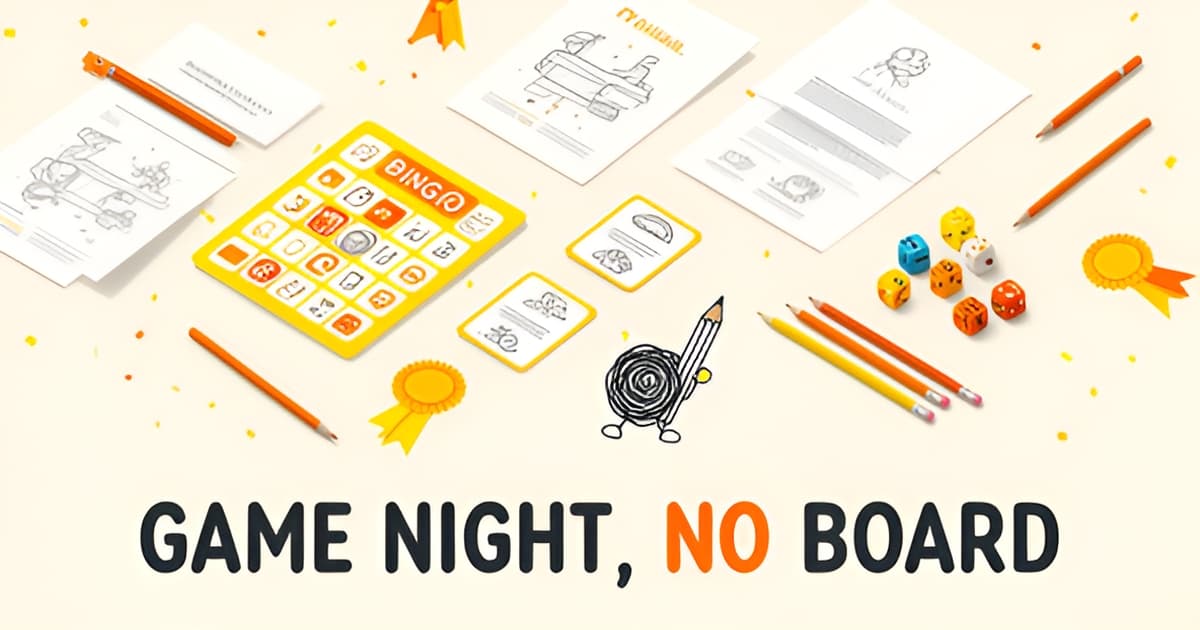
- Bingo cards customized to your family (inside jokes make great squares)
- Escape-room-style puzzle kits, which EscapeRoomGeeks describes as "no screens, just paper & play," with 45–90 minutes of gameplay from 12–24 printed pages
- Charades-style guessing games like People.com's "It's in the Bag!", which has no upper player limit
- A custom quiz built with a quiz board game maker, with easier questions for little kids and harder ones for adults
Act three: the wind-down. Coloring pages and dot-to-dot puzzles let everyone's energy settle while hands stay busy. This is also where the stakes get settled: Mayday Games suggests homemade trophies, funny titles like "Queen of Chaos," and sticker charts, while People.com's experts favor silly consequences, such as the losing team cleans the kitchen.
One planning rule ties the whole night together. Match every activity to your audience's attention span, keeping each round in the 5–20 minute range so, as hostess Amanda Saiontz Gluck puts it, the night ends wanting more rather than wishing it would end. Creativity beats budget every time, and a printer plus a stack of paper is genuinely all you need. Print it, doodle it, done.
Make It Work for Every Age in the Room
Few things derail game night faster than a 5-year-old in tears over rules a 10-year-old finds trivial. The mixed-age problem is real, but it's solvable with a little structure.
Start with expectations. According to game expert guidance from Keewa Nurullah, owner of Chicago children's shop Kido, four years old is roughly when kids can really listen to, understand, and follow most simple game instructions. Younger siblings can still join in, but plan for them to play alongside a grown-up rather than on their own team.
Brian Mayer, a library technology and gaming specialist in New York, puts it plainly: "with younger kids you want a much simpler rule set because they aren't reading the rules, they're playing based on how they remember." His other observation matters just as much. Cooperative play "fosters discussion and collaborative thinking, and allows players of different ages and skill levels to enjoy the game together." When everyone works toward a shared goal, the 5-year-old's contribution counts as much as anyone's.
Rebecca Gardner, founder of Houses & Parties, offers the simplest fix of all: "Pair children with adults for fair competition and excitement." A child paired with a parent on a team can handle harder questions, and the stakes stay silly either way. Think "losing team cleans the kitchen" or the winners pick Sunday's restaurant, two stakes hosting experts recommend for keeping every age engaged.
Printables make tiered play easy. With a quiz board game maker like Printoodle's, parents can build one game with questions at multiple difficulty levels, so the same family trivia game deck works for the whole table. A few ways to tier it:
- Easy questions for young kids, read aloud slowly
- Medium questions for tweens and teens
- Hard questions for adults, worth more points
- Cooperative rounds where teams pool their answers
The same logic works for a family trivia board game you print at home. Keep each round short, in the 5 to 20 minute range that children's game researchers recommend for holding attention, and end the night while everyone still wants more. Amanda Saiontz Gluck, founder of Fashionable Hostess, says it best: "You always want the night to end wanting more rather than wishing it would come to an end."
Hosting Details That Cost Nothing: Prizes, Snacks, and a Phone Basket
The best game night atmosphere costs almost nothing to create. According to hosting experts at People.com, a cozy setup with plush blankets and pillows, plus mini snack trays within reach, keeps everyone settled and playing longer. None of it requires a trip to the store.
The same goes for stakes. People.com suggests keeping them silly: the losing team cleans the kitchen, or the winner picks the restaurant for Sunday supper. Stakes like these give kids a reason to care about the final round without spending a dime.
Prizes can be printed instead of purchased. Mayday Games recommends homemade trophies, funny titles like "Queen of Chaos," and sticker charts to track wins across multiple game nights. A printable trophy taped to the fridge has more staying power than a candy bar, and a running sticker chart gives kids something to come back for next week.
- Printable trophies or certificates for the winning team
- Funny superlative titles ("Queen of Chaos," "Comeback Kid") awarded at the end
- A sticker chart that tracks wins from week to week
- A phone basket by the door: everyone's device goes in before the first round
That last item matters more than it looks. The NC Cooperative Extension notes that families at organized game nights loved "interacting and laughing without cell phones or other forms of digital engagement," and a PBS Parents piece points out that the quality interaction itself is what drives the benefits, no matter what games you play. A screen-free zone is the whole point of the night.
One final tip from hosting pro Amanda Saiontz Gluck, founder of Fashionable Hostess: "You always want the night to end wanting more rather than wishing it would come to an end." Match the games to your audience's attention span and stop while everyone's still having fun.
If you want prizes, scorecards, or a custom family trivia game personalized with your family's inside jokes, Printoodle can generate print-ready pages in seconds. Print it. Doodle it. Done. Reprints are free forever, so you can restock a lost trophy certificate or rerun a favorite trivia round anytime.
Frequently Asked Questions
What are some fun family game night ideas without board games?
Can printable games really hold kids' attention like boxed board games?
How do I keep kids of different ages engaged during the same game?
Do family game nights actually provide developmental benefits for kids?
What are some low-cost ways to add prizes and stakes to game night?
How can I make game night screen-free and engaging for the whole family?
Game Night Without the Guilt: Why the Board Doesn't Matter
The research is clear: the magic of family game night isn't found on a boxed board, but in the quality time spent together. A Pew Research Center survey found that 73% of adults consider spending time with family one of life's most important things, and studies confirm that the act of playing, regardless of format, drives real developmental benefits for children, from stronger vocabularies to better problem-solving skills. Whether you're printing a custom trivia game about your household inside jokes or simply enjoying a round of word searches, the format is secondary to the connection. As Mayday Games reminds us, creativity matters far more than budget, and a simple printer and stack of paper are genuinely all you need to create lasting memories. The key is matching activities to your family's attention span, keeping rounds short and engaging, and ending the night while everyone still wants more. If you're ready to retire the guilt about that unopened game closet and start building your own board-free traditions, Printoodle makes it easy to generate printable trivia, bingo cards, and puzzles personalized with your family's unique story. Print it. Doodle it. Done. Reprints are free forever.