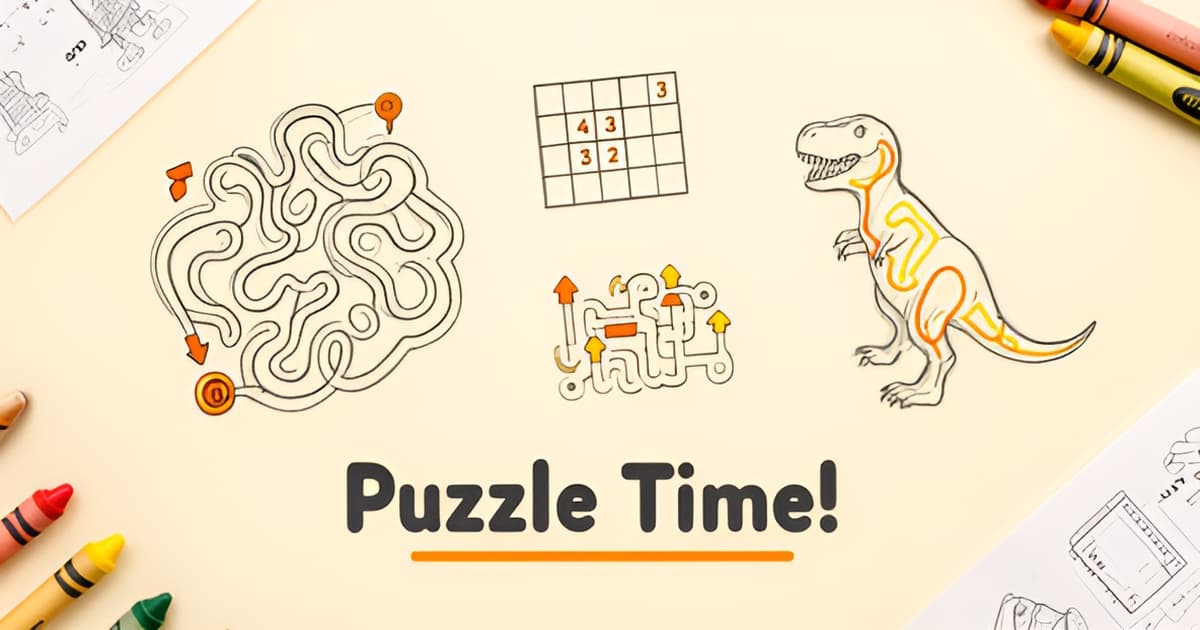
What are some fun puzzle ideas for kids?
Key Facts
- A kids maze is defined by wide pathways, short obvious dead ends, and clearly labeled start and goal points, according to maze design guidance.
- Over 15 distinct kids maze types exist, from arrow mazes to themed T-Rex shapes, per doyoumaze.com's showcase.
- Printoodle's maze generator delivers 30 easy mazes per download on 15×15 grids, two per page with numbered answer keys, per a third-party review.
- Mazes must print at 100% scale because 'Shrink to Fit' drops lines and breaks the puzzle, The Teacher's Corner warns.
- The Kennedy Center's maze-making lesson teaches the branch method: draw the solution path first, then erase wall sections to create wrong turns.
- Movement mazes built with floor tape give kids a roughly two-minute whole-body reset, and one third grader said it helps you 'focus and learn,' per the Moving Minds blog.
- Laminating mazes for dry-erase solving turns one sheet into a reusable rotation station, a tip from the Kennedy Center's lesson.
Why Kid Puzzles Fail (and How to Fix the Design)
If you've ever asked yourself what are some fun puzzle ideas for kids and then watched your child abandon a maze after ninety seconds, you already know the problem: most puzzles fail before the pencil touches the paper. They're too hard, too fiddly, or too boring. The good news is that failure usually comes down to design, and design is fixable.
According to maze design guidance from doyoumaze.com, a kids maze is really just "an easy maze" built so children don't get frustrated and quit before reaching the goal. Three traits make that happen:
- Wide pathways, so small hands can trace without slipping between walls
- Short, obvious dead ends, so a wrong turn teaches instead of punishing
- Clearly labeled start and goal points, so the child always knows what they're working toward
The same source also describes a skill-matching rule that applies to every puzzle, not just mazes: "Most people want to solve a puzzle/maze that is just slightly below or slightly above their skill level." A puzzle that's far too easy feels boring. One that's far too hard feels like work. The sweet spot is barely a stretch, which is why a five-year-old needs a different puzzle than a ten-year-old even when both say "I love mazes."
Design flaws explain abandoned puzzles, but sameness explains bored ones. doyoumaze.com showcases 15 different kids maze types, from arrow mazes and number mazes to themed shape mazes like a T-Rex, and its author's view is blunt: "The use of many different maze types creates a more fun book in my opinion." Rotating formats keeps the same core skill feeling fresh.
That's where a quick generator earns its keep. Printoodle formats kid-friendly maze ideas for fast printing, and its mazes for kids tool pairs naturally with other formats when mazes lose their shine. A kids sudoku printable builds the same logical-muscle from a different angle, and rebus puzzles for kids add a picture-guessing twist that rewards lateral thinking. Batch printing helps too: one third-party review of Printoodle's generator describes 30 easy mazes per download, 15×15 grids, two per page, with numbered answer keys so kids can check their own work.
One last practical note: if printed maze lines ever look incomplete, check your printer settings. The Teacher's Corner notes that mazes must print at 100% scale, since "Shrink to Fit" drops lines and breaks the puzzle.
Fun Puzzle Ideas for Kids: 10+ Maze Types to Rotate
What if the maze your child tackles today feels brand new tomorrow? Mixing up puzzle types is the secret to keeping screen-free play fresh, and research into kid-friendly design shows that variety isn't just fun, it's how you build a habit of solving. From arrow-based pathways to number-guided routes, the right mix turns a simple activity into a mini-adventure that grows with your child's skills.
According to maze-design guidance, kids mazes are defined by accessibility rather than complexity, featuring wide pathways, short obvious dead ends, and clearly labeled start and goal points to prevent frustration. This foundation makes it easy to layer in different styles without overwhelming young solvers. Research shows that 15+ named kids maze types exist, including arrow mazes, number mazes, circle escape, dot mazes, pipe mazes, and themed shape mazes like a T-Rex. The author's opinion notes that "the use of many different maze types creates a more fun book," and mixing these formats keeps engagement high as children progress.
Arrow Mazes direct movement with simple indicators, perfect for early readers building directionality. Number Mazes require following a sequence, turning the path into a counting exercise. Circle Escape formats challenge kids to navigate round obstacles, while Dot Mazes use scattered points to create unique branching paths. Pipe Mazes add a layer of connection logic, and Themed Shape Mazes, like a T-Rex outline, tap into current interests to make the goal feel personal.
Narrative twists can level up the experience for older kids. Kennedy Center educational resources describe maze-making lessons that incorporate story tasks, such as a knight collecting a sword or saving a princess, transforming a flat puzzle into a collect-item mission. Avoid-item variations, where the path must dodge obstacles, add another layer of strategy that keeps solvers on their toes.
The practical benefits of this variety extend beyond entertainment. Printoodle's maze generator produces 30 easy mazes per download package with 15×15 grids, two puzzles per page, and numbered answer keys in PDF format, making it simple to print a fresh batch for rainy days or classroom bins. For readers who want variety beyond mazes, Printoodle also offers kids sudoku printable and rebus puzzles for kids, all designed for quick printing and reusable play.
Print it. Doodle it. Done.
Level Up: Story Mazes and Movement Mazes
When kids breeze through basic mazes, the challenge, and the fun, starts to fade. The good news is that maze design has evolved well beyond simple line-drawing, offering layered experiences that engage both the mind and the body.
Research into maze-making highlights that variety is a key driver of engagement. According to doyoumaze.com, over 15 distinct kids maze types exist, ranging from arrow mazes and number mazes to themed shape puzzles like the T-Rex. Mixing these formats prevents the monotony that can set in with single-style books, keeping puzzles fresh for repeat solving. Printoodle’s maze generator supports this diversity, allowing users to produce custom layouts that incorporate the specific types cited in design guides, all ready for quick printing. For parents and teachers looking to stock up, Printoodle offers mazes for kids in ready-to-print formats, while those seeking number-based challenges can explore kids sudoku printable options, and wordplay lovers can try rebus puzzles for kids to mix up the routine.
For children who have mastered the basics, narrative mazes provide a compelling upgrade. The Kennedy Center’s lesson on maze-making weaves storytelling directly into the puzzle path, transforming a navigation exercise into a mission. In these designs, a knight might collect a sword, defeat a dragon, and ultimately save a princess, each turn of the page a step in a larger story. This approach taps into the natural love of adventure, giving kids a reason to trace the path beyond simply “finding the end.” Printoodle’s themed generators can format these story-driven layouts, turning a standard tracing activity into a short narrative adventure that feels earned.
Physical engagement is the other frontier for kids who need to move. Movement mazes, built with floor tape in a hallway or large room, turn the puzzle into a whole-body break. Color-coded zones guide kids through hopping, crab-walking, and wall sits for a roughly two-minute reset. As the Moving Minds blog notes, one third grader reported that “when you come back inside it's a nice wiggle and you can focus and learn!” This aligns with Dr. Lanningham-Foster of the Mayo Clinic, who emphasizes that kids need movement for proper development. Integrating these active breaks into a day, whether in a classroom or at home, provides the physical reset many children need before settling back into focused work.
For those ready to level up from flat puzzles, Printoodle’s tools make it easy to generate and print these engaging formats at home or in the classroom. Print it. Doodle it. Done.
Print, Laminate, Repeat: Practical Tips for Parents and Teachers
A great printable puzzle can be solved once and tossed, or set up once and reused all year. The difference comes down to a few printing and prep habits that take minutes but save hours of re-printing.
The first rule is the one that trips up almost everyone: print at 100% scale. If your printer dialog is set to "Shrink to Fit," maze lines can go missing entirely, leaving kids with an unsolvable grid. The Teacher's Corner flags this exact issue as the most common printing problem with generated mazes, so check that setting before you hit print.
Once the maze prints correctly, make it reusable. Laminate the page, or slip it into a glass picture frame or acetate sleeve, and hand kids dry-erase markers. The Kennedy Center's maze-making lesson recommends this approach so multiple children can attempt the same maze, wipe it clean, and try again. It's a classroom staple for good reason: one sheet becomes a rotation station instead of a one-and-done activity.
Batch printing is the other habit worth building. When you're prepping for a rainy day or a substitute teacher, a single maze won't stretch far. Tools like mazes for kids generators format packs that solve this: Printoodle's maze downloads include 30 easy mazes on 15×15 grids, printed two per page, with numbered answer pages so kids can check their own work without calling you over every ninety seconds. That self-checking step matters more than it sounds, since it keeps the activity running independently while you do literally anything else.
A few other prep tips that pay off:
- Print answer keys separately from the puzzles so kids aren't tempted to peek at the solution on the same sheet.
- Keep a small stash of dry-erase markers with felt erasers (or old socks) next to your laminated mazes.
- Mix puzzle types in one pack. A batch of mazes alongside a kids sudoku printable or a set of rebus puzzles for kids keeps things fresh longer than thirty identical grids.
- Store finished packs in a folder by difficulty level so you can grab the right one fast.
None of this requires special equipment or a laminating machine the size of a suitcase. A standard home laminator, a box of acetate sleeves, or even a clear page protector gets you most of the way there. The point is to set up the puzzle once and let it do its job repeatedly, whether that's at the kitchen table on a wet Saturday or as an early-finisher activity in a classroom of twenty-six kids.
Make Your Own in Seconds (Even DIY with the Branch Method)
You've got the ideas. Now you need the actual puzzles, and you have two good ways to get them: generate them in seconds, or draw your own with a technique straight from an arts educator.
Path 1: Generate them instantly. If you're wondering what are some fun puzzle ideas for kids that don't require a craft session, Printoodle's mazes for kids generator turns a short brief into print-ready PDFs themed to whatever your child is into: a birthday, a lesson unit, or a favorite animal. Each download includes 30 easy mazes on 15×15 grids, printed two per page with numbered answer keys, according to a third-party overview of the tool. Everything you generate lives in your library, so reprints are always free, which matters more than you'd think when a maze gets solved in ninety seconds and a second kid wants a turn. If you want variety beyond mazes, the same idea works for a kids sudoku printable or rebus puzzles for kids.
Path 2: Draw your own with the branch method. The Kennedy Center's maze-making lesson teaches a surprisingly forgiving technique:
- Draw one clean, winding path from start to finish first.
- Erase small sections of the walls along that path to create wrong turns and branches.
- To make it harder, move the start and finish points, or open connections between branches.
Because you drew the solution path first, you always know the maze works, which solves the most common DIY problem: a hand-drawn maze with no actual route to the goal. Maze design guidance from doyoumaze.com recommends keeping pathways wide and dead ends short and obvious for young solvers, and always labeling the start and goal clearly so kids don't quit out of frustration.
Two practical tips worth remembering. Print at 100% scale rather than "Shrink to Fit," since shrunk mazes can end up with missing lines. And if you want a maze to survive a whole classroom or a rainy afternoon, laminate it or slip it under acetate so kids can solve it with dry-erase markers and wipe it clean for the next person.
Print it. Doodle it. Done.
Frequently Asked Questions
What are some fun puzzle ideas for kids besides regular mazes?
Why does my kid quit a maze after two minutes?
How can I make mazes reusable for a classroom or rainy day?
Why do my printed mazes have missing or broken lines?
Can I draw my own maze for my kids without it being unsolvable?
Are there puzzle ideas for kids who can't sit still?
Your Next Ninety Seconds, Solved
So, what are some fun puzzle ideas for kids that actually get finished? The answer comes down to three moves: match the puzzle to your child's skill level with wide paths and short dead ends, rotate formats, from arrow and number mazes to story missions and movement mazes, so nothing feels stale, and prep smart by printing at 100% scale and laminating for wipe-clean reuse. Whether you generate a batch or sketch one yourself with the branch method, the goal is the same: a puzzle that stretches your child just enough to feel like a win. When you're ready to stock up, Printoodle's mazes for kids generator turns a short brief into print-ready PDFs, 30 easy mazes per download with numbered answer keys, and pairs nicely with a kids sudoku printable or a set of rebus puzzles for kids when mazes need a day off. Reprints are always free, so a rainy Saturday never runs out of puzzles. Print it. Doodle it. Done.