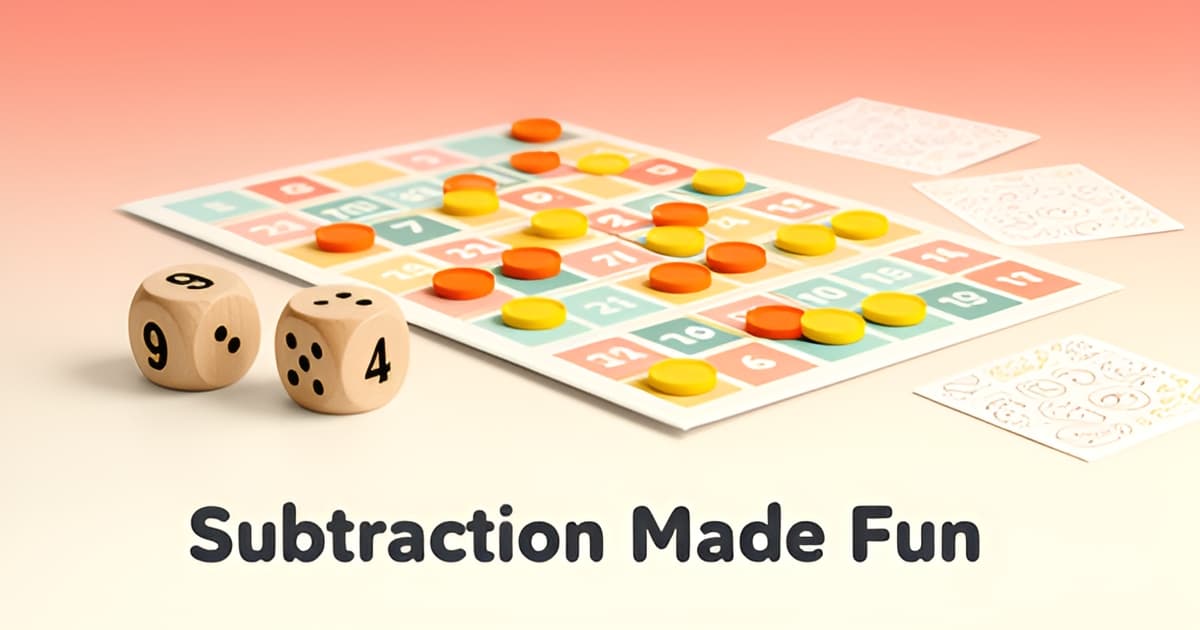
What are some good math subtraction games for 1st grade?
Key Facts
- The Grade 1 fluency target is addition and subtraction within 10, building on kindergarten's within-5 goal, according to Illustrative Mathematics.
- Illustrative Mathematics defines fluency as using procedures flexibly, accurately, efficiently, and appropriately, built through centers, not isolated drills per its curriculum writers.
- Math Salamanders' most popular first-grade subtraction games support 2–3 players and need only counters and 1–2 dice per its free PDF collection.
- This Reading Mama's no-prep subtraction pack covers facts from -0 through -10, including doubles and mixed review in its roll-and-cover games.
- The 'On and Off' game scales from 10 counters for struggling learners to 20-plus for advanced students, same rules, only the number changes says The First Grade Roundup.
- In partner card sorts, the child not solving acts as the coach and re-teaches or corrects as needed, according to teacher Susan Jones.
- Prodigy's subtraction guide lists 8 first-grade games, including two free online options like Cat Rescue and Penalty Kick Subtraction per its education team.
Why Flashcards Alone Don't Build Subtraction Fact Fluency
You've run the flashcards a dozen times. Your first grader aces 9 − 3 at the kitchen table, then blankly stares at the same fact the next morning. That cycle of drill, forget, repeat is frustrating, and it's also a sign the practice itself isn't working.
So, what are some good math subtraction games for 1st grade, and why do they work better than isolated drills? The answer starts with what fluency actually means at this age. According to Illustrative Mathematics, the Grade 1 fluency target is addition and subtraction within 10, building on the kindergarten goal of within 5. Their curriculum writers define fluency as using procedures "flexibly, accurately, efficiently, and appropriately," and they build it through centers, warm-ups, and distributed practice rather than isolated drills.
The research consensus is clear: games build subtraction fact fluency better than flashcards alone. Math Salamanders puts it simply: using games is a great way to learn math facts and develop mental calculation skills in a fun and easy way. Games ask kids to recall facts repeatedly in a low-pressure, playful context, which is exactly the kind of distributed practice fluency research calls for.
Games also give subtraction meaning. Prodigy's education team recommends starting with physical manipulatives like LEGO bricks or bowling pins so children can visualize what subtracting actually means before moving to abstract symbols. First-grade teacher Susan Jones agrees, teaching manipulatives first because they're the most concrete and let students "really see what it means to subtract." A flashcard shows a fact; a game shows the math happening.
What good first-grade practice looks like:
- Facts within 10 as the core target, with some stretch to within 12 or 20
- Dice, counters, and printable boards rather than rote repetition
- Partner formats, which teachers like Susan Jones favor because they're consistently engaging and turn one child into a coach for the other
- Easy differentiation, like the "On and Off" game that scales from 10 counters for struggling learners to 20 or more for advanced students
The practical upside for busy parents and teachers: most of these games need nothing more than a printed board, a die, and some counters. Roll-and-cover formats, where a child rolls, solves a subtraction problem, and covers the answer to get five in a row, work like first grade sight word bingo and its second grade and third grade sight word bingo cousins: familiar, quick to set up, and endlessly replayable. With a tool like Printoodle, you can generate those boards, mats, and recording sheets as print-ready PDFs in seconds, and reprint them free whenever a game gets loved to shreds.
Print it. Doodle it. Done.
What Makes a Subtraction Game Work in 1st Grade
Before you scroll through another list of "good math subtraction games for 1st grade," it helps to know what actually makes a game work. First-grade teachers and curriculum designers converge on three criteria, and once you know them, you can judge any game you find in about thirty seconds.
Six-year-olds need to see subtraction before they can compute it. Prodigy's game guide recommends beginning with manipulatives like playdough, bowling pins, and LEGO bricks so students visualize what's actually happening before touching abstract equations. Teacher-blogger Susan Jones agrees, teaching manipulatives first because they're "the most concrete" and let students really see what it means to subtract.
This matters for game selection. A game built entirely around printed equations may look productive, but it skips the developmental step. The best games either include physical objects (counters, dice, cups) or pair a printed board with hands-on pieces.
Susan Jones calls partner games "some of my favorite to play because they are always so engaging," and she runs them while pulling small strategy groups. There's a built-in academic bonus too: in her partner card sorts, "the person not solving is the coach and re-teaches/corrects as needed." The non-solving player stays mentally active instead of waiting around.
Most of Math Salamanders' popular subtraction games follow this design, supporting 2–3 players with nothing more than counters and one or two dice. If a game works solo, that's fine, but the partner versions tend to hold attention longer.
First graders in the same room can sit anywhere from a kindergarten skill level (within 5) to well beyond the Grade 1 fluency target of addition and subtraction within 10. A good game stretches across that range without requiring you to learn three separate rule sets.
The teacher behind The First Grade Roundup describes "On and Off" as "the absolute easiest game to prep" and "a powerful tool for teaching ways to make ten," partly because differentiation is built in:
- Struggling learners use 10 or fewer counters
- On-grade-level students use 20 counters
- Advanced students get more counters or a second mat
Same rules, same cup, same mat. Only the number changes.
When you evaluate any subtraction game, ask three questions. Does it let kids touch and move objects before writing numbers? Does it work with a partner? Can you scale it up or down in ten seconds?
Concrete-to-abstract progression is the pedagogical backbone, partner play is the engagement engine, and flexible differentiation is what makes a game survive a whole school year. Notably, many of the best formats, like "On and Off," need only a cup, counters, and a printable mat, which is exactly the kind of printable piece you can generate yourself with Printoodle rather than hunting for a paid download. And if you're building a family game shelf anyway, printable games pair nicely with tools like first grade sight word bingo, second grade sight word bingo, or third grade sight word bingo for reading practice on the same shelf.
7 Subtraction Games 1st Graders Actually Want to Play
Finding the right subtraction games for 1st grade can transform a repetitive math lesson into something students actually look forward to. Research shows that game-based practice builds fact fluency more effectively than traditional drills, and the best activities for this age group follow a concrete-to-visual progression before moving to abstract equations.
The strongest options highlighted in recent classroom research include printable board games that require minimal setup. Math Salamanders’ free PDF collection features Race to the Moon (which targets subtraction to 10), Subtraction Cover Up to 12, and Salamander Shoot Out to 10, all playable with a simple board, counters, and one or two dice. These formats map directly to the printable worksheet generators available through Printoodle, letting teachers and parents customize the numbers or themes in seconds.
Another high-engagement format is the no-prep "roll, solve, cover" five-in-a-row game. This Reading Mama’s free pack covers subtraction facts from 0 through 10, including doubles and mixed review, and the reusable boards can be slipped into dry-erase pockets for repeated use. Because the format only requires a die and a set of counters, it’s an easy addition to math centers or homework folders.
For a hands-on activity that uses household objects, "Bowl & Subtract" gives students a tangible way to visualize taking away. Prodigy’s blog describes the game as inexpensive to recreate, typically using a bowl, counters, and a recording sheet, and notes that starting with manipulatives helps young learners grasp the concept of subtraction before moving to abstract symbols. A printable scorecard from Printoodle can turn the informal game into a trackable center activity.
The "On and Off" game is another teacher favorite for differentiating subtraction within 10 or 20. Using a cup of counters and a simple mat, students see how a starting number breaks apart into two parts. The First Grade Roundup notes it’s "the absolute easiest game to prep" because everything needed is already in the classroom or at home, and the format scales easily: fewer counters for struggling learners, more for advanced students.
Word-problem practice rounds out a balanced subtraction routine. Education.com’s first-grade subtraction word problem activities align with curriculum standards and help students apply math to everyday situations, building both confidence and critical thinking skills. These printable worksheets work well as a follow-up to the more active games, reinforcing the connection between the written equation and the story problem.
All of these games share a common goal: to give first graders repeated, meaningful practice with subtraction within 10–20 in a format that feels like play rather than work. When students can roll dice, move counters, and see numbers break apart in real time, they develop the mental strategies they need for fluency.
Printoodle makes it easy to bring these game formats into your home or classroom. Generate printable subtraction boards, mats, and recording sheets in seconds, then print as many copies as needed for free. First grade sight word bingo, second grade sight word bingo, and third grade sight word bingo are also available for families building a complete printable activity library. Print it. Doodle it. Done.
Print Your Game Boards, Mats, and Recording Sheets in Minutes
Once you've picked your favorite subtraction games for 1st grade, the only thing standing between you and game day is a stack of printables you don't have yet. That's where a tool like Printoodle changes the math: you describe the game you want, and it generates a print-ready PDF board, mat, or recording sheet in seconds instead of an evening spent formatting tables in a word processor.
The formats that work best are the ones teachers already trust. Math Salamanders' most popular first-grade games, like Race to the Moon and Subtraction Cover Up to 12, need nothing more than a printed board, counters, and one or two dice, and they target subtraction within 10 and 12, right where first graders should be building fluency. The Grade 1 standard, per Illustrative Mathematics curriculum writers, is addition and subtraction within 10, so boards that keep numbers in that range hit the sweet spot.
A "roll, solve, cover" bingo-style board is another easy win. This Reading Mama's no-prep version covers subtraction facts from -0 through -10, including doubles and mixed review, and players race for five in a row. You can generate the same format yourself with custom numbers, then slide the printed page into a dry erase pocket so one board survives weeks of practice.
Here's what to generate for a complete subtraction game kit:
- A bingo-style cover board with answers to subtraction facts within 10 or 12
- An "On and Off" mat and recording sheet, the game one first-grade teacher calls "the absolute easiest game to prep" for teaching combinations of ten
- A simple scorecard to pair with manipulative games like "Bowl & Subtract"
- A word-problem card set for subtraction within 20, echoing the word-problem practice Education.com recommends
Because every Printoodle page lives in your library with free reprints forever, you can refresh boards as your child's skills grow, or print a second copy for a sibling. And if you're building a full printable game library at home, the same generator handles literacy practice too, from first grade sight word bingo through second grade sight word bingo and third grade sight word bingo, so one rainy afternoon of printing covers math night and reading night alike.
Partner play deserves a mention here. First-grade teachers consistently report that two-player formats keep kids engaged longest, with one teacher noting the child who isn't solving acts as the "coach" and re-teaches as needed. Print two boards, hand over a cup of counters, and let the math talk begin.
Frequently Asked Questions
Are subtraction games really better than flashcards for first graders?
What subtraction facts should a first grader be fluent in?
What are some easy subtraction games I can play with just dice and counters?
Why do teachers start subtraction with manipulatives like LEGO bricks or bowling pins?
How do I make one subtraction game work for kids at different skill levels?
Are partner games better than solo practice for first graders?
Your First Game Night Is One Print Away
So, what are some good math subtraction games for 1st grade? The answer isn't one perfect game, it's a small shelf of formats that let kids see subtraction happen: a "roll, solve, cover" board racing to five in a row, an "On and Off" mat that scales from ten counters to twenty, a scorecard for "Bowl & Subtract," and a word-problem card set to tie the math to real stories. Every one of them needs just a printed page, a die, and a handful of counters, and each targets the fluency sweet spot of addition and subtraction within 10 that first graders are working toward. Start with one board this week, print two copies so a sibling or classmate can be the coach, and add a new format only when the first one gets loved to shreds. When you're ready, Printoodle can generate your boards, mats, and recording sheets as print-ready PDFs in seconds, with free reprints forever, plus first grade sight word bingo and third grade sight word bingo for the literacy side of your shelf. Print it. Doodle it. Done.