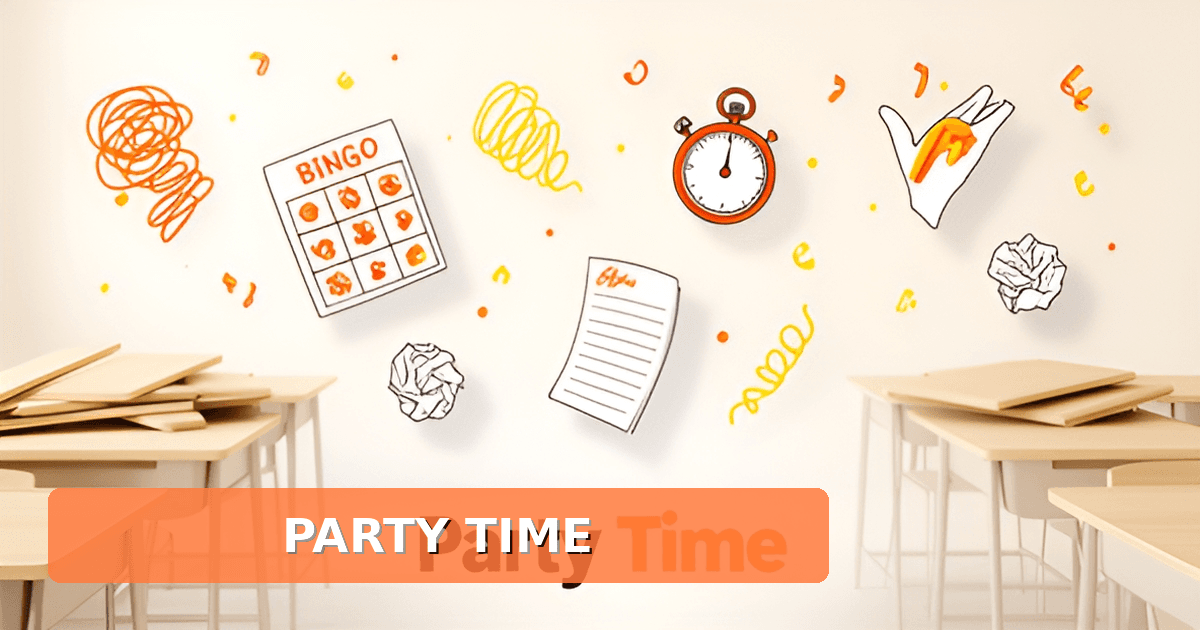
What are some good party games to play in the classroom?
Key Facts
- Charades is the most-validated classroom party game, appearing in three separate teacher roundups.
- Teach Starter's 'Tricks in 60 Ticks' collection packs 10 timed party games requiring little to no preparation.
- Review Bingo pays off: the first winner earns 3 bonus test points, the next 2, and the last 1, per Rutgers Alternate Route.
- Angela Watson's collection of 24 whole-class games is deliberately designed to avoid elimination and heartbroken losers.
- One teacher switched from a full food buffet to one snack plus games, making parties something she finally looked forward to alongside her students.
- Scholastic Printables offers over 20,000 teaching resources including games and puzzles, with a 30-day risk-free trial.
- 'Fun day minus behavior management plan equals disaster,' warns The Simply Organized Teacher.
Why Classroom Parties Are Moving From Food Buffets to Games
Planning a classroom party for 25+ kids is a logistical puzzle that often feels impossible to solve. Between the mountain of prep time and the mountain of materials, many teachers default to the traditional food buffet route simply because it feels easier, until they realize the chaos of sugar-high students and endless cleanup. Research across eight education sources confirms a documented shift: classroom parties are moving away from endless food buffets and toward activity-focused celebrations that keep students engaged. Teaching in the Fast Lane reports that one teacher switched from "tons of food with a single game" to "just a snack and multiple games," and suddenly the party became something she looked forward to right alongside her students. The Simply Organized Teacher adds a healthy-celebration angle, arguing that teachers should model healthy choices rather than defaulting to junk food at every gathering.
The consensus is clear: the best classroom games need few materials, minimal setup, and whole-class participation. Teachers prioritize games that include as many students playing at one time as possible, avoiding elaborate prep or expensive supplies. This is where the 60-second challenge trend comes in, Teach Starter’s "Tricks in 60 Ticks" collection features timed games designed for little to no preparation, proving that fun doesn't require hours of setup. Academic remixes of classic party games are also gaining traction; Academic Charades puts a curriculum twist on the classic using vocabulary words, while Simon Says adapts to subject-specific terms like astronomy or architecture vocabulary.
The "greatest hits" of classroom-ready games appear repeatedly across multiple sources, validated by at least two independent sources each. Charades and Pictionary show up across three and two sources respectively, serving as adaptable vehicles for any subject. Bingo doubles as assessment review, with some teachers adding points to test scores for each line completed. Minute to Win It-style 60-second challenges and Would You Rather prompts keep energy high and materials low. Scavenger hunts and Heads Up/Headband round out the list, offering movement and guesswork respectively without requiring a classroom supply closet.
Printoodle was built for exactly this moment. The platform’s bingo generators, trivia card creators, word search makers, and themed party packs turn a teacher’s brief into a print-ready PDF in seconds, freeing up the time needed to actually enjoy the party. Whether printing a custom bingo card for vocabulary review or a set of minute-to-win-it score sheets, the free tier gives 10 credits on email verification, and every reprint is free forever. Print it. Doodle it. Done.
- Low-prep, minimal-material games are the top selection criterion for today’s classroom parties.
- Academic remixes like Vocabulary Charades turn game time into learning time.
- Printable resources remove the friction of gathering materials and prepping games.
- Whole-class participation keeps the energy up and the behavior management smooth.
- A single snack plus a drink replaces the food buffet without sacrificing celebration.
According to Teaching in the Fast Lane, the shift toward games over food is already well underway, with teachers reporting that a single snack and a drink are enough to keep the celebration going. Pair that with the documented preference for low-prep games, and the classroom party transforms from a stressful production into a manageable, fun-filled hour. The research is consistent: when the focus moves from the food buffet to whole-class games, everyone, students and teachers alike, looks forward to the party.
7 Teacher-Approved Party Games That Work in Any Classroom
So which party games actually work in a classroom? We compared eight education sources, and seven classics show up again and again. Each one is validated by at least two independent teacher sources, needs minimal materials, and adapts to any grade band.
Charades earns top billing, appearing in three separate roundups from SimpleK12 to Truth for Teachers. One student acts out a word while the class guesses. Try "Academic Charades" with vocabulary words, historical figures, or scientific processes for a curriculum twist. Best for: all grades.
Pictionary follows the same guess-the-answer logic with drawing instead of acting. Split the class into teams and have one student sketch while teammates guess. Best for: all grades.
Bingo doubles as a party game and a review tool. One Rutgers Alternate Route roundup describes teachers using it for assessment review, with the first Bingo earning 3 bonus points, the second 2, and the last 1. Best for: elementary and middle school.
Minute to Win It taps the 60-second challenge trend. Teach Starter's "Tricks in 60 Ticks" collection features 10 timed party games requiring little to no preparation, like stacking five apples in under a minute. If you want ready-made challenges, Printoodle's one minute games for kids tool generates print-ready task cards in seconds. Best for: elementary through middle school.
Would You Rather needs zero materials. Pose a question, have students move to sides of the room, and let them defend their choices. Best for: all grades.
Scavenger Hunt works indoors or out, with printable versions widely available. Best for: elementary.
Heads Up has one student hold a card on their forehead while classmates give clues. Best for: middle and high school.
For high school specifically, the Rutgers roundup also suggests remixes like Dance Jeopardy, where teams get 3 seconds to discuss and 10 seconds to perform, and Double Dare-style quiz challenges.
A few quick tips from veteran teachers:
- Model each game yourself first; "modeling is vital," warns one teacher.
- Pair games with one snack and a drink instead of a full buffet.
- Have a behavior management plan in place before party day.
- Schedule games monthly or weekly on Friday afternoons so students have something to look forward to.
One caution on format: elimination games can leave students sitting out, so if your class skews sensitive, favor whole-class versions where everyone plays until the end. As MyClassroomPARTY puts it, students who have fun while learning are more likely to participate and retain what they've learned. When classrooms feel playful, learning sticks.
The Academic Remix: Turning Party Games Into Learning Tools
The academic remix turns familiar party formats into low-stakes retrieval practice, letting students review vocabulary or concepts without the pressure of a traditional quiz. As Angela Watson notes, these joyful moments create memories that help students attach positive emotions to their learning, which helps the information stick. Research across eight education sources confirms that the biggest barrier to classroom fun isn’t student resistance, it’s teacher prep time. Teachers consistently prioritize games that require minimal materials and setup, with 60-second challenges explicitly designed for "little to no preparation." This is where Printoodle’s generators earn their keep: by letting teachers input their own lesson material to instantly produce bingo cards, trivia cards, word searches, and party packs that are print-ready and free to reprint.
The trend of "Academic Charades" demonstrates how easily classic party games adapt to the curriculum. SimpleK12 reports that Academic Charades puts a curriculum twist on the classic using vocabulary words, historical figures, or scientific processes, turning what could be rote memorization into an active, whole-class engagement strategy. Similarly, "Sun Says" adapts the playground favorite for astronomy terms, proving that a simple rule change can align a game with specific learning objectives. Bingo remains a staple for test review, and research from Rutgers shows teachers are adding point incentives to the card, first Bingo earns 3 points, the next 2, and the last 1, transforming a game of chance into a strategic review session.
Printoodle’s platform directly addresses the prep friction identified across these sources. With tools to generate word searches, trivia cards, and bingo from your own lesson material in seconds, teachers can shift focus from administration to instruction. Whether you are looking for a quick brain break or a structured review activity, Printoodle provides the print-ready PDFs needed to keep the classroom moving. Print it. Doodle it. Done.
Competition vs. Inclusion: Picking the Right Format for Your Class
Here's the honest tension in the classroom game world: some teachers treat competition as motivation, and others treat it as a heartbreak machine. Both camps have real classroom experience behind them, so the right answer depends on your students, not on a rulebook.
On the inclusion side, Angela Watson's collection of 24 whole-class games at Truth for Teachers is deliberately built to avoid elimination. As she puts it, "generally these are not games that will result in a heartbroken loser" (Truth for Teachers). Her reasoning is grounded in Responsive Classroom philosophy: safety, belonging, and fun are needs, not nice-to-haves, and a student who gets knocked out in round one spends the party watching instead of playing.
The competitive camp is equally confident. The Bored Teachers roundup embraces team competition with concrete rewards: "a prize, a bonus point on the test, a privilege" (Bored Teachers). Rutgers' Alternate Route blog goes further, describing a review Bingo game where the first winner earns 3 bonus points on the test, the next earns 2, and the last earns 1 (Rutgers Alternate Route). For some classes, that stakes-raising is exactly what drives engagement.
So how do you choose? A quick gut-check works better than a formula:
- Go cooperative if you have students who shut down after losing, a class still building community, or a group where a few confident kids tend to dominate.
- Go competitive if your class already handles losing well, the stakes are small (bonus points, privileges), and teams are balanced so no one student carries the blame.
- Split the difference with timed challenges. Teach Starter's "Tricks in 60 Ticks" collection runs 10 games at exactly 60 seconds each, so everyone attempts the same task and the "loser" is a clock, not a classmate.
Whatever format you pick, keep it manageable. Teacher modeling matters more than most people expect: "Modeling is vital for this activity," as one experienced teacher writes (Teaching in the Fast Lane). And don't skip the management piece. The Simply Organized Teacher puts it bluntly: "Fun day, behavior management plan = disaster!" (The Simply Organized Teacher).
Prep is the other bottleneck, and it's where format meets practicality. Cooperative games often need task cards or prompt lists for every student, while competitive ones need scorekeeping materials. This is exactly why printable game formats have taken hold. Printoodle's one minute games for kids fit the timed-challenge model especially well: print a set, hand one card to each student, and nobody sits out waiting for a turn. Print it. Doodle it. Done.
How to Run a Classroom Party That Doesn't Descend Into Chaos
Even the best party games fall flat without a plan behind them. Teachers who run smooth classroom celebrations tend to follow the same handful of habits, and the difference between a fun afternoon and a chaotic one usually comes down to preparation.
Start by modeling every game before students play it. Experienced teachers are blunt about this: "Modeling is vital for this activity," as one classroom blogger puts it. When you demonstrate the rules yourself, you cut down on confusion, arguments, and the off-task behavior that follows both.
Second, keep your behavior management plan running at full strength. The Simply Organized Teacher frames it as an equation: "Fun day, behavior management plan = disaster!" A party doesn't suspend your normal expectations. It raises the stakes on them.
Third, scale the food back. One teacher who switched from a full buffet to a single snack and a drink reports that classroom parties became something she looked forward to along with her students. Games, not food, should be the centerpiece. Here's the practical checklist:
- Model each game before students play it, including how winners are decided.
- Keep your regular behavior management plan in place during the party.
- Serve one snack and a drink, then put the rest of the time into games.
- Schedule game sessions weekly or monthly so students have something to anticipate.
That last point matters more than it sounds. MyClassroomPARTY recommends scheduling games once a month, or once a week on Friday afternoons, so students have something to look forward to. Anticipation does half the motivational work for you. When time is short, a quick round of one minute games for kids works as a brain break without derailing the day.
The remaining friction is prep. Timed challenge games work because they require little to no preparation, and printable resources like task cards remove the guesswork from game selection entirely. That's where Printoodle fits in: you can generate print-ready bingo cards, scavenger hunt lists, and full themed party packs in seconds, and every file stays in your library with free reprints forever. Lose a card to a juice spill? Print it again.
Print it. Doodle it. Done.
Your Next Classroom Party Starts With One Snack and Seven Games
So, what are some good party games to play in the classroom? The answer eight education sources agree on: low-prep, whole-class games like Charades, Pictionary, Bingo, and 60-second challenges, paired with a single snack instead of a buffet. The shift from food to fun is well documented, with one teacher reporting that swapping "tons of food with a single game" for "just a snack and multiple games" made parties something she looked forward to alongside her students (Teaching in the Fast Lane). Your next steps are simple: model each game first, keep your behavior plan running, and schedule celebrations monthly or on Friday afternoons so anticipation does the motivational work for you. When prep time is the barrier, let Printoodle handle the materials, generate print-ready bingo cards, trivia, and one minute games for kids in seconds, with free reprints forever. Print it. Doodle it. Done.