What are some literacy activities for Halloween?
Key Facts
- Halloween-themed spelling units scale from 20 words in Grade 3 to 21 words in Grade 5, per Super Teacher Worksheets.
- The International Literacy Association's advice for Halloween is simple: take advantage of their excitement rather than pushing it aside.
- One upper-elementary Halloween pack includes 32 fluency task cards and a reading project covering 16+ literacy skills, according to Teaching with a Mountain View.
- Halloween began as Samhain, an ancient Celtic agrarian holiday marking winter's start, according to Gale's historical research.
- Teachwire's roundup features 16 printable phonics flashcards covering CVC words like bat and CVCC words like fang, per its Halloween resource list.
- Scholastic offers 11 Halloween story starters that turn seasonal excitement into creative writing practice, per the ILA's roundup.
- Twinkl's ESL list includes 13 Halloween activities, and its educator calls the Día de los Muertos overlap "a great chance to celebrate diversity" in its activity roundup.
Why Halloween Is a Literacy Goldmine (And Why It Feels Like a Scramble)
If you're wondering what are some literacy activities for Halloween that actually keep kids learning, you're asking the right question at the right time. Late October brings a specific kind of chaos: your students are buzzing about costumes, your pacing guide hasn't moved, and every spare minute goes to hunting down printables that are both on-standard and actually fun.
The International Literacy Association's advice is refreshingly simple: don't fight the excitement, lean into it. Their "Trick or Read" roundup urges teachers to "take advantage of their Halloween excitement" by pairing seasonal energy with reading and writing practice rather than pushing the holiday to the margins of the school day.
That framing shows up everywhere. Super Teacher Worksheets notes that Halloween-themed materials encourage a balance between learning and fun, keeping students engaged while they build core skills. Reading Eggs makes a similar case for parents, calling the spooky season a perfect chance to spark imagination while practicing essential reading and writing. And upper-elementary teachers report the same thing: seasonal activities can deliver real fun while still hitting your literacy standards.
The catch, of course, is prep time. The good activities are out there, but they're scattered across dozens of sites, and cobbling together a week's worth takes an evening you don't have. That's the gap Printoodle was built to close: generate a themed worksheet, word search, or trivia page in seconds, download a print-ready PDF, and get back to teaching. Whether you need a quick halloween word search for morning work, a halloween maze for early finishers, or a round of halloween trivia for a class party, the materials take less time to make than the copies take to run.
Here's what makes Halloween worth the effort, in practical terms:
- Kids are already invested in the theme, so engagement comes built in rather than something you have to manufacture.
- The holiday spans every skill level, from CVC phonics words like bat, cat, and hat to inference mysteries and fluency work for grades 3 to 5.
- It opens doors to real content, including Halloween's Celtic origins as Samhain and its overlap with Día de los Muertos, which one Twinkl educator calls "a great chance to celebrate diversity."
- The format range is huge: word puzzles, story starters, comprehension passages, reader's theater, and descriptive writing all fit the theme.
The rest of this guide walks through the activity types that show up most consistently across teacher resources, organized so you can match them to your grade level and grab what fits. Print it. Doodle it. Done.
Word Puzzles and Vocabulary: The Most Universal Halloween Literacy Activities
If you're wondering what are some literacy activities for Halloween that work across every grade level, word puzzles and vocabulary games are the answer that comes up again and again. Word searches, spelling lists, flashcards, and bingo appear in nearly every major resource roundup, making them the most reliable starting point for October lesson planning.
For early years, phonics flashcards are the go-to. A Teachwire roundup features 16 printable Halloween phonics flashcards covering CVC words like bat, cat, hat, rat, fog, and web, plus CVCC words like fang, dark, howl, mask, newt, and worm. That CVC-to-CVCC progression mirrors exactly how early readers build decoding skills, just with a seasonal twist. The same roundup includes word mats pairing six words with images, which works well for vocabulary reinforcement at this age.
Older students get their own track. Super Teacher Worksheets offers grade-specific Halloween spelling units for grades 1 through 5, each with word lists, cloze sentences, flashcards, word wheels, word scrambles, and alphabetical order activities. The Grade 3 list contains 20 words and the Grade 5 list contains 21, so the difficulty scales meaningfully year over year. As the site puts it, themed materials encourage a balance between learning and fun so students stay engaged while still developing important skills.
The most common formats to pull together for a Halloween literacy center:
- Word searches for seasonal vocabulary reinforcement, also recommended in Twinkl's ESL activity list
- Class bingo and letter mix-up games for whole-group fun
- Phonics flashcards for CVC and CVCC decoding practice
- Spelling units with cloze sentences and word scrambles for grades 1–5
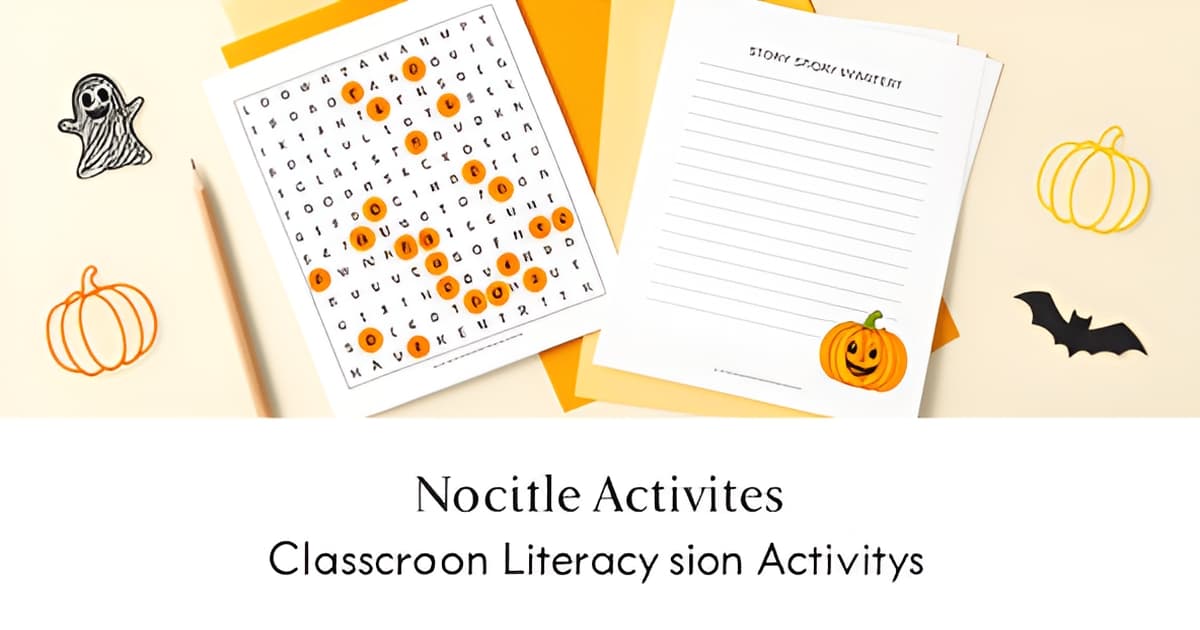
If you'd rather build these yourself than hunt through pre-made packs, Printoodle's halloween word search tool generates a print-ready puzzle in seconds, and you can control the word list so it matches your exact spelling unit. Pair it with a halloween maze for early finishers, or pull in halloween trivia cards for a vocabulary-rich warm-up. The International Literacy Association's advice is to lean into the seasonal excitement rather than fight it, and a fresh, personalized puzzle is one of the fastest ways to do exactly that. Print it, doodle it, done.
Spooky Story Starters and Creative Writing Prompts
Nothing gets a reluctant writer going like a blank page that starts with "The door creaked open and..." Halloween is prime creative-writing season, and there's no shortage of structured ways to channel all that spooky energy onto paper.
The easiest entry point is descriptive writing. Teachwire's roundup of Halloween resources includes a "My Halloween monster" worksheet where kids design a creature and describe it, plus witch's cauldron writing worksheets in both basic and advanced versions, so younger children can invent potion ingredients while older ones craft fuller recipes with instructions. These worksheets work well because they give kids a frame to write inside rather than an intimidating empty page.
For story writing itself, Scholastic offers 11 Halloween-themed "spooktacular" story starters, and the International Literacy Association's advice is to lean into the season rather than fight it: take advantage of their Halloween excitement. A story starter does exactly that. The first sentence is written; the child supplies everything after it.
If you want something the whole family can join, Reading Eggs suggests collaborative spooky storytelling where each person adds to the tale in turn. The real payoff is what happens afterward: write the finished story down, illustrate it, and staple it into a homemade book. Kids get genuine pride from seeing their own story on a shelf.
A simple progression by age looks like this:
- Ages 4–6: describe a monster with a few adjectives, or list silly potion ingredients for the witch's cauldron.
- Ages 6–8: finish a story starter in three or four sentences, then read it aloud.
- Ages 8–11: write a complete short story. Teachwire highlights Pie Corbett's "The Nightmare Man" as a model text for KS2 pupils to study structure before writing their own.
- Any age: family round-robin storytelling, turned into a homemade book at the end.
Older primary students can push further with descriptive technique. Teaching with a Mountain View offers a free set of 16 simile and metaphor task cards for grades 3–5, which pairs nicely with monster descriptions ("its fur was as matted as an old mop...").
When you're short on prep time, tools like Printoodle generate themed writing worksheets and supporting activities such as a halloween word search or halloween trivia cards as print-ready PDFs in seconds, so the writing session gets a vocabulary warm-up without an evening of searching. Whether you use published story starters or invent your own, the goal stays the same: get kids writing while the season has them fully hooked.
Reading Comprehension, Inference, and Fluency for Upper Elementary
Upper elementary is where Halloween literacy gets genuinely meaty, because third through fifth graders are ready to infer, question, and read between the lines. If you've been asking what are some literacy activities for Halloween that go beyond cute worksheets, this is the sweet spot: comprehension work that leans into the season instead of fighting it. As the International Literacy Association puts it, take advantage of their Halloween excitement.
A popular approach from Teaching with a Mountain View builds a full Halloween Inference Mystery set in "the town of Spooksville," where students piece together clues like detectives. The same resource includes context clues activities in seven themed formats, from Witches' Brew to Candy Chaos, plus 32 fluency task cards aimed at grades 3–5. Reader's theater scripts round out the set, giving students repeated-reading practice that doesn't feel like drill.
Chapter books offer another entry point. Ready-made literacy units exist for Bunnicula, Candy Corn Contest, and Magic Tree House #3: Mummies in the Morning, each pairing fiction and nonfiction comprehension passages with chapter-by-chapter work. A Super Teacher Worksheets unit on Bunnicula alone covers vocabulary, sequencing, and recall across an entire novel.
For quick comprehension checks, a set of halloween trivia cards works surprisingly well as an exit ticket: students read each question, discuss answers in pairs, and justify their reasoning. You can pair it with a halloween word search for vocabulary reinforcement, or a halloween maze as a fast-finisher that keeps early readers occupied while others finish their passages.
Older students also handle the real history well. According to Gale's historical research, Halloween began as Samhain, an ancient Celtic agrarian holiday marking the start of winter. Irish immigrants brought customs like pranking to the U.S. in the mid-nineteenth century, and trick-or-treating emerged as a parental response to early-1900s pranks. That's a ready-made nonfiction reading passage.
The calendar overlap with Día de los Muertos opens a cultural comparison discussion. As Twinkl's Miranda Crowhurst notes, the two holidays differ in fundamental ways, which makes the comparison "a great chance to celebrate diversity" and invite students to share their own traditions.
A few formats that consistently work in grades 3–5:
- Inference mysteries where students solve a "crime" using text evidence
- Context clues activities themed around potions, monsters, and candy
- Reader's theater scripts for repeated-reading fluency practice
- Chapter book units like *Mummies in the Morning* for sustained comprehension
- Trivia cards as quick, low-stakes comprehension checks
Each of these addresses real literacy standards while the seasonal theme does the motivating for you.
Build Your Halloween Literacy Pack in Minutes with Printoodle
By now you've probably got a dozen browser tabs open, each holding one printable from a different site. If you're wondering what are some literacy activities for Halloween that you can actually assemble without an evening of clicking, the answer is simpler than you'd expect.
The research backs up what teachers already do. Grade-specific spelling units run from a word list plus a dozen supporting worksheets in Grade 1 up to 21 words by Grade 5, per Super Teacher Worksheets. Upper-elementary packs get even bigger: one educator's Halloween set includes 32 fluency task cards and a reading project covering 16+ skills. That's a lot of material to pull together piecemeal.
With Printoodle, you build the whole week from your own word lists instead. Type in your CVC words (bat, cat, rat), your Grade 3 spelling list, or your inference vocabulary, and the generator produces print-ready PDFs in seconds. No hunting across four sites for a matching theme.
Here's how a week stacks up by skill level:
- Early years: a halloween word search built from CVC and CVCC words like "fang," "howl," and "mask," mirroring the phonics flashcard sets highlighted by Teachwire.
- Mid-primary: a halloween maze as a warm-up, then a descriptive writing worksheet for "My Halloween monster" or a witch's cauldron prompt.
- Upper elementary: a halloween trivia set drawn from Samhain and Día de los Muertos reading passages, plus context-clues practice pages.
- Whole class: bingo cards and flashcards from the same master word list so every activity reinforces the same vocabulary.
Every page you generate lands in your library, and reprints are free forever. Ripped a page on Friday afternoon? Print it again Monday morning at no cost. That's the practical difference between buying fixed packs and generating your own: you can tweak a word list mid-week when half the class hasn't mastered "cauldron" yet.
The International Literacy Association puts it plainly: take advantage of their Halloween excitement. You now have a way to do it in minutes, with your own words, at your own skill levels.
Print it. Doodle it. Done.
Frequently Asked Questions
What are some literacy activities for Halloween that work for younger kids?
Is it worth doing Halloween-themed lessons, or does the holiday just distract from learning?
What Halloween literacy activities are best for grades 3-5?
How can I use Halloween to teach creative writing?
Can Halloween activities teach real content, like history?
How do I put together a week of Halloween literacy activities without spending hours prepping?
Your Halloween Literacy Plan, Wrapped Up in a Bow (Well, a Bat)
So, what are some literacy activities for Halloween that actually deliver? The answer runs from CVC phonics flashcards and grade-level spelling units for early years, to spooky story starters and monster descriptions for mid-primary, all the way up to inference mysteries, reader's theater, and chapter book units for grades 3–5, with Samhain history and Día de los Muertos comparisons thrown in as rich nonfiction reading. The common thread across every expert source: don't fight the seasonal excitement, channel it. The only real obstacle is prep time, and that's where a generator beats a dozen open browser tabs. Pick one activity to start with, a halloween word search for morning work, a halloween maze for early finishers, or halloween trivia cards as an exit ticket, build it from your own word list in seconds, and download the print-ready PDF. Reprints are free forever, so a page ripped on Friday is back by Monday. Your students bring the excitement; you just supply the paper. Print it. Doodle it. Done.