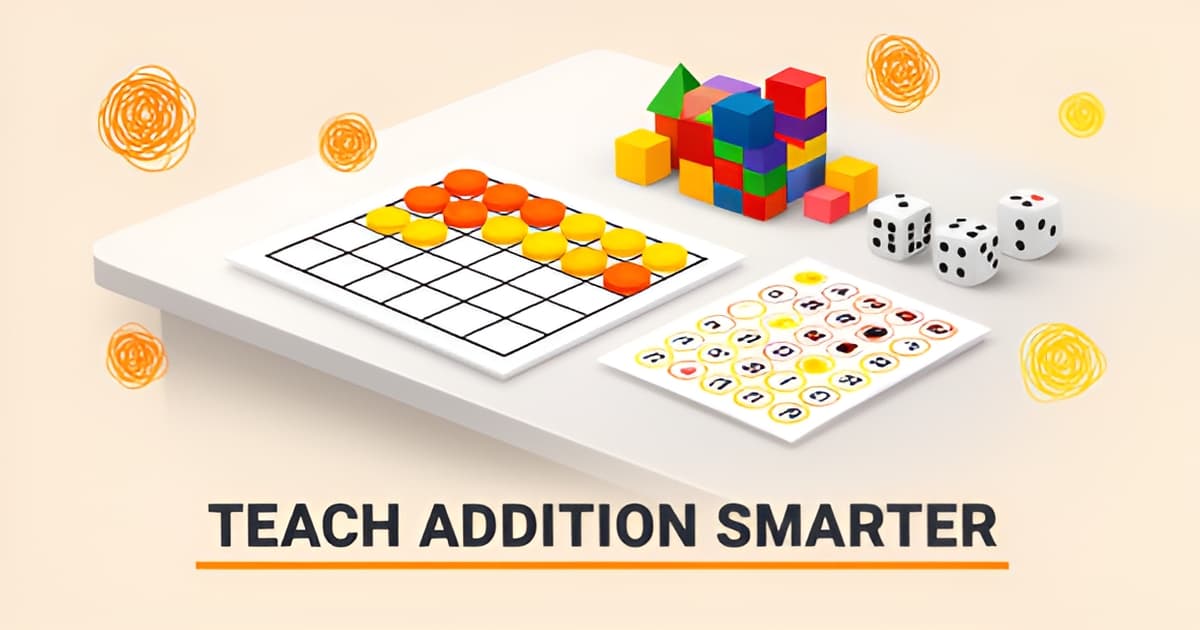
What are some new ways to teach addition?
Key Facts
- Students who use accurate visual representations are six times more likely to solve math problems correctly than those who don't.
- Instead of memorizing 100+ isolated facts, kids can master addition with just 6–14 teachable strategies according to math education research.
- Roughly 25–35% of students genuinely struggle with math, and 5–8% face significant challenges per Understood.org's data.
- A third-grade student with dyscalculia achieved over 90% of objectives in basic addition and subtraction skills through a structured, individualized program in a published case study.
- Addition bingo is an evidence-backed fluency game where students roll two dice and cover the sum, with 3×3 boards for sums to 12 and 5×5 boards for sums to 20 according to Understood.org.
- The Education Endowment Foundation notes that manipulatives like buttons, beans, and straws help reveal mathematical structure and build fluency in its teaching guidance.
- Teacher demand for addition strategies is strong, with one 14-strategies article earning 8.8K shares from educators.
Why Flashcard Drills Fall Flat (and What Works Instead)
When kids spend hours memorizing 100+ isolated addition facts, it’s no surprise that 25–35% of students truly struggle with math. Research shows these children aren’t lacking ability, they’re lacking strategy. A landmark study found that students who use accurate visual representations are six times more likely to solve problems correctly compared to those who don’t, yet traditional flashcard drills often skip the visual step entirely. The good news? The research consensus is clear: strategy-based learning replaces the overwhelming load of 100+ facts with just 6–14 teachable strategies that cover all addition problems from 1+1 to 9+9.
The most effective alternatives follow the CRA progression, moving from concrete manipulatives to representational drawings and finally to abstract symbols. The Education Endowment Foundation emphasizes that manipulatives “help reveal mathematical structure and support children in making connections in their learning,” but many classrooms stop at the concrete phase. Innovative methods ensure students can translate their hands-on experience into mental models, with the “Making 10” strategy emerging as a cornerstone. One first grade teacher described using ten frames and two-color counters so students can physically see combinations, noting that this visual approach makes the abstract concept of decomposition concrete and memorable.
Game-based fluency offers another research-backed path forward. Understood.org documents that addition bingo, where students roll two dice and cover the sum on their boards, serves as an “evidence-backed way to teach addition facts” that supports fact fluency while enabling self-checking. The same source outlines specific differentiation: 3×3 boards cover sums up to 12 using dice, while 5×5 boards cover sums up to 20 using index cards or two 10-sided dice, with built-in supports for struggling learners like oversized dice and large-print number lines. These game formats transform practice from rote memorization into meaningful engagement.
Printoodle’s platform is purpose-built for this shift. Teachers and parents can generate ten-frame worksheets, number line templates, and bingo cards that follow the CRA progression without spending hours designing them from scratch. A recent study of students with dyscalculia found that structured, individualized programs helped one third-grade student achieve more than 90% of objectives in basic addition and subtraction skills, suggesting that Printoodle’s customizable activity sheets could provide the differentiated support struggling learners need.
The data is compelling: move beyond flashcards and give students the strategies and visual tools they actually need to succeed. Print it. Doodle it. Done.
New Ways to Teach Addition: Five Strategies That Actually Stick
What if the secret to addition mastery isn't more worksheets, but the right strategy? Research into innovative addition instruction reveals a clear consensus: students retain facts better when they learn 6 to 14 strategic approaches rather than attempting to memorize 100 isolated facts. This shift from rote memorization to strategy-based learning is supported by strong market demand, with teacher strategy content receiving 8.8K shares, and is grounded in the Concrete-Representational-Abstract framework proven to build mathematical flexibility.
The most effective methods begin with visual anchors that make abstract concepts concrete. The "Making 10" strategy, for instance, leverages the brain's natural affinity for the number 10 to simplify complex problems. Educators report that using ten frames and two-color counters allows students to physically see number combinations, while the Boddle Learning source specifically describes a "drawing circles in groups of five under each addend, then 'stealing' circles from one addend to make the other into 10" procedure that transforms equations like 9 + 5 into the friendlier 10 + 4. This visual decomposition is not just a trick; it is a core, standards-aligned method for first grade that reduces the cognitive load of fact retrieval.
For fact fluency practice, game-based approaches provide the repetition necessary for automaticity without the boredom of drills. Addition bingo emerges as a prominent evidence-backed method where students roll two dice, add the numbers, and cover the sum on their bingo boards. Research indicates this method works across two board formats: 3×3 boards using numbers 1–12 (with three numbers left over) for sums up to 12, and 5×5 boards using numbers 0–20 (with three numbers used twice) for sums up to 20. A recommended practice session of 10–15 minutes with a timer balances fluency building with student engagement, making it an ideal activity for both classroom centers and take-home practice.
Beyond visual strategies and games, certain foundational facts deserve explicit attention. Zero facts, often overlooked, can be taught by framing zero as "the mirror", any number plus zero remains unchanged. Turn-around facts reinforce the commutative property, teaching students that 3 + 5 and 5 + 3 are essentially the same fact, halving the number of facts they need to memorize. When these are paired with open number lines, students develop strong place value understanding. Teachers model "think-aloud jumps," verbalizing each hop by tens and ones, which bridges the gap between concrete counting and abstract mental math.
Finally, schema-based word problems shift the focus from keyword hunting to structural understanding. By teaching students to recognize the "two sets + together" pattern, they learn to identify addition situations regardless of whether the larger number comes first or last. This approach addresses the diverse needs of all learners, including those with dyscalculia, who can achieve more than 90% of objectives in basic skills through structured, individualized programs. When students understand the why behind the operation, fluency follows naturally.
Ready to bring these strategies to life? Printoodle makes it easy to generate printable activities that reinforce these methods, from ten-frame worksheets to customized bingo cards. Print it. Doodle it. Done.
Turning Each Strategy Into a Printable Activity
Transforming addition strategies into printable resources starts with the tools that make abstract concepts concrete. The research is clear: students who use accurate visual representations are six times more likely to solve problems correctly compared to those who rely on abstract calculation alone. This significant boost in problem-solving success underscores why converting each teaching strategy into a paper-based format is so valuable for classroom implementation.
The foundation of many innovative methods is the CRA (Concrete-Representational-Abstract) framework emphasized by the Education Endowment Foundation. Their guidance highlights that manipulatives help reveal mathematical structure and support children in making connections in their learning, building both flexibility and fluency. Printoodle’s platform naturally extends this research by turning these essential tools into accessible, print-ready assets.
One of the most immediately adaptable strategies is the use of ten frames. Printable ten frame templates allow students to visualize number bonds and the "Making 10" strategy without needing physical counters. Teachers can generate worksheets where students fill in counters or color sections to see how numbers combine to reach ten, providing the visual bridge the research identifies as critical. Similarly, rekenrek cards, visual abacus-style tools, can be printed to help students subitize and compose numbers quickly, moving them efficiently from concrete manipulation to mental math.
Number lines represent another core strategy that translates directly into printable format. Whether using a structured line with marked intervals or an open number line for strategic jumping, these templates support the "counting on" and "skip counting" methods highlighted by classroom practitioners. Printoodle can generate number line activities where students solve addition problems by drawing jumps, reinforcing place value understanding and the mental process of incrementing quantities.
For a more tactile experience, counter templates using everyday objects provide an accessible entry point. The Education Endowment Foundation specifically recommends low-cost, everyday objects like buttons, beans, or straws as effective manipulatives. Printable templates can outline spaces for these items, allowing students to group and count physical objects on the page. This approach aligns with the research finding that structured, visual representations are essential for building accurate mathematical understanding, particularly for students who struggle with traditional instruction.
Game-based practice is where these visual tools become engaging activities. Differentiated bingo packs offer a practical application of the research-backed fact fluency method. Understood.org describes addition bingo as an evidence-backed way to teach addition facts, where students roll two dice, add the numbers, and cover the sum on their bingo boards. Printable packs can differentiate by board size: 3×3 boards covering sums up to 12 for beginners, and 5×5 boards covering sums up to 20 for more advanced students. This structure allows for self-checking and teacher observation while keeping practice sessions concise, with the recommended 10–15 minute timeframe supported by evidence-based math instruction guidelines.
Turning each strategy into a printable activity ensures that visual representation is not an afterthought but a central component of addition instruction. By providing ten frames, rekenrek cards, number lines, and counter templates, educators can give students the accurate visual representations the research identifies as a primary driver of success. These paper-based tools bridge the gap between concrete experience and abstract calculation, making addition accessible and understandable for every learner.
addition worksheets on Printoodle
A Simple Weekly Routine for Building Fact Fluency
Knowing which strategies work is one thing; turning them into a habit is another. If you're exploring what are some new ways to teach addition, the answer often isn't a flashy new tool but a short, consistent routine that moves deliberately between hands-on materials and abstract practice.
Set aside 10–15 minutes, ideally with a timer, as recommended in Understood.org's evidence-based fluency guidance. Short, focused sessions beat long drilling marathons because they keep working memory fresh and motivation intact. Four or five sessions a week is plenty.
Structure each session around three moves:
- Warm-up (3 minutes): quick dice or bingo fluency play covering known facts.
- New strategy (5–7 minutes): introduce one strategy with counters or ten frames, then the same facts on paper.
- Mix and check (3–5 minutes): revisit older strategies so nothing fades.
The key is flexibility between representations. Understood.org is explicit that you don't need to follow a rigid concrete-then-representational-then-abstract sequence; you can go back and forth between the three based on your students' needs. If a child nails 9 + 5 on paper but stalls when you hand them counters, that's a signal to step back, not push forward.
For struggling learners, individualization matters more than intensity. Research suggests 25–35 percent of students genuinely struggle with math, and 5–8 percent face significant challenges, according to Understood.org. The encouraging news: a published case study of a third-grade student with dyscalculia found that a structured, individualized program helped the student achieve more than 90 percent of objectives in basic addition and subtraction skills. Struggling doesn't mean stuck.
Visual supports are worth the effort. Students who use accurate visual representations are six times more likely to solve problems correctly than those who don't. Keep ten frames, number lines, and counter mats within reach during every session, and let students choose their tool.
Anchor the routine to your grade-level expectations. First grade targets fluency within 10 and strategy-based addition within 20 (CCSS 1.OA.C.6), while second grade calls for fluent adding and subtracting within 20 using mental strategies (CCSS 2.OA.B.2). A weekly routine that pairs strategy work with timed fact practice hits both standards without extra planning.
To keep prep light, you can generate matching practice pages for each session. Printoodle lets you turn any of these strategy formats, from ten-frame exercises to bingo boards, into printable addition worksheets in seconds, so the routine stays consistent even when your planning time doesn't.
Frequently Asked Questions
What are some new ways to teach addition instead of relying on flashcard drills?
How can I help my child understand addition facts without just memorizing them?
What does game-based addition practice look like in the classroom?
How can printable activities support my child's addition learning?
What if my child struggles with math, are there individualized supports available?
Small Strategies, Big Math Wins
So, what are some new ways to teach addition? As we've seen, the answer isn't another stack of flashcards, it's strategy. The Making 10 approach, turn-around facts, open number lines, addition bingo, and schema-based word problems together replace the burden of memorizing 100+ isolated facts with just 6–14 teachable strategies. Pair them with a simple 10–15 minute weekly routine, and you give students the visual foundations research shows they need: students who use accurate visual representations are six times more likely to solve problems correctly than those who don't. The best part? Every one of these strategies translates directly to paper. With Printoodle, you can generate ten-frame worksheets, number line templates, and differentiated bingo boards in seconds, no design skills or Sunday-night prep marathons required. Start small: pick one strategy from this article, print a matching activity, and try it in your next session. Your first ten credits are free, and every page you make stays in your library for free reprints. Print it. Doodle it. Done.