What are some practical activities for teaching fractions?
Key Facts
- Federal research recommends number lines as a central representational tool for teaching fractions from the early grades onward, according to the IES Teaching Fractions Toolkit.
- The What Works Clearinghouse advises building conceptual understanding before teaching procedures like cross-multiplication, per its fractions practice guide.
- The Benchmark Fractions card game deals 5 cards to each of 2–4 players across six rounds, targeting benchmarks of 0, 1/2, and 1, per Empower Education Connections.
- Classroom research finds the most effective part of a fraction activity is often not the game itself but the conversation surrounding it, according to practitioner documentation.
- The IES Teaching Fractions Toolkit includes six professional development modules, with release planned for 2026 and an evaluation study in the 2024/25 school year, per IES researchers.
- Fractions are typically introduced in third grade and expanded in fourth and fifth grades, according to Super Teacher Worksheets.
- Grade 6 is described as a high-leverage grade level where teachers identify and remediate fraction misconceptions, per federal research.
Why visual models still come first in fraction instruction
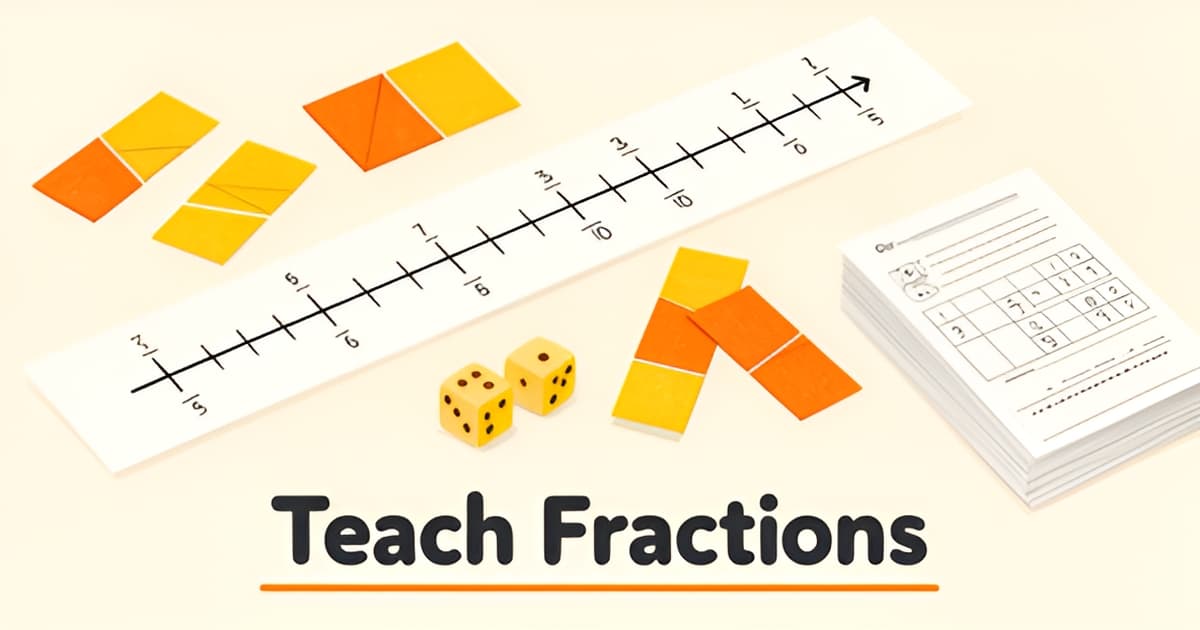
Before you reach for games, puzzles, or word problems, the research is clear about where fraction instruction should start: with something students can see. The U.S. Department of Education's Institute of Education Sciences recommends that teachers use number lines as a central representational tool from the early grades onward, and its Teaching Fractions Toolkit names fraction strips as a key tool for showing equivalence and density.
That's a strong signal for your lesson planning. When you're sorting through practical activities for teaching fractions, visual models aren't just one option among many. They're the foundation everything else sits on.
The What Works Clearinghouse practice guide on fractions instruction advises developing students' conceptual understanding before teaching procedures like cross-multiplication. In other words, students should see why a strategy works before they memorize the steps. IES researchers describe how visual representations help students "draw out" a solution and connect the picture to formal notation.
This ordering matters because fractions come with predictable landmines. Common misconceptions include believing larger denominators mean larger fractions, or treating numerators and denominators as separate whole numbers. A number line makes both errors visible in a way a worksheet of bare calculations never can.
The core visual tools worth prioritizing:
- Number lines, which position fractions as numbers that extend the number system students already know
- Fraction strips, which make equivalence concrete when students fold, stack, and compare them
- Fraction circles and pizzas, which show parts of a whole in a form children recognize from real life
- Tape diagrams and double number lines, which build on tools from whole-number work
Practitioner sources back this up too. Classroom catalogs describe fraction circles, bars, and number lines as aids that help students see how fractions represent parts of a whole, alongside hands-on experiences like cutting paper into fractional parts.
Here's the practical catch: printing, laminating, and cutting fraction strips for thirty students eats your planning time. That's where a generator like Printoodle earns its place in your routine. You can create printable worksheets with number line practice, fraction strip templates, and visual comparison tasks in seconds, download a print-ready PDF, and reprint from your library whenever a set gets worn out.
The same logic applies to vocabulary reinforcement. Fraction lessons depend on terms like numerator, denominator, and benchmark, and a quick word search maker or a ready-made printable word search built from your own word list gives students low-pressure exposure to that language while you keep the heavy visual work on number lines and strips.
Print it, hand it out, and spend your energy where it counts: on the math conversation those models make possible.
Three low‑cost games that build fraction number sense
A strong fraction foundation starts with visual models that make abstract values concrete. Research from the U.S. Department of Education’s Institute of Education Sciences confirms that number lines serve as a central representational tool for fraction concepts from the early grades onward, helping students “draw out” solutions and connect visual models to formal notation. Complementary studies show that hands-on games and printable worksheets reinforce these ideas through repeated, low-stakes practice, turning classroom time into meaningful exploration rather than rote drill.
Fraction Rejection turns a simple pair of dice into a strategic comparison challenge. In this partner game, students roll and decide whether to place the resulting numerator or denominator into their fraction, or “reject” the number entirely, before justifying their comparison using benchmarks, visual models, or number lines. Because the activity requires only two dice and a scrap of paper, it fits any budget while directly addressing the common misconception that larger denominators always mean larger fractions.
Fraction Shake repurposes an everyday egg carton labeled 1–12 with a single counter. Students shake the carton, read the two numbers the counter lands on, and treat them as fractions with a denominator of 12. They then add the two fractions and simplify the result, reinforcing both equivalence and operations with like denominators. The tactile “shake” element keeps engagement high, and the built-in denominator simplifies the mental math, allowing students to focus on the addition process.
Benchmark Fractions uses a customized deck of cards, with 7s, 9s, jacks, and queens removed and kings assigned the value 100, to create fractions close to, but not equal to, the benchmarks of 0, 1/2, or 1. Played in small groups of two to four over six rounds, the game prompts students to reason about fraction size and proximity to key reference points, building number sense that transfers to larger-scale fraction work.
For teachers who need zero-prep independent practice, Printoodle’s word search maker and printable word search tools generate fraction-themed puzzles in seconds. Educators can input key vocabulary, numerator, denominator, equivalent, benchmark, and Printoodle instantly produces a print-ready PDF that reinforces terminology while students hunt for words. These puzzles serve as a calm, focused follow-up to the more active games, solidifying language retention without adding to the teacher’s workload.
By grounding each activity in visual representation and purposeful math talk, educators can move beyond memorized rules toward genuine fraction fluency. Printoodle’s suite of printable tools extends this approach with customizable, credit-based activities that reprint for free, ensuring that every student has the practice they need, exactly when they need it. Print it. Doodle it. Done.
Turning activities into math talk that sticks
Here's the thing most fraction activity lists miss: the activity itself is only half the lesson. Classroom practitioners have found that the most effective part of an activity is often not the game or manipulative alone, but the conversation that surrounds it. A dice game with no talk is just dice.
That's good news for you, because conversation is free. You don't need new materials to deepen a lesson; you need prompts that make students explain their reasoning out loud. The same source recommends turn-and-talk structures, sentence stems, and partner discussion as the core talk moves, alongside differentiation supports like fraction strips, estimation before calculation, and preteaching vocabulary such as numerator, denominator, equivalent, and benchmark for multilingual learners.
A few sentence stems work especially well for fractions because they force students to justify, which is exactly where misconceptions surface. Try these:
- "I know ___ is greater than ___ because..."
- "___ is close to the benchmark ___ because..."
- "If I drew this on a number line, it would look like..."
- "Another way to show the same amount is..."
- "I disagree with ___ because..."
The benchmark stem matters more than it looks. Federal guidance from the Institute of Education Sciences treats benchmark reasoning around 0, 1/2, and 1 as a foundation for comparing fractions, and its Teaching Fractions Toolkit for grade 6 explicitly targets identifying and remediating fraction misconceptions, the same ones that show up when students talk: that larger denominators mean larger fractions, or that numerators and denominators can be treated as separate whole numbers. When a student says "1/8 is bigger than 1/4 because 8 is bigger," you've found your next mini-lesson.
You can also build talk prompts directly into your printable materials. Task-card style pages work well for this: one card shows a fraction pair, and partners take turns defending which is larger before checking with fraction strips. If you're making your own, Printoodle's generators can turn a quick list of fraction prompts into a polished, print-ready page in seconds, the same way you'd use its word search maker to spin up a warm-up puzzle, then print a printable word search for early finishers while discussion groups run. Reprints stay free in your library, so a prompt set you refine after hearing student thinking costs you nothing to update.
Keep the ratio simple: for every ten minutes of hands-on work, reserve at least five for structured talk. That's where the durable learning happens.
Common misconceptions and how specific activities correct them
Even strong fraction lessons leave behind predictable errors. The good news: each one has a matching activity that fixes it, and grade 6 is exactly where federal research says teachers should identify and remediate these misconceptions (according to the IES Teaching Fractions Toolkit).
Misconception 1: "Bigger denominator means bigger fraction." Students see 1/8 and assume it beats 1/3 because 8 is larger than 3. The fix is visual: fraction pizzas and fraction strips let them physically see that eighths are smaller pieces than thirds. The IES toolkit names fraction strips as a core tool for showing equivalence and density, and practitioners echo that fraction circles, bars, and number lines help students see fractions as parts of a whole (per Super Teacher Worksheets).
Misconception 2: Treating numerator and denominator as separate whole numbers. Students add 1/2 + 1/3 and get 2/5. Number lines are the strongest correction here, since the What Works Clearinghouse recommends them as a central representational tool from the early grades onward (IES guidance). A worksheet that asks students to place 1/2, 1/3, and 2/5 on one line exposes the error fast.
Misconception 3: Struggling to compare unlike denominators. The Benchmark Fractions card game targets this directly: players get 5 cards each in groups of 2–4 and build a fraction as close as possible, without equaling it, to a benchmark of 0, 1/2, or 1 (Empower Education Connections). Estimating against benchmarks first builds number sense before any common-denominator procedure.
Misconception 4: Relying on memorized rules without meaning. The WWC practice guide advises developing conceptual understanding before introducing procedures like cross-multiplication (the full practice guide). Fraction Rejection, a partner dice game, works well because students must justify each comparison using benchmarks, models, or drawings, not a shortcut.
Here's a quick reference you can use during independent practice:
- Error "1/8 is bigger than 1/3": assign fraction strip or pizza worksheets, then a number line placement task.
- Error "1/2 + 1/3 = 2/5": use tape diagrams and double number lines before any algorithm.
- Error guessing on comparisons: run a Benchmark Fractions card game round, then follow with a mixed review worksheet.
- Error reciting rules with no reasoning: require a written or verbal justification with every answer, using sentence stems.
Remember that the activity itself is only half the remedy. Research on these classroom games found that the most effective part is often the conversation surrounding the game, so pair every worksheet with turn-and-talk or partner discussion (per the activity documentation).
To keep remediation from feeling like a chore, you can fold fraction vocabulary into lighter formats too. A Printoodle word search maker or a ready-made printable word search built from terms like numerator, denominator, and equivalent gives students low-pressure exposure to the language they'll need when the harder reasoning tasks return. Print it, doodle it, done.
Frequently Asked Questions
What are some practical activities for teaching fractions that actually work?
Why should I teach fractions with number lines and fraction strips before games?
What are the most common fraction misconceptions, and which activities fix them?
How can I teach fractions without spending money on materials?
Is the game itself enough, or do I need to add discussion to fraction activities?
Which grade levels are these fraction activities best for?
From Fraction Strips to Fraction Confidence
The best practical activities for teaching fractions all follow the same recipe: start with something students can see, layer in games that make reasoning playful, and wrap every activity in math talk that surfaces misconceptions before they harden. Number lines and fraction strips build the conceptual foundation federal researchers recommend; dice and card games like Fraction Rejection and Benchmark Fractions turn that understanding into number sense; and sentence stems turn a ten-minute game into the conversation where durable learning actually happens. The prep, though, shouldn't eat your planning period. Printoodle's word search maker spins fraction vocabulary into a print-ready warm-up in seconds, and a ready-made printable word search keeps early finishers engaged while discussion groups run, with free reprints whenever a set wears out. This week, pick one misconception from the list above, match it to its activity, and try it with your class. Print it. Doodle it. Done.