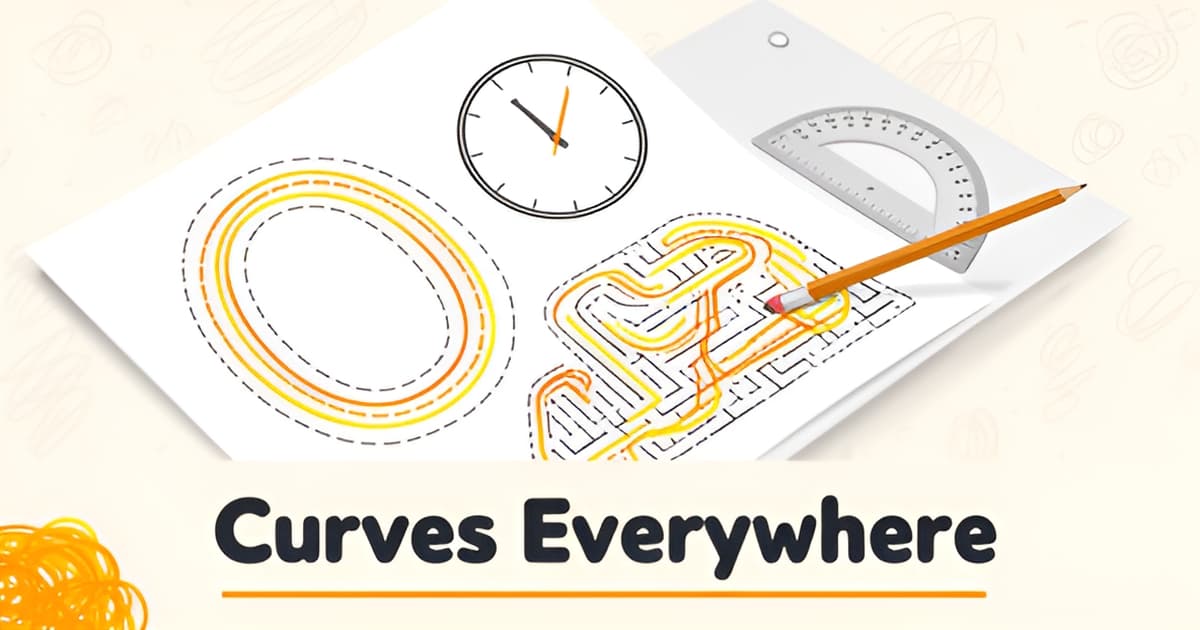
What are some things at school that have curved lines?
Key Facts
- Letters like O and Q are built entirely from curved lines, while L and H use only straight segments, per a peer-reviewed study.
- Tracing curved and straight lines is a formal Grade 2 geometry skill, featured in Khan Academy's curriculum.
- Drawing curved lines facilitated English word recognition among dyslexic readers, according to research in Frontiers in Psychology.
- Between 30–50% of children with dyslexia show significant handwriting difficulties, the same study reports.
- Curved-line practice helped English reading but hindered Chinese character recognition, showing effects depend on the writing system involved.
- Chinese characters consist of 1–36 overlapping strokes, the handwriting study found.
- Math education leader Katey Arrington warns that over-scaffolding takes 'all the power' from high-quality materials, told EdWeek Market Brief.
Letters and Lines: The Curved Alphabet Secret
The classroom alphabet is a masterclass in geometry hiding in plain sight. While many letters rely on straight edges, key players like O and Q are built entirely from curved lines, creating a visual distinction that early learners instinctively notice. This contrast between curved and straight elements goes beyond academics, it is a foundational skill reinforced through everyday classroom tools.
Research into early geometry confirms that tracing curved lines is a standard Grade 2 skill, marking it as a critical milestone in a child's visual development. For students navigating dyslexia, the same study notes that drawing curved lines can facilitate word recognition in English, though the effect reverses when dealing with Chinese characters, highlighting how writing system context shapes learning. These findings underscore why activities involving line type matter: they support literacy development in nuanced ways.
Teachers leverage this geometry naturally through Printoodle’s extensive worksheet library. Mazes, dot-to-dot sequences, and coloring pages all rely on curved pathways to guide the hand and eye. Even the school crossword puzzle generator features clues and grids where curved letters like O and Q appear, giving students practice recognizing these shapes within word structures. Each activity transforms abstract line concepts into tangible practice.
Beyond the alphabet, common classroom items reinforce shape recognition daily. A protractor’s semi-circular arc, the round edge of a safety scissors, and the curved spine of a reading textbook all serve as real-world examples. Printoodle’s themed coloring pages often feature objects with curved silhouettes, allowing children to identify and trace these forms while engaging creatively. These moments connect the geometry lesson to the physical space of the classroom.
Recognizing curved lines is more than an art skill, it is a building block for reading, writing, and spatial reasoning. When children can distinguish a curve from a line, they are better equipped to form letters, navigate geometric concepts, and process visual information. Printoodle makes this reinforcement accessible, turning simple shape spotting into structured, print-ready practice that fits seamlessly into any lesson plan.
Tracing Curves: A Grade 2 Geometry Skill
When a second grader traces the loop of an "O" or the swing of a "C," she's doing real geometry rather than mere busywork. Tracing curved and straight lines is a formal part of early-elementary math instruction: Khan Academy's Grade 2 geometry curriculum includes a lesson titled "Trace and draw: curved and straight lines," which formalizes this skill for young learners (see the Khan Academy lesson). So if you're wondering what are some things at school that have curved lines, you're actually asking a question the Grade 2 curriculum takes seriously.
The alphabet is the most everyday example. A peer-reviewed study in Frontiers in Psychology notes that of the 26 letters in the English alphabet, some consist of curved lines (like "O" and "Q") while others consist of straight lines (like "L" and "H"). Every word wall, name tag, and morning-message board in your classroom is quietly full of curves.
There's a literacy angle too. The same study found that drawing curved lines facilitated word recognition in English among dyslexic readers. That's a single-study finding, so treat it carefully, but it suggests curve-tracing practice may support more than geometry alone. The study also reports that 30–50% of children with dyslexia show significant handwriting difficulties, which makes low-pressure tracing activities a practical addition to a differentiated toolkit.
If you're building a curve-focused activity block, a few formats work especially well:
- Tracing worksheets with curved paths that mirror the Khan Academy skill, moving from simple arcs to full loops
- Dot-to-dot pages, where a curved reveal keeps kids tracing past the first few dots
- Mazes with winding corridors that require smooth, controlled pencil movement
- A school crossword puzzle packed with curved letters like O, Q, S, and C, so students hunt for curves inside real words
Printoodle generates any of these as print-ready worksheets in seconds, so you can build a whole "curves at school" lesson without hunting through five different resource sites. One caution from math education leaders: resist over-scaffolding. Katey Arrington of the Dana Center has argued that when teachers over-guide, "we're taking all the power out of the high-quality instructional materials." Let students trace, wobble, and self-correct. The curve teaches itself.
Printoodle Activities That Build Curve Confidence
A pencil that stays on the page while it loops, dips, and swings is doing something important: it's teaching a hand to control a curve. That's exactly the kind of practice Printoodle worksheets are built for, and it's why so many teachers keep a stack of them in the classroom drawer. Curved-line tracing isn't busywork, either. Khan Academy includes a Grade 2 geometry lesson called Trace and draw: curved and straight lines, which means recognizing and drawing curves is a real, standard part of early math instruction.
So when a teacher asks what are some things at school that have curved lines, the honest answer starts with the alphabet itself. A peer-reviewed study on handwriting and reading notes that letters like "O" and "Q" consist of curved lines, while letters like "L" and "H" are made of straight ones. Every clock face, every round table edge, every letter "C" on the whiteboard is a curve waiting to be traced. Printoodle worksheets turn those observations into something students can actually do with a crayon.
The toolset covers the classic curve-heavy activity types teachers already know:
- Mazes that force the pencil to bend around rounded walls instead of marching in straight corridors.
- Dot-to-dot pages, where connecting numbered points often means drawing arcs rather than rulers-straight segments.
- Coloring pages, whose outlines (balloons, faces, planets, fruit) are almost entirely curves.
- Tracing worksheets built around letters and shapes, so students practice the same curves they'll need for handwriting.
One more classroom staple deserves its own mention: puzzles. A school crossword puzzle generated with Printoodle can be themed around any lesson, and the letter shapes students write into those boxes are full of curves. Teachers can build the puzzle from their own vocabulary list, download a print-ready PDF, and hand it out the same afternoon. Reprints are always free, so a worksheet that works for one class stays in the rotation for years.
The research backs up why this practice matters beyond geometry. In that same handwriting study, drawing curved lines facilitated word recognition in English among dyslexic readers, and the authors report that 30–50% of children with dyslexia show significant handwriting difficulties. One study with a small sample shouldn't be treated as a cure-all, but it suggests that giving struggling readers more curve practice is a reasonable, low-cost addition to a classroom routine.
There's also a good argument for less scaffolding, not more. Katey Arrington, NCSM President and Charles A. Dana Center Director, has warned that over-guided math materials take the thinking away from students, who "need to be thinking and asking questions." A maze or dot-to-dot page does that naturally: the child controls the pencil, makes the turns, and sees immediately whether the curve worked.
Print it. Doodle it. Done.
Curved Lines and Literacy: What the Research Says
Curved lines do more than decorate a classroom. There's a small but intriguing body of research suggesting they might play a role in how some children learn to read, which makes the question of what are some things at school that have curved lines more than a geometry exercise.
The most interesting evidence comes from a peer-reviewed study published in Frontiers in Psychology, which examined how handwriting different types of lines affects word recognition. The researchers worked with 9–10-year-old dyslexic Chinese children (24 of them, matched with 24 typically developing peers), plus a separate experiment involving 21 children in grades 3–4. Their finding on English was striking: drawing curved lines facilitated word recognition in English among dyslexic readers.
Before you redesign your literacy block around this, some context matters. The same study found the opposite effect for Chinese: handwriting straight strokes actually helped visual word recognition in Chinese characters compared with curved lines. The effect of curved-line practice depends on the writing system, so this is one study's insight, not a general rule about how all children learn to read.
The connection makes intuitive sense, though. Letters like "O" and "Q" are built entirely from curved lines, as the study's authors note, while others like "L" and "H" use only straight segments. English print is a mix of both, and dyslexic readers often struggle most with the fluid, rounded forms. The study also cites research showing that 30–50% of children with dyslexia experience significant handwriting difficulties, which suggests motor practice and letter shapes may be more intertwined than we usually assume.
What can a teacher actually take from this? A few practical ideas:
- Treat curved-line tracing as genuine literacy practice rather than filler. Tracing curved and straight lines is already an established skill in early-elementary geometry instruction, including a dedicated Grade 2 lesson on Khan Academy.
- Pair letter-shape work with word practice. If you're asking students to trace rounded letters, follow up with recognizing those letters inside real words.
- For dyslexic learners in English, don't avoid the curves. The research hints that drawing them may give word recognition a small boost, though one study can't settle the question.
This is also a good reminder of why everyday classroom materials deserve a second look. Letters on a worksheet, the loops in a cursive chart, the rounded paths in a maze, even the curved clues in a school crossword puzzle all give students low-pressure encounters with curved forms. Printoodle's tracing and worksheet tools make it easy to build pages where students practice those rounded shapes alongside actual reading and vocabulary work, so the motor practice and the literacy practice reinforce each other.
The honest takeaway: curved lines probably won't fix reading difficulties on their own, and the evidence here is preliminary and specific to English. But it's one more reason to see the rounded shapes filling your classroom as part of the learning rather than the scenery.
Frequently Asked Questions
What are some things at school that have curved lines?
Is tracing curved lines an actual school skill or just busywork?
Can practicing curved lines help kids with reading?
How common are handwriting difficulties in children with dyslexia?
Which letters should kids trace to practice curved lines?
Should I guide students closely during tracing activities?
Curves That Connect: From Classroom Geometry to Confident Writing
From the looping letter O to the winding corridors of a maze, curved lines are far more than geometry: they're a foundational building block for how children learn to read, write, and make sense of the world around them. As we've explored, tracing these shapes supports everything from early Grade 2 geometry milestones to nuanced literacy development, especially for students navigating dyslexia. Whether it's a protractor's arc, the rounded edge of safety scissors, or the letters that fill our word walls, these everyday curves shape how students interact with information. Printoodle makes this reinforcement accessible, turning simple shape spotting into structured, print-ready practice that fits seamlessly into any lesson plan. Ready to add some curve to your classroom routine? Print it. Doodle it. Done.