What are the 7 seas and 7 oceans?
Key Facts
- Nearly 97% of Earth's water is contained in its oceans, according to the National Science Foundation.
- The phrase 'Seven Seas' dates back roughly 4,300 years to a Sumerian hymn from around 2300 BC, per the Library of Congress.
- The Bering Sea is the largest sea on Earth, spanning more than 876,000 square miles, according to the Library of Congress.
- The Red Sea is both the saltiest and warmest sea on the planet, with 41 parts salt per 1,000 parts water.
- The modern Seven Seas are seven ocean regions, Arctic, North and South Atlantic, North and South Pacific, Indian, and Southern, confirmed by NOAA.
- Geographers recognize about 50 seas on Earth today, so any list of seven is really just a highlight reel, notes Sea History for Kids.
- The Sargasso Sea has no land boundaries at all, it is defined entirely by four circulating ocean currents, per Sea History for Kids.
The Modern Answer: Seven Seas, Five Oceans
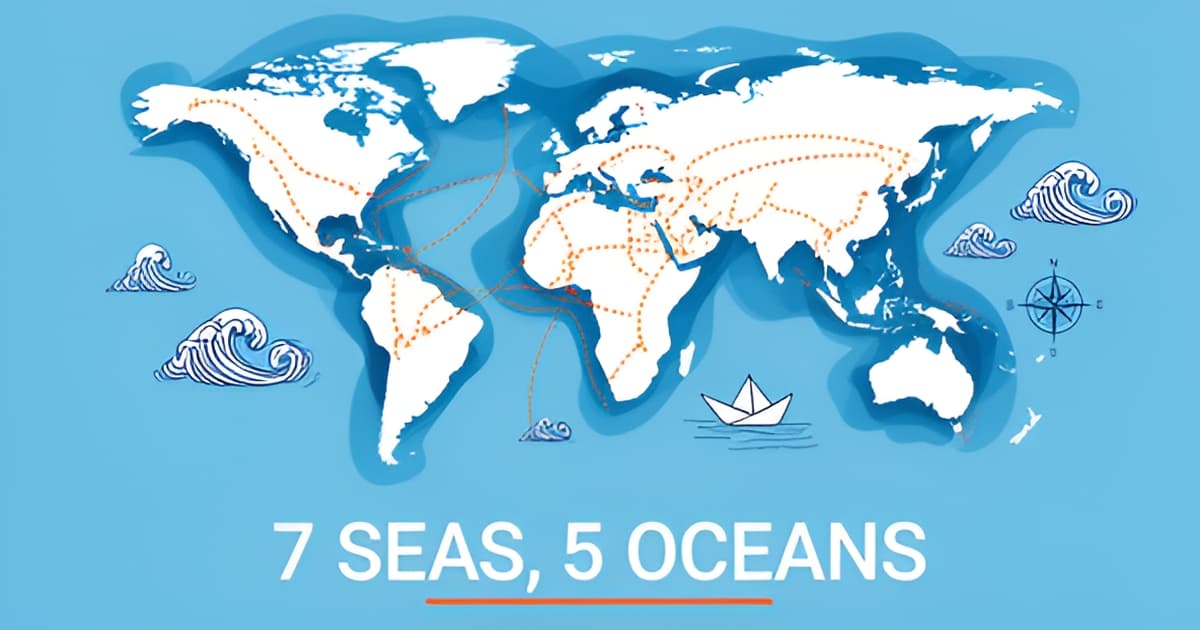
The phrase "Seven Seas" has no single fixed answer, but modern geography offers a clear consensus. The National Science Foundation and NOAA both confirm that the modern Seven Seas are the Arctic, North Atlantic, South Atlantic, North Pacific, South Pacific, Indian, and Southern oceans. This list comes from splitting the Atlantic and Pacific oceans into northern and southern regions, which explains why the standard ocean count remains five: Atlantic, Pacific, Indian, Arctic, and Southern. The Southern Ocean, encircling Antarctica, was added as the fifth official ocean in modern usage, though some traditions still recognize only four.
Nearly 97% of Earth's water is contained in its oceans, and the Red Sea holds the distinction of being both the saltiest and warmest sea on the planet. The Bering Sea is the largest sea by surface area, spanning over 876,000 square miles. For those creating word search puzzles, these names provide a rich set of terms, from the Arctic Ocean to the Persian Gulf, that can be mixed and matched for different skill levels.
Drop these ocean and sea names into Printoodle's word search maker for an instant printable word search, or browse the printable word search library for ready-made puzzles. Print it. Doodle it. Done.
Seven Seas Through History
Before Google Maps, before even paper maps, people were already counting seas. The phrase "Seven Seas" is older than almost any geography book you've ever read, and the Library of Congress traces it back to a Sumerian hymn from around 2300 BC, making it one of the oldest surviving figures of speech in human history.
That's the key to understanding the question "what are the 7 seas and 7 oceans": there has never been one official list. The Library of Congress puts it plainly: the phrase is a figure of speech that has referred to different bodies of water at various times and places. Each era counted the waters that mattered most to the people sailing them.
The Greek version entered Western literature first. According to NOAA, ancient Greek lists included the Aegean, Adriatic, Mediterranean, Black, Red, and Caspian seas, plus the Persian Gulf counted as a seventh "sea." These were simply the waters a Greek sailor would actually encounter. The Romans later borrowed the idea, calling the lagoons near Venice the septum maria, or seven seas.
Medieval Europeans redrew the map as their world expanded. Their Seven Seas shifted to the North Sea, Baltic, Atlantic, Mediterranean, Black, Red, and Arabian seas, reflecting the trade routes that connected medieval Europe to the Middle East and beyond.
Then the Age of Discovery changed everything. Mariners who crossed whole oceans needed a bigger list, and the Sea History for Kids archive notes that sailors' versions came to include the Atlantic, Pacific, Arctic, and Indian Oceans, plus the Mediterranean, Caribbean, and Gulf of Mexico. The "seas" had quietly become oceans.
Other cultures counted differently still:
- Asian and Middle Eastern lists centered on trade waters: the Bay of Bengal, Arabian Sea, Gulf of Thailand, Singapore Strait, Strait of Malacca, South China Sea, and Persian Gulf.
- The Library of Congress's most-cited current list returns to traditional seas: the Indian Ocean, Black Sea, Caspian Sea, Adriatic Sea, Persian Gulf, Mediterranean Sea, and Red Sea.
- Geographers today recognize about 50 seas on Earth, so any list of seven is really just a highlight reel.
All this variation is a gift if you're building an educational puzzle. You can drop the Greek names into a word search maker for a history-themed activity, or use the modern ocean regions for a geography lesson, then print a printable word search in seconds. Print it. Doodle it. Done.
Sea or Ocean? Definitions and Edge Cases
When people ask about the seven seas and seven oceans, they are usually looking for two different things: the modern map of global waters and the colorful history behind the phrase. The short answer is that today, the world is generally understood to have five oceans, while the "seven seas" label has shifted and changed depending on who you ask and when.
Geographically, the standard answer for the five oceans is the Atlantic, Pacific, Indian, Arctic, and Southern (or Antarctic) ocean. The "seven" designation for oceans actually comes from splitting the Atlantic and Pacific into northern and southern regions, creating a list that includes the Arctic, North Atlantic, South Atlantic, North Pacific, South Pacific, Indian, and Southern oceans. This modern breakdown is consistently cited by major scientific bodies; the National Science Foundation and the National Oceanic and Atmospheric Administration both confirm this seven-ocean framework as the current scientific consensus.
The phrase "seven seas," however, is far older and more flexible. Historically, it has referred to entirely different bodies of water. In ancient Greek texts, the seven seas included the Aegean, Adriatic, Mediterranean, Black, Red, and Caspian seas, plus the Persian Gulf. Medieval European sailors might have named the North Sea, Baltic, Atlantic, Mediterranean, Black, Red, and Arabian seas. Even in the Age of Discovery, the list changed again to include the Mediterranean, Caribbean, and Gulf of Mexico alongside the four traditional oceans. In parts of Asia and the Middle East, the seven seas traditionally meant the Bay of Bengal, Arabian Sea, Gulf of Thailand, Singapore Strait, Strait of Malacca, South China Sea, and Persian Gulf. The Library of Congress notes that there is no single definitive answer, as the phrase has functioned as a figure of speech for millennia, appearing in a Sumerian hymn nearly 4,300 years ago.
Beyond the naming conventions, there are some fascinating edge cases that blur the line between sea and ocean. About 50 seas are recognized on Earth today, though their definitions vary. The Caspian Sea, for instance, is landlocked and contains saltwater, leading some geographers to classify it as a giant lake rather than a sea. The Sargasso Sea is another unique case; it has no land boundaries at all, instead being defined by four circulating ocean currents, the Gulf Stream, North Atlantic Current, Canary Current, and North Equatorial Current. Meanwhile, the Great Lakes are frequently called inland seas, yet they are freshwater bodies. These distinctions make for excellent talking points and puzzle words for anyone creating educational materials.
For teachers, parents, or puzzle makers looking to turn this geography into a printable activity, Printoodle offers tools to generate custom word searches. You can drop these ocean and sea names into the word search maker or browse a printable word search template to get started. It is a straightforward way to create a custom activity that reinforces learning. Print it. Doodle it. Done.
Build Your Own Ocean Word Search
Now that you know what are the 7 seas and 7 oceans, put that knowledge to work. The word lists in this article double as ready-made puzzle material, and building your own ocean word search takes less time than reading about the Sumerian hymn that first mentioned the seven seas back around 2300 BC.
Here are three difficulty tiers to choose from:
- Easy: The five standard oceans: Atlantic, Pacific, Indian, Arctic, and Southern. Five short, familiar names make this a great starter puzzle for younger kids.
- Medium: The modern seven seas as ocean regions: Arctic, North Atlantic, South Atlantic, North Pacific, South Pacific, Indian, and Southern. This is the list NOAA and the National Science Foundation both confirm, and the longer compound names add a satisfying challenge.
- Hard: Historical seas from the Greek, medieval, and mariners' versions of the seven seas: Aegean, Adriatic, Mediterranean, Black, Red, Caspian, Baltic, Arabian, Caribbean, and Bering. Mix in a few bonus words like Sargasso for extra credit.
The hard tier is where the fun facts live, too. The Bering Sea is the largest sea on Earth at 876,000 square miles, and the Red Sea is both the saltiest (41 parts salt per 1,000 parts water) and the warmest, ranging from 68°F to 87.8°F, according to the Library of Congress. Tuck those tidbits onto the answer key and the puzzle becomes a mini geography lesson.
To build your puzzle, pick a tier, then drop the words into Printoodle's word search maker. It generates a free printable PDF in seconds, sized for Letter paper with an A4 toggle if you're printing outside the US. Every puzzle you make is saved to your library, so reprints are always free, which is handy when a whole classroom wants the same sheet.
A few practical tips before you print: use uppercase words to keep letter recognition consistent for early readers, and if you're working with the medium tier, remember that "North Atlantic" and "South Atlantic" share letters, which makes the grid trickier in a good way. You can also add theme words like SEVEN and OCEAN as hidden extras.
If you'd rather start from something ready to go, Printoodle also offers a printable word search option with themed templates you can customize. Either way, you're a couple of clicks from a finished page.
Print it. Doodle it. Done.
Frequently Asked Questions
What are the 7 seas and 7 oceans in modern geography?
Is there one official list of the seven seas?
How many oceans are there, four, five, or seven?
Where did the phrase "seven seas" come from?
What's the difference between a sea and an ocean?
Which sea is the largest, saltiest, and warmest?
From Ancient Hymns to Modern Puzzles
Whether you're tracing the phrase back to a Sumerian hymn from 2300 BC or mapping the modern seven seas as confirmed by NOAA and the National Science Foundation, one thing is clear: the world's waters offer endless fascination. From the five standard oceans, Atlantic, Pacific, Indian, Arctic, and Southern, to the shifting historical lists that once guided medieval sailors and ancient Greeks, there's a rich tapestry of names to explore. This variety makes the topic perfect for educational word searches, whether you're a teacher creating a classroom activity or a parent looking for a rainy-day project. Ready to turn these fascinating facts into a printable puzzle? Drop the ocean and sea names into Printoodle's word search maker for an instant, custom printable PDF, or browse the printable word search library for ready-made templates. Print it. Doodle it. Done.