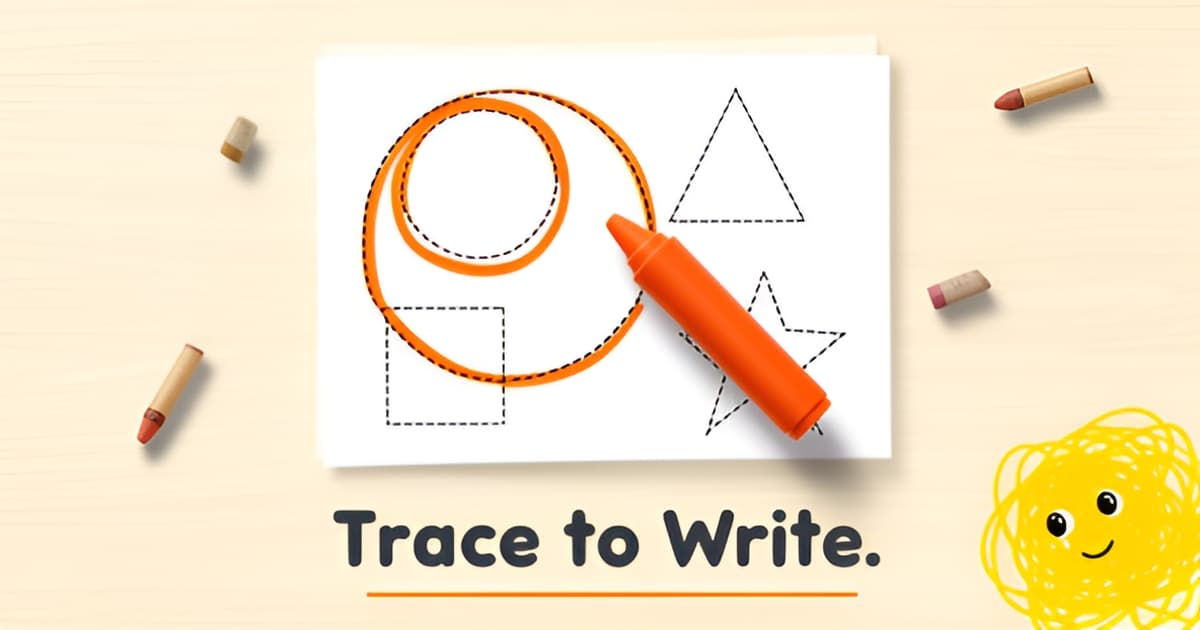
What are the benefits of tracing shapes?
Key Facts
- Only 27% of students show writing proficiency nationally, which is why occupational therapists point to pre-writing shape practice first source.
- Half of children can't intersect both oblique lines to form an X until age 4 years 11 months, according to GriffinOT's developmental data source.
- Every capital letter is built from just 8 pre-writing strokes, so a child stuck on letters is usually stuck on a stroke, per Spectrum Unlocked source.
- The tripod grasp typically develops between ages 3 and 4, with fine motor basics mastered by ages 3–5, per Cleveland Clinic guidance source.
- Mindful tracing delivers far more benefit than mindless repetition, art educators at Ridge Light Ranch report source.
- Children confident with pre-writing shapes show better engagement and better handwriting outcomes, according to GriffinOT source.
- Only 10% of the population is left-handed, a factor GriffinOT notes in adapting pre-writing shape instruction source.
Why Writing Practice Starts Before Letters
Many parents and teachers jump straight to letter worksheets, expecting immediate results, but kids often get frustrated because they are missing the underlying strokes. Research shows that every capital letter is built from eight pre-writing strokes: vertical line, horizontal line, circle, cross, square, diagonal, X, and triangle. A child stuck on letters is usually stuck on a stroke they haven't mastered yet.
The research data confirms that shape tracing serves as a critical developmental bridge between visual recognition and motor skill acquisition. Studies indicate that children progress from mark-making to imitating templates, then copying models, and finally drawing independently. Only 27% of students show writing proficiency at a national level, highlighting the importance of building strong foundations early. Furthermore, 4 years and 11 months is the age at which half of children can intersect both oblique lines to form an "x," demonstrating that these skills develop in a stable, predictable sequence.
Confidence building is one of the most consistent psychological benefits reported across sources. The structured nature of tracing "provides a sense of comfort and success," boosting confidence and reducing anxiety when learning new skills. By removing the fear of making mistakes, tracing helps kids build trust and enjoy the work of learning to write.
Printoodle makes it easy to integrate this practice into any routine. The platform offers ready-to-print templates that follow the established pre-writing stroke sequence, allowing children to master each stroke before advancing to letters. Whether used at home or in the classroom, these templates provide the guided practice children need to build fine motor control and hand-eye coordination.
Mindful engagement over mechanical repetition is key to maximizing benefits. Tracing practice enhances broader cognitive skills such as pattern recognition and sequencing, supporting reading and problem-solving. Printoodle’s customizable activity pages let you adjust the level of guidance, from heavily traced dashed lines to lightly outlined shapes, supporting the transition to independent writing.
Ready-to-use templates are available for immediate practice. Printoodle’s library includes shape tracing worksheets designed to build the foundational strokes every child needs before tackling letters. Users can generate personalized pages in seconds and download print-ready PDFs, with reprints always free.
What Are the Benefits of Tracing Shapes for Child Development?
Ask any occupational therapist and they'll tell you the same thing: a child who is stuck on letters is usually stuck on a stroke. Before kids can form a single letter, their hands need to master the strokes those letters are built from.
The core benefit of tracing shapes is fine motor control. Guided practice with a pencil builds the grip strength, precision, and hand-eye coordination that handwriting demands, as pencil control worksheets are specifically designed to develop. Most children master these fine motor basics between ages three and five, with the tripod grasp typically emerging by ages 3–4, per Cleveland Clinic guidance cited by Grooved Learning.
Tracing also builds the bridge between what a child sees and what their hand can do. It teaches kids where strokes start and stop, and as GriffinOT explains, it's impossible to draw something you don't have a visual representation of. Tracing provides that template for imitation, one step before copying from a model and eventually drawing independently. The developmental sequence is remarkably stable across children:
- Vertical and horizontal lines come first
- Circles and crosses follow
- Squares, diagonals, X shapes, then triangles
Every capital letter is built from those strokes. A child who can't yet copy a cross can't reliably form a t, an f, or an E, which is why Spectrum Unlocked argues that most handwriting programs start one step too late.
The psychological wins matter just as much. Tracing removes the fear of mistakes: the outline is already there, so the child experiences a sense of comfort and success instead of the frustration of a blank page. Those early wins keep kids practicing, and practice is the only path to improvement. By building trust in the process first, tracing reduces the anxiety that makes some children give up on writing before they've really started.
There are cognitive payoffs too. Tracing practice strengthens pattern recognition and sequencing, skills that later support reading and problem-solving. Drawing also helps children organize memories in sequence, what happened first and what came next, the same mental skill behind writing sentences.
Perhaps the most practical insight comes from occupational therapy: children who feel confident with pre-writing shapes before touching letters show better engagement and better handwriting outcomes. That's why shape tracing typically comes first in the progression, before letter tracing and number tracing take over around ages 3–4. One caution from art educators at Ridge Light Ranch: mindful tracing, where the child pays attention to each stroke, delivers far more benefit than mechanical repetition.
If you want ready-to-print pages that follow this progression, Printoodle lets you generate tracing templates in seconds, so your child can practice exactly the strokes they're ready for.
The Right Progression: Lines, Curves, Then Shapes
If you've ever watched a child scribble furiously and wonder why their letters still look wobbly, the answer usually isn't effort. It's sequence. When you understand what are the benefits of tracing shapes, you quickly see that the order of practice matters as much as the practice itself.
Occupational therapists describe a stable developmental order for pre-writing strokes: vertical line, horizontal line, circle, cross, square, diagonal line, X, then triangle. According to developmental sequencing research, every capital letter is built from that list, so a child who can't yet copy a cross can't reliably form a t, an f, or an E. A practical progression looks like this:
- Straight lines, vertical and horizontal, to build basic stroke control
- Zig-zags, to practice direction changes without lifting the pencil
- Circles and curves, which appear in half the alphabet
- Shapes like crosses, squares, and triangles
- Letters, once the underlying strokes are secure
Age gives you a rough map, not a deadline. The GriffinOT guidance notes that published shape ages represent the point at which 50% of children can draw the shape, meaning half will be slower. For example, half of children can intersect both oblique lines to form an X around 4 years and 11 months. Meanwhile, per Cleveland Clinic, the tripod grasp typically develops between ages 3 and 4. Readiness beats chronology every time.
Here's the diagnostic trick experienced educators use: a child stuck on letters is usually stuck on a stroke. Find the last shape they can copy from a model, and teach the next one on the list rather than drilling the letter harder. Most handwriting programs start at the letter, and that's one step too late for a lot of children.
Quality of practice counts too. Art educators point out that mindful tracing delivers far more benefit than mindless repetition, so keep sessions short and attentive rather than turning pages into drills. When your child is ready for letters and numerals, Printoodle's letter tracing and number tracing generators let you create fresh, printable practice pages in seconds.
One more thing: keep free drawing alongside guided practice, not instead of it. Drawing helps children organize what happened first and what happened next, the same sequencing skill they'll use when writing sentences. Tracing builds precision; free drawing builds ownership. A child who does both arrives at handwriting with steady hands and ideas of their own to write down.
How to Make Shape Tracing Actually Stick
Knowing what are the benefits of tracing shapes only gets you halfway. The other half is running the practice in a way your child actually sticks with, and small tweaks to how you set it up make a big difference.
Start by varying the surface. Occupational therapy guidance notes that tracing practice doesn't need to be pen-and-paper only: try sand trays, shaving foam, chalkboards, or a whiteboard at standing height. Surface variation can genuinely help children who refuse to draw the same line twice on paper, and it keeps the activity feeling fresh while the underlying skill stays the same. Different tools count too. Crayons, chunky markers, and pencils each ask slightly different things of small hands.
Go big and bold first. Large, thick-outlined shapes are easier for young hands to follow, and they set kids up for wins early. That matters more than it sounds: tracing's clearly outlined structure provides a sense of comfort and success, which reduces anxiety for children meeting writing for the first time. Every clean lap around a big circle is a small confidence deposit that keeps practice going.
Mix templates with blank space. This is the single most useful design choice you can make. Children progress along a path from mark-making to imitating a traced template, then copying a model, then drawing independently. A page that offers a dashed shape to trace alongside an empty box for a solo attempt supports that whole progression in one sitting. It also encourages what art educators call mindful tracing, since the child has to actually look at the shape and plan the stroke rather than coast through mechanical repetition.
Watch for readiness rather than fixating on age. Age charts vary across sources, and the ages attached to each shape typically mark when half of children can draw it, meaning plenty of kids will be slower and that's normal. A more useful signal is the classic pre-writing sequence itself:
- Vertical lines, then horizontal lines
- Circles, then crosses
- Squares, then diagonals and triangles
This order holds consistently across children, and it matters because every capital letter is built from these strokes. A child who can't yet copy a cross won't reliably form a t, an f, or an E, so if letters get frustrating, the fix is usually the next shape on the list, not more letter drills.
Keep free drawing alongside the guided practice rather than replacing it. Guided tracing builds control; open drawing lets kids use it.
Once your child can copy circles and crosses with reasonable control, they're ready to carry those strokes into numbers and letters. That's where ready-to-print practice earns its keep: Printoodle's number tracing and letter tracing generators turn the same progression into personalized, print-ready pages in seconds, so you can move from shapes to digits and letters the moment the readiness signs show up. Print it. Doodle it. Done.
When a child first picks up a crayon, the goal isn’t neatness, it’s connection. Shape tracing provides that connection, turning abstract lines into recognizable forms while little hands learn the muscle memory needed for every future letter. Research consistently shows that tracing shapes serves as a critical bridge between visual recognition and motor skill acquisition, with studies indicating that children must master pre-writing strokes like vertical lines, horizontal lines, circles, and crosses before they can reliably form letters. In fact, the established progression, vertical line, horizontal line, circle, cross, square, diagonal line, X, then triangle, holds consistently across development, serving as the foundation upon which every capital letter is built. This is why occupational therapists emphasize that if a child cannot yet copy a cross, they will struggle to form letters like t, f, or E. Furthermore, the structured nature of tracing provides a sense of comfort and success, boosting confidence and reducing anxiety when learning new skills, making it the perfect low-stakes entry point into writing.
Printoodle makes it easy to support this developmental sequence with personalized, print-ready shape tracing templates generated in seconds. Whether you need a simple circle for a toddler just starting out or a complex square for a preschooler refining pencil control, the platform adapts to your child’s current level. Each template can be customized with themes your child loves, from dinosaurs to rockets, ensuring the practice feels like play rather than a chore. And because every creation lives in your library, reprints are always free, meaning if a page gets smudged or a child wants to try again, there’s no extra cost. Print it. Doodle it. Done.
number tracing and letter tracing templates are also available for families ready to take the next step in their writing journey.
Frequently Asked Questions
Why should my child trace shapes before starting letters?
What age should kids start tracing shapes?
What order should shapes and strokes be taught in?
Does tracing really help, or is it just mindless repetition?
What are the psychological benefits of tracing shapes?
How does shape tracing support skills beyond handwriting?
From Wobbly Circles to Confident Writers
Understanding what are the benefits of tracing shapes comes down to one simple truth: letters are built from strokes, and strokes are built from practice. The research is clear that children follow a stable sequence, lines, circles, crosses, squares, then diagonals and triangles, and that a child stuck on letters is usually stuck on a stroke they haven't mastered yet. With only 27% of students showing writing proficiency nationally, per data cited by Grooved Learning, building that foundation early matters. The wins go beyond motor control: tracing builds confidence, reduces writing anxiety, and strengthens the sequencing skills behind reading and sentence writing. Your next step is easy, watch which shape your child can copy from a model, and practice the next one on the list. When circles and crosses are secure, move on to number tracing and letter tracing with Printoodle's ready-to-print templates. Print it. Doodle it. Done.