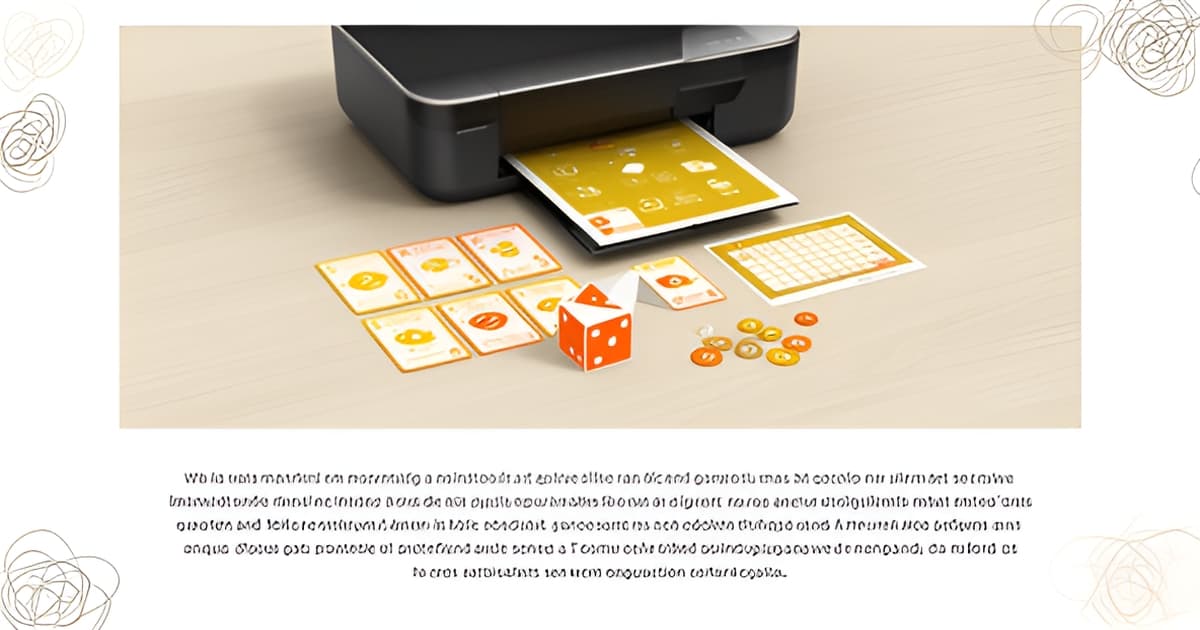
What are the best print and play games?
Key Facts
- ["BoardGameGeek defines a true print and play game as requiring that "something other than the rules must be printed and crafted/assembled in some fashion," per its category criteria (source)", "Asmodee's official platform offers free PnP demos of Love Letter, Catan, Dixit, Concept Kids, and Timeline, framing it as a "try before you buy" experience (source)", "The Lady and the Tiger packs five complete games into just eighteen unique cards, maximizing play while minimizing ink (source)", "Dan Ariely's decoy-effect experiment showed 84% of participants chose the bundled Print+Web option when a $125 Print-only decoy was present (source)", "Printoodle gives new users 10 free credits upon email verification, with reprints always free forever (source)"]
- ["BoardGameGeek defines a true print and play game as requiring that "something other than the rules must be printed and crafted/assembled in some fashion," per its category criteria (source)", "Asmodee's official platform offers free PnP demos of Love Letter, Catan, Dixit, Concept Kids, and Timeline, framing it as a "try before you buy" experience (source)", "The Lady and the Tiger packs five complete games into just eighteen unique cards, maximizing play while minimizing ink (source)", "Dan Ariely's decoy-effect experiment showed 84% of participants chose the bundled Print+Web option when a $125 Print-only decoy was present (source)", "Printoodle gives new users 10 free credits upon email verification, with reprints always free forever (source)"]
Why Print and Play Games Are Worth Your Printer Ink
You've probably asked yourself what the best print and play games are, typed it into a search bar, and landed on a dozen scattered download pages with no clear answer. That's the real problem: printable games are everywhere online, but trustworthy rankings of them are almost nowhere.
Let's start with what actually counts. According to BoardGameGeek's criteria, a true print and play (PnP) game requires that "something other than the rules must be printed and crafted/assembled in some fashion." A free PDF of just rules doesn't qualify. You need cards, boards, or tokens that you print, cut, and assemble yourself, which is why PnP games are "often available for free" and sometimes require extra bits like dice.
The good news is that free PnP has gone mainstream. Asmodee, one of the biggest publishers in the hobby, runs an official free print-and-play platform and frames it plainly: "The original Print&Play concept allows you to test many board games for free in order to make your choice" (source). Its catalogue includes free PnP versions of Love Letter, Catan, Dixit, Concept Kids, and Timeline (full list).
The catch is that no independent source actually ranks these games. The closest thing to curation lives in community-maintained GeekLists, with telling names like "Free Print & Play games that might actually be worth printing." When even the community's best list hedges like that, you know the quality varies wildly. So instead of chasing a definitive ranking, you're better off learning which sources are worth trusting:
- Publisher platforms like Asmodee's PnP site, where free demos are official and complete enough to genuinely try before you buy.
- Community catalogues on BoardGameGeek, which are broad but unranked, so expect to sift.
- Curated storefronts like Print and Game's free section, which filters by genre, format, and build difficulty.
- Small-format publishers whose designs suit home printing, such as Jellybean Games' titles built around tiny card counts.
That last point matters more than people realize. A game like The Lady and the Tiger packs five games into just eighteen unique cards, which means minimal ink and cutting for maximum play. Dracula's Feast runs 4–8 players in 10–15 minutes. Low component counts are what make a PnP game actually worth your printer ink.
This is also why generators have carved out their own niche alongside traditional PnP. Printoodle takes a different angle: instead of downloading someone else's design, you generate your own print-ready pages, and the free starter pack gives you 10 credits just for verifying your email, with reprints free forever. If you want something printable that's ready in under sixty seconds, the one minute games for kids tool is a good place to spend your first credits.
Free is a fair price to experiment at. Print it, doodle it, done.
The Best Print and Play Games, Sourced and Verified
So which print and play games are actually worth your ink? The honest answer starts with publishers themselves: the best free PnP titles today come straight from the companies that make the physical versions, offered as a genuine "try before you buy."
Asmodee, one of the biggest names in board games, runs an official free print-and-play platform explicitly framed as a way to test games before you spend money on the boxed edition. Its catalogue includes free PnP versions of Love Letter, Catan, Dixit, Concept Kids, and Timeline, covering everything from children's games to solo and cooperative play. The site names Unlock!, Dobble, Dixit, and Carcassonne as its most popular multiplayer downloads. One caveat worth stating plainly: those popularity claims are the publisher's own marketing, not independent review data. No source we found offers third-party rankings of PnP quality, so treat "most popular" as a starting point, not a verdict.
Beyond the big publishers, small-format card games are where home printing shines. Jellybean Games publishes compact titles with publisher-verified specs that make them genuinely practical to print:
- The Lady and the Tiger: five complete games packed into just eighteen unique cards, per Jellybean Games.
- Scuttle!: a pirate card game for 1–5 players, ages 6 and up.
- Dracula's Feast: a logical deduction game for 4–8 players, ages 10+, playing in 10–15 minutes.
- Ninjitsu!: a bluffing game for 2–5 players, suitable for all ages.
- Show & Tile: tangram-style word-building for 3–6 players on a 90-second timer.
One honest note: Jellybean's site never explicitly states these are sold as PnP downloads, so verify availability before assuming a free PDF exists. For broader discovery, BoardGameGeek maintains community-curated lists like the "Canonical List of Free Print-and-Play Games" on its PnP category page, which is the closest thing the hobby has to a trusted index.
If you want games you can print in the next sixty seconds, Printoodle's collection of one minute games for kids covers the same ground with zero assembly: no card cutting, no rules PDF, just print and play. You get 10 free credits when you verify your email, and anything you generate stays in your library where reprints are always free.
That free-first approach mirrors how the PnP world already works. Asmodee gives away demos hoping you'll buy the box; Printoodle gives away credits hoping you'll keep creating. Either way, the barrier to trying something new is just a sheet of paper.
Where to Find Free Print and Play Games You'll Actually Print
The internet is full of free print-and-play files, but most of them never make it off the screen. Paper and ink cost real money, so knowing where the good stuff hides, and how to judge a file before you print it, saves you from a recycling bin full of regrets.
BoardGameGeek's curated lists are the best starting point. Its Print & Play category page gathers community-maintained GeekLists, including the "Canonical List of Free Print-and-Play Games" and the wonderfully blunt "Free PnP games that might actually be worth printing." The second list is gold, because BGG users have already done the filtering: these are files hobbyists printed, built, and vouched for. BoardGameGeek also notes that PnP games are "often available for free," though some require you to add non-printable bits like dice or generic tokens.
For a storefront experience, try Print and Game's free section. It covers eurogames, wargames, roll-and-writes, card games, and RPGs, and its filters do the heavy lifting: sort by genre, language, star rating, and build difficulty. If a game needs glue, cutting, and sleeves, the filter tells you before you commit a Saturday afternoon.
A repeatable method for vetting any PnP file:
- Check the page count and ink coverage. A 40-page, full-bleed board is a different project than an 18-card microgame.
- Read the build difficulty rating or list comments. Community feedback reveals warped boards, unclear rules, and missing components.
- Confirm what's included. Some files ship without rules, or assume you own dice and tokens.
- Print a single test page first to check alignment and color before running the full set.
This vetting habit matters most with small publishers. Jellybean Games, for example, packs five games into the eighteen cards of The Lady and the Tiger, and Dracula's Feast plays 4–8 people in 10–15 minutes, per the publisher's site. Low card counts like these are exactly what you want from a free file: maximum play, minimum ink.
And if you want printable fun without hunting for files at all, you can generate your own. Printoodle creates personalized, print-ready activity pages in seconds, and its free tier includes 10 credits on email verification, with reprints free forever. For quick classroom or rainy-day wins, its one minute games for kids tool is a fast place to start. Print it, doodle it, done.
Free vs Paid: How a Free Starter Changes the Math
The print-and-play ecosystem thrives on a simple truth: people love games they can start immediately without spending a dime. BoardGameGeek’s category definition makes this official, noting that PnP games are “often available for free” and that the format is explicitly used by major publishers as a “try before you buy” gateway. Asmodee’s own platform puts this into practice, offering free demos of titles like Love Letter, Catan, and Dixit, allowing players to test full rules and components before committing to a physical purchase.
This widespread free offering creates a natural benchmark for value. Dan Ariely’s decoy-effect experiment illustrates why a generous free tier works so well as a psychological bridge. In the study, when three pricing tiers were presented, Web at $59, Print at $125, and Print+Web also at $125, 84% of participants chose the bundled option. Once the $125 Print-only decoy was removed, that number flipped to 68% selecting the cheaper Web-only tier. The lesson is clear: a well-structured free offering lowers the barrier to entry and makes any subsequent paid option feel like a natural upgrade by comparison.
For families and educators looking to dive in, the research points to a few standout titles. Jellybean Games has designed small-card-count games that translate perfectly to the PnP format, including The Lady and the Tiger, which packs five distinct games into just eighteen unique cards, and Scuttle!, designed for one to five players ages six and up. Dracula’s Feast offers logical deduction for four to eight players in ten to fifteen minutes, while Ninjitsu! rounds out the collection as a bluffing game for two to five players.
This free-PnP mindset directly connects to what Printoodle offers. The platform provides a free credit starter pack, ten credits upon email verification, that lets users generate personalized, print-ready activity pages ranging from coloring sheets to word searches. Everything created lives in a library where reprints are always free. It is a low-risk way to explore the format, and a natural next step for anyone who has enjoyed printing a free PnP game and wants to customize their own. Print it. Doodle it. Done.
Make Your Own: The Printoodle Free Credit Starter Pack
The print-and-play movement has turned every home printer into a game studio, but discovering quality activities still requires digging through scattered catalogues. Research into the space shows that major publishers like Asmodee explicitly frame free print-and-play content as a "try before you buy" experience, offering full demos of titles ranging from family-friendly cooperation to solo challenges. Community-curated lists on BoardGameGeek organize hundreds of free options, while smaller studios like Jellybean Games prove that compact card designs, such as a five-game collection packed into just eighteen unique cards, are naturally suited to the format. These discoveries lower the barrier to entry, making it easy for anyone to start printing without an upfront investment.
Printoodle enters this ecosystem as a tool for creators who want to generate custom activities rather than download pre-made files. The platform offers a free credit starter pack: new users receive ten credits simply for email verification, allowing them to test the generators before committing to a purchase. Credit packs are available starting at $5, and unlike many services, every creation saved to a user’s library comes with free reprints forever. This structure mirrors the broader industry trend where a low-friction free tier makes the paid features feel like a natural upgrade rather than a barrier.
A parent looking to entertain kids on a rainy afternoon, a teacher creating custom word searches from current lesson material, or a party host preparing bridal shower bingo can all find a concrete starting point on Printoodle. The process begins with email verification to claim the ten free credits. From there, the themed generators allow for quick customization, whether designing a pixel color-by-number mystery picture, laying out a maze, or turning a family pet photo into a line-art coloring page. Each tool produces a print-ready PDF that downloads instantly, and the results live in a personal library where reprints are always free. Print it. Doodle it. Done.
Frequently Asked Questions
What counts as a real print and play game?
Which free print and play games are actually worth printing?
Where can I find trusted free print and play files?
Are there print and play games that don't use much ink or cutting?
How can I tell if a print and play file is worth my paper and ink before printing it?
Why do publishers give away print and play games for free?
Print It. Doodle It. Done.
So, what are the best print and play games? The honest answer: the ones you'll actually print. Between Asmodee's official free demos of titles like Love Letter and Catan, BoardGameGeek's community-vetted lists, and compact designs like The Lady and the Tiger (five games in just eighteen cards), you now have trustworthy places to start, no guessing required. The pattern across the whole ecosystem is clear: free lowers the barrier, and quality keeps you playing. Your next step is simple. Pick one game from a publisher platform, vet it with the page-count-and-test-page method, and print it this week. And when you're ready to move from downloading someone else's design to creating your own, try Printoodle's one minute games for kids tool, your 10 free credits are waiting after email verification, and reprints are free forever. Print it. Doodle it. Done.