What are the learning objectives for subtraction in grade 1?
Key Facts
- Grade 1 students add and subtract within 20, demonstrating fluency within 10 by year's end UnboundEd standards guide
- The standard borrow-and-carry algorithm is delayed until 4th grade; grade 1 never includes regrouping Education Week
- Fluency means flexibility, efficiency, and accuracy, not speed Math Learning Center
- Students solve 13 − 7 as a missing addend: 7 + □ = 13 Ohio standards
- Counting on is the grade 1 bridge: starting at 8 and counting up 3 to solve 8 − 3 UnboundEd guide
- Key strategies include making ten (8 + 6 becomes 8 + 2 + 4) and decomposing to a ten (13 − 4 becomes 13 − 3 − 1) Education Week
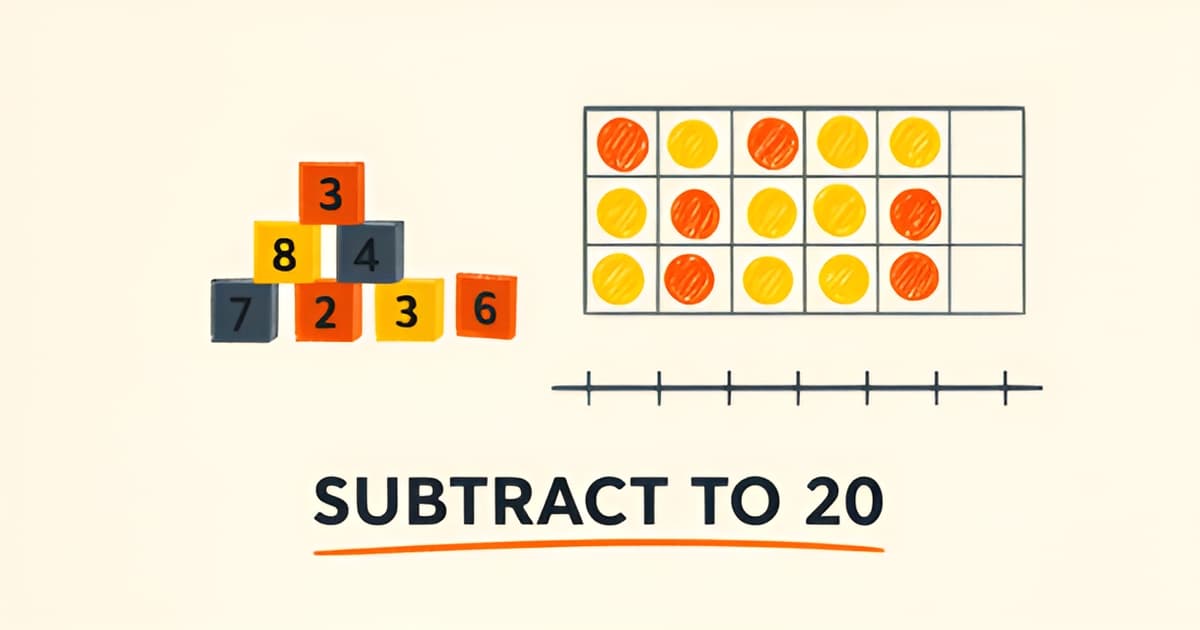
- Tools like number lines and ten-frames must connect to written equations, not stand alone Ohio standards
Why Grade 1 Subtraction Looks Different Than You Remember
You have probably noticed subtraction worksheets looking a little different these days. If you are used to seeing your child bring home pages filled with vertical equations requiring borrowing, you are not alone, many parents and teachers are puzzled by the shift. The standard algorithm of regrouping and carrying is no longer a grade one objective; education experts confirm it is a fourth-grade skill, meaning worksheets that drill that process are out of sync with what six- and seven-year-olds actually need to master this year.
Research into the Common Core standards reveals that grade one subtraction focuses on fluency within twenty, with a firm expectation of mastery within ten by the end of the year. Students are not expected to simply memorize facts, however. They must demonstrate fluency using named strategies such as counting on, making ten, and decomposing numbers to lead to a ten. For example, a problem like eight plus six is solved by breaking the six into two and four, creating a ten plus four. These strategies build a foundation of flexibility and efficiency that the Math Learning Center emphasizes is the true definition of fluency, moving away from timed speed drills and toward accurate, efficient mental math.
A critical objective that often surprises adults is the introduction of the missing-addend concept. Subtraction is framed as an unknown-addition problem; students learn that thirteen minus seven can be asked as, "seven plus what equals thirteen?" This shift helps children view the operations as interconnected rather than isolated procedures. Furthermore, word problems are designed with varied contexts, think of eleven bananas on a counter with four eaten leaving seven, or start-unknown scenarios where the initial amount is hidden and cannot be solved by simple take-away modeling. Tools such as counters, number lines, and ten-frames are required to help students connect physical representations to the abstract equations they are writing.
The progression of skills follows a natural three-level hierarchy that guides worksheet design. Students begin by counting all objects, move to counting on from a given number, and eventually convert problems into easier known sums. Educators like Diane Briars note that this counting-up method has been around forever because it builds toward stronger mental math capabilities. However, experts caution that premature direct instruction of strategies can undermine a child's numerical foundation, a perspective balanced by those who advocate for explicit connections between manipulatives and written methods. Regardless of teaching style, one fact remains clear across credible standards sources: the standard regrouping algorithm is explicitly delayed until fourth grade. Including borrowing problems in a grade one curriculum is developmentally inappropriate and contradicts the established learning progressions.
If you are looking to align home practice or classroom activities with these objectives, Printoodle offers printable worksheets designed to support the grade one subtraction trajectory. Their resources focus on the required strategies, missing-addend formats, and the use of visual tools like number lines and ten-frames, all without introducing the out-of-scope regrouping steps. You can print it, doodle it, and have confidence that the activities match what students are actually expected to learn.
CTA Text: Print it. Doodle it. Done.
Social Proof Text: Trusted by thousands of teachers and parents for printable math practice that matches current standards.
The Core Grade 1 Subtraction Objectives, Standard by Standard
The Common Core framework sets a clear boundary: grade 1 students work within 20 conceptually, but achieve fluency specifically within 10. UnboundEd’s operations-algebraic-thinking guide identifies this as the non-negotiable benchmark, students must add and subtract within 20 while demonstrating automaticity for facts up to 10. This split creates the natural difficulty sequence that drives worksheet design, where early problems stay in the fluency zone and later ones push into the conceptual range.
The five named strategies outlined in 1.OA.C.6 form the bridge between those two zones. Counting on, making ten (as in 8 + 6 becoming 8 + 2 + 4), decomposing to a ten (13 − 4 turning into 13 − 3 − 1), using the addition-subtraction relationship, and creating equivalent easier sums give students a toolkit for mental math. Clever School Teacher notes that fluency is now defined by flexibility, efficiency, and accuracy, not speed, so these strategies exist to build that flexibility. Students who can decompose 14 − 6 into 14 − 4 − 2 are demonstrating the kind of numerical reasoning the standards prioritize.
Subtraction also appears as a missing addend problem. A question like 13 − 7 = □ can be restructured as 7 + □ = 13, asking students how much more they need to add to 7 to reach 13. Ohio’s learning standards embed this format as a core objective, reinforcing the idea that addition and subtraction are inverse operations rather than isolated procedures. This framing helps students who struggle with the “take away” mental model find an entry point they can trust.
Word problems round out the objectives, but they must cover varied contexts. Students encounter classic “how many left” scenarios, like the bananas example where 11 − 4 = 7, but they also face start-unknown problems that cannot be solved by simple removal. A prompt might ask how many bananas were on the counter originally if 4 were eaten and 7 remain. Ohio standards and UnboundEd both flag these variations as essential, ensuring students recognize subtraction in real-world situations beyond the textbook.
Tools such as counters, base-ten blocks, number lines, and ten-frames help students connect physical representation to symbolic equations. Education Week reports that manipulatives must be linked to written methods, not treated as standalone computation devices. A student might use a number line to count on from 7 to 13, then write the corresponding equation. That connection, between the tool, the strategy, and the symbol, is what turns a procedure into understanding.
The standard algorithm is explicitly not a grade 1 objective. Math Transformations and Education Week both confirm that borrowing and carrying are delayed until 4th grade, and UnboundEd reinforces that grade 1 work should never include regrouping. Attempting standard algorithm problems too early undermines the conceptual foundation the standards are trying to build.
A three-level progression guides the entire year: level 1 is counting all (the kindergarten baseline), level 2 is counting on (the grade 1 bridge under 1.OA.C.5), and level 3 is converting to an easier problem using the strategies above. Printoodle’s printable worksheets can be structured to follow this exact sequence, moving students from concrete counting toward abstract mental math by year’s end.
Understanding the equal sign is another often-overlooked objective. Students should know that 5 + 3 = 8 is the same relationship as 8 = 5 + 3. Clever School Teacher includes this as part of the grade 1 common core addition and subtraction ideation, emphasizing that the equal sign signals equivalence, not just the answer.
Two-digit decomposition lays groundwork for future work. Any two-digit number breaks into tens and ones, 35 becomes 30 + 5, providing the foundation for later subtraction strategies. Ohio’s standards include this as a prerequisite skill, making it a natural bridge between grade 1 fluency and grade 2 mental math within 20.
Printoodle offers a free tier with 10 credits on email verification, allowing teachers to generate custom subtraction worksheets in seconds. Whether you need themed coloring pages to accompany a lesson or standard practice sheets, the platform lets you tailor every page to your students’ needs. Print it. Doodle it. Done.
How Fluency Actually Works: The Three-Level Progression
Subtraction in grade 1 is not about memorizing procedures; it is about building a toolkit of strategies that students can select flexibly and apply efficiently. The journey begins with counting all, where students physically remove objects one by one, a natural starting point from kindergarten that establishes the concept of "taking away." As students move into the grade 1 band, they transition to counting on, a critical bridge identified by UnboundEd that allows them to solve problems like 8 − 3 by starting at 8 and counting up three more. This strategy leverages the addition-subtraction relationship, a core objective of 1.OA.C.6, and shifts the focus from procedure to number sense.
The progression culminates in converting to an easier problem, where students decompose numbers to make ten. A problem like 13 − 4 becomes 13 − 3 − 1, which simplifies to 10 − 1, reaching the answer of 9. This strategy relies on prerequisites established early in the year: partners of 10 and the understanding that teen numbers are 10 + n. Fluency, as defined by the Math Learning Center, is not measured by speed but by flexibility, efficiency, and accuracy. Research confirms that students should add and subtract within 20 while demonstrating fluency specifically within 10 by the end of the grade. Furthermore, grade 2 objectives build on this foundation, targeting fluent mental addition and subtraction within 20, making grade 1 the essential launchpad.
Expert opinion is divided on the best path forward. Kristin Frang and the Math Learning Center advocate for intentional, explicit instruction, arguing that fluency within 20 is largely a first and second-grade phenomenon and that connecting tools like number lines and ten-frames to written symbols prevents gaps in understanding. Conversely, Christina Tondevold argues that strategies should not be directly taught, noting that students naturally develop them through cognitively guided instruction, and famously stating that "the number line is not a strategy. It's a way to model my strategy." Both perspectives highlight a central debate: whether teachers should model strategies explicitly or create the conditions for students to discover them.
Printoodle supports this work by providing print-ready worksheets that align with these grade 1 objectives. Teachers can generate activities that incorporate missing addends, start-unknown word problems, and multiple representations, all without the need for regrouping, which is reserved for fourth grade. third grade sight word bingo, first grade sight word bingo, and second grade sight word bingo offer quick ways to supplement math practice with engaging, themed activities.
Partners of 10, teen numbers as 10 + n, and the three-level progression are the prerequisites every grade 1 teacher should prioritize. By focusing on flexibility over speed and connecting concrete tools to abstract equations, students develop the deep understanding needed for future math success.
Building Practice Pages That Match the Objectives
Once you know what the learning objectives for subtraction in grade 1 actually demand, the hard part is turning them into practice pages a six-year-old can succeed on. The good news: the standards themselves hand you a difficulty ladder.
UnboundEd's guide to the grade 1 standards describes a clear trajectory: counting all, then counting on, then converting to an easier problem. Build your pages in that order. Early sets let kids cross out pictures and count what's left. Middle sets push counting on from the larger number. Final sets introduce making ten and decomposing, like rewriting 13 − 4 as 13 − 3 − 1.
The 1.OA.C.6 benchmark is specific: students add and subtract within 20, with fluency within 10 by the end of grade 1, according to the Common Core fluency expectations. So every problem stays within 20, and your timed or repeated fluency sets live within 10. And skip regrouping entirely: the borrow-and-carry algorithm is a fourth-grade objective, not a first-grade one.
Take-away stories ("11 bananas, you eat 4") are only part of the picture. Ohio's grade 1 standards treat subtraction as a missing addend, so 13 − 7 can appear as 7 + □ = 13. Mix in start-unknown problems too, since those can't be modeled by removing objects and force real strategy work.
A well-balanced page includes:
- Take-away problems with pictures to cross out (Level 1)
- Counting-on problems on a number line (Level 2)
- Missing-addend equations like 7 + □ = 13
- Start-unknown word problems
- Fluency sets of facts within 10 for repeated practice
Ohio's standards call for connecting multiple representations: counters, number lines, ten-frames, and written equations. A problem that appears as a ten-frame on Monday and a number-line hop on Wednesday builds the flexibility that fluency is now defined by. As the Math Learning Center notes, fluency means flexibility, efficiency, and accuracy, not speed.
This is where a worksheet generator earns its keep. With Printoodle, you can sequence pages along these three levels, keep every problem within 20, and print fresh fluency sets whenever a student needs another round. You can also build mixed-practice packets that pair math pages with literacy tools like first grade sight word bingo, second grade sight word bingo, or third grade sight word bingo for morning work or centers. Print it, doodle it, done.
Checking Progress Without Turning Practice Into a Speed Test
You have a handful of subtraction facts to assess, but the data you gather should tell a much richer story than whether a child can answer quickly. The goal is to see which strategies a student selects naturally, how they connect physical tools to the equations on the page, and whether they can flexibly reframe a problem when the context shifts. Research confirms that first graders should be moving through a three-level progression, starting with counting all, bridging to counting on, and eventually converting problems into easier forms using making ten or decomposing numbers, but speed is not the metric that matters. As UnboundEd guidance emphasizes, manipulatives must be connected to written methods, not treated as standalone computation tools, and fluency is defined by flexibility, efficiency, and accuracy, not how fast a student can circle an answer.
When you are checking progress, watch for strategy use rather than fast answers. A student who counts on two fingers to solve 9 − 4 is demonstrating a more efficient strategy than one who counts all thirteen objects, even if the latter finishes first. You should also vary the problem contexts presented. Math Transformations highlights that distance problems, such as "How much farther is 12 to 7?", often prompt a different strategy choice than take-away scenarios, and students should be comfortable navigating both. Furthermore, include missing-addend and start-unknown word problems in your assessments; Ohio standards and UnboundEd both flag these as core grade 1 objectives, and they reveal whether a student truly understands the relationship between addition and subtraction. By keeping all problems within 20 and focusing fluency sets within 10, you align with the 1.OA.C.6 benchmark while setting the stage for the grade 2 goal of fluent mental addition and subtraction within 20 (2.OA.B.2). If a student can decompose 13 − 4 into 13 − 3 − 1 and arrive at 10 − 1 with ease, they are demonstrating the kind of conceptual flexibility that predicts success in the next grade.
third grade sight word bingo, first grade sight word bingo, and second grade sight word bingo are ready to support your classroom needs.
Print it. Doodle it. Done.
Frequently Asked Questions
What are the learning objectives for subtraction in grade 1?
Why isn't my first grader learning borrowing and regrouping?
How fast should my child be able to answer subtraction facts?
What does 'subtraction as a missing addend' mean?
What strategies should first graders use to subtract?
How can I make subtraction worksheets that match what my first grader is actually learning?
The Bottom Line: What Grade 1 Subtraction Is Really About
So, what are the learning objectives for subtraction in grade 1? It comes down to this: add and subtract within 20, achieve fluency within 10, and get there through named strategies, counting on, making ten, decomposing to a ten, and reframing subtraction as a missing addend problem. The three-level progression from counting all to counting on to converting problems into easier forms is your roadmap, and the borrow-and-carry algorithm stays firmly off the table until fourth grade. Fluency means flexibility, efficiency, and accuracy, not speed, as the Math Learning Center emphasizes. Your next step is simple: audit your current practice pages against these objectives, then build new ones that follow the difficulty ladder, mix in start-unknown word problems, and connect tools like ten-frames to written equations. Printoodle makes that easy, generate standards-aligned subtraction worksheets in seconds, plus fun extras like first grade sight word bingo, second grade sight word bingo, and third grade sight word bingo for centers and morning work. Start with the free tier of 10 credits and print your first aligned set today. Print it. Doodle it. Done.