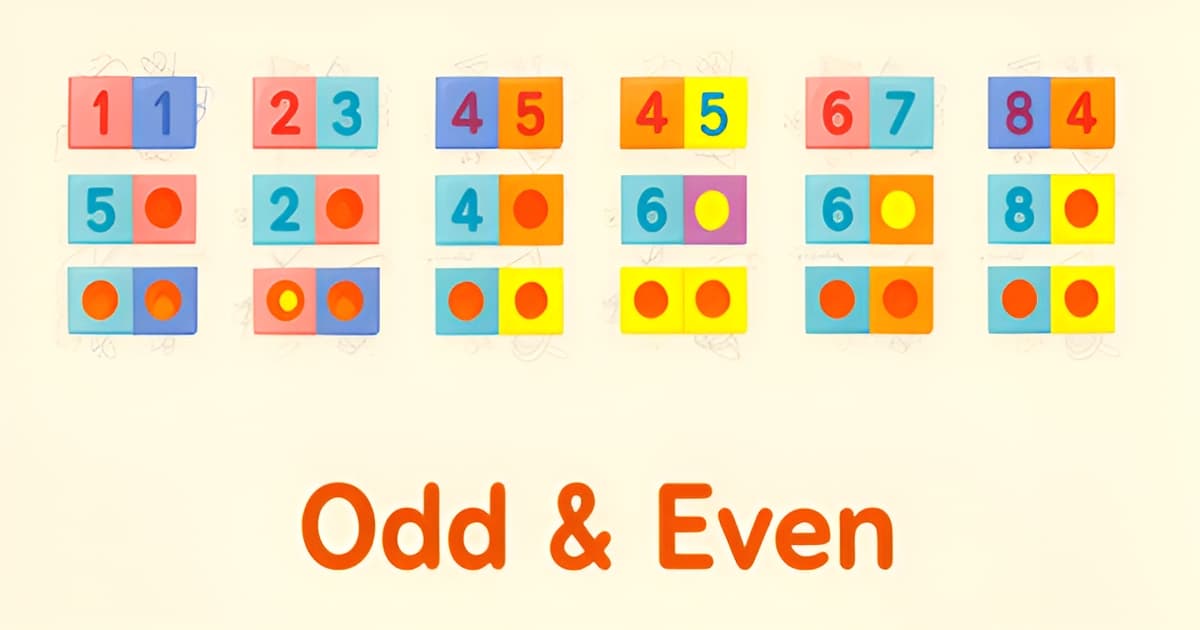
What are the rules for odd and even numbers?
Key Facts
- Only 53% of U.S. 4th graders correctly identified even and odd numbers on the NAEP national assessment, according to federal data.
- Even numbers make up 75% of multiplication table results because odd × odd is the only combination that produces an odd product, research shows.
- 30% of 4th graders couldn't find the missing number (75) in a simple sequence between 70 and 80, NAEP results reveal.
- Math education experts warn that last-digit tricks can help kids name a number, but pairing objects builds real understanding, according to practitioner guidance.
- Experienced teachers hold off on the words 'odd' and 'even' until children discover the patterns themselves through hands-on exploration, Jillian Starr recommends.
- Adding or subtracting two odd numbers always produces an even result, like 53 − 45 = 8, standard math references confirm.
- Parity judgment is one of the earliest mathematical tasks learned in school, according to peer-reviewed research.
Why Odd and Even Numbers Trip Kids Up
Only 53% of U.S. 4th graders correctly identified even and odd numbers on the NAEP national assessment, a figure that highlights how easily a foundational math concept can trip up young learners. Once kids know the rules for even and odd numbers, practice with printable even and odd numbers worksheets makes them stick.
The rules themselves are straightforward once broken down. Even numbers are integers divisible by 2 with a remainder of 0, while odd numbers leave a remainder of 1. A practical shortcut many classrooms use is the last-digit test: numbers ending in 0, 2, 4, 6, or 8 are even, and those ending in 1, 3, 5, 7, or 9 are odd. However, research suggests that relying on tricks alone can leave gaps. Education experts recommend teaching the concept visually first, through pairing objects or using a “line of equality” where two groups are matched one-to-one, and any leftover indicates an odd number.
Real-world anchors help the rules click. Street addressing is a familiar example: even numbers typically fall on one side of the street, odd on the other. Dice also offer a built-in pattern, with odd numbers featuring a center dot and even numbers spreading their dots symmetrically. These everyday observations turn abstract rules into something a child can see and test.
For parents and teachers looking to reinforce these ideas at home or in the classroom, Printoodle offers a simple way to generate customized practice pages. The even and odd numbers tool lets you create printable worksheets tailored to a specific skill level or theme, turning repetition into a hands-on activity. Print it. Doodle it. Done.
The Three Rules for Odd and Even Numbers
Ask a fourth grader whether 75 is even or odd, and there's a good chance you'll get a shrug. On the 2018 NAEP national assessment, only 53% of U.S. fourth graders correctly identified even and odd numbers. The good news: the rules for odd and even numbers boil down to three layers, and each one is simple enough to teach with things you already have at home.
Rule 1: The divisibility rule. An even number divides evenly by 2 with no remainder; an odd number leaves a remainder of 1. Take 14: divide it by 2 and you get 7 with nothing left over, so it's even. Take 15: divide by 2 and you get 7 with 1 left over, so it's odd. Mathematically, even numbers take the form 2k and odd numbers take the form 2k + 1, a definition researchers describe as one of the earliest mathematical tasks learned in school.
Rule 2: The last-digit rule. You don't have to divide a big number to test it. Just look at the final digit:
- Ends in 0, 2, 4, 6, or 8: even (2,416 is even because 6 is even)
- Ends in 1, 3, 5, 7, or 9: odd (357 is odd because 7 is odd)
- Works for any size number, from 10 to 10,000,000
As standard math references note, this shortcut is reliable for every integer. One caution from educators: the shortcut helps kids name a number, but pairing helps them understand it.
Rule 3: The pairing rule. This is the conceptual foundation. An even number splits into two equal groups; an odd number always leaves one leftover. Give a child 8 beans and they can make two piles of 4. Give them 9 and one bean sits alone. Experienced teachers recommend this hands-on matching approach first, before any memorized trick.
The real world is full of anchors. Street addresses put even numbers on one side of the road and odd on the other. On a die, every odd face has a center dot while even faces don't. Counting itself follows an odd-even-odd-even rhythm, which is why kids who "get it" start predicting what comes next.
Once the concept clicks through pairing, printed practice locks it in. Printoodle's even and odd numbers worksheets work best as that second step: explore with counters or dice first, then let kids sort, circle, and color their way to fluency.
Rules for Adding, Subtracting, and Multiplying
Once kids grasp the basic rules for odd and even numbers, practice with printable even and odd numbers worksheets makes them stick. The arithmetic rules are consistent across all credible sources: adding or subtracting two even numbers always results in an even sum or difference, while adding or subtracting two odd numbers also produces an even result. Mixing an odd and an even number always yields an odd answer, and the same logic applies to subtraction. For multiplication, the pattern holds that only an odd times an odd combination creates an odd product; any involvement of an even number means the result will be even. This is precisely why roughly 75% of multiplication table results are even, since odd × odd is the sole combination that stays odd. Concrete examples reinforce these patterns, subtracting 45 from 53 leaves 8, and subtracting 72 from 86 leaves 14, both even differences that follow the "odd minus odd equals even" rule. Once kids know the rules for even and odd numbers, practice with even and odd numbers worksheets makes them stick.
Teach the Concept First, Then Practice
Knowing the rules is one thing; building real understanding is another. On the most recent national assessment, only 53% of U.S. 4th graders correctly identified even and odd numbers, a gap that suggests many kids are memorizing shortcuts without ever grasping the idea underneath them (NAEP data reported by Fox 17).
Math education specialists are blunt about why. The ones-place trick, where kids just check whether a number ends in 0, 2, 4, 6, or 8, is technically true but teaches nothing. As one practitioner puts it, "Tricks can help kids name a number. But they don't help them understand it" (Structures of Equality).
The consensus approach starts with pairing and matching. Kids physically build numbers with counters, beans, or Unifix cubes and split them into two equal groups. If everything pairs up, the number is even. If one is always left over, it's odd. Experienced teachers like Jillian Starr recommend holding off on the words "odd" and "even" entirely until children have explored the patterns themselves.
Strong hands-on starting points include:
- Sharing a set of objects between two students and asking whether the shares are equal
- Filling ten frames by 2s and noticing which numbers leave empty squares
- Building two-color pattern towers and finding the "line of equality" where the colors match up
- Comparing dice faces, since odd numbers have a center dot and even numbers don't
So where do worksheets fit? After exploration, and that ordering matters. Jillian Starr explicitly avoids worksheets during the concept-building phase, and that's the right instinct (Jillian Starr Teaching). A printable page can't replicate the moment a child discovers that nine counters always leaves one sitting alone.
What printables do well is the step after that discovery: repeated, independent practice that cements the pattern. Once a child has physically split numbers into pairs, a sorting worksheet lets them apply the rule quickly and confidently across dozens of examples. That's why Printoodle's even and odd numbers worksheets are designed as reinforcement, with the hands-on pairing work coming first.
The sequence is simple: explore with counters, name the pattern, then practice on paper. Kids who follow that order don't just identify parity correctly. They understand why the rule works, which is exactly what the NAEP numbers show many students are missing.
A Simple Practice Routine at Home or in Class
Knowing the rules is one thing. Getting a child to apply them without hesitation takes practice, and the sequence you use matters more than the amount.
Start with objects, not numbers. Hand your child a pile of beans, counters, or blocks and ask them to share the set between two people. As math educator Julie Beauregard recommends, line the objects up one-to-one and ask a simple question: do both sides have the same amount? If they match perfectly, the number is even. If one is left over, it's odd. Eight splits into two towers of four; nine always leaves an extra.
Resist naming the concepts too early. Experienced teachers like Jillian Starr hold off on the words "odd" and "even" until children have noticed the pattern themselves, through ten frames filled by twos, dice patterns, and simple sharing games. The understanding comes first; the vocabulary follows.
Once the pairing idea is solid, introduce the last-digit test as a shortcut, not a substitute. A number ending in 0, 2, 4, 6, or 8 is even; a number ending in 1, 3, 5, 7, or 9 is odd. Frame it as a fast way to check what the pairing already proved. Then anchor it in the real world your child already knows:
- Street addresses: even numbers on one side of the road, odd on the other
- Dice: odd numbers have a center dot, even numbers don't
- Counting aloud: the odd-even-odd-even rhythm of the number line
Finally, move to independent practice. This is where worksheets earn their place, as reinforcement after hands-on exploration rather than a replacement for it. The stakes are real: NAEP results show only 53% of U.S. 4th graders correctly identified even and odd numbers, and 30% couldn't find the missing number in a simple sequence from 70 to 80. A few minutes of focused, written practice each day closes exactly that kind of gap.
You don't need to build those pages by hand. With Printoodle's even and odd numbers worksheet generator, you create personalized practice pages in seconds, tailored to the number range your child is working on, then print them at home or for the whole class. Every page you generate lives in your library, and reprints stay free forever, so revisiting a set your class struggled with costs nothing.
Print it. Doodle it. Done.
Frequently Asked Questions
What are the rules for odd and even numbers?
How do I quickly tell if a big number is even or odd without dividing?
What happens when you add, subtract, or multiply odd and even numbers?
Why do so many kids struggle with odd and even numbers?
What's the best way to teach my child odd and even numbers at home?
Are worksheets effective for practicing odd and even numbers?
Odd, Even, and Ready for What Comes Next
The rules for odd and even numbers come down to three simple layers: a number divisible by 2 with no remainder is even, the last digit tells you which side it lands on, and pairing objects into two equal groups shows you why. Teach the concept through hands-on pairing first, layer in the last-digit shortcut, and anchor it in real life with street addresses and dice. Then let practice do the rest, because with only 53% of U.S. 4th graders correctly identifying even and odd numbers on the NAEP national assessment, a few minutes of focused repetition at home or in class genuinely closes the gap. When you're ready for that practice step, Printoodle's even and odd numbers worksheet generator creates customized practice pages in seconds, tailored to the number range your child is working on, and reprints stay free forever. Explore with counters, name the pattern, then print a page and let your child show you what they know. Print it. Doodle it. Done.