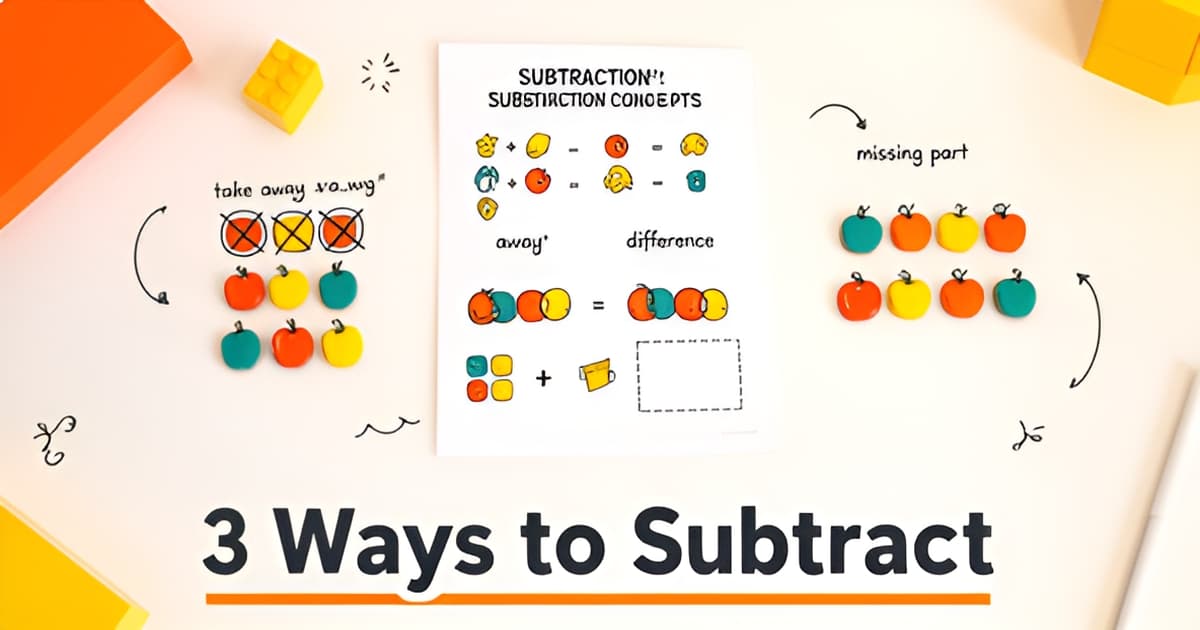
What are the three types of subtraction?
Key Facts
- Only 1 of 7 common subtraction word problems truly involves taking something away, according to iLearn's analysis.
- The three types of subtraction are take away, difference, and missing part, a framework aligned with Singapore's Primary Mathematics syllabus.
- Defining subtraction as 'take away' has been a staple of U.S. textbooks since the mid-1800s, iLearn traces.
- Many students can't solve missing-start subtraction problems until grade 3, and some never learn to at all, research summarized by iLearn shows.
- Keyword tricks fail because 'more' can signal subtraction and 'left' can mean direction, eduKate Asia explains.
- Studies spanning more than 30 years show students stumble on comparison and missing-part problems even when they calculate correctly.
- The counting-up subtraction method 'has been around forever,' says NCTM president Diane Briars, as Education Week reported.
Why 'Take Away' Isn't the Whole Story
Most of us learned subtraction as one thing: you have some, you take some away, and what's left is the answer. That single framing is so entrenched in U.S. math education that iLearn traces it back to textbooks from the mid-1800s. And according to iLearn's analysis of common subtraction situations, it's wrong. Only 1 of 7 typical subtraction word problems truly involves taking something away.
That mismatch shows up in classrooms every day. A child who nails "8 minus 3" on a worksheet freezes when asked, "Sue has 12 cards and Sam has 7. How many more does Sam need to have as many as Sue?" Nothing gets taken away there. Something gets added. Yet the problem requires subtraction, and a student who equates the minus sign with removal has no mental model for it.
The research on this is surprisingly deep. Studies spanning more than 30 years, as summarized by iLearn, show that students consistently stumble on comparison and missing-part problems even when they can calculate correctly. In other words, the breakdown isn't computational. It's conceptual. Kids can do the arithmetic but can't recognize which situations call for it.
Missing-start problems are the hardest of all. iLearn notes that many students can't solve them until grade 3, and some never learn to at all. If your only picture of subtraction is "remove and count what's left," a problem like "? + 5 = 12" simply doesn't fit the frame.
So when parents and teachers ask what are the three types of subtraction, the question really matters. The three types, take away, difference, and missing part, each model a different relationship between numbers:
- Take away: a quantity is removed and you find what remains.
- Difference: you find the gap between two quantities, like comparing how many cards two kids hold.
- Missing part: you know the whole and one part, and you find the other part.
Keyword tricks don't rescue the situation either. As eduKate Asia points out, "more" can signal subtraction ("Siti has 12 stickers, 4 more than Ali") and "left" can mean direction. Students need to read the relationship in the problem, not hunt for trigger words.
This is why practice materials matter more than they seem. A page of twenty "take away" problems, the default on most printable subtraction worksheets, drills one structure while leaving the other two untouched. When you build practice pages, whether by hand or with a generator like Printoodle's, mixing all three problem types is what turns procedural fluency into actual understanding.
The Three Types: Take Away, Difference, and Missing Part
When someone asks what are the three types of subtraction, the clearest answer comes from a framework aligned with Singapore's Primary Mathematics syllabus: take away, difference, and missing part. As eduKate Asia puts it, subtraction is one operation that can model several relationships, and children taught only one meaning can calculate correctly yet still fail problems that don't fit it.
Type 1: Take away. This is the meaning everyone knows. You start with 12 cookies, 5 get eaten, and 7 remain. Something is physically removed from a set, and you find what's left. It's the easiest structure for young learners, which is why most early worksheets lean on it.
Type 2: Difference. Here nothing disappears. You compare two quantities and find the distance between them. Consider the example eduKate Asia uses: "Siti has 12 stickers, 4 more than Ali." If Ali's amount is unknown, you subtract, even though the word "more" appears. This is why keyword hunting fails: "more" can signal subtraction, and "left" can mean direction rather than remaining amount.
Type 3: Missing part. The result is known, but the starting point or one part isn't. For example: "Some children were on the playground. 8 went inside. 5 are still outside. How many started?" Research cited by iLearn notes that many students can't solve missing-start problems until grade 3, and some never learn to solve them at all.
Here's a quick summary of the three structures:
- Take away: 12 cookies, 5 eaten, how many left? The result is unknown.
- Difference: Siti has 12 stickers, 4 more than Ali. How many does Ali have? You compare.
- Missing part: Some children, 8 leave, 5 remain. The start is unknown.
One caveat for teachers: terminology varies across frameworks. iLearn classifies subtraction word problems as change, combination, and comparison types, and its research, spanning more than 30 years, argues that only one of seven possible subtraction situations is truly a "take away" scenario. The labels differ, but the underlying insight is the same: subtraction is bigger than removal.
That's worth keeping in mind when you build practice materials. If every problem on a page is a take-away story, students never meet the structures that trip them up later. Mixing all three types into your subtraction worksheets, which you can generate in seconds with Printoodle, keeps practice aligned with how these problems actually show up on assessments and in real life.
How to Teach Each Type Without Confusing Kids
Once a child can calculate 9 − 4, the real teaching challenge begins: helping them see that the same operation covers three different relationships. Each type needs its own teaching approach, and mixing them up is where confusion creeps in.
For take-away problems, start with what kids can touch. Real objects work best: put out nine counters, physically remove four, and count what's left. Drawings come next, then abstract numbers. This concrete-to-pictorial-to-abstract sequence mirrors the meaning-first approach in Singapore's Primary Mathematics syllabus, which explicitly teaches subtraction through several relationships rather than a single action.
Difference problems need a different tool entirely. Instead of removing anything, teach kids to think about the gap between two numbers. The counting-up (or "adding on") method fits here naturally: to find 34 − 9, a child might notice it's the same problem as 35 − 10. Diane Briars, president of the National Council of Teachers of Mathematics, points out that this method "has been around forever," so it's long-established practice, not a newfangled experiment, as Education Week reported. Ask "how many more?" questions with two visible quantities side by side so the comparison is something kids can actually see.
Missing-part problems are the trickiest, and the data backs that up. Many students can't solve missing-start problems until grade 3, and research summarized by iLearn notes some never learn to solve them at all. Number bonds and part-whole diagrams are your best defense here. Draw the whole number at the top, the two parts below, and let the unknown part sit visibly empty. The diagram does the structural thinking the child can't yet do in their head.
- Take away: counters, blocks, and drawings where objects visibly disappear.
- Difference: counting up from the smaller number, or comparing two rows of objects.
- Missing part: number bonds and part-whole diagrams with the unknown clearly marked.
One habit to drop: keyword hunting. As the eduKate Asia breakdown of the three subtraction meanings puts it, "more" can actually require subtraction (think "Siti has 12 stickers, 4 more than Ali" when Ali's amount is unknown), and "left" can simply mean direction. Words don't reliably signal the operation; the structure of the problem does.
When you build practice pages, vary where the unknown sits. A good set of subtraction worksheets should mix result-unknown, change-unknown, and start-unknown problems rather than drilling "take away" as a catch-all. Kids who only ever see one structure can calculate perfectly and still fail a comparison problem, which is exactly the outcome we're trying to avoid.
Building Practice Pages That Cover All Three
If every subtraction worksheet you print looks the same, you're teaching only a fraction of subtraction. The research is blunt on this point: only one of seven common subtraction situations actually involves "taking away" something, according to iLearn's analysis of problem structures. Yet take-away drills remain the default, largely because that definition has been a staple of U.S. textbooks going back to the mid-1800s.
The cost shows up in student performance. Studies spanning more than 30 years show a high percentage of students struggle with problem types beyond take-away, and iLearn notes that many students can't solve missing-start problems until grade 3, with some never learning to solve them at all. Children drilled only on take-away can calculate correctly and still fail comparison or missing-part problems, as eduKate Asia explains in its breakdown of the three meanings of subtraction.
So when you build practice pages, mix the structures deliberately. A good worksheet set rotates through:
- Result unknown: the classic take-away problem, where the starting amount and the amount removed are given.
- Change unknown: "Siti has 12 stickers, 4 more than Ali. How many does Ali have?" Here "more" actually calls for subtraction, which is why keyword hunting fails.
- Start unknown: the missing-start problems that trip up students well into elementary school.
- Comparison and equalize problems: questions about the distance between two quantities, or how many more one child needs to match another. The equalize type is easy to miss because solving it involves getting more, not removing anything.
Varying the position of the unknown matters as much as varying the story. A page with all result-unknown problems looks rigorous and teaches almost nothing new, because students learn to perform one procedure rather than choose a strategy. Fluency, as eduKate Asia puts it, includes strategy selection, not one universal procedure.
This is where a generator earns its keep. With Printoodle, you can build subtraction worksheets that deliberately rotate problem structures instead of defaulting to a stack of take-away drills, then download a print-ready PDF in seconds. Everything you make is saved in your library, so reprints are always free, and the free tier gives you 10 credits to experiment with before spending anything.
One practical rule of thumb: introduce each structure with concrete examples before layering in strategies like counting up or place-value decomposition. The Singapore Primary Mathematics syllabus supports exactly this meaning-first approach, presenting subtraction as one operation that models several relationships. Your practice pages should mirror that, one mixed set at a time.
Print it. Doodle it. Done.
Frequently Asked Questions
What are the three types of subtraction and how do they differ?
Why do some students struggle with subtraction even when they can calculate math problems?
How can I help my child understand subtraction beyond just 'taking away'?
What is the difference between 'difference' and 'missing part' subtraction problems?
Why do keyword tricks like 'more' and 'left' fail with subtraction?
How should subtraction worksheets be designed for the best learning outcome?
Subtraction Is Bigger Than Take-Away, Teach All Three Meanings
So, what are the three types of subtraction? Take away, difference, and missing part, and each one models a different relationship between numbers. The research is clear that kids who learn subtraction as only "remove and count what's left" can calculate perfectly and still freeze on comparison or missing-start problems, which iLearn's 30-plus years of research show many students never master. The fix isn't more drilling; it's deliberate variety. Rotate where the unknown sits, drop the keyword-hunting habit, and give each structure its own teaching tool: counters for take-away, counting up for difference, and number bonds for missing parts. Your next step is simple: audit the practice pages you already use. If every problem is a take-away story, you've found the gap. With Printoodle, you can build mixed-structure subtraction worksheets in seconds, download a print-ready PDF, and reprint from your library for free, so trying all three types costs you nothing but a few clicks. Print it. Doodle it. Done.