What are the two types of mazes?
Key Facts
- The first official corn maze was cut in 1993 at Lebanon Valley College in Annville, Pennsylvania, by Don Frantz and Adrian Fisher according to maze history.
- Psychologist Karl S. Lashley proved in 1918 that simple mazes yield data as valid as complicated ones per a peer-reviewed review.
- Cool Patch Pumpkins in Dixon, California built a 60-acre corn maze that set a record in 2014 per corn maze history.
- A Springer case study found personalized maze games with sixth-graders improved motivation, immersion, and learnability scores in academic research.
- The first recorded labyrinth appeared in 5th century B.C. Egypt, described by the Greek historian Herodotus according to historical accounts.
- Maze-solving requires constructing a correct sequence of left and right turns in memory, a working-memory workout for kids according to maze research.
- Scientific maze research splits mazes into dry and water types, with reliability coefficients strongly dependent on the maze used per a systematic review.
The Two Types of Mazes: Picture Mazes vs. Classic Mazes
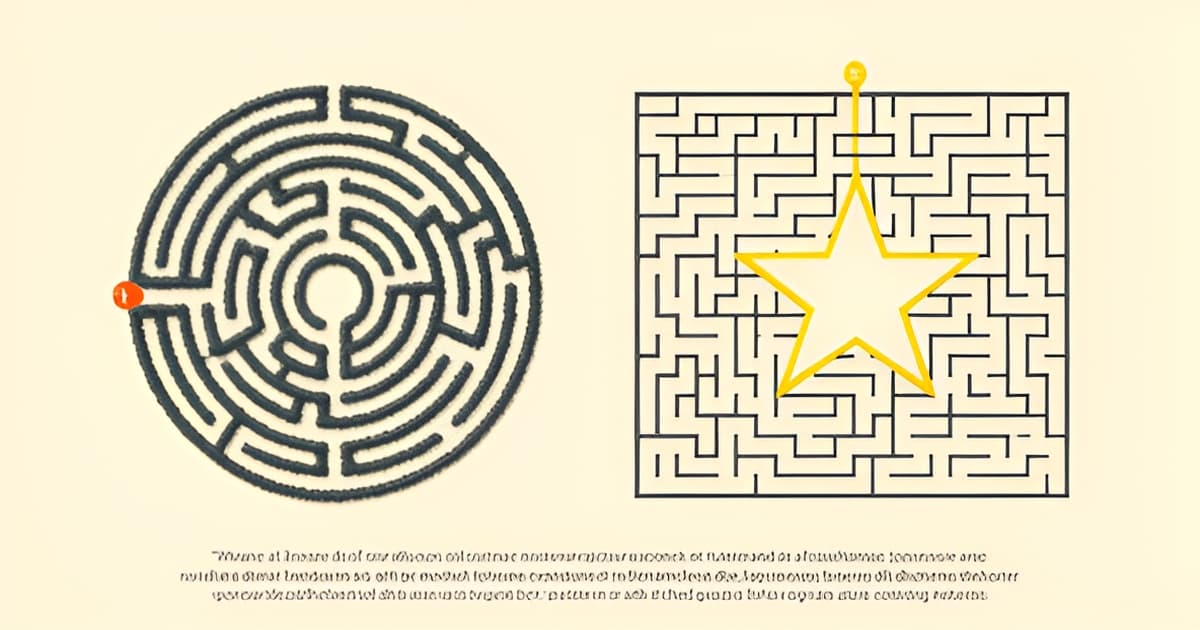
When people think of a maze, the image that comes to mind is usually a puzzle of walls and turns, a classic maze designed to test navigation. However, for printable activity audiences, the category splits into two distinct formats: the traditional path-through-walls design and the picture maze, where the path itself forms a recognizable image that only becomes clear once the puzzle is solved. Oh My Dots, a maze generator product, explicitly offers creators the choice to "create an exclusive picture maze or a classic maze to play online or print," highlighting how these two styles serve different user needs. A picture maze works like a regular maze, but its shape is based on a picture; once the solver reaches the end, the hidden image magically reveals itself, turning a navigation task into a reveal experience. This format mirrors the design philosophy behind Printoodle’s own tools, where users can upload photos or briefs to generate custom line-art mazes that print ready on Letter or A4 paper, with options to include difficulty settings and solution pages for self-checking.
Beyond the printable realm, taxonomies diverge into scientific and historical frameworks. In rodent cognitive research, the distinction falls between dry mazes and water mazes, with the choice of maze type fundamentally determining the reliability of the data collected; research notes that the values of reliability coefficients are strongly dependent on the kind of applied maze used in testing. Historically, mazes trace a path from ancient labyrinths described by Herodotus in 5th century B.C. Egypt through Renaissance hedge mazes to the modern agricultural phenomenon of corn mazes. The first official corn maze appeared in 1993 at Lebanon Valley College in Annville, Pennsylvania, created by Don Frantz and Adrian Fisher, and GPS technology would later transform these designs into multi-layered experiences with pre-planned dead ends and loops. For educators and parents, the benefits of these puzzles are well-documented: a Springer academic chapter on personalized educational maze games found that testing with sixth-graders showed personalized versions improve motivation and immersion while yielding higher learnability scores, with students expressing interest in replaying at higher difficulty levels.
Printoodle supports both primary maze types through its generator. Classic maze layouts can be produced with adjustable wall density and solution keys, while picture mazes leverage the platform’s photo-to-line-art technology, allowing users to turn a family pet or a holiday snapshot into a custom puzzle shape. The platform’s free tier gives new users 10 credits upon email verification, and every creation lives in a personal library where reprints are free forever, making it easy for parents to generate a new maze for a rainy day or for teachers to print a batch of word-search style challenges from lesson material. Whether the goal is a simple path-finding exercise or a reveal-style image puzzle, the tools are designed to be intuitive and immediately shareable.
- Customize difficulty from easy to hard, ideal for ages 3-12.
- Add optional solution pages so solvers can check their own work.
- Upload a photo or select a shape to generate a picture maze in seconds.
- Download print-ready PDFs in Letter or A4 format instantly.
According to a peer-reviewed systematic review on maze experimentation, choosing the different types of mazes depends on the aim of the research, and simple mazes can yield data as valid as complex ones, supporting the pedagogical legitimacy of printable formats for young learners. Whether you are a parent looking for a rainy-day activity or a teacher creating a worksheet from your own material, Printoodle’s maze generator offers a quick way to print a custom puzzle that fits your theme and your students’ skill levels. Print it. Doodle it. Done.
Why the Maze Type You Pick Matters for Kids
It's tempting to grab any maze off the internet and hand it over with a crayon. But the maze type you pick, and how it's personalized, genuinely changes what your child gets out of it. When parents ask what are the two types of mazes and which one matters for learning, the answer starts with how the brain actually solves one.
Solving a maze isn't just visual problem-solving. According to research on maze learning, the solver must construct a correct sequence of directions, left and right turns, in memory and then follow that sequence. That's a working-memory workout, and it's the same skill kids use for spelling patterns, math steps, and following multi-part instructions.
There's also good news for parents of younger kids who worry that easy mazes are "too simple" to count. Back in 1918, psychologist Karl S. Lashley demonstrated that data from a simple maze was as valid as data from complicated ones, partly because simple mazes allow more trials. Translated to your kitchen table: an easy printable maze your four-year-old can complete three times in a row is doing real cognitive work, not just filling time.
Personalization appears to amplify the benefit. A case study of an educational maze game tested with sixth-graders found that personalized versions improved motivation and immersion and yielded higher learnability scores. Students even wanted to replay the game at higher difficulty levels. The takeaway for parents and teachers is straightforward: a maze built around something a child already cares about gets more engagement than a generic one.
That's where the two main printable formats come in:
- Classic mazes, the traditional winding-path puzzles, work well for pure turn-sequence practice and quick warm-ups.
- Picture mazes, where the maze's shape follows an image that reveals itself once solved, add a payoff moment that keeps kids going when the path gets tricky.
- Difficulty settings matter: matching the challenge to the child prevents both boredom and frustration.
- An optional solution page lets kids self-check, which builds independent problem-solving rather than guess-and-ask habits.
This is the thinking behind how Printoodle approaches its printable mazes. You can generate a classic maze at the difficulty you choose, or turn a photo (a pet, a grandparent, a favorite toy) into a picture maze whose hidden image emerges as your child solves it, all as a print-ready PDF. Since reprints are always free from your library, the "more trials" advantage Lashley identified costs you nothing extra.
Pairing a maze with other pencil-and-paper activities rounds out the session nicely. A round of halloween trivia after a spooky-shaped maze, or a quick family trivia game alongside a maze built from a family photo, turns one worksheet into a full activity. The maze builds memory for sequences; the trivia builds recall and conversation. Different skills, same printed page.
A Quick History: From Egyptian Labyrinths to Corn Mazes
Long before anyone asked "what are the two types of mazes," people were getting gloriously lost on purpose. Maze history stretches back roughly 2,500 years, and the story runs from Egyptian temples to a Pennsylvania cornfield.
The first recorded labyrinth appears in 5th century B.C. Egypt, described by the Greek historian Herodotus, who wrote about a vast, winding structure he considered more impressive than the monuments he'd seen elsewhere. From there, the idea traveled through Renaissance Europe, where gardeners turned hedges into puzzle walls for aristocrats to wander. Those hedge mazes gave us the familiar branching design most people picture today: multiple paths, dead ends, and a genuine risk of spending your afternoon going in circles.
The modern chapter opens in 1993, when Don Frantz and Adrian Fisher cut the first official corn maze at Lebanon Valley College in Annville, Pennsylvania. What started as a novelty became a full-blown fall tradition, and GPS technology pushed it further. Designers now plan multi-layered mazes with dead ends, loops, and varying difficulty levels on a computer before a single stalk is cut, according to the same history of corn mazes.
Some of these field puzzles have reached remarkable sizes:
- Cool Patch Pumpkins in Dixon, California, built a 60-acre maze that set a record in 2014.
- Richardson Adventure Farm in Spring Grove, Illinois, runs a 24-acre John Deere-themed maze.
- Treinen Farm in Lodi, Wisconsin, consistently designs mazes over 15 acres.
That scale explains why corn mazes and autumn go hand in hand now. A trip to the pumpkin patch comes with cider, hayrides, and a half hour of family teamwork arguing over whether the left turn was the right call. It's the same appeal that makes a family trivia game or a printable maze such reliable rainy-day entertainment: a puzzle big enough to be worth solving, small enough to finish before dinner.
The seasonal tie-in runs even deeper at Halloween, when spooky themes and puzzle-solving naturally pair up. If you're planning an October party or classroom activity, Printoodle's halloween trivia generator sits nicely alongside a themed maze, and you can print both from the same place. The ancient Egyptians didn't see that coming, but Herodotus would probably approve of the ambition.
How to Make Each Maze Type with Printoodle
Now that you know the answer to "what are the two types of mazes," let's make one. Printoodle handles both the classic maze and the picture maze, and each takes seconds rather than an afternoon of graph paper and eraser shavings.
Making a classic maze. Open the maze generator, pick a theme, and choose your difficulty. A preschooler needs wide paths and few dead ends; a ten-year-old wants loops and long false trails. Difficulty settings and an optional solution page are standard features in modern maze generators, and comparable tools confirm this is how most creators work. Add a title, toggle the answer key, and download.
Making a picture maze. This is where it gets fun. A picture maze works like a regular maze, but its shape is based on a picture, and the image reveals itself as the solver traces the path. Upload a photo of your dog, a birthday cake, or a dinosaur sketch, and Printoodle converts it to clean line art that doubles as the maze outline. The same difficulty controls apply, so a photo of Grandma can challenge a seven-year-old or a twelve-year-old.
A quick guide by age:
- Ages 3-5: easiest setting, one clear path, big print. Keep it under a minute of solving.
- Ages 6-8: medium difficulty with a few dead ends, plus a picture maze of something they recognize.
- Ages 9-12: hard mode, loops, and a solution page they only get after two honest attempts.
Don't worry that simpler mazes are somehow "lesser." Karl Lashley showed back in 1918 that data from a simple maze was as valid as data from complicated ones, a finding noted in this peer-reviewed review of maze research. Easy mazes are legitimate mazes. Match the challenge to the kid, not to your own ambition.
Every maze downloads as a print-ready PDF, with Letter as the default and an A4 toggle for international printers. Your first 10 credits come free when you verify your email, and anything you generate lives in your library where reprints are free forever. Print the birthday maze once or fifty times; the cost never changes.
Want to build a full activity pack? Pair your mazes with a family trivia game for a rainy afternoon, or match a fall-themed maze with halloween trivia cards for an October party. There's real backing for combining mazes with quizzes, too: a Springer case study with sixth-graders found that a maze paired with mini-games improved motivation, immersion, and learnability scores.
Print it. Doodle it. Done.
Frequently Asked Questions
What are the two types of mazes?
What's the difference between a classic maze and a picture maze?
Are easy mazes actually good for my child, or just busywork?
What skills do kids build by solving mazes?
When was the first corn maze created?
How do I make a picture maze from my own photo?
So, Which Maze Will You Make First?
Now you know the answer to "what are the two types of mazes": the classic winding-path puzzle built for turn-sequence practice, and the picture maze, where a hidden image reveals itself as the path gets traced. Both are legitimate learning tools, research going back to Karl Lashley in 1918 showed that simple mazes yield results as valid as complicated ones, and a Springer case study found personalized maze games boosted motivation, immersion, and learnability among sixth-graders. The real magic happens when the puzzle matches the kid: a dog-shaped picture maze for the seven-year-old, a hard-mode classic for the ten-year-old. Your next step is simple, pick a type, pick a difficulty, and turn a photo or a theme into a print-ready maze in seconds. Printoodle gives you 10 free credits to start, and every maze you make reprints free forever from your library. Round it out with a halloween trivia pack or a family trivia game, and one printed page becomes a whole afternoon. Print it. Doodle it. Done.