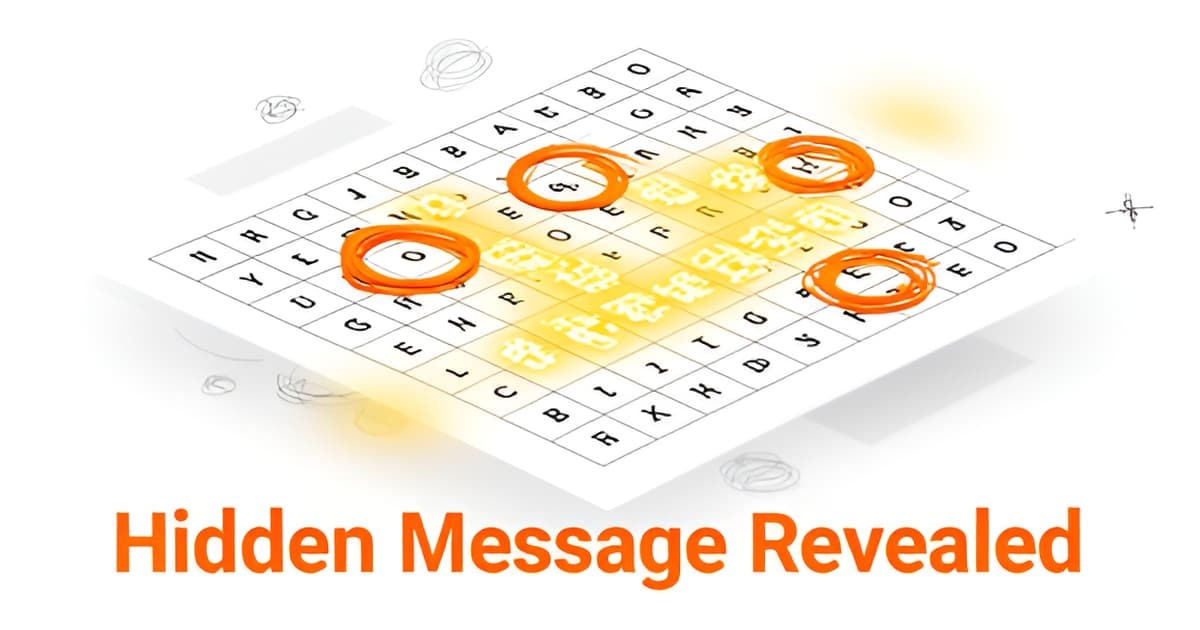
What are word puzzles with hidden messages?
Key Facts
- Word search grids contain two letter types: needed words and filler letters, where the leftover fillers spell a hidden message after all words are circled according to puzzle-craft communities
- Personalized gift items command 34% higher average order values than standard products, making custom hidden-message puzzles a high-value keepsake according to Persistence Market Research
- The global word games market reached USD 1.455 billion in 2025 and is projected to grow to USD 2.565 billion by 2034 at 6.5% annually according to Dataintelo
- Print word search books and magazines hold their own alongside apps, comprising the remainder of the word search segment after 85.9% of word game revenue comes from mobile according to Dataintelo
- Game-based learning improves retention by 40% compared with conventional methods, supporting educational use of custom word searches according to Research and Markets
- Adults represent the largest puzzle demographic at ~40% of games-and-puzzles revenue, driven by digital fatigue and stress management needs according to Persistence Market Research
- Puzzle designers equalize letter frequency across grids so hidden messages remain invisible, using algorithms that insert the least frequent letter until letter distribution is balanced according to puzzle-craft discussions
The Puzzle: You Want a Word Search That Reveals a Secret, Not Just a Word List
You've made a hundred word searches, and they all end the same way: last word circled, pencil down, done. What you actually want is a puzzle with a payoff, a birthday name, a punchline, a "look behind you" that only appears after the hard work is done. That's the appeal behind the question what are word puzzles with hidden messages, and the answer is simpler than you might think.
The mechanics are clever. In a hidden-message word search, the listed words are only half the story. Once you've found and circled every word from the list, the leftover letters in the grid, read in order, spell out a secret message. The filler letters, the ones puzzle designers normally scatter randomly to disguise the hidden words, become the payload. As puzzle-craft communities explain, that filler-versus-word-letter distinction is the structural foundation of every word search, and it's exactly what makes the hidden-message variant possible.
Why do these puzzles land so well? Because the reveal rewards persistence. The solver earns the surprise, and the surprise is personal: a name, an inside joke, a proposal. A few occasions where that payoff shines:
- Birthday parties, where the child's name appears in the uncircled letters as the grand finale
- Classroom lessons, where the leftover letters reveal the answer to a review question
- Bridal and baby showers, where the hidden message delivers the announcement itself
- Family game nights, where the punchline only makes sense to the people in the room
The timing is right for this kind of puzzle, too. Word games are a $1.455 billion market growing 6.5% a year according to Dataintelo, and print word search books and magazines still hold their own alongside apps. Meanwhile, Persistence Market Research describes a structural shift in consumer entertainment toward screen-free, socially enriching activities, driven partly by rising screen-time concerns. Families are actively choosing tactile, offline options. That's a preference change, and it's not reversing.
Personalization is the other force at work. The same Persistence research notes that customized puzzle offerings are helping online retail become the fastest-growing distribution channel in the category. A word search with a hidden message is about as customized as a puzzle gets.
The good news is that you don't need to hand-place letters in a grid. A word search maker can arrange your word list and plant your message in the leftover letters automatically, and a printable word search gives you a print-ready page in seconds. You bring the surprise; the grid does the rest.
How Hidden Messages Actually Work Inside the Grid
Every word search grid is a tiny machine with two kinds of parts: letters the puzzle needs, and letters that just fill space. Puzzle designers on Puzzling StackExchange describe this split as the foundation of the craft. A hidden message works by hijacking the second category. Instead of scattering random filler letters, the designer places the letters of a secret phrase into the leftover positions, so the message reveals itself only after you've crossed off every word on the list.
The trick is keeping the message invisible until the end. Good fillers mirror the natural letter distribution of the language, according to the same puzzle-craft discussion, so a grid carrying a message looks statistically identical to any other grid. One advanced technique goes further: if the hidden words contain five E's, three M's, and one Z, the filler uses one E, three M's, and five Z's, equalizing every letter's frequency. The message hides in plain sight because nothing about the grid's texture gives it away.
Orientation controls difficulty. The community consensus is that words running rightwards and downwards are easiest to spot, while non-southeast diagonals are the hardest. Designers also plant red herrings: hide STACK, then flank it with STALK and SACK so a solver's eye keeps snagging on near-misses.
- Beginners (ages 6–8): 10x10 grids, forward-only words, per this word search design guide
- Intermediate (9–12): 15x15 grids with diagonals and reverse words
- Advanced (13+): 20x20 grids with all directions, plus red herrings
Here's the part beginners often miss: readability beats raw difficulty. The StackExchange thread is blunt on this point. "Really hard to solve ≠ good fun puzzle," one contributor puts it, and tricks that make a grid hard to read are called "a horrible designer choice." A hidden message should delight the solver at the finish line, not punish them on the way there. "A good word search will have just the right amount of cruel and kind elements."
That balance matters most for message puzzles, because the payoff is the whole point. A birthday name or a punchline revealed in leftover letters lands only if the solver actually reaches it. The reveal is a gift, and the grid should be kind enough to let it arrive.
If you want to build one yourself, a tool like Printoodle's word search maker handles the letter placement so you can focus on the message, then export a printable word search ready for the kitchen table. Print it, doodle it, done.
Making One: Difficulty, Grid Size, and Your Audience
The secret to a great hidden-message word search isn't cleverness. It's fit. A grid that's too big frustrates a six-year-old, and one that's too easy bores a teenager, so tuning difficulty, grid size, and the message itself to your audience is what separates a puzzle kids beg to print again from one that lands in the recycling bin. That's true whether you're building a classic word search or one of those word puzzles with hidden messages, where the leftover letters spell out a name or phrase after the word list is found.
Start with the grid. The word search construction guide from jigsawmake lays out a simple age-based ladder that works well as a starting point:
- Ages 6 to 8: a 10x10 grid with forward-only words (left to right, top to bottom)
- Ages 9 to 12: a 15x15 grid that adds diagonals and reversed words
- Ages 13 and up: a 20x20 grid using all eight directions
- Every level: 10 to 20 themed words, which is enough to fill the grid without overwhelming it
The message itself should scale the same way. For young solvers, keep the hidden reveal short, like a first name or a single word, because their patience for scanning leftover letters is limited. Older solvers can handle a longer phrase, especially in a 20x20 grid where there's more filler to work with. The puzzle-craft community on Puzzling StackExchange puts it well: the right balance of "cruel and kind" elements depends entirely on your target audience. A hidden message is the kindest element of all, since it rewards persistence with a payoff.
One design rule matters more than any other: keep the reveal legible. Puzzle designers consistently warn that tricks which make a grid hard to read are "a horrible designer choice," because they make the puzzle less fun rather than more challenging. Choose an easy-to-the-eye font and generous letter spacing so the leftover letters actually form readable words when the hunt is over. If the message is cramped or visually noisy, the big reveal falls flat. When you build one with a word search maker like Printoodle's, the tool handles grid generation and keeps the printed output clean, so you can focus on picking the words and the message.
There's a solid educational case for the effort, too. Word searches are a low-prep way to practice vocabulary, spelling, pattern recognition, and focus, and the research backs the format: game-based learning improves retention by 40% compared with conventional methods, according to eLearning Industry data cited by Research and Markets. Teachers can even build a printable word search from their own lesson vocabulary, hiding a review phrase in the leftovers.
Match the grid to the solver, size the message to the attention span, and print it clean. Print it. Doodle it. Done.
From Idea to Printable: Building Your Hidden-Message Puzzle with Printoodle
Now that you know how hidden messages work, here's the good news: you don't have to plot a letter grid by hand. Printoodle's word search maker does the heavy lifting. You type a theme, paste your word list, enter the secret message, and the generator places your words in the grid and reserves the leftover letters for the reveal. A print-ready PDF comes out in seconds, sized for Letter by default with an A4 toggle if you're outside North America.
The whole process takes about two minutes, and the output is genuinely yours. A few ways people use it:
- Teachers: hide the answer to a review question in the leftover letters, so students who finish the word list get the payoff. Word searches are a low-prep way to practice vocabulary and spelling, and research on game-based learning suggests it can lift retention by 40% over conventional drills.
- Parents: build a puzzle where the uncircled letters spell "Happy 8th Birthday, Maya." The reveal lands better than any card, because she earned it.
- Party hosts: create a baby shower word search where the last letters announce the baby's name, or a bridal shower version that reveals the honeymoon destination.
There's a practical reason this kind of customization is worth the extra two minutes. Personalized gift items command 34% higher average order values than standard products, according to Shopify data cited by Persistence Market Research. A mass-produced puzzle book costs a few dollars; a puzzle with someone's name hidden inside feels like a keepsake. That's the gap between a filler activity and something people keep.
Difficulty tuning matters too. If you're making the puzzle for younger kids, keep the grid small and the words forward-only; for older solvers, go bigger and allow diagonals and reversals. Puzzle designers generally recommend matching grid size and word direction to the solver's age, and the community consensus is clear that readability beats raw difficulty. A puzzle nobody can read is, as one designer put it, "a horrible designer choice." The hidden message should delight, not frustrate.
If you'd rather skip the building part entirely, the printable word search library has themed, ready-to-print examples you can download and use as-is. Either way, everything you make lives in your Printoodle library, and reprints are always free.
Print it. Doodle it. Done.
Frequently Asked Questions
How exactly do hidden messages work inside a word search grid?
Can I create a custom word search with a hidden message for a birthday or special event?
Are hidden-message word searches suitable for kids, or are they too difficult?
Why do hidden-message puzzles feel more rewarding than a regular word search?
Do I need design skills to make a word search with a hidden message?
Will the hidden message be legible, or does the grid make it hard to read?
The Secret's in the Leftover Letters
So, what are word puzzles with hidden messages? They're word searches with a plot twist: the words you find are just the warm-up, and the real payoff, a birthday name, a lesson answer, a baby's-name announcement, hides in the uncircled letters until the very last word is found. The mechanics come down to filler letters doing double duty, and the design wisdom is simple: match the grid to the solver, keep the reveal legible, and let the surprise be the reward for persistence. In a market where families are choosing screen-free activities and personalized gifts command 34% higher average order values, a puzzle with someone's name hidden inside isn't a filler activity; it's a keepsake. Ready to plant your own secret? Open Printoodle's word search maker, type your message, and download a printable word search in about two minutes. Print it. Doodle it. Done.