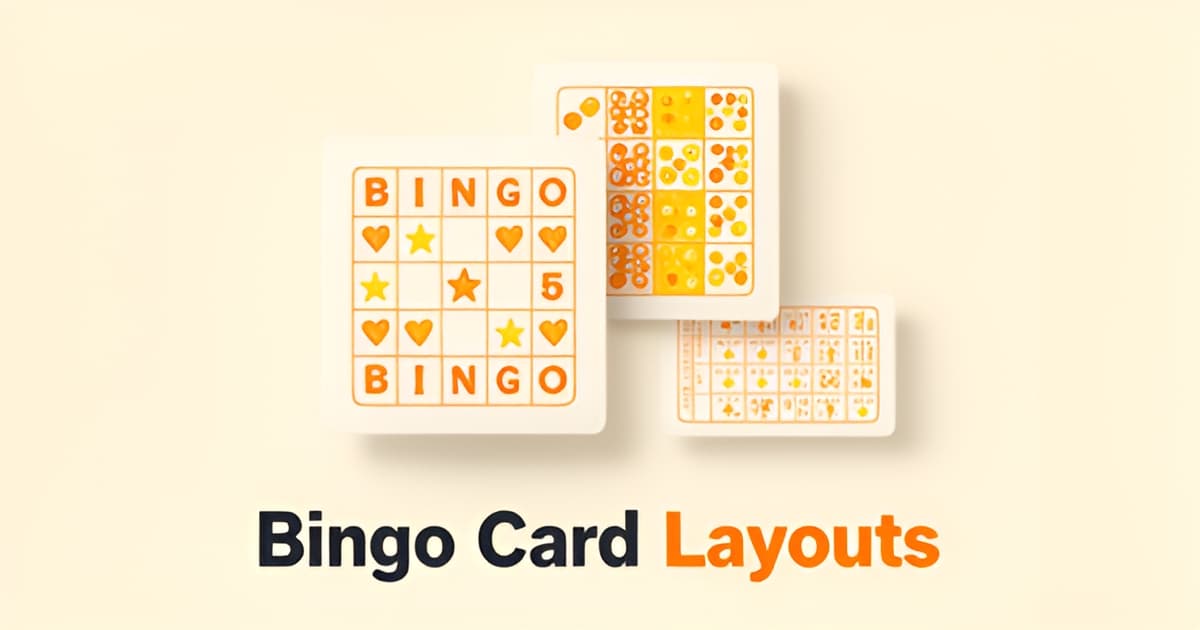
What does a bingo card look like?
Key Facts
- The classic 75-ball bingo card is a 5x5 grid of 25 squares with numbers 1–75 and a free pre-daubed center square, according to bingo game guides.
- A single horizontal line pattern gives bingo players five different ways to win, per pattern research from Arrow International.
- The 80-ball bingo card packs 16 squares into a 4x4 grid, with each column color-coded for faster scanning, BingoBlitz's game guide explains.
- The UK-style 90-ball card holds 27 squares in a 3x9 structure, with five numbers and four blank spaces per row, per BingoBlitz specifications.
- Unlike other variants, 90-ball bingo recognizes only three winning conditions: one line, two lines, or a full house, BingoBlitz's guide confirms.
- Themed bingo patterns like the Valentine's Heart, New Year's Champagne Glass, and Christmas Tree keep seasonal games fresh, Arrow International notes.
- Without new patterns, bingo games 'would quickly get tiresome and boring,' according to Arrow International.
The Classic Bingo Card: A 5x5 Grid with a Free Center Square
When you picture a bingo card, you're almost certainly imagining the 75-ball version: a tidy 5x5 grid of 25 squares, each holding a number from 1 to 75, with one square in the very middle already marked for you. It's the layout that has defined the game for generations, and it's the answer to "what does a bingo card look like" for most players in North America.
According to bingo game guides, the 75-ball card is "played on a card with 25 squares, arranged in five rows and columns," and every square contains a number except the center one, which is pre-daubed as a free space. That free square counts toward any winning pattern, giving every player a small head start before the first number is even called.
The core mechanic is simple. A caller announces numbers one at a time, and players mark, or "daub," each matching square on their card. You're racing to complete a target pattern before anyone else does.
The pattern is where the 5x5 grid really shines. Because the layout is symmetrical, it supports a huge variety of winning shapes:
- Lines in any direction: horizontal, vertical, or diagonal. A single horizontal line alone gives players five different ways to win, per pattern research from Arrow International.
- Letter shapes like X, T, and L, plus combinations such as any two lines or one line plus all four corners.
- Themed shapes for holidays: a heart for Valentine's Day, a champagne glass for New Year's, a Christmas tree for December games.
- A full blackout, where every square on the card gets daubed.
That flexibility is exactly why the 75-ball grid became the default. It's easy to read at a glance, simple enough for a child to follow, and roomy enough to hold creative patterns without getting confusing.
The classic layout also adapts beautifully to custom play. If you're building cards for a classroom, a book club, or a birthday party, you don't have to stick with plain numbers. Printoodle's bingo card generator lets you produce print-ready 5x5 cards in seconds, so every player gets a unique grid. Teachers running a literacy unit can do the same with reading bingo, swapping number squares for titles, authors, or reading challenges.
The familiar grid stays the same. What fills the squares is entirely up to you. Print it, doodle it, done.
Not All Bingo Cards Look the Same: 80-Ball and 90-Ball Layouts
If you're picturing what a bingo card looks like and imagining only the classic 5x5 grid, you're missing half the story. Two other major variants, the 80-ball and 90-ball games, use completely different card shapes, and each one changes how the game plays out.
The 80-ball card is the most compact of the three. It has 16 squares arranged in four rows and four columns, with each square holding a number from 1 to 80, according to BingoBlitz's game guide. The visual twist is the color: every column gets its own distinct shade, which makes the card easier to scan mid-game.
Winning on an 80-ball card works a lot like the 75-ball version. You can complete a line in any direction, horizontal, vertical, or diagonal, or aim for patterns like Four Corners. The smaller grid means faster games, which is part of why this variant has found a home in online bingo rooms.
The 90-ball card looks the least like what most people expect. It's a 3x9 structure containing 27 squares total, with numbers drawn from 1 to 90. Here's the unusual part: each row contains only five numbers and four blank spaces, per the same BingoBlitz specifications. Those blanks are a defining visual feature, giving the card an irregular, scattered look that players in the UK and Europe know well.
This layout also changes the winning conditions more than any other variant. In 90-ball bingo, there are only three ways to win:
- One line: a complete horizontal row of five numbers
- Two lines: any two complete rows on the same card
- Full house: all fifteen numbers on the card daubed
No diagonal wins, no shaped patterns, no four corners. That simplicity is deliberate, and as Arrow International notes in its discussion of game patterns, straightforward win conditions are the easiest for players to follow, which keeps the game accessible to newcomers.
Because each variant has its own grid dimensions, a card that works for 75-ball play won't fit the 80-ball or 90-ball format. If you're creating cards for a classroom, a party, or a themed event, you'll want a tool that lets you build grids to match the game you're actually playing. Printoodle's bingo card generator handles exactly this, letting you produce print-ready cards tailored to your chosen format, whether it's a quick 4x4 game for kids or picture-based squares for a reading bingo challenge.
Whatever grid you choose, the core mechanic stays the same: daub the called numbers, watch for your pattern, and call it before anyone else does.
Winning Patterns: How the Grid Becomes a Heart, a Letter, or a Christmas Tree
The same 25-square grid that answers "what does a bingo card look like" can turn into a heart, a letter X, or a Christmas tree with nothing more than a change of rules. The grid never moves. Only the target shape does.
Start with the simplest case: a horizontal line. According to Arrow International's breakdown of bingo patterns, a horizontal line alone gives players five different ways to win. That's the entry point most beginners understand instantly, which is exactly why pattern play works for mixed-age crowds.
From there, the shapes escalate. Letter patterns like X, T, and L trace diagonals and edges across the card, while combinations (any two lines, or one line plus the four corners) keep regulars guessing. Complex designs go further:
- Windmill: the four corner squares plus the center, spinning off the free space
- Clock: a full frame with "hands" reaching inward
- Seasonal shapes like the Heart for Valentine's Day, the Champagne Glass for New Year's, and the Christmas Tree for December games
- Four Corners, the quick-hit favorite for short rounds
The seasonal designs are where themed cards shine. A Valentine's party plays the Heart pattern; a classroom in December chases the Christmas Tree. Because the 75-ball card's center square is already daubed as a free space, per BingoBlitz's guide to card layouts and patterns, many shapes get a helpful head start built right into the grid.
Why does all this variety matter? Arrow International puts it bluntly: without new patterns, "bingo games would quickly get tiresome and boring." The grid is static; the patterns are what keep the game fresh. The same logic applies at home. If you're building cards for a holiday party or a reading challenge, Printoodle's bingo card generator lets you set up themed cards in minutes, and its reading bingo tool swaps numbers for words and pictures, which works well for kids and classrooms where number-based play is too abstract.
One practical note for 90-ball players: pattern play mostly belongs to the 75-ball and 80-ball games. The 90-ball format recognizes only three winning conditions: one line, two lines, or a full house. Save your windmills and champagne glasses for the square grids.
When you sit down to create a bingo card, the first thing you notice is the grid. The classic 75-ball card features a 5x5 layout with 25 squares, and that free center space is already marked for you before the game even starts. If you are working with an 80-ball version, you are looking at a compact 4x4 grid with 16 squares, where each column is color-coded to help you track numbers quickly. For a 90-ball game, the card stretches into a 3x9 structure, giving you 27 squares total, with each row holding five numbers and four blank spaces. These distinct layouts are the foundation for every game, but the real magic happens when you start tailoring them to your specific group.
Customization is where the grid becomes a tool for engagement rather than just a game board. For teachers, a bingo card can be a dynamic way to reinforce sight words or math facts, turning a standard 5x5 grid into a literacy center activity. Party hosts often lean into themed grids, imagine a bridal shower card featuring hearts and champagne glasses, or a baby shower design with rattles and booties. The research confirms that pattern variety is essential to keeping games fresh; from simple horizontal lines to complex shapes like windmills and clocks, the grid accommodates a wide range of winning conditions. BingoBlitz explicitly promotes custom card creation for these patterns, noting that players can design them in minutes, which aligns perfectly with the growing trend of personalized activity pages.
Using Printoodle’s bingo card generator, you can move from a standard template to a custom creation in seconds. The tool lets you input your own list, whether that is a list of sight words for a classroom, birthday themes for a child’s party, or bridal shower prompts for a guest list, and the generator produces a print-ready PDF instantly. There is even a free sample available so you can test the layout before you commit. Since custom card creation is a promoted feature across the bingo space, using a tool like this is a normal, easy route rather than a hack. It it bingo card generator to see how it works, or try the reading bingo tool for word-focused games. Print it. Doodle it. Done.
Frequently Asked Questions
What does a bingo card look like exactly?
Why is the middle square on a bingo card already marked?
Do all bingo cards use the same 5x5 grid?
What patterns can you win with on a bingo card?
Can a 90-ball bingo card have themed patterns like hearts or Christmas trees?
Can I make a bingo card with words or pictures instead of numbers?
Your Grid, Your Rules
So, what does a bingo card look like? It depends on the game: a 5x5 grid with a free center square for 75-ball, a compact color-coded 4x4 for 80-ball, or the scattered 3x9 rows of 90-ball. But the real answer is that a bingo card looks like whatever you need it to be, numbers for game night, sight words for a literacy center, or hearts and champagne glasses for a shower. Pattern variety is what keeps the game fresh, and a horizontal line alone gives players five different ways to win, so even the simplest grid stays lively. Ready to make your own? Printoodle's bingo card generator turns any list into a print-ready set of unique cards in seconds, and the reading bingo tool swaps numbers for words and pictures, perfect for classrooms and young readers. Pick your grid, fill it with your own content, and print. It's that easy: print it, doodle it, done.