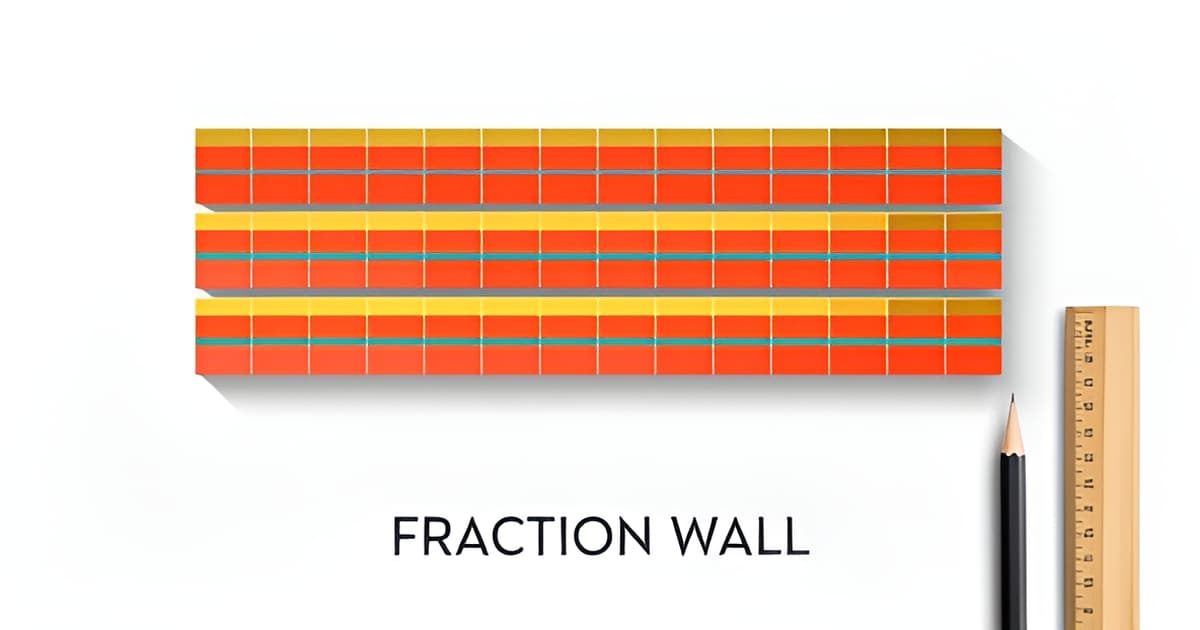
What does a fraction strip look like?
Key Facts
- A standard classroom fraction strip set stacks 9 rows, the whole plus halves through twelfths, all exactly the same length, according to this overview of fraction strip basics.
- Every fraction strip row shares a left edge and total width drawn to exact scale, so 1/2, 2/4, and 3/6 end at the same spot, per design documentation for fraction strip generators.
- In a peer-reviewed study of nearly 200 Australian primary teachers, fraction bars ranked among the most preferred manipulatives for teaching fraction concepts, published in the Journal of Mathematics Teacher Education.
- Blank, mixed-up fraction strips promote deeper learning than labeled ones because students must reason which bar represents which fraction, according to Ignite Learning Company.
- Fraction strips are length models, not area models, unlike pizza drawings, they show fractions as distances along one shared whole, per SpecialEdNews.
- A distinct color per denominator row, like purple halves and orange fourths, helps students organize their thinking, per Mashup Math's printable guide.
- Cardstock and lamination are the gold standard for durable strips, and pre-cut sets remove fine-motor barriers for all students, recommends Understood.org.
Why Fraction Strips Confuse at First Glance (and What They Actually Are)
If you've ever searched "what does a fraction strip look like" and gotten back a jumble of colored bars, blank tiles, and something called a "fraction wall," you're not alone. Fractions are inherently abstract, and the images that come back from a quick search don't all agree, which makes a simple tool feel more complicated than it is.
Strip away the variations and the core visual is consistent. A fraction strip set is a collection of rectangular bars, all exactly the same total length, where each bar is divided into a different number of equal segments: one bar for the whole, then halves, thirds, fourths, and so on, stacked into rows beneath it. According to design documentation for fraction strip generators, the standard layout places the "1 whole" strip at the top, with each row beneath it matching that total length exactly.
That stacked arrangement is called a fraction wall, and it's the version most teachers recognize. A typical classroom set includes the whole plus rows for halves, thirds, fourths, fifths, sixths, eighths, tenths, and twelfths, nine rows in all, as described in this overview of fraction strip basics. You'll also hear the tool called fraction bars, fraction tiles, or tape diagrams, which adds to the first-glance confusion.
Here's what makes the design work: every row shares a left edge and total width, drawn to exact scale. That alignment is the whole point. Because the rows are proportional, equivalent amounts line up at the same horizontal position, so a student can see that one-half, two-fourths, and three-sixths all end at exactly the same spot. It's equivalence shown as "the same length, split differently" rather than a memorized rule.
Fraction strips are also a specific type of model, and knowing the type helps you read any image you find. They're length models, not area models like pizza or pie drawings. Unlike Cuisenaire rods, where each rod has a different length, every fraction strip row partitions the same whole length, which is what makes the horizontal comparisons possible.
If you're designing your own set, the key visual decisions are straightforward:
- Denominator range: generators typically support rows from the whole (1) through twelfths, so you can print a full wall or a compact starter set.
- Labels on or off: labeled strips work as a teaching reference; blank strips push students to reason about which row represents which fraction.
- Color coding: a distinct color per row (say, purple halves, blue thirds, orange fourths) helps students organize their thinking, per Mashup Math's printable guide.
- Cut lines: clear lines between segments let students cut rows into unit fractions and reassemble them.
Printoodle's fraction strips tool and fraction chart generator let you toggle these options, so you can print a labeled color wall for your reference wall and a blank black-and-white version as a worksheet. The format you choose depends on the job: labeled and organized for demonstration, blank and mixed-up when you want students doing the thinking.
The Design Choices That Change How a Fraction Strip Looks
The first thing you notice about a well-designed fraction strip set is the rectangular length model: every bar stretches to the exact same total length, representing one whole, while each subsequent row divides that length into a different number of equal segments. Research into visual design variables confirms that a typical classroom set runs from the "1 whole" strip at the top down through rows of halves, thirds, fourths, fifths, sixths, eighths, tenths, and twelfths, covering a denominator range of 1 to 12. A peer-reviewed study of nearly 200 Australian primary teachers found that while the set model was most preferred for teaching fractions generally, the rectangle model came a close second, and teachers consistently showed a high preference for using fraction bars manipulatives across several concepts.
This structure creates a natural pedagogical tension that customization tools must balance. Labeled strips, where each piece displays “1/n,” serve as efficient teaching references; a student can simply look at the label to identify the fraction. However, removing those labels forces a different cognitive process. When strips are blank, students must reason which bar represents the target fraction, engaging in critical thinking and experimentation rather than passive label-matching. The same research notes that organized, color-coded walls help students keep track of which row they are on, but blank-and-mixed-up sets push learners to construct their own understanding of part-whole relationships. Printoodle’s fraction strips and fraction chart tools address this divide by offering both labeled reference versions and blank worksheet formats, letting educators toggle between guided instruction and independent reasoning.
Beyond labeling, visual design choices like color coding and shading further shape how the strips function in a lesson. A common color scheme assigns distinct hues to each denominator row, purple for halves, blue for thirds, orange for fourths, which helps students organize their thinking and avoids confusion when comparing equivalent fractions. Shading features allow a specific fraction, such as 3/4, to be highlighted by coloring the first three segments of the fourths row, making equivalence lessons intuitive. Printable formats typically fall into three categories: color (for quick row identification), black-and-white (so students can add their own palette), and blank (requiring students to label and shade themselves). Clear cut lines between unit segments are also essential for cut-apart activities, where students reassemble pieces to build new fractions, a practice recommended for grades five through six.
For teachers planning repeated use, durability matters. Cardstock and lamination are the recommended materials to withstand frequent handling, and printables should remain legible when projected onto a classroom screen. Printoodle’s free-reprint library model naturally supports this workflow, allowing educators to regenerate and reprint strips as needed without additional cost. Whether you need a compact classroom starter set or a full-color wall poster, the design variables, denominator range, label toggles, color coding, and shading, give you control over how the fractions look and how students interact with them.
Explore the design options yourself with Printoodle’s fraction chart and fraction strips generators, and see how labeled, blank, and color-coded versions can fit your next lesson.
How to Design Your Own Fraction Strips with Printoodle
If you know what a fraction strip should look like, building your own takes about a minute. The design choices are simple, but each one changes how students use the page.
Start with the rows. A typical classroom set includes one whole plus bars for halves, thirds, fourths, fifths, sixths, eighths, tenths, and twelfths, all the same total length and stacked into a wall. Printoodle's fraction strips tool lets you pick any rows from 1 through 12, so you can print the full set or a compact 1-to-8 starter wall for younger kids. Every row shares the same left edge and total width, which is what makes equivalent fractions line up at the same position.
Next, decide on labels. This is the biggest pedagogical fork in the road. Labeled strips work well as a reference for the wall or a handout, since students can find "1/4" instantly. But blank strips push deeper thinking: when students have to figure out which bar represents which fraction, they experiment and reason instead of just reading a label. That's why the smart move is to generate both versions. Print a labeled set for the front of the room and a blank one for the worksheet, and you've covered both use cases in seconds.
Then choose your output style:
- Color helps students identify each row quickly and organize their thinking, since a distinct color per denominator reduces confusion.
- Black-and-white prints cheaply and lets students color each row themselves, which doubles as a labeling activity.
- Blank output leaves both labels and color to the student, the format best suited to shading and discovery work.
For equivalence lessons, use the shading option. Shading the first few segments of a row, say 3/4, and matching it against shaded halves or sixths turns "1/2 = 2/4 = 3/6" into something students can see rather than memorize. A good fraction chart works the same way for whole-wall comparisons.
A few practical tips before you print. Print on cardstock or laminate the sets you plan to reuse, since both are recommended for repeated classroom handling. If students will cut the strips into unit pieces and reassemble them, make sure the segment lines print clearly. And because Printoodle keeps everything you generate in a library with free reprints, replacing a chewed-up set mid-semester costs nothing.
One last note on classroom research: a peer-reviewed study of nearly 200 Australian primary teachers found that model choice should match the specific fraction concept being taught, and teachers showed a strong preference for fraction bars as a manipulative. Having both the labeled and blank versions ready means you can match the strip format to the task instead of the other way around. Print it, doodle it, done.
Printing, Cutting, and Making Your Strips Last
Setting up your fraction strips for classroom use starts with choosing the right material. Research shows that cardstock and lamination are the gold standard for durability, with Understood.org recommending a few laminated sets for repeated student use. For teachers managing fine motor challenges, pre-cut sets remove the barrier of cutting individual segments, ensuring every student can participate in the manipulative experience.
When printing from a customization tool, keeping clear cut lines between segments is essential. The design should allow students to cut the strips into unit fractions and reassemble them, a hands-on activity proven effective for grades 5–6. Visual design options like shading toggles further support this, letting educators highlight specific fractions such as 3/4 to build equivalence lessons without memorized rules.
Legibility is just as important as durability. Printables must remain clear when projected onto a whiteboard, ensuring the entire class can reference the strip geometry regardless of seating. Printoodle’s free-reprint library means worn-out sets are never a permanent problem, teachers can simply regenerate a fresh PDF from their library, maintaining a consistent visual reference year after year.
Color coding serves a practical purpose beyond aesthetics. Educational sources note that a distinct color per denominator row helps students organize their thinking and avoid confusion when comparing fractions. Whether using a full color set for quick identification or a black-and-white version for students to shade themselves, the printable format should match the lesson objective.
Printoodle’s fraction chart and fraction strips tools give educators control over these variables. With options to toggle labels on or off, select denominator ranges from 1 to 12, and choose between color, black-and-white, or blank outputs, the platform addresses both the reference and worksheet use cases identified in classroom research. Start designing your set today and see how a simple printable can transform fraction instruction.
Frequently Asked Questions
What does a fraction strip actually look like?
Why are fraction strips sometimes called fraction bars or tiles?
Should fraction strips have labels or be blank?
How does color coding help when using fraction strips?
Can I design my own fraction strips with specific denominator ranges?
What materials are best for making fraction strips last longer in the classroom?
Mastering the Fraction Wall: From Confusion to Clarity
At first glance, the jumble of colored bars and fraction walls can make a simple tool feel intimidating, but understanding the core design, rectangular length models stacked to exact scale, reveals their true power. By aligning every row to the same total length and left edge, fraction strips turn abstract equivalence into a visual "same length, split differently" experience that students can grasp intuitively. Whether you need a labeled reference wall for quick identification or a blank worksheet to push deeper reasoning, the right design choices, denominator range, color coding, and shading options, make all the difference in the classroom. As research confirms, having both labeled and blank versions on hand lets educators match the format to the specific learning task rather than forcing a one-size-fits-all approach. Ready to see how these visual tools can transform your next lesson? Print it. Doodle it. Done.