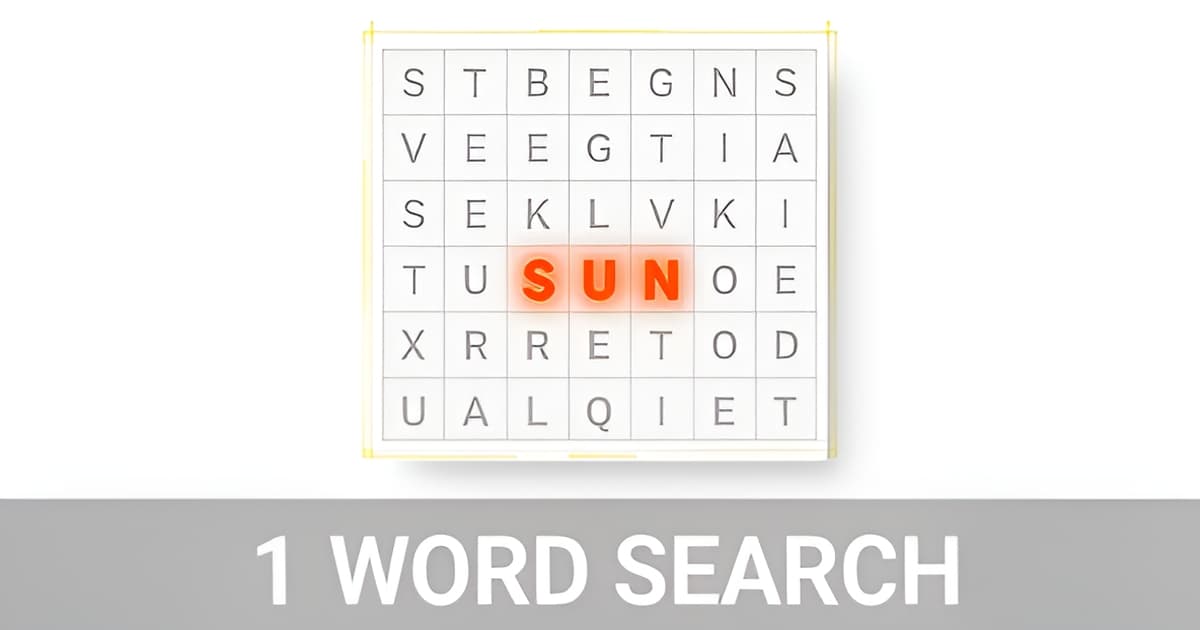
What is a 1 word word search?
Key Facts
- No dictionary or puzzle authority officially defines a "1 word word search", it's a minimalist twist built from the standard grid format per Cambridge's baseline definition.
- Word searches first appeared in 1968, credited to Norman E. Gibat via the Selenby Digest according to the puzzle community encyclopedia.
- Hidden words must contain a minimum of three letters and can run in any direction, forward or backward per classic puzzle-building guidance.
- Editors expect at least 75 percent of a puzzle's letters to be part of the solution, frowning on too much empty space according to construction standards.
- A typical 15x15 grid holds 30-40 words, a one-word puzzle in that footprint turns every other letter into deliberate decoy filler per standard grid sizing.
- Building a puzzle by hand takes about 45 minutes, while generators do the job in roughly 90 seconds according to teacher tool comparisons.
- Solvers can speed up by hunting rare letters like J, K, Q, X, and Z, which mark the answer's path per puzzle community tips.
The Puzzle Nobody Officially Defined (And Why That's Fine)
The phrase “1 word word search” doesn’t appear in any dictionary or puzzle authority’s index. It’s a minimalist twist on a format that has been played by the rules since 1968.
The Cambridge Dictionary defines a word search simply: “a word puzzle (= type of game) in which letters are written in a grid and you have to find words made by these letters, following the lines in any direction.” That baseline, letters in a grid, words findable horizontally, vertically, or diagonally, is all the framework needed to build a one-word variant. The result is a grid of filler letters hiding exactly one target word instead of the usual list of 10 to 40.
The format’s origin story supports this minimalist extension. Word searches first appeared in 1968, credited to Norman E. Gibat via the Selenby Digest. Gibat’s original design philosophy was to “create a puzzle that could be solved in line at a supermarket”, quick, low-barrier entertainment. A one-word version fits that DNA naturally; it is a puzzle designed to be solved in moments, not minutes.
Research into construction rules confirms what a valid one-word puzzle looks like. Mother Earth News notes that words must contain a minimum of three letters and can run in any direction, forward or backward. Editors generally frown on too much “empty” space, recommending that at least 75 percent of the grid’s letters be part of circled words. Typically, a 15x15 grid holds a list of 30 to 40 words; a one-word puzzle in the same footprint would leave the remaining cells as deliberate filler, turning the solve into a focused search rather than a scavenger hunt.
Word lists are standard but not mandatory. The Puzzles Wiki observes that writers can “choose to obfuscate their word lists, or remove them entirely, in order to create a puzzle that requires more thought.” A one-word search is the logical extreme of that flexibility: instead of hunting down a list, the solver identifies a single word embedded in a sea of letters.
Printoodle’s word search maker can produce this format by design. Users enter a single word, a child’s name for a birthday kit, a vocabulary term for early learners, or a themed word for a rainy-day activity, and the tool generates a print-ready PDF. The same interface that creates standard lists can generate a one-word grid in seconds, a speed advantage the research highlights: generators cut creation time from roughly 45 minutes by hand to under 90 seconds.
Theming is well-established in the format, and themed one-word puzzles feel like a natural fit. Cambridge and Mother Earth News both note that word searches are commonly built around themes, holidays, hobbies, jobs. A single themed word can serve as a quick “puzzle of the day” or a personalized name hide for party kits. It is a purposeful micro-activity rather than a time filler, echoing educator guidance that word searches are most motivating when used sparingly and with intention.
- Start with a word containing rare letters, J, K, Q, X, or Z, to give the grid character and avoid obvious patterns.
- Aim for at least 75 percent of the grid letters to be part of the hidden word or its surrounding filler, minimizing “empty” space.
- Keep the target word 3+ letters minimum, per standard word search construction rules.
- Use the word search maker to generate a print-ready PDF in under two minutes.
A one-word word search isn’t a new category so much as a deliberate constraint. It strips the format down to its core: a grid, a goal, and one word to find. For parents, teachers, and party hosts looking for a quick, personalized activity, it offers the familiar satisfaction of a word search in a package that takes seconds to solve, and even faster to print.
word search maker to build a custom puzzle in seconds, or browse our printable word search collection for ready-to-print themes.
What Makes a One-Word Word Search Actually Work
A grid full of letters with exactly one word hiding in it sounds like the easiest puzzle you could build. In practice, it's one of the trickiest formats to construct well, because every design choice you make either gives the answer away or buries it so deep nobody bothers looking.
The construction standards come from the same rules that govern any word search. The hidden word needs at least three letters, and it can run horizontally, vertically, or diagonally, spelled forward or backward, according to classic puzzle-building guidance from Mother Earth News. A one-word puzzle simply applies those rules to a single entry.
The catch is the filler. With only one word hidden, every other letter in the grid is decoy text, and those decoys can betray you in two directions. Filler letters that cluster carelessly can accidentally spell near-words that send solvers chasing ghosts. Worse, if the filler follows an obvious pattern, the real word pops out instantly. As Mother Earth News warned back in 1983, it takes only one wrong letter to completely ruin a puzzle.
There's a quality bar, too. Editors expect at least 75 percent of a finished puzzle's letters to belong to the solution, and they frown on too much empty space. A one-word grid can't hit that ratio literally, so the skill shifts to making the filler feel genuinely random rather than sparse.
If you're on the solving side, the puzzle community offers a shortcut: start hunting for rare letters like J, K, Q, X, and Z. Constructors fill gaps in the grid based on how often letters normally appear, so rare letters stand out and mark the answer's path.
For constructors, the essentials look like this:
- Hide one word of three or more letters, running in any direction.
- Randomize filler so it doesn't accidentally spell near-words or reveal patterns.
- Consider dropping the word list entirely, which puzzle writers do to demand more thought from solvers.
- Keep the grid small enough that one word stays findable but not obvious.
That last construction point matters most here. Word lists are almost always present in newspaper word searches, but writers can remove them entirely to force real searching. A one-word puzzle with no word list is the natural extreme of that idea: the solver knows something is hidden, and that's all they get.
Building one by hand still takes real care, since every filler letter needs a second look. A tool like Printoodle's word search maker handles the randomization for you: enter a single word, a name, or a birthday term, and download a print-ready PDF. If you'd rather browse finished options first, the printable word search collection shows how a minimalist grid looks on the page before you build your own.
When a Single Hidden Word Beats a Full Puzzle
Why hide thirty words when one will do the job? The one-word word search strips the format down to its most useful core: a grid of letters with exactly one hidden word, findable in any direction, just as the Cambridge Dictionary definition describes for word searches generally. It's a puzzle you can solve in under a minute, which is precisely the point.
Three situations where a single word works better than a full list:
- A birthday activity kit with the child's name hidden inside. One name, one grid, and suddenly the puzzle is about *them*. Word searches have always leaned on themes, from gardens to holidays, so a name-based grid is a natural fit.
- A 30-second focus exercise for early learners. Hide one vocabulary word and the puzzle becomes a quick spelling reinforcement, not a marathon. Construction rules still apply: the hidden word needs a minimum of three letters, per classic puzzle-building guidance.
- A themed rainy-day micro-puzzle. One seasonal word, one small grid, one satisfying circle at the end. It fills five quiet minutes without demanding forty.
The honest question, of course, is whether word searches belong in learning at all. Some schools have dismissed them as low-rigor time fillers, and that criticism isn't baseless. But experienced teachers push back. Matt and Tara, educators with over 20 years in the classroom, put it plainly in their reflection on classroom word searches: "Word search puzzles, by themselves, do not provide the level of rigor we like to maintain," yet "when used sparingly, word search puzzles have been very motivating for my students." They even recommend a highlight-and-circle technique as a quick vocabulary check.
That's exactly where the one-word version earns its place. It's the "used sparingly and purposefully" principle built into the format itself. You can't pad thirty minutes with a puzzle that takes thirty seconds; you use it as a warm-up, a transition activity, or a small win for a struggling reader, and the word gets circled, spelled, and remembered.
The practical barrier used to be construction. Hiding even 12 words by hand takes about 45 minutes, according to teacher-focused tool comparisons, while a generator does the same job in roughly 90 seconds. A one-word puzzle collapses that to nearly nothing: enter a single word, and the grid fills itself. Printoodle's word search maker handles it the same way it handles full lists, and every printable word search comes out as a clean, print-ready PDF you can reprint as often as you like.
One word, one grid, one purpose. Sometimes the smallest puzzle is the one that actually gets used.
How to Make a 1 Word Word Search in Under Two Minutes
Hiding a single word by hand is faster than hiding twelve, but it still takes longer than most people expect. Puzzle constructors report that manually building a 12-word puzzle takes about 45 minutes, and a one-word version still demands careful filler placement so the grid doesn't look empty. Editors of traditional puzzles "frown on too much 'empty' space," and they like at least 75 percent of a solution's letters to be part of real words. With one hidden word, that balance is tricky to eyeball.
A generator solves that problem in about 90 seconds. Here's how to make a 1 word word search with Printoodle's word search maker:
- Enter one word. A child's name for a birthday kit, a single vocabulary term for an early reader, or one themed word as a quick puzzle-of-the-day. Just remember the format's floor rule: hidden words need a minimum of three letters.
- Pick your grid size. A 10x10 grid is the recommended preset for elementary-level puzzles, so it's a sensible default for a single short word.
- Choose directions. Words can run horizontally, vertically, or diagonally, forward or backward. For young kids, stick to horizontal and vertical; for a harder challenge, allow diagonals and reversals.
- Export the PDF. You get a print-ready file in Letter or A4, ready to print at home or school.
Once your puzzle is made, it lives in your library, so reprints are always free. That matters more than it sounds. If you're a teacher using the puzzle as a quick vocabulary warm-up (the kind educators say works well "when used sparingly"), you can reprint a fresh copy for each class without rebuilding anything. If you're a party host, you can print extra copies when three more kids show up. Every puzzle also comes with an answer key, which saves you from re-solving your own grid to check a student's work.
For a zero-effort starting point, grab a sample from the printable word search page and see the format before you generate your own. Then swap in your word. Print it. Doodle it. Done.
Frequently Asked Questions
What is a 1 word word search?
How long should the hidden word be in a one-word word search?
Is there a word list in a one-word word search?
How do I solve a one-word word search faster?
Are one-word word searches good for learning, or just time fillers?
How do I make a one-word word search quickly?
One Word, One Grid, One Small Win
So, what is a 1 word word search? It's a minimalist twist on a classic format: a grid of letters hiding exactly one word instead of the usual list of 30 to 40. It follows the same rules that have governed word searches since Norman E. Gibat's original 1968 design, a hidden word of at least three letters, running in any direction, but strips the solve down to seconds rather than minutes. That makes it ideal for birthday kits with a child's name, quick vocabulary warm-ups, or a five-minute rainy-day puzzle, and it sidesteps the "time filler" criticism by being purposeful by design. The practical barrier used to be construction: hiding even 12 words by hand takes about 45 minutes, while a generator does the job in roughly 90 seconds. Printoodle's word search maker handles the one-word version the same way, enter a single word, export a print-ready PDF, and reprint from your library free, forever. Curious how a minimalist grid looks on the page? Browse the printable word search collection for a free sample, then swap in your own word. Print it. Doodle it. Done.