What is a fun game to teach place value?
Key Facts
- Non-digital board and dice games produce a large effect size of 1.032 on primary math outcomes, more than double digital games' 0.436, according to a meta-analysis.
- A four-week study of 51 second graders found game-based place value learning beat conventional instruction while students reported having fun, per peer-reviewed research.
- Place value boards with concrete materials only work when adults explicitly link the materials to number-system structure, an action research study found.
- Place Value Yahtzee offers five differentiated versions spanning 3-digit numbers through decimals, its teacher-creator explains.
- One classroom rule forces real comprehension: students must read their number aloud correctly to earn any point, per Games 4 Gains.
- Third graders cracked a secret 3-digit number in just eight guesses playing Digit Place, a classroom teacher reports.
- Promoting home-school connections is one of six research-backed principles of educationally rich math games, according to Frontiers in Education.
Why Place Value Is Where Math Wins or Loses
You have likely seen it happen: a child can rattle off the digits one through nine, but when asked to build the number forty-seven, they freeze. This is the place value gap, where memorization ends and number sense begins. It is the moment math shifts from counting to calculating, and for many students, it is where confidence stalls. Research confirms that place value is the bedrock of all later arithmetic; without a firm grasp of it, every addition and multiplication problem that follows becomes a struggle. As the WeAreTeachers resource emphasizes, if you are going to understand our number system, and everything based on it like addition, subtraction, multiplication, and so on, you have to understand place value first. The good news is that hands-on, physical activities dominate effective teaching. A meta-analysis cited in Frontiers in Education found that non-digital games, including board and dice games, produce a large effect size of 1.032 on primary math outcomes, significantly outperforming digital alternatives with a small effect of 0.436. This data directly supports the use of printable, tactile games over worksheets alone.
A peer-reviewed action research project further validates the format of the place value board. When students use concrete materials on a board to explore the number system’s structure, their understanding deepens, but only if the links between the materials, the activities, and the number system are made explicit. Games like Place Value Yahtzee and Digit Place leverage this principle by turning abstract concepts into concrete challenges. Brittney Field, a classroom teacher, notes that the best games use familiar mechanics so students can jump in quickly, allowing more time for math and less time for rules. She also recommends a built-in comprehension check: before earning a point, students must read their number aloud correctly. If they cannot read it, they do not earn the point, ensuring that practice remains meaningful.
The research also highlights that implementation quality matters. Games do not automatically produce positive outcomes; the teacher’s role in guiding the connection between the game and the number system is critical. However, the data is clear: students engaged in these activities report having fun, and teachers view them as highly effective for developing fluency, understanding, problem-solving, and reasoning. Differentiation is also built into many of these designs. For example, Place Value Yahtzee offers five differentiated versions ranging from 3-digit numbers to decimals, while Digit Place can be modified from 2-digit to 4-digit challenges to meet students where they are.
A printable place value board game bridges the gap between abstract digits and concrete understanding. It transforms the “I don’t get it” moment into an “I got it” victory by letting students physically move markers, group items, and see the value of each digit. This format is naturally suited for both classroom centers and family game night, reinforcing skills in multiple environments.
Printoodle makes it easy to create this resource in seconds. You can generate a place value chart or a family trivia game tailored to your lesson objectives. Print it, doodle it, and watch number sense click into place.
The Research Case for a Fun Game to Teach Place Value
The research is clear: when it comes to teaching place value, how you play matters as much as what you play. A peer-reviewed study of 51 second-grade students over four weeks found that game-based learning led to better understanding and higher motivation than conventional instruction, with students reporting they actually had fun in the process. This aligns with a broader meta-analysis that compared non-digital and digital games for primary math outcomes, finding non-digital games, board, dice, and card games, produced a large effect size of 1.032, while digital games came in at a small 0.436. The data suggests that a simple, printable board game using concrete materials can deliver stronger results than a screen-based alternative.
What makes a printable format particularly effective? Research into the "base ten game" found that students using a place value board and concrete materials developed a stronger grasp of the number system, but only when the links between the materials, the activities, and the structure of our number system were made explicit. In other words, the board itself isn't a magic solution; it's the intentional pairing of physical movement with conceptual understanding that drives the gain. This is why games that use familiar mechanics see faster adoption; students spend less time learning the rules and more time practicing the math. As one teacher noted, when a game feels familiar, students can "jump in much more quickly" and focus on the skill at hand.
A successful place value board game also builds in comprehension checks so that play doesn't outpace learning. One expert recommends that before a player earns a point, they must read their constructed number aloud correctly. If the number can't be read, the point isn't awarded, regardless of how large the value is. This simple rule ensures that the game remains a tool for understanding, not just a race to the finish. For families or classrooms looking to extend the learning beyond school hours, a printable format makes it easy to send a board home, turning a single lesson into a home-school connection that reinforces concepts through repeated, meaningful practice.
If you're looking to create a customized place value board that fits your classroom or family game night, Printoodle offers a place value chart tool that generates print-ready PDFs in seconds. You can also explore a family trivia game for a different style of at-home math fun. Print it. Doodle it. Done.
How to Play: A Printable Place Value Board Game That Works
The best part about this game is how fast kids pick it up. Teacher Brittney Field found that when a game uses familiar mechanics, "students could usually jump in much more quickly," which means more minutes spent on actual math practice and fewer spent explaining rules (Games 4 Gains).
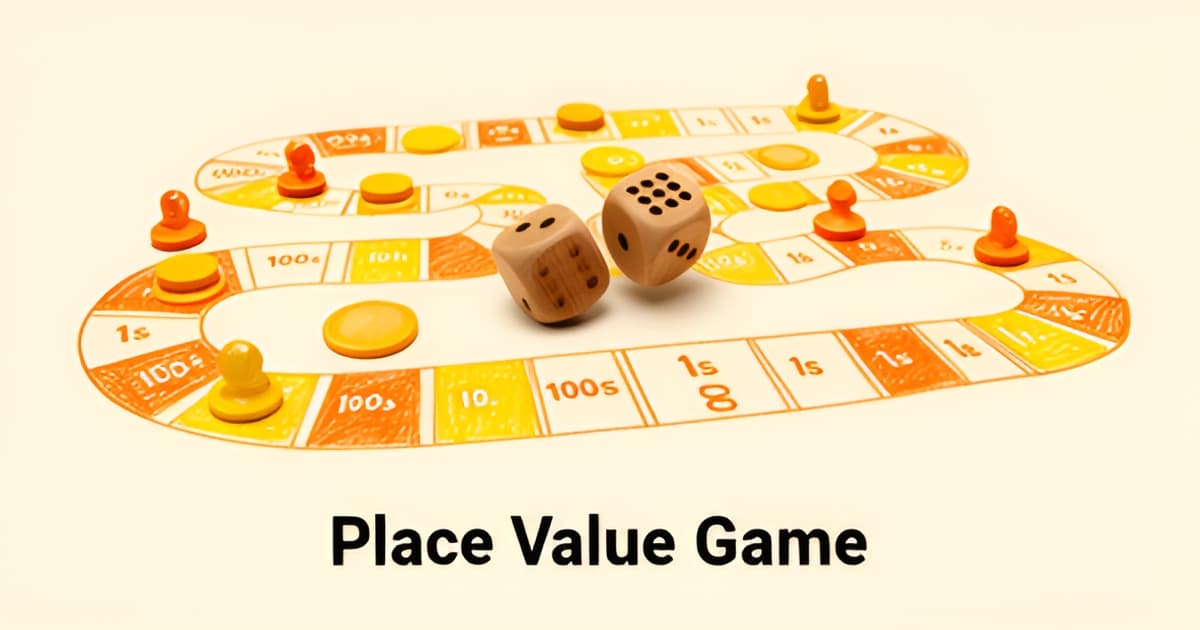
Here's the setup. Print a game board with a row of blank place value columns and give each player one die per column. On a turn, a player rolls all their dice at once, then arranges them into the columns to build the biggest (or smallest, or oddest) number possible. Score one point for the round's winning number. First player to a set number of points takes the game. Because it borrows the roll-and-rank rhythm of Yahtzee, most kids recognize the pattern within a round or two.
One rule does the heavy lifting for comprehension: before earning a point, the player must read their number aloud correctly. Field is blunt about why it matters: "If they can't read it correctly, they don't earn the point, even if their number is the greatest!" (Games 4 Gains). This single rule guards against the biggest documented risk of hands-on math games, which is that materials alone don't build understanding unless you explicitly connect them to the structure of the number system (ERIC-indexed classroom research).
Differentiation is where a printable board really earns its keep. The same game stretches across grade levels with a quick change to the board:
- 2-digit boards for first and second graders still solidifying tens and ones
- 3- and 4-digit boards for the core elementary years, matching the five differentiated versions Field's version offers, from 3-digit up through decimals
- 5- and 6-digit boards for older students ready to reason about ten thousands and hundred thousands
Keep a place value chart next to the board as a reference. Kids who hesitate mid-read can glance over, anchor each digit to its column, and get back to playing independently, which keeps the game moving instead of stalling on a correction.
The format itself has research behind it. A meta-analysis found non-digital games, meaning board, dice, and card games, had a large effect size of 1.032 on primary math outcomes, compared with 0.436 for digital games (Frontiers in Education). That's a strong argument for keeping this one on paper. And because printable games travel home easily, they double as a family game-night activity, one of the six research-backed principles of educationally rich math games. If you want a change of pace on the same night, a family trivia game rounds out the rotation nicely.
Print the board, grab the dice, and you're playing within five minutes.
Making It Stick: Play Rules, Home Nights, and Honest Limits
A printable game on the kitchen table doesn't teach place value by itself. The research is clear on this point: games don't automatically produce learning gains, because implementation quality and curriculum relevance matter just as much as the game itself, according to a meta-analysis of math game research. What turns a board game into a lesson is the conversation happening around it.
That conversation starts with the materials. An action research study on the "base ten game" found that a place value board with concrete materials works well, but only when adults explicitly connect the materials to the structure of the number system. Moving a bean from the tens column to the ones column means nothing unless someone says out loud what just happened to the number. Build that talk into your rules:
- Before a player earns any points, they must read their number aloud correctly. Teacher Brittney Field uses this rule in Place Value Yahtzee: if a child can't read the number, they don't score, even when their number is the biggest at the table (Games 4 Gains).
- Ask "what changed?" whenever a digit moves columns, so the physical action maps onto the number's structure.
- Keep a place value chart next to the board as a shared reference both players point to during turns.
- Scale the difficulty to the child: start with 2-digit numbers and extend toward thousands as confidence grows, the same way Digit Place adapts from 2-digit to 4-digit secrets (Jillian Starr Teaching).
Be honest with yourself about limits, too. In a study of 51 second graders, game-based learning beat conventional instruction over four weeks, and students reported having fun, yet a few children still preferred traditional teaching. Some kids genuinely like worksheets and quiet repetition. Treat the game as a supplement in your rotation, not a replacement for whatever already works for your child.
The good news is that a printable game does double duty as a home-school connector. Promoting home-school connections is one of the six research-backed principles of educationally rich math games, and a printed board travels easily between classroom and kitchen table. If you want to build a fuller family game night around math, Printoodle's family trivia game makes a natural companion: a few rounds of place value, then a round of trivia everyone can join.
Here's the practical takeaway. The evidence favors your laminated board and dried beans over any app: non-digital games showed a large effect size of 1.032 on primary math outcomes, versus 0.436 for digital games. The format matters. The talk around the table matters more. Print the game, set the rules that force kids to read and explain their numbers, and let the play do the teaching.
Print it. Doodle it. Done. Generate your place value board game and print it tonight.
Frequently Asked Questions
What is a fun game to teach place value that actually works?
Do board games really teach math better than math apps?
Are hands-on place value games enough on their own, or do kids need more?
How can I make a place value game easier or harder for different ages?
What's the one rule that makes a place value game actually teach something?
My child prefers worksheets, should I still push games?
Print It Tonight, Play It Tomorrow, Watch Number Sense Click
So, what is a fun game to teach place value? The evidence points to something delightfully low-tech: a printable board, a handful of dice, and rules that make kids read their numbers aloud. Non-digital games produced a large effect size of 1.032 on primary math outcomes in a peer-reviewed meta-analysis, more than double the impact of digital alternatives. The winning formula is simple: familiar mechanics so play starts fast, a read-it-to-score-it rule so practice stays meaningful, and plenty of conversation connecting dice to digits. Scale the board from 2-digit to 6-digit challenges as confidence grows, and send a copy home so family game night doubles as math practice. With Printoodle, you can generate a place value chart to keep beside the board, or round out the evening with a family trivia game. Print it, doodle it, done, tonight's printout is tomorrow's "I got it" moment.