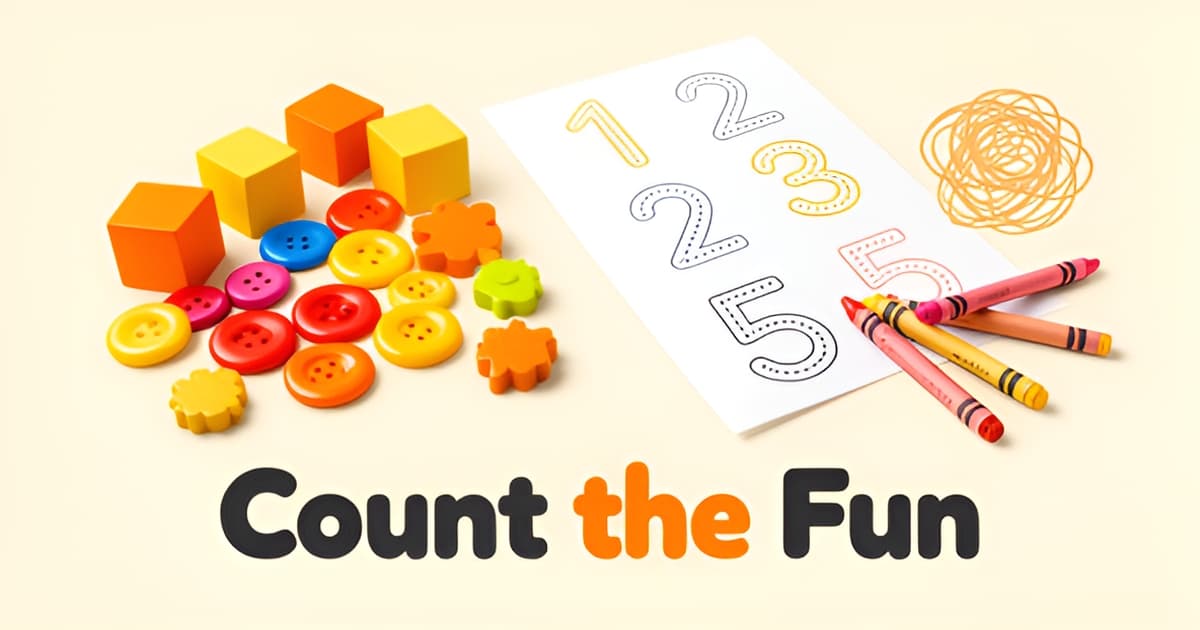
What is a fun way to teach numbers?
Key Facts
- Many kindergartners can count to ten without understanding that each number represents a quantity, according to Understood.org.
- Children's math knowledge at school entry is the strongest predictor of later academic success, per an NCBI study cited by SplashLearn.
- One educator has cataloged more than 100 hands-on number activities for preschoolers, reports Fun Learning for Kids.
- Teaching the numeral, number name, and a matching set of objects together builds real number sense, an evidence-based strategy from Understood.org.
- Hopscotch, number line jumping, and count-and-jump games recur as top kinesthetic ways to teach numbers, according to SplashLearn.
- Early numeracy skills are powerful predictors of school-age mathematical learning and performance, research cited by SplashLearn shows.
- Seasonal themes like winter, fall, and holidays keep kids engaged in number practice year-round, notes Fun Learning for Kids.
Why Counting Isn't the Same as Understanding Numbers
Your four-year-old counts to ten perfectly at the dinner table, and you feel a flash of pride. Then you ask for "three crackers" and they hand you a random handful. If you're wondering what is a fun way to teach numbers that actually builds understanding, this gap is exactly where to start.
According to Understood.org, many students start kindergarten already knowing how to count to ten, but they don't always understand that each number they're saying is a quantity. Reciting "one, two, three" is memory work, like learning a song. It tells you nothing about whether a child grasps that "four" means a set of four things, whether that's crackers, blocks, or fingers.
The stakes here are higher than most parents realize. Research cited by SplashLearn, drawing on an NCBI study, found that children's mathematical knowledge at school entry is the strongest predictor of their later math success, and even of success in other academic areas. In other words, the number sense your child builds before kindergarten ripples across their entire school career.
That's what makes the counting gap so sneaky. A child who can recite numbers looks ready for math. Teachers and parents see the performance and assume the understanding is there. But memorized counting can mask a genuine number sense gap, one that only shows up later when the child hits real math work and can't connect symbols to quantities.
The fix, according to the evidence, is teaching numbers through multiple representations at once. Understood.org recommends pairing three things together so a child sees them as one concept:
- The numeral itself, like the written "5"
- The number name, "five," spoken aloud
- A picture or set of objects that shows the quantity
When a child counts five apples, says "five," and sees the numeral 5 on the same page, the abstract symbol finally has meaning. Hands-on practice matters here too. As Fun Learning for Kids puts it, the best way for kids to learn numbers and practice counting is with fun, hands-on activities, and the site catalogs more than 100 of them.
This is also why worksheets built around quantity, not just sequence, are worth their weight. A page that asks a child to circle sets of six, sort even and odd numbers, or match numerals to pictures does something a counting song can't. Printoodle's customizable templates make it quick to generate exactly that kind of quantity-focused practice, so you're reinforcing real understanding rather than another round of rote recitation.
What Makes Number Lessons Actually Fun (and What Works)
Ask a teacher what actually gets kids excited about numbers, and you'll rarely hear "worksheets." You'll hear hopscotch. When Fun Learning for Kids cataloged its collection of number activities, the site listed more than 100 hands-on activities, and its author put it plainly: "the best way for kids to learn numbers and practice counting is with fun, hands-on activities" (Fun Learning for Kids).
The pattern across the research is movement. SplashLearn's review of preschool number activities found that physical engagement shows up again and again: hopscotch, number line jumping, ladder climbing, count-and-jump. That's kinesthetic learning at work, and it points to a clear answer for anyone asking what is a fun way to teach numbers: get kids moving while they count, and the numbers stick.
But fun alone isn't the whole story. The most useful framework comes from Understood.org, which highlights a common gap: many kindergartners can recite "one, two, three" up to ten without understanding that each word represents a quantity. Their evidence-based strategy teaches three representations of the same quantity:
- The numeral itself (7)
- The number name ("seven")
- A picture or set of objects (seven dots, seven blocks)
Using physical objects and pictures alongside numerals, Understood.org notes, helps students practice stable order and one-to-one correspondence, the foundations of real counting. That's why the best activities pair a number with something kids can touch, move, or jump onto.
There's a practical payoff, too. Research cited by SplashLearn shows early numeracy skills are "powerful predictors of school-age mathematical learning," and math knowledge at school entry is the strongest predictor of later success across academic areas, not just math. Fun number practice is high-leverage time.
You don't need to build all of this from scratch. Printoodle's customizable templates let you generate movement-friendly number activities, themed counting pages, and practice sets like even and odd numbers in seconds, so the planning takes minutes and the playing takes the whole lesson.
5 Fun Number Activities You Can Set Up in Minutes
Wondering what is a fun way to teach numbers that doesn't take an hour of prep? The best activities are the ones you can set up in minutes and play for longer. According to one educator who has cataloged over 100 hands-on number activities, the most effective approach combines physical engagement with play, and most of her ideas use materials you already own.
Movement games for gross motor learners. Research consistently shows that kinesthetic learning works: SplashLearn's roundup of preschool number activities highlights hopscotch, number line jumping, ladder climbing, and count-and-jump as recurring favorites. Tape a number line to the floor and have your child jump to the number you call out. It's that simple, and it builds one-to-one correspondence while they burn energy.
Seasonal and themed counting. Themed activities keep number practice fresh all year. Fun Learning for Kids organizes its activities around winter, fall, spring, summer, and holidays precisely because themes sustain engagement. Rotate your counting objects to match the season: leaves in fall, snowflakes cut from paper in winter, seashells in summer.
Games that pair numerals with object sets. This one matters most. As Understood.org's evidence-based strategy explains, many children can recite "one, two, three" without grasping that each number is a quantity. Their fix is teaching three representations together: the numeral, the number name, and a set of objects. Try these quick setups:
- Number hunt: hide numeral cards around the room, then have your child collect that many small objects to match each card.
- Snack sorting: give a numeral card and let your child count out crackers or raisins to build the set.
- Odd-and-even sort: split numeral cards into two piles, then count each set by twos to check.
For that sorting game, Printoodle's even and odd numbers tool generates a customizable set of numeral cards in seconds, so you can print exactly the number range your child is working on and start playing right away. It's a fast way to build a matching game without hand-writing twenty cards first.
The research is clear that early numeracy is worth this effort. NCBI findings cited by SplashLearn show children's math knowledge at school entry is the strongest predictor of later academic success, well beyond math class. A few minutes of playful counting today compounds for years.
How to Generate Custom Number Lessons in Seconds with Printoodle
Finding ways to make numbers feel like play rather than a lesson is a challenge every parent and teacher knows well. Counting drills often fall flat, but the research is clear: hands-on, play-based activities are the dominant and most effective approach for engaging young learners in number concepts. Studies confirm that physical movement combined with number learning, think hopscotch, number line jumping, or ladder climbing, transforms abstract digits into something a child can actually grasp.
The good news is that customizable, print-ready templates are emerging as a practical solution for this exact problem. Rather than spending hours searching for or creating materials that fit a specific theme or skill level, educators and parents can generate tailored number lessons in seconds. Research shows that thematic engagement is a key trend for maintaining interest; activities organized around seasons, holidays, or a child’s specific interests keep them coming back for more. Furthermore, evidence-based frameworks emphasize the importance of connecting a numeral to its name and a corresponding picture or set of objects, a gap that many children experience when they can count but don’t yet understand quantity. By using templates that structure number representation this way, adults can bridge that divide more efficiently.
Printoodle’s platform addresses the prep-time crunch directly. With customizable, print-ready templates, users can generate themed worksheets tailored to a child’s interests or a teacher’s lesson material. The system targets age ranges from 0 to 20 for preschool learners and extends up to 100+ for early elementary, ensuring the complexity matches the developmental stage. A significant time-saver is the free reprints from your library, once a worksheet is generated, it lives there forever, ready to be printed again whenever needed. For those just starting out, the free 10-credit starter tier provides an immediate way to test the service without any upfront cost, allowing you to print, doodle, and see the results immediately.
Print it. Doodle it. Done.
Frequently Asked Questions
My kid can count to ten, but can they actually understand what the numbers mean?
What are some fun, hands-on ways to teach numbers at home?
How can I teach numbers without relying on worksheets or rote memorization?
I'm short on time, are there quick number activities I can set up in minutes?
What if my child can count but struggles to connect numbers to quantities?
Can I generate custom number activities quickly without designing them from scratch?
From Counting Songs to Real Number Sense: Your Next Move
So, what is a fun way to teach numbers? The research points to one clear answer: get kids moving, get their hands on real objects, and always pair numerals with quantities. A child who can recite "one, two, three" hasn't necessarily built number sense, and that gap matters. As SplashLearn's research review notes, math knowledge at school entry is the strongest predictor of later academic success, well beyond math class. The good news is that the fix is genuinely fun: hopscotch number lines, snack sorting, seasonal counting hunts, and games that match numerals to sets of objects. You don't need hours of prep to make it happen, either. Printoodle's customizable templates let you generate quantity-focused number activities, from themed counting pages to even and odd numbers practice sets, in seconds, and every worksheet stays in your library for free reprints. Ready to turn playtime into number sense? Print it. Doodle it. Done.