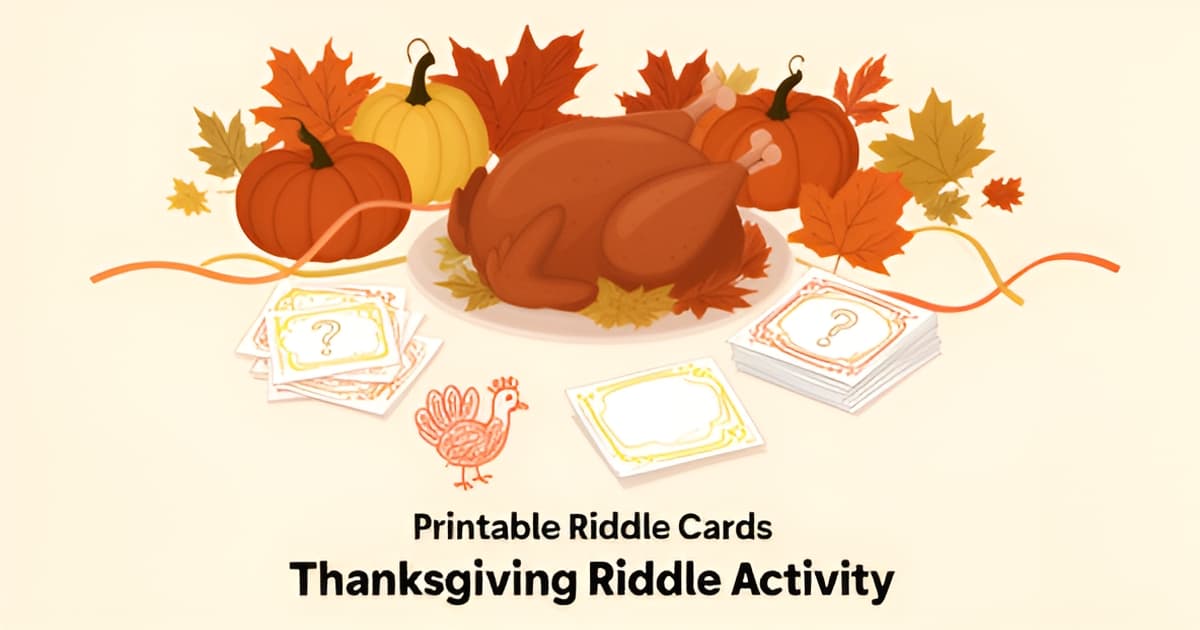
What is a good Thanksgiving riddle?
Key Facts
- Here are 7 compelling key facts extracted and distilled from the research:
- ["Thanksgiving riddles are positioned as screen-free entertainment for kids' tables and post-feast family games, keeping everyone engaged without relying on historical trivia according to parenting blog Mimosas & Motherhood", "Reader's Digest organizes 70 Thanksgiving riddles into four difficulty tiers, kids, adults, easy, and challenging, to ensure mixed-age participation as reported by Reader's Digest", "Mimosas & Motherhood splits 75 riddles into three age tiers: approximately 25 little kids, 25 older kids, and 25 whole family groups per the site's structure", "Two dominant formats drive engagement: short Q&A puns like \"What do you call a turkey the day after Thanksgiving?, Lucky!\" and descriptive \"What am I?\" riddles such as \"I get stuffed and I get dressed on Thanksgiving\" per Reader's Digest research", "Concrete game mechanics like riddle strips in a bowl, team scoring with \"steal\" rules, and place-setting conversation starters are validated across multiple parenting and activity blogs as noted by Mimosas & Motherhood", "The distinction between riddles and trivia is key: riddles rely on wordplay and creative thinking rather than historical knowledge, making them ideal for mixed-age groups according to Mimosas & Motherhood", "Printoodle enables users to generate tiered, print-ready riddle cards in seconds with a free tier of 10 credits on email verification and free reprints forever as described in the business context"]
The Post-Dinner Slump: Why You Need a Good Thanksgiving Riddle
The post-dinner slump is a Thanksgiving tradition, and without a plan, it usually means scattered screens and restless kids. A good Thanksgiving riddle cuts through that downtime by combining holiday wordplay, turkey, stuffing, pie, wishbone, with a simple Q&A or "What am I?" format that works for every age at the table. Research shows these riddles are specifically positioned as screen-free entertainment for the kids' table and post-feast family games, offering a mixed-age activity that doesn't rely on historical trivia but on clues and puns everyone can guess.
Data from industry sources highlights two dominant formats that drive engagement: short Q&A puns like "What do you call a turkey the day after Thanksgiving?, Lucky!" and descriptive "What am I?" riddles such as "I get stuffed and I get dressed on Thanksgiving. What am I?", Aha! Puzzles. These formats are consistently organized into age tiers, with collections ranging from 20 to 75 riddles split into categories like kids, adults, easy, and challenging, Reader's Digest, Mimosas & Motherhood. This tiered structure is what makes them effective; it ensures a riddle isn't too easy for the adults or too hard for the youngest guests, keeping everyone at the kids' table involved.
Beyond just reading, the most successful setups include concrete game mechanics. Riddle strips placed in a bowl for each person to pull, team scoring with "steal" rules on wrong answers, or placing a card at each place setting as a conversation starter, all validated across multiple parenting and activity blogs, Mimosas & Motherhood, Little Tennessee Home. Pairing a correct answer with a small prize, like first pick of dessert, transforms a simple riddle into a mini-game that bridges the gap between the main course and the pumpkin pie.
The distinction between riddles and trivia is also key to their success. While trivia tests what someone knows, riddles rely on wordplay and creative thinking, making them ideal for mixed-age groups where kids can participate without needing to memorize historical facts, Mimosas & Motherhood. This naturally complements other screen-free activities, and for those looking to expand the game, Printoodle offers tools like a thanksgiving maze, thanksgiving trivia, and thanksgiving crossword to keep the holiday spirit going.
Print it. Doodle it. Done.
Two Riddle Formats That Work on a Printed Card
A good Thanksgiving riddle walks the line between seasonal wordplay and genuine brain-teasing fun. Research into the top Thanksgiving riddle collections shows that the strongest entries rely on familiar holiday imagery, turkeys, stuffing, pie, and the wishbone, paired with formats that work for a range of ages. Whether posted on a kids' table or used as a post-dinner icebreaker, the best riddles turn a simple punchline into a moment of shared laughter.
Two formats dominate printable card designs. Short Q&A puns deliver a quick laugh with minimal setup; the classic example is "What do you call a turkey the day after Thanksgiving? Lucky!" These one-liners work well for readers who want an immediate payoff. The second format, the descriptive "What am I?" riddle, asks the reader to identify a person, place, or thing based on clues. A sample might be "I get stuffed and I get dressed on Thanksgiving. What am I?" These riddles reward observation and are especially engaging for readers who enjoy unpacking a short narrative before landing on the answer.
Age-tiering is how most curated riddle collections organize their content. One widely cited source splits 70 riddles into kids, adults, easy, and challenging categories, while another groups 75 riddles into little kids, older kids, and whole-family tiers. This structure ensures that a six-year-old at the kids' table isn't stumped by a reference only an adult would understand, and that older children and grandparents alike can find a riddle that matches their comfort level. For mixed-age gatherings, riddles hold a distinct advantage over trivia: they rely on clues and wordplay rather than historical knowledge, meaning every participant can contribute regardless of how much they know about the holiday's origins.
Printoodle makes it easy to generate tiered riddle cards ready for printing. The platform’s print-ready PDF generator handles the formatting, so users can focus on the wordplay instead of the layout. Whether producing a batch for the dinner table or a classroom party, the output is designed to be downloaded, printed, and cut without extra steps.
Printoodle also offers complementary seasonal tools for groups that want to mix up the format. A thanksgiving trivia set can test knowledge of holiday facts, while a thanksgiving maze provides a quiet, screen-free challenge for early finishers. For a different kind of puzzle, a thanksgiving crossword blends wordplay and theme vocabulary into a grid format.
Cut riddles into strips, place them in a bowl, and let each guest draw one to answer. Team play with a point system and "steal" rules on wrong answers adds a competitive edge, while placing a riddle at each place setting serves as a conversation starter before the meal even begins. Rewarding correct answers with the first pick of dessert or a small sticker turns the game into a lighthearted incentive that keeps the table engaged without feeling like a test. Print shops are an option for a polished look, but regular printer paper works perfectly for a DIY approach, just download, print, and cut.
The most memorable holiday activities are often the simplest ones that get everyone interacting without screens. A well-crafted riddle card sits at the intersection of seasonal cheer and playful problem-solving, offering a low-friction way to fill downtime, spark conversation, and create a few shared laughs around the table. Print it. Doodle it. Done.
Five Game Mechanics That Turn Riddle Cards into a Real Activity
A good Thanksgiving riddle sits at the intersection of holiday-specific wordplay and a format that works at the dinner table. Research across multiple parenting and lifestyle sites shows that the strongest collections combine short Q&A puns with descriptive "What am I?" riddles, organized by audience age so kids and adults can both participate without feeling left out. Reader's Digest, for example, organizes 70 riddles into four difficulty tiers, kids, adults, easy, and challenging, while Mimosas & Motherhood splits 75 riddles into little kids, older kids, and whole family groups, proving that age-tiering is the industry standard for keeping mixed-age gatherings flowing.
Two formats consistently rise to the top: the classic Q&A pun like "What do you call a turkey on the day after Thanksgiving?, Lucky!" and the rhyming descriptive riddle such as "I have feathers, I gobble, and you might see me on a farm. What am I?, A turkey!" These work because they rely on clues and wordplay rather than historical trivia, making them ideal for families where not everyone knows the Pilgrim story. This distinction naturally supports cross-linking to complementary Printoodle tools like the thanksgiving maze and thanksgiving trivia generators, which offer different types of holiday engagement for the same group.
Beyond the riddle card itself, research identifies several proven mechanics that turn static prompts into a real activity. Cutting riddles into strips and placing them in a bowl for guests to draw one each creates immediate participation without preparation. Team scoring with "steal" rules on wrong answers adds a competitive edge, while prizes like the final slice of candy or pie motivate continued play. Placing a riddle at each place setting serves as a conversation starter throughout the meal, and using a timer for speed rounds adds energy for those ready for a challenge. These mechanics map directly onto Printoodle’s print-ready riddle card workflow, where users generate, download, and cut their custom sets in seconds.
Printoodle’s platform is built for exactly this kind of frictionless holiday activity. The web app lets anyone generate personalized, print-ready activity pages, including riddle cards, in seconds, with a free tier that gives 10 credits on email verification and free reprints forever. Users upload a brief or select a theme, spend credits, and download a Letter-size or A4 PDF that lives in their library for reprinting anytime. For hosts, this means no design skills are needed; just generate the cards, print them on card stock for durability, and cut them out to start the game. It’s the "print it. doodle it. done." approach that modern hosts are looking for.
Card stock is recommended for durability, though regular printer paper works for a one-night event. The download-print-cut workflow is simple: generate the PDF, print on your preferred paper, and use scissors or a paper trimmer to separate the strips. Whether you’re hosting a kids’ table or a full family dinner, Printoodle’s tools give you the cards you need to keep the conversation, and the laughter, going all evening.
thanksgiving maze and thanksgiving trivia and thanksgiving crossword offer additional ways to fill the time between courses and keep screens off.
Make Your Own Riddle Card Set in Minutes with Printoodle
You've found your riddles. Now you need them on the table before the turkey gets cold. The best collections organize everything by age tier, and that's exactly the structure worth recreating: Reader's Digest sorts 70 riddles into kids, adults, easy, and challenging tiers, while Mimosas & Motherhood splits 75 riddles into little kids, older kids, and whole family groups. With Printoodle, you can turn that same tiered structure into a personalized, print-ready card set in minutes.
Describe what you want, spend a few credits, and download a print-ready PDF in Letter size, or toggle to A4 if that's your paper. Want 20 easy "What am I?" cards for the little kids and a batch of groan-worthy puns for the adults? Just say so. Every set you generate lives in your library, so reprints are always free: print one draft on regular paper, then a final copy on card stock, which sources recommend for durability, at no extra cost.
Here's a proven way to use your finished set, drawn from mechanics that already work for families:
- Cut riddles into strips and place them in a bowl; each person pulls one and tries to answer.
- Play in teams with one point per correct answer, and let other teams "steal" on wrong answers.
- Tuck a riddle card at each place setting as a conversation starter, with correct answers earning first pick of dessert.
- Add a timer for speed rounds between dinner and pie.
Riddles rely on clues and wordplay rather than historical knowledge, which is why they work so well for mixed-age groups, as one parenting blog points out. When you want a round that actually tests what people know, pair your cards with a thanksgiving trivia set. And to round out the kids' table activity pack, add a thanksgiving maze and a thanksgiving crossword, both generated and printed the same way.
The whole setup matches what families already ask for: screen-free interaction with a simple "download, print, and cut" workflow, as one printable-riddles site puts it. No sign-ups at the kids' table. Just paper, a pair of scissors, and dessert on the line.
Print it. Doodle it. Done. Generate your Thanksgiving riddle cards with Printoodle and get everyone guessing before the leftovers are even packed away.
Frequently Asked Questions
What makes a good Thanksgiving riddle?
How many Thanksgiving riddles do I need for a family gathering?
What's the difference between Thanksgiving riddles and trivia?
How do I turn riddles into an actual game at the dinner table?
Are Thanksgiving riddles good for kids, or just for adults?
What's the easiest way to print Thanksgiving riddle cards?
Key Takeaways
{ "title": "From Punny Puzzles to Playful Tables", "content": "Thanksgiving riddles prove that the simplest traditions often spark the most connection. By blending holiday wordplay with age-tiered formats, from quick Q&A puns to descriptive "What am I?" brain teasers, these activities cut through