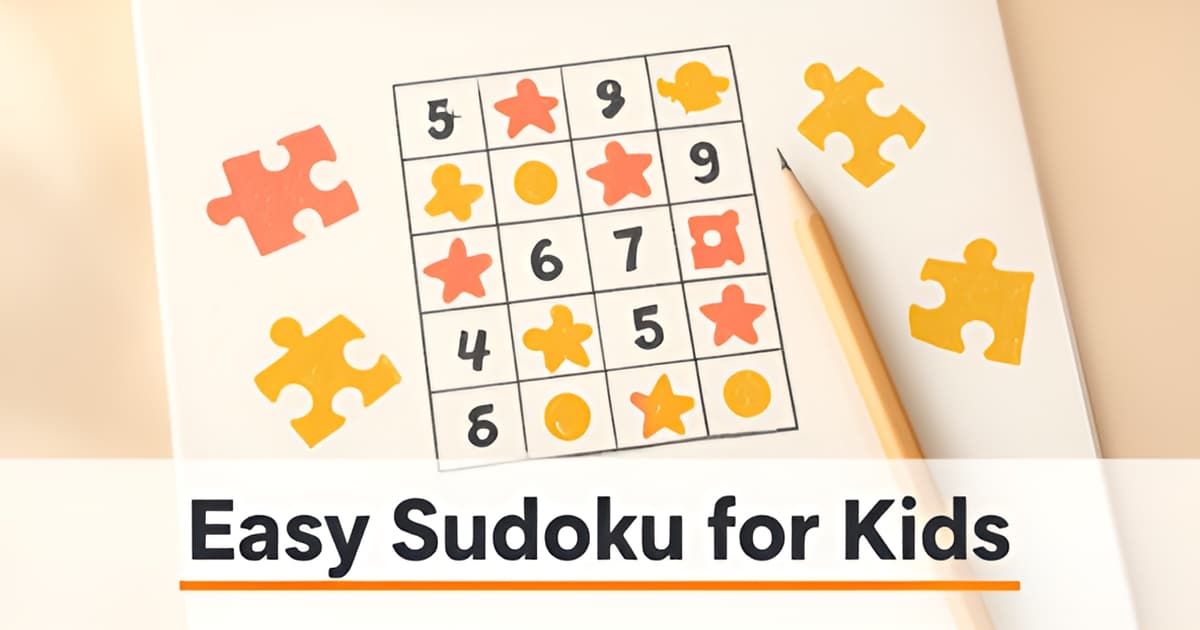
What is a really easy Sudoku puzzle for kids?
Key Facts
- A really easy kids' Sudoku uses a 4×4 or 6×6 grid, not the adult 9×9, the BBC's SUDO-Q show used only these smaller grids according to Wikipedia.
- A proper 9×9 Sudoku can be valid with as few as 17 clues, a puzzle no child should attempt first per Wikipedia's Sudoku data.
- edu-games.org defines its easiest 9×9 level as 51–53 starting clues, leaving just 28–30 blank cells, for Grade 3+ students according to its difficulty table.
- Sudoku requires zero arithmetic: any symbols could replace the digits since no calculations are applied as Wikipedia notes.
- Peer-reviewed research recommends simplified Sudoku for grades 4–6, teaching three strategies: Obvious Missing Number, Elimination, and Either This or That per Tengah's 2011 study.
- Krazydad offers thousands of free 9×9 puzzles across seven difficulty levels but no dedicated kids' format at all according to its site.
- Only two techniques, Naked Single and Cross-Hatching, are needed to finish all Very Easy Sudoku puzzles according to edu-games.org.
Why 'Easy' Sudoku Confuses Parents (and What Kids Actually Need)
Your six-year-old grabs a puzzle off a "free Sudoku" site, stares at a 9×9 grid with 30 empty cells, and gives up in ninety seconds. The problem isn't your kid. It's that most free Sudoku sites build their puzzles for adults, so parents searching for what is a really easy sudoku puzzle for kids end up handing their children something genuinely too hard.
The research-backed answer comes down to two things: grid size and clue count. For the youngest solvers, smaller grids are the established standard. Wikipedia documents kid-specific variants like Mini Sudoku (a 6×6 grid with 3×2 regions) and "The Junior Sudoku," created specifically for younger puzzle solvers, while the BBC's SUDO-Q game show used only 4×4 and 6×6 puzzles for exactly this reason. Even a 4×4 grid with 2×2 regions counts as a legitimate Sudoku variation, not a dumbed-down imitation.
For kids in Grade 3 and up, a full 9×9 grid can work if it's loaded with starting clues. The free generator at edu-games.org defines its "Very Easy" level as a 9×9 puzzle with 51–53 given numbers, leaving just 28–30 cells blank, and labels it best for "first-time solvers, young students (Grade 3+)." Compare that to a typical adult "easy" puzzle, and the difference is dramatic: a proper 9×9 Sudoku can be valid with as few as 17 clues, which is a puzzle no child should touch first.
So what should you actually hand your child? Look for these markers:
- A 4×4 or 6×6 grid for kids under about eight years old
- A 9×9 grid with 51–53 starting clues for Grade 3+
- Exactly one valid solution, so logic always wins
- Solvable with basic techniques only: finding the obvious missing number and simple elimination
That last point matters more than parents realize. Sudoku requires zero arithmetic. As Wikipedia notes, the puzzle would work identically with any symbols in place of the digits, since no calculations are applied during solving. A child who "isn't good at math" can still be great at Sudoku, because the real skills are pattern-spotting and deduction. Peer-reviewed research from Columbia University's Journal of Mathematics Education at Teachers College recommends simplified Sudoku for grades 4–6 precisely because it builds pattern-discovery and elimination skills.
This is also where free generators differ sharply. Krazydad, one of the biggest printable puzzle sites, offers thousands of 9×9 puzzles but no dedicated kids' format at all, and edu-games.org is 9×9-only. If you want a ready-made example that follows the small-grid, high-clue formula, Printoodle's kids sudoku printable generates exactly that kind of age-appropriate puzzle, and it pairs well with other logic builders like mazes for kids and rebus puzzles for kids. Print it. Doodle it. Done.
What Makes a Sudoku Puzzle Really Easy for Kids
If you've ever watched a child bounce off a full 9×9 Sudoku, the problem usually isn't the child. It's the puzzle. So what is a really easy sudoku puzzle for kids? Research points to three markers: a smaller grid, lots of starting clues, and solving techniques simple enough that a third grader can finish without help.
Start with grid size. The classic 9×9 board isn't the only way to play. Wikipedia documents several kid-friendly variants, including a 6×6 Mini Sudoku with 3×2 regions that has appeared in USA Today, a "Junior Sudoku" published in The Daily Mail for younger solvers, and 4×4 grids with 2×2 regions. Even the BBC's Sudoku game show SUDO-Q (2005–2007) relied entirely on 4×4 and 6×6 puzzles, a good sign that smaller grids genuinely work for younger audiences.
The second marker is clue count. On a full 9×9 grid, more given numbers means less deduction required. edu-games.org defines its "Very Easy" level as 51–53 starting clues, leaving only 28–30 empty cells, and explicitly recommends it for first-time solvers and young students in Grade 3 and up. The general principle holds across formats: remove fewer numbers and the puzzle gets easier.
Third, a really easy puzzle should be solvable with just two basic techniques. According to edu-games.org, "Naked Single and Cross-Hatching" are enough to complete all Very Easy and most Easy puzzles. If a puzzle demands anything fancier, it's beyond the "really easy" label.
Two ground rules apply no matter the difficulty. A valid Sudoku puzzle has exactly one solution, as Sudoku expert Meghan Kim puts it. And no arithmetic is involved: as Wikipedia notes, the puzzle would work the same if any symbols replaced the digits, since no calculations are ever applied. That's worth telling any kid who insists they're "bad at math."
The research backs this up in the classroom, too. A peer-reviewed study by Tengah (2011) in the Journal of Mathematics Education at Teachers College recommends simplified Sudoku for grades 4–6, teaching three kid-friendly strategies: "Obvious Missing Number," "Elimination," and "Either This or That." The study's approach starts with a simplified version of the puzzle first to explain the aim and reinforce the rules.
So what does this look like in practice? A good example is a 4×4 grid with 2×2 regions, each row, column, and region containing the digits 1 through 4 exactly once, with plenty of numbers already filled in. A single solution, solvable by scanning for the obvious missing number. That's the whole recipe.
If you want to print a batch without hand-building them, Printoodle's kids sudoku printable generator produces exactly this kind of beginner-friendly puzzle as a print-ready PDF. Once your solver has the hang of it, the same logic skills carry over nicely to other pencil-and-paper challenges like mazes for kids and rebus puzzles for kids.
Small grid, many clues, one solution. Print it. Doodle it. Done.
How Free Sudoku Generators Compare for Kids
Free Sudoku generators all promise "easy," but they don't all mean the same thing, and the differences matter a lot when you're printing puzzles for a seven-year-old. Some stick to full 9×9 grids with lots of clues, while others shrink the grid itself, which is the approach most suited to the youngest solvers.
Here's how the three most useful free options compare:
- Krazydad offers thousands of free printable 9×9 puzzles across seven difficulty levels, free for personal and school use, and the site has been running since 2005. The catch for parents: there's no dedicated kids' format at all, so no 4×4 or 6×6 grids (Krazydad).
- edu-games.org is also 9×9 only, but its Very Easy level packs in 51–53 starting clues, leaving just 28–30 empty cells, and is explicitly recommended for first-time solvers and Grade 3+ students. Its one-puzzle-per-page print mode uses larger cells, roughly 13×13 mm on A4, better suited to younger students who need room to write (edu-games.org).
- puzzlegenerator.org is the only one of the three with a true kids' grid: a 4×4 option with an "Easiest Ever" level that includes many starting numbers and is described as ideal for kids and absolute beginners. It exports PDFs with answer keys, 1–12 puzzles per page (puzzlegenerator.org).
Both approaches to "really easy" are legitimate. A clue-dense 9×9 works for Grade 3 and up, while a 4×4 grid matches the Mini Sudoku and Junior Sudoku variants that newspapers and the BBC's SUDO-Q game show used for younger audiences. What every good kids' puzzle shares is a single valid solution and solvability with just two techniques: Naked Single and Cross-Hatching, which edu-games.org notes are enough to finish all Very Easy puzzles.
The gap across all three tools is personalization. None of them offer a dedicated, kid-shaped experience with themes, names, or a guided progression from tiny grids upward. That's where a purpose-built kids sudoku printable earns its place: Printoodle generates easy puzzles designed for children specifically, alongside related logic activities like mazes for kids and rebus puzzles for kids, so you can build a full activity set rather than a single grid.
If your child is brand new to Sudoku, start with the 4×4 format, then move to a clue-heavy 9×9 once the 2×2 regions feel routine. That's the same simplified-first approach researchers recommend for building pattern-discovery skills in the classroom.
Print it. Doodle it. Done.
An Example Really Easy Sudoku Puzzle, Made with Printoodle
Finding a Sudoku puzzle that feels effortless for a child starts with the right format. While standard 9×9 grids can overwhelm younger solvers, research consistently shows that smaller formats or clue-dense 9×9 puzzles are the key to building confidence. The Wikipedia entry on Sudoku documents kid-specific variants like Mini Sudoku and 4×4 grids with 2×2 regions, established as accessible entry points. Similarly, edu-games.org defines its “Very Easy” level as 51–53 starting clues, 28 to 30 empty cells, positioned as best for first-time solvers and young students in Grade 3 and above.
Printoodle’s kids sudoku printable tool is designed around these research-backed principles. By default, it generates smaller 4×4 and 6×6 grids that fit small hands and short attention spans, while also offering 9×9 options with ample starting numbers for those ready to scale up. All puzzles are generated with a single, valid solution and require no arithmetic, just logical deduction, making them pressure-free for kids who may feel anxious about math. As wikiHow notes, the puzzle’s symbols could easily be replaced with shapes or icons, further removing any barrier to entry.
Beyond the grid itself, the real value lies in how kids actually solve these puzzles. Tengah (2011) found that simplified Sudoku is an effective problem-solving task for grades 4–6, and identified three kid-friendly strategies that make the process intuitive: Obvious Missing Number, Elimination, and Either This or That. These methods turn guessing into a logical habit, reinforcing pattern-finding and elimination skills that transfer to other subjects. edu-games.org supports this, confirming that Naked Single and Cross-Hatching are sufficient to complete most Very Easy and Easy puzzles.
For parents and teachers looking to complement Sudoku with other logic builders, Printoodle also offers mazes for kids and rebus puzzles for kids. These activities exercise the same core skills, sequencing, deduction, and visual scanning, without feeling like “more schoolwork.” The research into simplified Sudoku highlights that puzzles broadly build these cognitive muscles, making a varied puzzle menu a smart way to keep engagement high.
Print it. Doodle it. Done.
Frequently Asked Questions
What size Sudoku grid should I give my 6-year-old to start?
How many starting numbers make a Sudoku puzzle easy for a child?
My child says they're 'bad at math', can they still do Sudoku?
What techniques will my child actually use to solve an easy Sudoku?
I tried a free Sudoku site and it was too hard for my kid. What should I look for instead?
Where can I find printable Sudoku puzzles actually designed for kids?
Small Grid, Big Confidence: Your Next Move
So what is a really easy sudoku puzzle for kids? It comes down to a simple recipe: a 4×4 or 6×6 grid for younger solvers, or a clue-dense 9×9 with 51–53 starting numbers for Grade 3 and up, exactly one valid solution, and nothing more demanding than spotting the obvious missing number. Remember, Sudoku involves zero arithmetic, as Wikipedia notes, the digits could be swapped for any symbols without changing the puzzle, so a child who "isn't good at math" can still shine. Start small, celebrate the first win, then scale up. When you're ready to print, Printoodle's kids sudoku printable generates age-appropriate puzzles in seconds, and pairs nicely with mazes for kids and rebus puzzles for kids for a full logic-boosting activity set. Print it. Doodle it. Done.