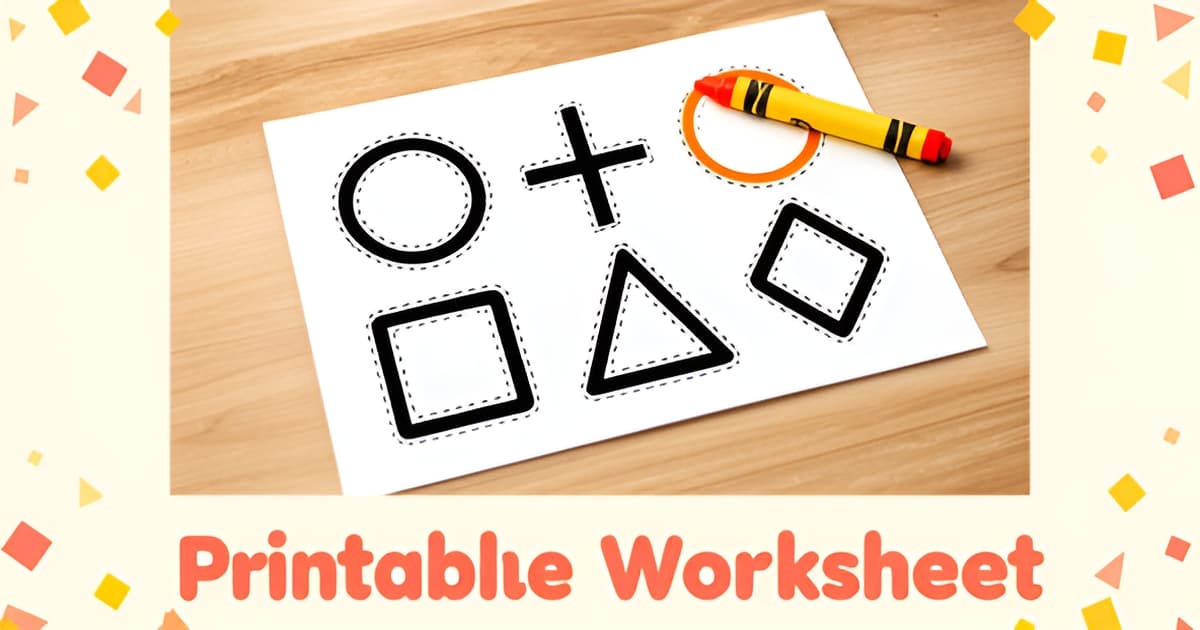
What is a shape worksheet?
Key Facts
- Shape worksheets serve dual purpose: building pencil control and hand-eye coordination for pre-writing while introducing shape vocabulary aligned with kindergarten Common Core math standards
- Children acquire shapes in order of motor difficulty: circle (around age 3) → cross → square (around age 4) → triangle → diamond (around age 5–6), with windows being readiness, not deadlines
- If a child cannot copy a square, the triangle is not the next thing to practice; dropping back to master the square is the most effective next step
- Tracing teaches the pencil path and specific muscle memory for letter formation, while coloring teaches staying inside a boundary, which research suggests is a related but often easier task
- One generator covers 12 shapes with three styles (Dotted, Solid Gray, Hollow Outline), multiple size settings (largest prints 2 across, smallest prints 5 across), and a four-step support ladder; free with no account or watermark
- A child who presses hard, grips tightly, or gives up quickly is usually being asked for a size smaller than the hand is ready for; moving one step up is the first troubleshooting strategy
- Shape worksheets are most effective when used as one component within a broader hands-on curriculum, alongside pattern blocks, playdough, and shape hunts
What Is a Shape Worksheet, Exactly?
A shape worksheet is a printable practice page designed for young children to trace, identify, color, or compose basic geometric figures such as circles, squares, triangles, and rectangles. These pages serve a dual purpose: they build the pencil control and hand-eye coordination needed for pre-writing, while also introducing the shape vocabulary that aligns with kindergarten math standards. According to early childhood experts, shape learning is a mandated content area under the Common Core State Standards for Mathematics, requiring children to analyze, compare, create, and compose these figures by the end of kindergarten.
The distinction between tracing and coloring is a practical consideration for educators and parents. Tracing teaches the specific path a pencil should follow, which develops the fine motor muscle memory required for letter formation. Coloring, by contrast, focuses on the skill of staying within a boundary, which research suggests is a related but often easier task; for a child who resists traditional worksheets, coloring can be the more inviting entry point into shape practice.
Developmentally, children acquire shapes in a sequence dictated by motor complexity. The typical progression begins with the circle, moves to the cross, then the square, followed by the triangle, and finally the diamond. This order is not a strict deadline, as children develop on their own timelines, but it offers a helpful guide for what to practice next. If a child struggles with a triangle, for instance, returning to master the square is often the most effective next step. Research also notes that stars, hearts, and diamonds are best introduced only after the child is comfortable with the circle, square, and triangle.
Customization is a key feature of modern shape worksheets, allowing educators to differentiate practice for diverse learners. Generators can produce worksheets with various shape styles, such as dotted, solid gray, or hollow outline, and adjustable size settings. Smaller sizes are not always better; children who press hard, grip tightly, or give up quickly are often asked to work with shapes smaller than their hands can manage. Moving up one size step is typically the first troubleshooting strategy. Additionally, options for multiple repeats per row and custom mode settings support individualized practice, including goals outlined in individualized education programs (IEPs).
While shape worksheets are a valuable tool, they are most effective when used as one component within a broader hands-on curriculum. Hands-on materials such as pattern blocks, playdough, and shape hunts remain foundational, particularly for young learners. Worksheets provide a low-prep extension of these experiences, offering structured practice that reinforces shape recognition and formation without replacing the tactile exploration that builds deep conceptual understanding.
Printoodle can produce shape tracing worksheets and math worksheet generator pages instantly for classroom or home use. These tools allow users to customize shapes, sizes, and support levels, downloading a print-ready PDF in seconds.
Printoodle library offers free reprints forever, making it easy to refresh materials as students master new shapes.
Why Shapes Come Before Letters (and the Order to Teach Them)
Shapes don't arrive in a child's hands all at once. They follow a predictable order of motor difficulty, and knowing that order turns shape practice from guesswork into a plan.
The widely used developmental sequence runs circle → cross → square → triangle → diamond. A shape tracing guide places the circle around age 3, the square around age 4, and the diamond around ages 5 to 6. Star, heart, and diamond work best after circle, square, and triangle feel comfortable. And if a child can't copy a square, the triangle isn't the next thing to practice. Drop back a step instead.
These windows aren't deadlines. Children develop on their own timelines, and the sequence describes readiness, not a schedule to enforce.
Why does this order matter so much? Because every letter a child will ever write is built from the same few movements: a closed curve, a straight line, a corner, a diagonal. Shapes let a child rehearse those movements without also having to remember which letter they're making. That's why shape worksheets sit at the front of pre-writing instruction, ahead of letter formation. It's also why they matter when handwriting falls apart later: the useful question is usually which underlying movement is missing, and a page of shapes answers it faster than another page of letters.
If your child presses hard on the pencil, grips it tightly, or gives up quickly, the problem is usually the size of the shape, not the child. A move a size up is the first thing to try: the hand isn't ready for shapes that small. Good generators make this easy to fix. Printoodle's shape tracing worksheets let you adjust size and support level and print a fresh PDF in seconds, so you can step up or down until the page matches the hand.
A quick order to work from:
- Circle, around age 3: the first closed curve
- Cross, then square, around age 4: straight lines and corners
- Triangle, once the square is steady: diagonals meet at a point
- Diamond, around ages 5 to 6: the full combination
Pair the sequence with hands-on work, too. Practitioner guidance from a kindergarten teacher favors pattern blocks, playdough, and shape hunts as the foundation, with worksheets as one flexible, low-prep piece of the routine rather than the whole thing.
Where Worksheets Fit in a Hands-On Shape Routine
Let's be honest about the tension: many early childhood educators are skeptical of worksheets, and for good reason. A kindergarten teacher writing about shape instruction recommends exploration first, with pattern blocks, playdough, and shape hunts before any paper practice, and NAEYC-published authors recommend hands-on shape activities like cut-and-glue composition, tangram pattern cards, and painting with shapes (Kindergarten Cafe; NAEYC). Those materials matter, and they should stay in your routine.
So where does a shape worksheet fit? Not as a replacement, but as the low-prep component you can pull out in the thirty seconds before small group starts. Hands-on centers take time to set up and clean up. A printed page takes none. And when you understand what a shape worksheet actually is, you can use it to target specific skills the manipulatives don't cover as cleanly, like pencil control and staying inside a boundary.
There's also the reusability question, and it's fair. One practitioner resource argues that laminated tracing mats are better than worksheets because they're reusable (Kindergarten Worksheets and Games). Reusable mats absolutely have a place. But a printed page has its own advantages: it goes home as evidence of progress, it works for a whole class simultaneously, and each child can have a different page. That last point is where worksheets earn their spot.
Differentiation is where printables pull ahead. Because a page is disposable, you can print different versions for different kids without anyone noticing. Generators make this practical: one offers a four-step support ladder so the same shape appears with more or less scaffolding depending on the learner, with sizes ranging from 2 across the page up to 5 across (Spectrum Unlocked). Another supports three line sizes and 1 to 3 repeats per row, up to 80 custom rows (EMStudio). Printoodle's shape tracing worksheets tool works the same way, generating print-ready PDFs in seconds so you're never stuck with a one-size-fits-all file.
For special education and IEP work, that flexibility is the whole point. A shape worksheet aligned to a specific motor goal, at the size a child's hand is ready for, is a concrete artifact you can attach to progress monitoring. And when handwriting goals extend into early math, Printoodle's math worksheet generator can produce matching practice from the same lesson material.
A sensible shape routine might look like this:
- Explore with pattern blocks, playdough, or a classroom shape hunt
- Practice the movement on a reusable tracing mat or dry-erase page
- Consolidate with a printed worksheet sized and scaffolded to the child
- Send the page home so families see the progress
One troubleshooting note from tracing pedagogy: a child who presses hard, grips tightly, or gives up quickly is usually being asked for a size smaller than their hand is ready for. Moving one step up is the first fix to try (Spectrum Unlocked).
Make Your Own in Seconds with Printoodle
Shape worksheets are printable practice pages where young children trace, identify, color, compose, or otherwise work with basic geometric shapes. Across sources, these worksheets are consistently framed as pre-writing and early-math tools that build pencil control, hand-eye coordination, and shape vocabulary, which later support letter formation and kindergarten math standards.
Developmental sequence research shows shapes are acquired in order of motor difficulty: circle (around age 3) → cross → square (around age 4) → triangle → diamond (around age 5–6). If a child cannot copy a square, the triangle is not the next thing to practice. Star, heart, and diamond are best left until circle, square, and triangle are comfortable, and typical windows are not deadlines, children develop on their own timelines.
Tracing versus coloring is a related but separate skill. Tracing teaches the path, while coloring teaches a child to stay inside a boundary, which is usually the easier of the two. For a child who resists worksheets, coloring is often the way in.
Printoodle’s shape tracing worksheets and math worksheet generator can produce customized, print-ready PDF shape worksheets instantly, with options for shape selection, tracing style, size, and support level. This replaces fixed, one-size-fits-all printable files and allows for differentiation, including special education contexts and IEP goals.
- One generator covers 12 shapes with three styles (Dotted, Solid Gray, Hollow Outline), multiple size settings (largest prints 2 across, smallest prints 5 across), and a four-step support ladder.
- Another generator covers 13 distinct shapes: star, square, half circle, triangle, rectangle, pentagon, octagon, oval, heart, hexagon, diamond, and circle.
- A third generator offers seven trace sets, three line sizes (½ in, ¾ in, 1 in), 1–3 repeats per row, custom mode up to 80 rows, and US Letter or A4 output at 100% free with no sign-up.
Design details matter pedagogically: a dashed contour is deliberately not offered because dashing the edge of a stroke draws both sides of it, so a child tracing a dashed shape makes two lines and learns the wrong motion. Sizing guidance also matters, a child who presses hard, grips tightly, or gives up quickly is usually being asked for a size smaller than the hand is ready for; moving one step up is the first thing to try.
Shape worksheets serve as one component within a broader hands-on shape routine. Hands-on-first educators emphasize pattern blocks, playdough, and shape hunts over worksheets, but customization options support individualized practice for diverse learners. Ready to make your own? Print it. Doodle it. Done.
Frequently Asked Questions
What is a shape worksheet, and what is it actually teaching my child?
In what order should I teach shapes to my child?
My child presses hard, grips the pencil tightly, or gives up quickly on worksheets. What should I do?
Is tracing shapes better than coloring them?
Aren't worksheets frowned upon in early childhood education?
Can shape worksheets be customized for special education or IEP goals?
Shape Mastery: From First Lines to Lasting Skills
Shape worksheets serve as a bridge between playful exploration and the pencil control needed for writing, offering a structured way for young learners to master geometric figures that form the foundation of both letter formation and math literacy. Research confirms that children acquire shapes in a predictable sequence, starting with the circle and progressing through the square and triangle, with each new figure building on the motor skills of the last. Whether a child prefers tracing the path or coloring within the boundary, the goal remains the same: developing hand-eye coordination and shape vocabulary aligned with kindergarten standards. While worksheets shine as a low-prep tool, they work best as one component in a hands-on curriculum that includes pattern blocks, playdough, and real-world shape hunts, ensuring that tactile experience leads conceptual understanding. Ready to put these principles into practice? Printoodle’s shape tracing worksheets and math worksheet generator make it easy to customize size, style, and support level, downloading a print-ready PDF in seconds so every child can work at their own pace. Shape mastery starts with a single line, make yours count. shape tracing worksheets